
Table of Contents >> Show >> Hide
- What “Waterfalls for Window Wells” Really Means
- Why Window Wells Turn Into Waterfalls
- Why This Matters More Than People Think
- How to Stop the Waterfall Effect
- Can a Decorative Waterfall Belong Near a Window Well?
- Egress and Safety Rules You Should Not Ignore
- Smart Design Ideas That Look Good and Stay Dry
- Maintenance: The Boring Part That Saves the Basement
- Conclusion
- Experiences Homeowners Commonly Have With Window-Well “Waterfalls”
If you typed “Waterfalls for Window Wells” hoping for a classy landscaping idea, there is good news and bad news. The good news: window wells can absolutely look better than a rusty half-moon full of wet leaves and one tennis ball from 2018. The bad news: when homeowners talk about a “waterfall” in a window well, they are usually describing a problem, not a peaceful backyard spa moment. In plain English, it means runoff is pouring into the well, pooling near the basement window, and trying very hard to turn your lower level into a damp cautionary tale.
That is why this guide treats the phrase from both angles. First, we will look at the literal issue: how rain, snowmelt, bad grading, and clogged drainage can make a window well behave like a tiny canyon during a storm. Then we will cover the design side: how to make window wells cleaner, safer, and more attractive without accidentally building a decorative water feature that sends moisture straight toward your foundation. Because a basement window should invite in sunlight, not audition for a role as Niagara’s smaller, meaner cousin.
What “Waterfalls for Window Wells” Really Means
A window well is the excavated area around a below-grade basement window. Its job is simple: hold back surrounding soil, let in light, allow ventilation, and, in some cases, provide emergency egress. The problem starts when the well becomes the low point for runoff. Instead of shedding water away from the house, the landscape funnels water toward it. Once that happens, the well becomes a collection bowl.
Homeowners notice the symptoms fast. During a heavy rain, water races off the roof, spills from gutters, or runs downhill across the yard and drops into the well. Gravel at the bottom may be compacted, dirty, or too shallow. A drain pipe may be clogged or missing. The cover may be cracked, badly fitted, or not there at all. The result is what many people describe dramatically but accurately: a waterfall into the window well.
Why Window Wells Turn Into Waterfalls
1. Roof runoff is being dumped too close to the house
Many basement moisture problems begin above your head, not below your feet. If gutters are clogged, undersized, or overflowing, they dump water beside the foundation. If downspouts discharge too close to the wall, the water has nowhere smart to go. It spreads across the soil, follows the easiest path, and often finds the window well. In storms, that flow can be surprisingly aggressive.
2. The yard slopes the wrong way
Soil should slope away from the house, but settlement changes that over time. Mulch beds get built up. Hardscape redirects runoff. A patio edge, flower border, or compacted path can quietly create a funnel effect. Then one day, a hard rain reveals the truth: the entire side yard has been training for years to pour into one unlucky well.
3. Gravel and drains stop doing their job
A healthy window well usually has gravel at the bottom to help water move down instead of standing against the window. Some systems also tie into perimeter drainage or a dry well. But gravel can fill with silt. Drain pipes can clog. Debris can build up. Once the drainage path slows down, even a moderate amount of water can linger where it should not.
4. The well cover is missing, weak, or wrong for the job
A proper cover helps keep out rain, leaves, twigs, pests, and snow. But not all covers behave the same way. A clear polycarbonate cover can shed water while still admitting light. A metal grate is excellent for safety and durability, but it allows rain and snow through, which means the drainage below had better be ready for business. A flimsy cover that bows, cracks, or sits poorly over the well is not a solution. It is just optimism in plastic form.
5. The window well was undersized or poorly installed
If the top edge sits too low, splash-over becomes more likely. If the well is too narrow or shallow, it can crowd the window, trap debris, and make maintenance miserable. If it was never sealed properly to the foundation, water can work its way behind the well and toward the window opening. That is how a landscaping annoyance graduates into a basement leak.
Why This Matters More Than People Think
A wet window well is not just ugly. It can stain the wall below the window, damage the frame, feed mold growth, and contribute to musty basement air. If water enters the basement, the problem gets expensive fast. Carpeting, trim, drywall, insulation, and stored belongings are all suddenly involved in a conversation no one wanted to have. Moisture that lingers can also lead to that familiar basement smell that says, “Hello, I am humidity, and I now live here.”
There is also the safety angle. Some window wells serve egress windows in finished basements or bedrooms. Those wells must stay functional, accessible, and code-compliant. A well full of water, debris, ice, or a cover that is hard to move is not just inconvenient. It can interfere with an emergency escape route.
How to Stop the Waterfall Effect
Fix the grading first
Start with the landscape. If the surrounding soil pitches toward the house, regrade it so runoff moves away from the foundation. This is one of the least glamorous fixes and one of the most effective. A yard does not need a dramatic slope; it just needs enough pitch to stop water from loitering around the walls. Swales, dry creek beds, and other drainage-friendly landscape features can help steer water away naturally.
Extend and redirect downspouts
If your downspouts empty beside the foundation, your window wells are being forced to play defense against your roof. Extend those outlets so water discharges well away from the house. In tougher sites, a buried line or dry well may be the smarter move. The core idea is simple: do not let roof water finish its journey next to a basement window.
Refresh the gravel bed
If the bottom of the well is muddy, compacted, or filled with leaf sludge, clean it out. Replace dirty gravel with washed stone if needed, and make sure the gravel layer is deep enough to support drainage. Keep it below the window sill so water is not standing directly against the window opening. Fresh gravel is not a miracle cure, but it is often part of a very respectable rescue plan.
Check the drain path
If the well has a vertical drain or connection to perimeter drainage, verify that it still works. This is where many “mystery” leaks stop being mysterious. The drain exists, but it is clogged. Or the drain was expected but never installed. If your site gets serious runoff, a more robust solution, such as tying the well into a drainage system or dry well, may be worth the upgrade.
Choose the right cover
For moisture control, a clear, properly fitted cover is usually the easiest improvement with the biggest day-to-day payoff. It helps keep out rainfall, snow, and debris while preserving light. For non-egress wells, attachment can be more straightforward. For egress wells, the cover still needs to allow a person to get out from the inside without special gymnastics, tools, or a heroic upper-body workout.
Seal and inspect around the window
If water has already been collecting in the well, inspect the perimeter of the window and the area where the well meets the foundation. Sealants and caulk are not substitutes for drainage, but they can be useful supporting players. Think of them as the backup singer, not the lead vocalist. The lead vocalist is still proper drainage.
Can a Decorative Waterfall Belong Near a Window Well?
Technically, you can build a decorative landscape waterfall almost anywhere. Practically, building one near a window well is usually a bad romance between aesthetics and moisture. Water features, splash zones, overspray, and irrigation all increase the moisture load near the foundation. That is the opposite of what basement windows want.
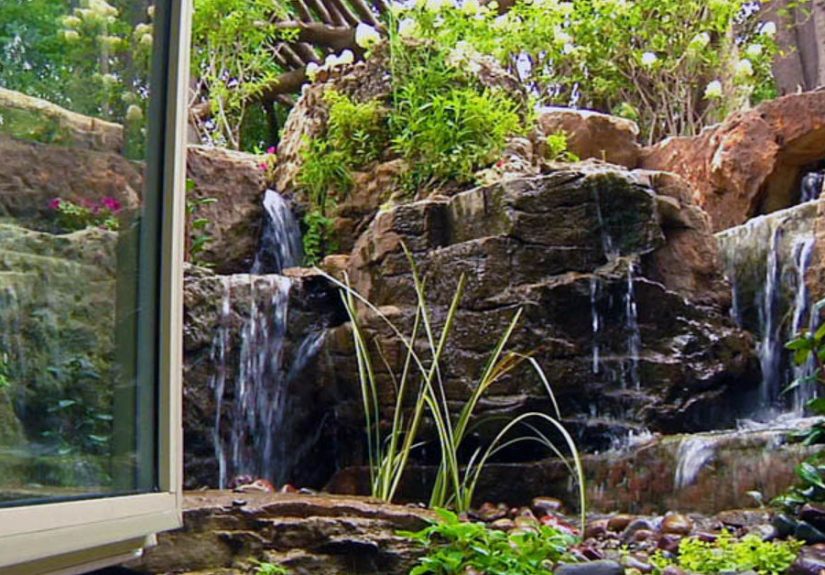
If you love the sound of moving water, keep the feature well away from the house and especially away from below-grade openings. The better design move near window wells is a dry waterfall look: stacked stone, river rock, a dry creek bed, sculptural gravel, or a swale that reads beautifully in the landscape without actually feeding water toward the foundation. In other words, go for the mood of a waterfall, not the plumbing of one.
Egress and Safety Rules You Should Not Ignore
Window wells are not just yard accessories. In many finished basements, they are part of a life-safety system. In jurisdictions using IRC-style residential rules, an egress well commonly needs at least 9 square feet of horizontal area, with a minimum width and projection of 36 inches. If the well is deeper than 44 inches, it typically needs a permanently attached ladder or steps. Covers, grilles, or similar devices over emergency escape openings must not prevent someone from getting out from the inside.
Translation: if your window well serves an egress window, design choices are not just about looks. They must preserve usable escape space. That means no cute landscaping trick that narrows the well, no permanently awkward cover, and no decorative feature that turns the exit route into a wet obstacle course. Always verify local building and fire code requirements before changing an egress setup.
Smart Design Ideas That Look Good and Stay Dry
Improving a window well does not mean making it look industrial. Some of the best-looking solutions are also the most practical:
Use clean stone. Washed gravel or river rock gives the well a finished appearance and supports drainage better than a muddy mix of dirt and mulch.
Add a clear cover. A good cover keeps the well visually tidy, preserves natural light, and cuts down on cleanup after storms.
Blend the edge with low-profile planting. Choose plants that do not trap debris or direct irrigation into the well. Keep roots and dense growth away from the opening.
Create a dry creek look. If runoff is an issue, shape the surrounding landscape to guide water away with stone-lined channels or subtle swales. This can be beautiful and functional at the same time.
Match materials to the house. Stone edging, neutral-toned covers, and coordinated hardscape details help the well look intentional instead of forgotten.
Maintenance: The Boring Part That Saves the Basement
Once the well is fixed, keep it fixed. Clean out leaves and dirt. Check the cover each season. Inspect after major storms. Watch how water behaves during a hard rain instead of waiting for the basement to file a complaint. If the well repeatedly fills with water, stop treating it like a random annoyance and investigate the drainage pattern around the entire wall, roofline, and yard.
A well-maintained window well should be quiet, dry, and almost boring. That is a compliment.
Conclusion
“Waterfalls for Window Wells” sounds whimsical, but for most homes it is a warning label in disguise. Window wells are supposed to protect below-grade windows, not become collection basins for everything the roof and yard throw at them. The best fix is almost never one magic product. It is a system: grade the soil away, control roof runoff, maintain gravel and drains, use the right cover, and protect egress function.
And if you want a beautiful yard, go ahead. Just do not place your beauty project where it can pour water straight into your basement wall. Your house can absolutely have drama. Your window wells should not.
Experiences Homeowners Commonly Have With Window-Well “Waterfalls”
One of the most common experiences homeowners describe is the surprise factor. The basement can seem perfectly fine for months, then one intense rain exposes a weakness that had been developing quietly for years. Everything looks normal on a sunny afternoon. Then a thunderstorm hits, the gutter overflows, the side yard turns into a shallow stream, and suddenly the window well fills like a bathtub with a grudge. People are often shocked by how fast it happens. Water does not politely seep in one teaspoon at a time when runoff is concentrated. It rushes.
Another familiar story is the “but I already have a cover” experience. A homeowner installs a cover and assumes the problem is solved forever. Then winter arrives, snow piles up, leaves collect around the edges, or the cover flexes just enough to let water slip in during heavy weather. The lesson is not that covers are useless. The lesson is that covers work best as part of a bigger drainage strategy. A cover helps a lot, but it cannot undo bad grading or a downspout that empties beside the foundation like it holds a personal grudge against drywall.
Then there is the cleanup lesson. Many people do not look inside their window wells until there is already a problem. By that time, the gravel is partly buried under dirt, the drain cap is hidden, and the well has become a tiny compost system with poor career boundaries. Homeowners who clean the well regularly almost always say the same thing afterward: they wish they had started sooner. A fifteen-minute seasonal cleanup feels laughably easy compared with dealing with wet insulation, a musty room, or a shop vacuum marathon after a storm.
Finished basements add another layer of emotion. When a window well floods next to an unfinished utility room, it is frustrating. When it happens next to a basement bedroom, office, gym, or playroom, it feels personal. Water near finished flooring and furniture changes the conversation fast. People go from “I should probably deal with that someday” to “I want every drop of water away from this wall immediately.” That urgency is understandable. Basement water problems do not stay neatly outdoors once they decide to get ambitious.
Homeowners also often learn that the true fix is outside, not inside. The first instinct is usually to seal something indoors, run a fan, or place a dehumidifier nearby. Those tools help with symptoms, but the lasting improvement usually comes from changing how water behaves before it reaches the well. Regrading soil, extending downspouts, restoring gravel depth, and correcting the drain path often make a bigger difference than any interior patch ever could. It is not as exciting as buying a new gadget, but it works.
Finally, there is the design lesson. People want the area around basement windows to look nicer, and that is completely reasonable. The best results usually come from low-maintenance, dry-minded design choices: clean stone, crisp edging, subtle planting, and drainage features that look intentional. The homeowners happiest with their window wells are rarely the ones who made them flashy. They are the ones who made them functional, safe, and easy to maintain. In the world of window wells, “quietly doing the job” is the real luxury finish.







 Close
Close