
Table of Contents >> Show >> Hide
- What “Best Temperature” Actually Means
- The Best Final Internal Temperature for Beef Tenderloin
- The Real Secret: Pull Temperature and Carryover Cooking
- The Best Cooking Temperature (Oven) for Beef Tenderloin
- The Best Temperature for Grilling Beef Tenderloin
- How to Hit the Right Temp Every Time (Without Losing Your Mind)
- Specific Examples: Best Temps by Goal
- Common Temperature Mistakes (and How to Avoid Them)
- So, What’s the Best Temperature for Beef Tenderloin?
- of Real-World “Been There” Experiences (What Usually Happens in Actual Kitchens)
- Conclusion
Beef tenderloin is the fancy sports car of the meat world: sleek, pricey, and absolutely unforgiving if you drive it into a brick wall called “overcooked.”
The good news? If you know the right temperaturesand when to stop cookingtenderloin turns out buttery, rosy, and dramatic in the best way.
This guide breaks down the best internal temperature for beef tenderloin, how oven (or grill) temperature affects results, and the small moves that separate
“holiday legend” from “why is it so dry?”
What “Best Temperature” Actually Means
When people ask for the best temperature for beef tenderloin, they usually mean one (or both) of these:
- The best final internal temperature (what your thermometer reads in the center when it’s ready to slice and serve).
- The best cooking temperature (oven/grill heat that helps you hit that internal temp without drying it out).
Tenderloin is very lean. That’s great for tenderness, but it also means it can go from “wow” to “why” in a few degrees. So the internal temperature is the boss.
Your oven temperature is just the employee trying to meet the boss’s expectations without crying in the walk-in fridge.
The Best Final Internal Temperature for Beef Tenderloin
For most people, the sweet spot is medium-rare because it keeps tenderloin juicy and silky. The most commonly recommended range for medium-rare is:
130–135°F after resting.
Beef Tenderloin Doneness Chart (Internal Temperature)
Use this as a practical guide for a whole tenderloin roast or thick filet mignon cuts. (More on “pull temps” in a minute.)
| Doneness | Final Internal Temp (After Rest) | What It Looks/Feels Like |
|---|---|---|
| Rare | 120–125°F | Deep red center, extremely juicy, very soft |
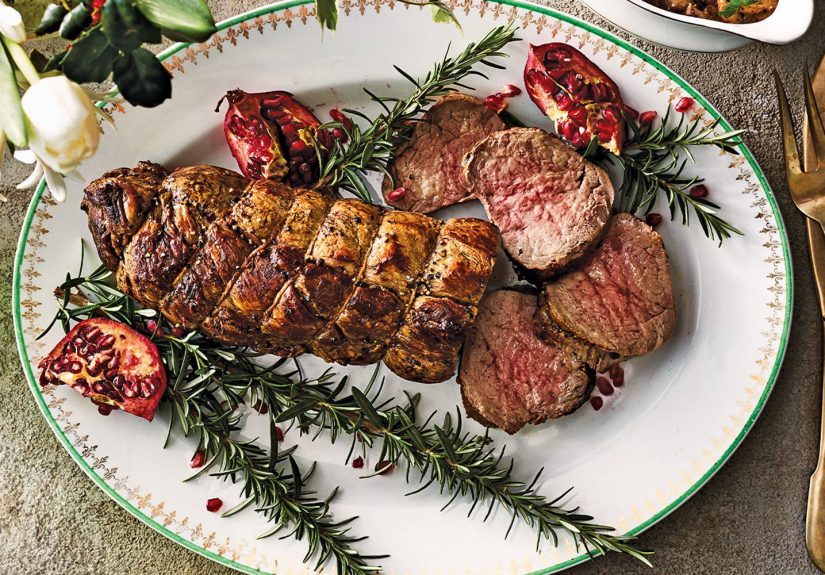
| Medium-Rare (Best for most tenderloins) | 130–135°F | Warm red-to-rosy center, tender, juicy, “steakhouse perfect” |
| Medium | 135–145°F | More pink than red, still tender but noticeably less juicy |
| Medium-Well | 145–155°F | Faint blush, drier, tenderloin starts losing its charm |
| Well Done | 155°F+ | Brown throughout, firm, “please don’t do this to tenderloin” |
A quick (important) note on food safety
U.S. food-safety guidance for whole cuts like steaks and roasts commonly cites 145°F plus a 3-minute rest as a safe minimum.
Many cooks prefer tenderloin below that for best texture and moisture, so you should use your judgmentespecially for higher-risk diners
(very young kids, older adults, pregnant people, or anyone immunocompromised). When in doubt, aim higher and prioritize safety.
The Real Secret: Pull Temperature and Carryover Cooking
If you cook tenderloin to 135°F in the oven, it won’t magically stop cooking because you turned the heat off. Meat holds heat, and the center continues
to risethis is called carryover cooking.
So when should you pull it?
A smart rule: pull the tenderloin 5–10°F before your final target, then rest it. For tenderloin, carryover is often around 5°F, but bigger roasts
(and hotter cooking methods) can push that higher.
- Target medium-rare (final 130–135°F): pull at 120–128°F depending on roast size and how hot you cooked.
- Target medium (final 135–145°F): pull at 130–138°F.
Think of resting like letting your steak “finish its sentence.” If you slice too early, juices run out, and you’ll wonder where your expensive moisture went.
(Spoiler: it’s on the cutting board.)
The Best Cooking Temperature (Oven) for Beef Tenderloin
There isn’t one single oven temperature that’s “best” for everyone. The best method depends on what you value most:
even doneness, speed, or maximum crust.
Option 1: Reverse Sear (Best for Even Doneness)
Reverse sear is the calm, organized approach: cook low and slow until the center is close to done, then sear at high heat for a browned crust.
It’s famous for producing a uniform rosy interiorless overcooked “gray band,” more steakhouse vibes.
- Low roast: 225–275°F until the center reaches your pull temp (often 120–125°F for medium-rare goals).
- Rest briefly: 10 minutes.
- Sear: very hot oven (450–500°F) or a ripping-hot skillet for a quick crust.
Why it works: low heat reduces the temperature gradient between outside and center, so you get more evenly cooked meat.
Option 2: High-Heat Roast (Best for Speed and Simplicity)
If you want a traditional roast method, a common approach is roasting in a 350–450°F oven (often around 425°F).
It’s faster than reverse sear and still very workableas long as you use a thermometer and pull early.
- Oven: 400–450°F (common: 425°F)
- Pull temp: typically 120–125°F for medium-rare goals (then rest to rise)
- Rest: 10–20 minutes before slicing
Option 3: Sear-Then-Roast (Best for Bold Crust)
This method starts on the stovetop (or a very hot oven) to brown the exterior quickly, then finishes at a moderate temperature.
It’s great for flavor, but you need to watch doneness carefully.
- Sear: hot pan (or brief blast at 475–500°F)
- Finish: 325–375°F until pull temp is reached
- Rest: 10–20 minutes
The Best Temperature for Grilling Beef Tenderloin
Grilling tenderloin is basically a performance: you’re managing direct heat for browning and indirect heat for gentle finishing.
The “best” grill setup is usually two-zone heat.
- Direct heat zone: sear for color and flavor.
- Indirect heat zone: finish cooking more gently to your pull temperature.
For medium-rare, many grill methods pull a whole tenderloin around 125–130°F, then rest so it rises a few degrees.
How to Hit the Right Temp Every Time (Without Losing Your Mind)
1) Use the right thermometer (and place it correctly)
Use an instant-read thermometer or a probe thermometer. Insert it into the thickest center part.
Avoid touching a pan, a rack, or a pocket of fat (tenderloin has less fat, but it can still fool you).
2) Tie the tenderloin for even thickness
Whole tenderloin has a tapered end. If you cook it as-is, the thin end finishes early and the thick end lags behind.
Folding the thin tail under and tying with kitchen twine helps the roast cook more evenly.
3) Don’t skip resting time
Resting does two important things:
- Carryover: it finishes the last few degrees.
- Juice redistribution: it reduces the “juice flood” when slicing.
Typical rest time: 10–20 minutes for a roast. Keep it loosely tented with foil (tight wrapping can soften your crust).
4) Salt early if you can
Tenderloin benefits from seasoning time. Salting ahead (even the day before, uncovered in the fridge if you can) helps flavor penetrate and can improve browning.
If you’re short on time, salt at least 45–60 minutes before cooking.
5) Slices matter (yes, your knife technique counts)
Slice across the grain into medallions. For a whole roast, many people like 3/4-inch to 1-inch slices.
Use a sharp knifetenderloin deserves better than a bread knife doing its best.
Specific Examples: Best Temps by Goal
Example A: Holiday beef tenderloin roast (2–3 lb) cooked in the oven
- Goal: Medium-rare
- Method: Roast at 425°F (or reverse sear at 250°F then finish hot)
- Pull temp: 120–125°F
- Rest: 15 minutes
- Expected final temp: ~130°F (give or take, depending on roast and method)
Example B: Whole tenderloin on the grill (two-zone heat)
- Goal: Medium-rare
- Method: Sear over direct heat, then finish over indirect heat
- Pull temp: ~125°F
- Rest: 10 minutes
- Expected final temp: ~130°F
Example C: Filet mignon steaks (thick cut)
- Goal: Medium-rare
- Method: Sear in a hot pan, then finish in a 350–400°F oven if needed
- Pull temp: ~125–130°F (depending on thickness and carryover)
- Rest: 5–8 minutes
- Expected final temp: 130–135°F
Common Temperature Mistakes (and How to Avoid Them)
Mistake 1: Cooking by time instead of temperature
Time is a rough suggestion; temperature is the truth. Oven hot spots, roast thickness, starting temperature, and pan choice all affect timing.
Use time to planuse a thermometer to decide.
Mistake 2: Pulling too late because it “doesn’t look done”
Tenderloin is lean, so it won’t have dramatic fat rendering cues like a rib roast. Trust the thermometer.
If you wait for it to “look ready” while it’s still in the oven, it may end up “ready for jerky.”
Mistake 3: Resting too short (or slicing on a warm pan)
Give it time on a cutting board. If you slice too early, juices escape. If you slice on a hot pan, you keep cooking the slices.
Either way: you lose the magic.
So, What’s the Best Temperature for Beef Tenderloin?
If you want the most widely loved resulttender, juicy, and restaurant-levelaim for:
- Final internal temperature: 130–135°F (medium-rare)
- Pull temperature: 120–130°F depending on roast size and cooking method
- Rest time: 10–20 minutes
If you prefer medium, go higherbut understand the trade: the leaner the cut, the faster it dries out as temperature rises.
Tenderloin is at its best when it’s still a little pink and very proud of it.
of Real-World “Been There” Experiences (What Usually Happens in Actual Kitchens)
Beef tenderloin has a funny way of turning everyone into an amateur detective. People hover. They squint at the oven light like it’s a crystal ball.
They poke the roast (please don’t), then panic-text someone: “Is 10 minutes too long to rest?” Meanwhile, the tenderloin is just trying to be
medium-rare in peace.
One of the most common experiences goes like this: the roast looks perfect on the outside, smells incredible, and you’re feeling unstoppableuntil you
remember you’re cooking for a crowd with very different opinions. Someone says, “I love rare.” Someone else whispers, “No pink.” This is where
temperature strategy saves you. Many home cooks learn that tenderloin is easiest to please when you cook to medium-rare (130–135°F final), then offer
warm sauce options (peppercorn, horseradish cream, red wine pan sauce) for anyone who wants “more done” energy without actually cooking the meat more.
Another classic: the “I nailed it… wait, why is it climbing?” moment. You pull at 130°F, proud and confident, then rest it and check againnow it’s 137°F.
That’s carryover cooking, and it’s not a betrayal; it’s physics. A lot of cooks only learn this the hard way once (usually on a holiday) and then become
evangelists for pulling early. After that, they’re the person at every gathering saying, “Pull it 5–10 degrees before target,” like it’s the most obvious
thing in the world.
Grill experiences have their own personality. People often discover that direct heat gives gorgeous browning fastbut it can also overshoot your target if
you don’t move to indirect heat soon enough. The “aha” moment for many grillers is using two-zone cooking: sear for color, then slide the tenderloin away
from the flames and let it coast to the pull temperature. It feels less dramatic, but the slices come out evenly rosy instead of “pink here, gray there,
and mystery in the middle.”
Then there’s the thermometer learning curve. Plenty of folks accidentally measure too close to the surface (reads hotter) or hit the pan (reads hotter)
and think the roast is done early. Later, they slice and realize the center needed more time. The fix is simple and very relatable: probe the thickest
center, go in from the side if needed, and take a couple readings to confirm. Once people start doing that, tenderloin stops feeling “risky” and starts
feeling repeatable.
Finally, the rest-and-slice experience: most cooks remember the first time they waited the full 15–20 minutes, sliced carefully, and saw juices stay in
the meat instead of racing across the board. That’s usually when tenderloin becomes a “special occasion staple” instead of a “special occasion gamble.”
Because once you own the temperatures, you own the outcomeand tenderloin becomes less of a luxury stressor and more of a victory lap.
Conclusion
The best temperature for beef tenderloin is the one that protects what makes it special: tenderness and juiciness. For most tables, that means
medium-rare (130–135°F final), achieved by pulling early and resting properly. Choose a cooking method that fits your vibereverse sear for
even doneness, high-heat roasting for speed, or grill two-zone cooking for smoky dramaand let the thermometer be the hero.







 Close
Close