
Table of Contents >> Show >> Hide
- Why the Additive Manufacturing Conversation Is Changing
- What HIP Actually Does in Additive Manufacturing
- Why Centrifugal Printing Is Suddenly Interesting
- HIP vs. Centrifugal Printing: Different Problems, Different Superpowers
- Where These Technologies Could Reshape Industry
- The Real Limitation: Manufacturing Is Still a System, Not a Single Machine
- Conclusion
- Field Experiences and Practical Lessons From HIP and Centrifugal Printing
Additive manufacturing has never been shy about big promises. Lighter parts. Faster iterations. Less waste. Geometries so weird they would make conventional machining mutter under its breath and leave the room. But as the industry matures, the real excitement is no longer just about printing a flashy prototype. It is about building parts that are stronger, larger, more reliable, and actually practical to manufacture at scale.
That is where two interesting contenders enter the conversation: hot isostatic pressing (HIP) and centrifugal printing. They are not twins. Frankly, they are not even close cousins. HIP is the pressure-loving perfectionist of advanced manufacturing, famous for squeezing out internal voids and improving density in metal parts. Centrifugal printing, meanwhile, is the upstart with a spinning habit, using rotational force to move, shape, or deposit materials in ways that standard layer-by-layer printing often struggles to match.
Together, these approaches point to something bigger than a new buzzword cycle. They reveal where additive manufacturing is heading next: toward better materials performance, higher throughput, broader material combinations, and more specialized manufacturing routes that solve specific problems instead of pretending one printer can do everything except make lunch.
Why the Additive Manufacturing Conversation Is Changing
For years, the loudest part of the 3D printing conversation focused on geometry. If you could print an intricate lattice, a topology-optimized bracket, or a part with internal channels, you had everyone’s attention. And to be fair, that was a huge leap forward. Standards bodies, federal labs, and aerospace groups have all helped move additive manufacturing from novelty toward repeatable industrial production, especially in powder bed fusion and directed energy deposition.
But geometry is only half the story. The other half is whether the finished part can survive real-world service. In aerospace, energy, medical, and industrial environments, manufacturers care about fatigue strength, density, residual stress, corrosion behavior, certification pathways, and quality control. A part that looks gorgeous but behaves like a cracker under cyclic load is not a breakthrough. It is a lawsuit with a nice surface finish.
That is why newer contenders are getting attention. Some, like HIP, improve the quality and reliability of printed metal parts after they come off the build plate. Others, like centrifugal printing methods, rethink how materials are deposited, switched, or organized during fabrication. One works like a clean-up crew with a PhD. The other feels more like an inventor who spun a cotton candy machine into a research grant.
What HIP Actually Does in Additive Manufacturing
Hot isostatic pressing is a post-processing method in which a metal or ceramic part is exposed to high temperature and high pressure, usually through an inert gas environment. The goal is straightforward: compress internal voids, reduce porosity, and improve part density and structural integrity.
In metal additive manufacturing, especially with processes such as laser powder bed fusion and electron beam melting, internal defects can be a stubborn problem. Tiny pores, lack-of-fusion defects, and residual stresses may not be obvious from the outside, but they can dramatically affect fatigue life. HIP helps address that by applying pressure uniformly in all directions, which makes it especially useful for parts that need to perform under demanding service conditions.
That is why HIP keeps showing up in aerospace and energy conversations. It is often treated less like an optional luxury and more like the grown-up in the room. If the printed part is headed into a high-stress application, HIP can be part of the route from “technically printable” to “trustworthy enough to fly, spin, or survive heat and pressure without becoming modern art.”
HIP as a Finishing Tool, Not a Magic Wand
Here is the important caveat: HIP is powerful, but it is not wizardry. It can close certain internal pores and improve density, but it does not automatically fix bad design choices, poor process parameters, rough surfaces, or every flavor of defect. Manufacturers still need strong process control, inspection, heat treatment strategy, machining where needed, and a qualification plan that reflects the actual service environment.
In other words, HIP is not a free pass for sloppy printing. It is more like a brilliant editor. It can tighten the manuscript, remove embarrassing gaps, and improve the final performance, but it cannot turn random nonsense into Shakespeare.
Where HIP Is Winning Attention
HIP matters most when performance demands are high and internal soundness matters more than bragging rights. Aerospace parts, medical implants, turbine hardware, nuclear and energy components, and high-value industrial metal parts are all natural fits. In these sectors, a denser part with better fatigue behavior can justify extra post-processing time and cost.
There is also growing interest in PM-HIP, or powder metallurgy-hot isostatic pressing, as an adjacent manufacturing route. PM-HIP is not classic layer-by-layer 3D printing, but it is increasingly part of the same advanced manufacturing ecosystem. It can be paired with additive tooling, printed molds, or complex capsules to produce large, near-net-shape metal components that are difficult to source through conventional forging or casting. This is especially relevant in energy and defense applications where large domestic metal parts are strategically important.
Why Centrifugal Printing Is Suddenly Interesting
If HIP is the reliability specialist, centrifugal printing is the experimental speedster trying to widen what additive manufacturing can physically do. The basic idea is to use rotational or centrifugal force as an active part of fabrication, material switching, or fiber formation. That sounds a little dramatic, but the payoff is real: better handling of difficult materials, faster switching in multimaterial systems, finer structural features, and new ways to build soft, fibrous, or heterogeneous objects.
Traditional additive manufacturing often struggles when you want several materials in one part, especially if those materials have different viscosities, curing behaviors, or structural roles. Swapping materials can be messy and slow. Residual material contamination can ruin interfaces. Support strategies can become complicated. And if you need fine fibers, soft tissue-like structures, or graded material performance, standard approaches may become painfully inefficient.
Centrifugal approaches attempt to solve those headaches by making spinning force do useful work.
Centrifugal Multimaterial Printing
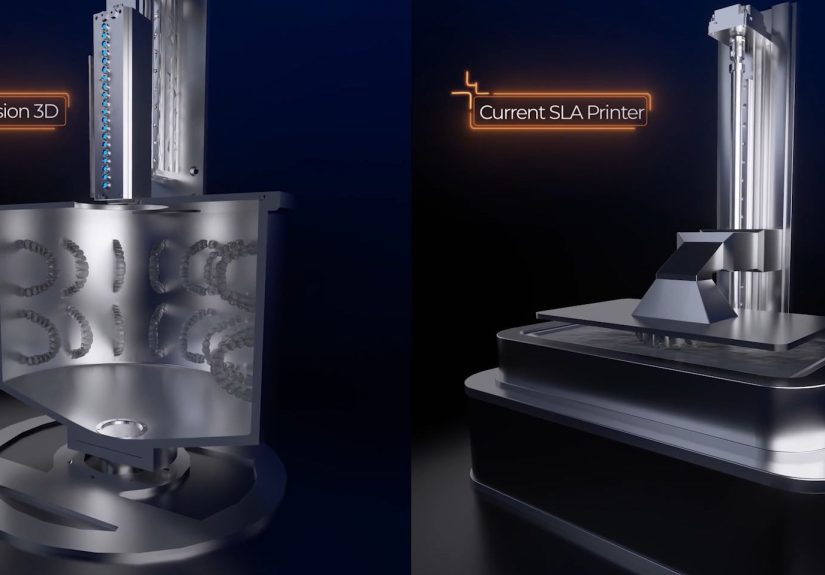
One of the most promising directions is centrifugal multimaterial printing in vat photopolymerization-style systems. In this approach, centrifugal force helps move or clear resin efficiently during material switching. That makes it easier to print large, heterogeneous objects with different materials arranged in specific regions or even at fine spatial resolution.
This matters because next-generation products are rarely satisfied with being made from just one material. Designers increasingly want parts that are stiff in one area, soft in another, conductive in one channel, transparent in one window, and perhaps ceramic where heat is the enemy. Centrifugal multimaterial methods are attractive because they offer a path toward those functionally varied parts without turning the printer into a sticky chemistry disaster.
Potential applications include wearable devices, sensors, biomedical components, soft robotics, custom fixtures, and multifunctional structures that combine mechanical and electrical behavior. If conventional single-material printing is like ordering plain toast, centrifugal multimaterial printing is trying to serve a layered brunch platter with all the sauces in the right places.
Centrifugal Fiber Printing and Biofabrication
Another major branch of centrifugal printing shows up in biofabrication and fiber-based manufacturing. Techniques such as rotary jet spinning and focused rotary jet spinning use centrifugal force to generate micro- and nanoscale fibers at high throughput. Those fibers can then be directed and deposited into scaffolds or structures that better mimic biological tissue than many standard extrusion-based printers can manage.
This is especially compelling in tissue engineering. Researchers have used spinning-based additive approaches to create heart-related structures, fiber-rich scaffolds, and other biomimetic architectures where alignment matters as much as shape. That is a big deal because biological tissues are not just blobs with good branding. They are highly organized systems, and the directionality of fibers can influence performance, cell behavior, and mechanical function.
Even outside medicine, fiber-oriented centrifugal methods may matter for lightweight composites, filtration media, flexible devices, and soft materials manufacturing. In short, centrifugal printing expands additive manufacturing into territories where “layer by layer” is not always the smartest route.
HIP vs. Centrifugal Printing: Different Problems, Different Superpowers
Putting HIP and centrifugal printing side by side is useful precisely because they are so different.
HIP improves what has already been made. It is about densification, defect reduction, performance enhancement, and qualification-friendly reliability in high-value metal parts.
Centrifugal printing changes how the part is made in the first place. It is about smarter material handling, new architectures, faster multimaterial transitions, fiber formation, and access to structures that conventional printing struggles to produce efficiently.
So which one is the bigger contender? That depends on what problem you are trying to solve.
- If your problem is metal fatigue, porosity, or certification risk, HIP is the stronger bet.
- If your problem is multimaterial complexity, fibrous structures, or unconventional material deposition, centrifugal printing is the more exciting frontier.
- If your problem is that your prototype looked amazing on LinkedIn but failed in the lab by Thursday, you may need both better process control and a more humble marketing team.
Where These Technologies Could Reshape Industry
Aerospace and Defense
HIP already has a clear role in aerospace-adjacent additive manufacturing because internal quality and fatigue performance are mission critical. As qualification pathways mature, HIP-supported AM parts are likely to remain important for engine hardware, structural brackets, manifolds, and heat-resistant components. PM-HIP may also expand options for large, hard-to-source domestic metal parts.
Energy and Heavy Industry
Energy systems love parts that are large, expensive, difficult to machine, and not remotely forgiving when they fail. That is why the combination of additive tooling, PM-HIP, and advanced metal fabrication is getting serious attention. On the centrifugal side, multimaterial printing may help with sensors, advanced seals, functional testing devices, and custom components in R&D environments.
Medical and Biofabrication
This is where centrifugal approaches could become especially influential. Fiber-rich, tissue-like, and gradient structures are more aligned with how biological systems actually work. Meanwhile, HIP remains valuable for metal implants and orthopedic devices where density and fatigue behavior matter.
Electronics, Soft Robotics, and Wearables
Multimaterial centrifugal printing could be a quiet star here. Devices that combine flexibility, conductivity, structural support, and small-scale precision are difficult to make with ordinary one-material workflows. Spinning-assisted material handling opens the door to more functional, integrated designs.
The Real Limitation: Manufacturing Is Still a System, Not a Single Machine
If there is one lesson running through all of this, it is that advanced manufacturing is no longer about choosing one miracle machine. It is about building a workflow. Design, feedstock quality, process control, monitoring, post-processing, inspection, and qualification all matter.
HIP succeeds because it fits into that system. It improves the downstream performance of parts produced by additive methods. Centrifugal printing is promising because it expands the upstream manufacturing toolbox. The industry does not need one winner that crushes all alternatives. It needs better combinations that make specific applications practical, affordable, and certifiable.
That may sound less glamorous than the old “print anything” fantasy, but it is much more useful. Manufacturing progress usually looks less like a sci-fi montage and more like a set of carefully engineered handoffs between complementary processes.
Conclusion
The next chapter of additive manufacturing will not be written by hype alone. It will be written by processes that solve stubborn industrial problems. HIP is earning its place by helping metal AM parts become denser, tougher, and more reliable. Centrifugal printing is earning attention by making multimaterial structures, fiber-rich architectures, and unconventional fabrication strategies more realistic.
Neither approach replaces the rest of additive manufacturing. Instead, each extends it in a different direction. HIP pushes AM toward performance and trust. Centrifugal printing pushes it toward complexity and new material behavior. One tightens the bolts. The other redraws the blueprint.
And that is exactly why these contenders matter. The future of additive manufacturing is not just about printing more things. It is about printing better things, building smarter workflows, and knowing when to spin, squeeze, or do both.
Field Experiences and Practical Lessons From HIP and Centrifugal Printing
Teams working with HIP and centrifugal printing tend to discover the same truth in different ways: the breakthrough rarely comes from the machine alone. It comes from how the process fits into the wider manufacturing chain.
In metal additive programs, engineers often begin with excitement about design freedom. Then the first round of testing arrives, and everyone becomes much more interested in porosity maps, fatigue coupons, and post-processing windows. This is usually the moment HIP stops sounding like a background detail and starts sounding like a project saver. A part may look nearly perfect on the outside, but once inspection data and mechanical testing are reviewed, the value of densification becomes obvious. Teams learn quickly that internal defects do not care how elegant the CAD model looked.
Another common experience is cost reframing. At first, HIP can seem like an annoying extra step that adds time and budget. But once manufacturers compare that cost against failed qualification, rejected batches, or reduced service life, the conversation changes. HIP often becomes easier to justify when the part is expensive, safety-critical, or hard to replace. Engineers may grumble about adding one more operation to the workflow, but they grumble a lot less than they do after a cracked turbine-related component or an inconsistent implant result.
On the centrifugal printing side, the experience is different but equally revealing. Researchers and product developers are often drawn in by the promise of faster material switching, fibrous architectures, or better multimaterial control. What they learn almost immediately is that these benefits depend on choreography. Resin behavior, rotational speed, curing conditions, airflow, deposition control, and interface cleanliness all need to cooperate. If one variable drifts, the whole process can go from elegant to sticky chaos with surprising speed.
That said, when centrifugal methods work well, they solve problems that conventional printing handles awkwardly. Multimaterial systems become more realistic. Fine fibers can be produced without painfully slow feature-by-feature deposition. Tissue-inspired structures become more than a beautiful rendering in a slide deck. In biofabrication, this matters because alignment, softness, and microstructure can be just as important as overall shape. In functional devices, it matters because the interface between materials often determines whether the product behaves intelligently or simply exists decoratively.
One practical lesson appears in both camps: inspection and validation should arrive early, not after everyone has fallen in love with the prototype. Teams that build testing into development move faster in the long run. They identify whether HIP truly improves the target property, whether a centrifugal multimaterial boundary is clean enough, and whether the final part behaves consistently enough for production. The romance phase of innovation is fun, but data is what pays the utility bill.
The most successful groups also avoid the trap of forcing one process to do everything. They treat HIP as one part of a metal manufacturing strategy, not a universal cure. They treat centrifugal printing as a specialized enabler, not proof that every printer should spin like a carnival ride. That mindset usually leads to better decisions, stronger parts, and fewer meetings where someone says, “In hindsight, perhaps we should have tested that sooner.”






 Close
Close