
Table of Contents >> Show >> Hide
- Meet the Beast: A Moving Mine on Steel Wheels
- The Route: From Saharan Iron to Atlantic Fog
- Inside a Cargo Carriage: Dust, Stars, and Sheep
- How 704 Kilometers Becomes 4,000
- What Locals Know That Tourists Learn the Hard Way
- Safety, Legality, and the Ethics of “Just One Epic Ride”
- If You Want the Story Without the Stunt
- Extra Field Notes: of On-the-Rail Experience (A Composite)
- Conclusion: A Legend Best Told With Both Feet on the Ground
Some travel memories come in the form of refrigerator magnets. This one comes as a fine red film in your eyebrows that refuses to leavelike the Sahara personally signed your face. Welcome to Mauritania’s iron ore train: an industrial, sandblasted serpent that hauls the country’s black rock across the desert and, unofficially, hauls stories across the internet.
Let’s get the first, unglamorous truth out of the way: this is a working freight line, not a theme-park ride. People talk about freight train hopping in Mauritania like it’s a checkbox on an adventure bingo card, but for many Mauritanians it’s transportationsometimes the only practical onefor merchants, herders, and families crossing a vast, sparsely populated landscape. Travelers have been fascinated by it for decades because it’s huge, raw, and stubbornly uncurated.
Meet the Beast: A Moving Mine on Steel Wheels
The line most people mean when they say “the Mauritania train” is the iron ore railway connecting the mining region around Zouérat with the Atlantic port city of Nouadhibou. It’s been operating since the early 1960s and runs roughly 704 kilometers (about 437 miles) across the Sahara. Depending on the consist, it can stretch for milesoften well over 200 carsand it’s routinely described as one of the longest and heaviest regularly operating trains on Earth.
That size is not a flex for Instagram. It’s engineering plus economics: iron ore is heavy, and moving it in bulk is how a mining industry feeds a port, pays wages, and keeps lights on. Mauritania’s economy has long been tied to mining (iron ore in particular), and that rail link is the artery that makes the export chain work. In other words: if this train ever showed up late, the country would notice.
Why a “freight only” train carries people anyway
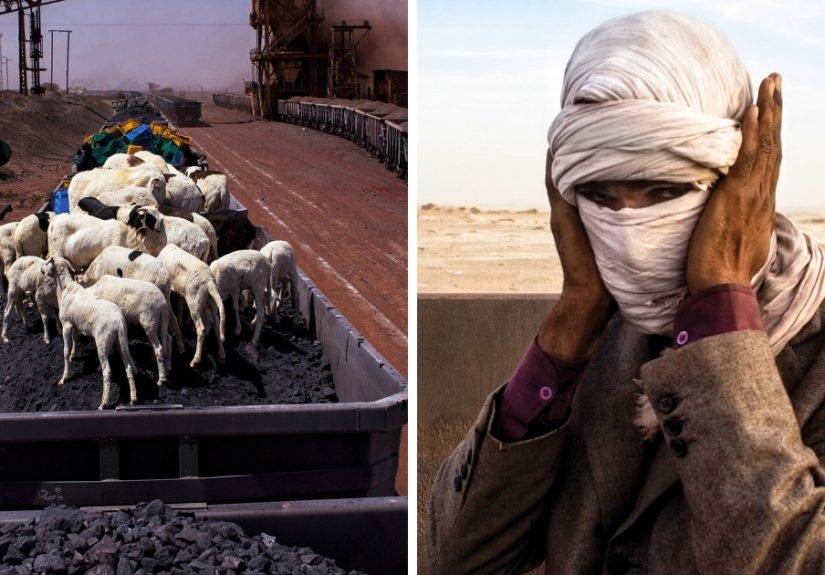
In remote desert regions, schedules are less “timetable” and more “event.” Locals ride because they need to get somewhere. Some accounts describe a passenger carriage sometimes attached to the ore train, while other riders perch in or on open wagons depending on what’s available and what’s tolerated that day. The result is an unusual social mix: mining workers, traders moving goods, and yessometimes herders traveling with animals. Smithsonian photo-essay entries have documented sheep traveling atop the ore in open cars, a surreal snapshot of how improvised desert logistics can be.
The Route: From Saharan Iron to Atlantic Fog
On a map, the journey looks like a clean line. On the ground, it’s a long lesson in scale. The train rolls out from the mining zone toward stations and sidings that are often more “dot in the desert” than “town.” The landscape shifts from hard rock and scrub to stretches of sand that feel infinite, then eventually to the cooler, saltier air nearer the coast.
Travel accounts frequently mention ride times in the teens of hours, with wide variability: freight priorities, desert conditions, and operational needs mean the rhythm isn’t built for passenger convenience. When the train slows, stops, or slams back into motion, you understand why rail fans call it a heavy-haul monster and travelers call it… other things that can’t be printed on a family blog.
Choum, Zouérat, Nouadhibou: names you start to feel
If you’re reading this because you’ve seen Train du Desert in photos, these names are usually in the caption. Zouérat is the mining hub. Nouadhibou is the coastal port where ore meets ships. Choum is one of the best-known points along the line in travel writing, partly because it represents the train’s in-between life: not departure, not arrivaljust the desert doing desert things while a two-to-three-kilometer train idles nearby.
Inside a Cargo Carriage: Dust, Stars, and Sheep
What does it actually feel like to ride in an open ore car? Imagine combining a slow roller coaster with a sandblaster and then removing the seatbelt, the snack bar, and the concept of “customer service.” The sensory highlights are vivid:
- Iron dust: Fine particles cling to skin, fabric, and camera gear. Some travelers report that the return journey on loaded ore can be especially dusty, turning everyone into a reddish-brown silhouette.
- Temperature swings: Daytime heat can be punishing, while nights can drop sharply. Desert air is dramatic like thatno warning, no apology.
- Sound and motion: Couplers clank, cars jolt, wheels sing a steady metallic note. It’s hypnotic until it isn’t.
- Night sky: With minimal light pollution, the stars can look close enough to tap like an app icon. Many accounts describe the Milky Way as a full-on ceiling mural.
Now add people. In many stories, the most memorable part isn’t the dust or the distanceit’s the strangers who turn into temporary family. A traveler offers dates; a merchant shares tea; someone laughs at your accent and then, five minutes later, helps you secure a scarf against the wind like it’s their job. When you see sheep balanced on ore like they’re commuting to an important meeting, you realize the desert has its own operating system.
How 704 Kilometers Becomes 4,000
The classic run is one long crossing. But “4,000 kilometers in a cargo carriage” makes sense when you think like a desert traveler rather than a spreadsheet. Many riders don’t do a single, clean point-to-point trip. They break it into legs, double back to catch connections, or ride multiple crossings over several days. Two round trips already push you past 2,800 kilometers; add a couple of partial segmentssay, to meet a driver, reach a market day, or return with goodsand you can stack up roughly 4,000 kilometers without ever leaving the same ribbon of steel.
And psychologically? After your first night of wind and dust, every additional kilometer feels like it counts double anyway.
What Locals Know That Tourists Learn the Hard Way
Travel writing tends to frame this ride as “extreme,” but locals tend to frame it as “Tuesday.” That difference is the whole story. Here are a few grounded truths that show up again and again in credible reporting and first-person accounts:
1) The train is not a service. It’s a system.
Freight comes first. People ride in the gaps of that reality, not the other way around. Waiting is part of the cost of entry, and “on time” is a concept that the Sahara treats as a suggestion.
2) Comfort is a negotiation, not a feature.
On open wagons there is no shade, no restroom, and no predictable shelter from wind. Riders improvise with scarves, blankets, and whatever they’ve brought. The desert does not provide a pillow menu.
3) Community is the safety net.
Even in a harsh setting, shared food and shared problem-solving are common themes. Stories from journalists and photographers regularly describe generosity among fellow riderstea offered without ceremony, advice given with a shrug, help provided before it’s requested.
Safety, Legality, and the Ethics of “Just One Epic Ride”
It’s tempting to turn the Mauritania railway into a viral rite of passage. But if you’re writing, filming, or even daydreaming about it, it’s worth pausing on three points.
Safety
Open freight riding carries real risks: falls, sudden jolts, dust inhalation, dehydration, and exposure. There’s also the simple fact that you are on industrial equipment built for ore, not humans. Multiple sources describing the ride are blunt: it’s dirty, it’s uncomfortable, and it can be dangerous.
Legality and enforcement
Rules and enforcement can vary, and some travelers report increased crackdowns as the train’s fame has grown. Even if locals ride out of necessity, a foreign traveler may attract more attention. If you’re researching this as a trip idea, verify current conditions locally and consider legal alternatives where available, including any official passenger options.
Ethics
For many communities, this line is infrastructure, not entertainment. Treating it like a playground can create pressure for stricter enforcement that affects locals first. If you tell the story, tell it with humility: emphasize the workers and riders who rely on the route, not just your own “look at me” moment.
If You Want the Story Without the Stunt
You can still write about the iron ore trainpowerfullywithout romanticizing risky behavior. Here are safer, more responsible angles that keep the fascination while lowering the harm:
- Follow the supply chain: Explain how iron ore moves from mine to port, and why rail matters where distances are brutal.
- Profile desert livelihoods: Pastoralism and trade remain vital even as mining dominates exports.
- Use photography as evidence, not bait: Focus on light, texture, and human connectionnot daredevil framing.
- Contextualize with travel advisories: Responsible travel writing should not gloss over security considerations.
Done well, your article becomes more than an adrenaline postcard. It becomes a portrait of how people move through one of the world’s harshest environmentsby necessity, ingenuity, and mutual aid.
Extra Field Notes: of On-the-Rail Experience (A Composite)
The following vignette is a composite scenepieced together from multiple documented accounts and reported detailsmeant to capture what riders describe without pretending one person’s experience is the only truth.
The first surprise isn’t the dust. It’s the silence right before the train movesthousands of tons of metal holding its breath. Then the couplers slam like a string of giant, impatient dominoes, and the whole world lurches forward. People don’t scream. They adjust. A man in a pale blue boubou shifts his bundle of goods two inches and looks at you like you’re the one being dramatic.
By midafternoon, the sun turns the ore car into a shallow pan. You learn the geometry of shade with the seriousness of someone studying for finals. A scarf becomes a sunhat, a face covering, andwhen the wind changesa tiny peace treaty between your lungs and the desert. Someone offers tea in a glass so small it seems designed to encourage humility. You accept because refusing feels like refusing the entire concept of hospitality.
Hours pass in a rhythm of clank, sway, and the occasional slow-down that makes you wonder if the train is negotiating with the laws of physics. The conversation around you moves between Arabic, Hassaniya, and the kind of universal hand gestures that translate perfectly: water? you okay? look at that. A boy points to a lone camel in the distance like he’s introducing a celebrity. The camel does not acknowledge fame.
Near sunset, the air cools fast, as if someone flipped a switch labeled “night mode.” A shepherdquiet, watchfulkeeps one hand near a small cluster of sheep huddled together in the car. The animals look offended by the entire arrangement, but they stay close, hooves braced, eyes half-lidded as the wheels sing beneath them. You’d expect chaos. Instead you get competence: a loop of rope here, a folded blanket there, a shared understanding that everyone’s job is to arrive with the same number of limbs and livestock they started with.
At night the stars are not decoration. They are an overwhelming fact. The Milky Way is so bright it feels like a road map drawn in chalk across the skyexcept the only route you’re on is steel. Someone laughs softly at a joke you don’t catch, and the sound carries strangely far, as if the desert keeps its own echo.
Sleep comes in scraps. You doze, wake, doze again. Iron dust settles into your hair like powdered cocoa, only less delicious and more committed. In the early hours, the train slows and stops. No announcement. No explanation. The group waits with the patience of people who have met the Sahara before. A thermos appears, tea is poured, and for a moment the freight car feels less like a machine and more like a moving porchneighbors sharing warmth in a place that doesn’t offer it freely.
By dawn, the horizon turns from black to charcoal to gold. The sheep stand, shake themselves, and resume looking unimpressed. Someone points aheadfaint structures, a hint of civilization, the promise of coast air. You realize the ride’s strangest souvenir isn’t the red dust. It’s the way a freight trainbuilt for orebriefly becomes a village that moves.
Conclusion: A Legend Best Told With Both Feet on the Ground
The Mauritania iron ore train is legendary because it’s real: a heavy-haul workhorse that stitches together mines, desert communities, and an Atlantic port across hundreds of miles of harsh terrain. The storiesof merchants, shepherds, and the occasional wide-eyed visitorare compelling precisely because they sit at the intersection of infrastructure and improvisation.
If you’re writing about freight train hopping in Mauritania, aim higher than shock value. Use the legend to illuminate the landscape: the economics of iron ore, the endurance of pastoral life, the generosity that shows up in unlikely places, and the sober risks that come with romanticizing an industrial lifeline. Tell it with humor, yesbut also with accuracy and respect. The desert deserves that much.






 Close
Close