
Table of Contents >> Show >> Hide
- Project Overview
- Materials You Will Need
- Tools You Will Need
- Step 1: Choose a Safe Wagon Design
- Step 2: Cut the Wagon Base
- Step 3: Build the Underside Frame
- Step 4: Add the Side Panels
- Step 5: Sand Every Edge Like You Mean It
- Step 6: Install the Axles and Wheels
- Step 7: Build the Pull Handle
- Step 8: Paint or Finish the Wagon
- Step 9: Test Before the First Ride
- How to Use a DIY Kid’s Wagon Safely
- Common Mistakes to Avoid
- Customization Ideas
- Real-World Experience: What Building a Kid’s Wagon Teaches You
- Conclusion
There is something wonderfully old-school about a kid’s wagon. It is part backyard adventure vehicle, part stuffed-animal taxi, part snack transportation system, and occasionallywhen nobody is watchingan emergency laundry cart. Building your own kid’s wagon gives you more than a weekend woodworking project; it gives you a handmade piece that can be customized for your child, your yard, and your family’s style.
This guide walks through how to build a sturdy wooden kid’s wagon using common materials, beginner-friendly joinery, and practical safety choices. The goal is not to create a high-speed race machine. The goal is a smooth-rolling, good-looking, parent-supervised pull wagon that can carry toys, picnic blankets, gardening supplies, or one seated child on flat ground when designed and tested responsibly.
Before you begin, remember one rule: a DIY wagon is only as safe as its weakest part. A beautiful painted side panel will not help if the axle wobbles, the handle pinches fingers, or the corners are sharp enough to start a tiny lawsuit. So we will focus on strength, smooth edges, secure hardware, and a design that is easy to inspect.
Project Overview
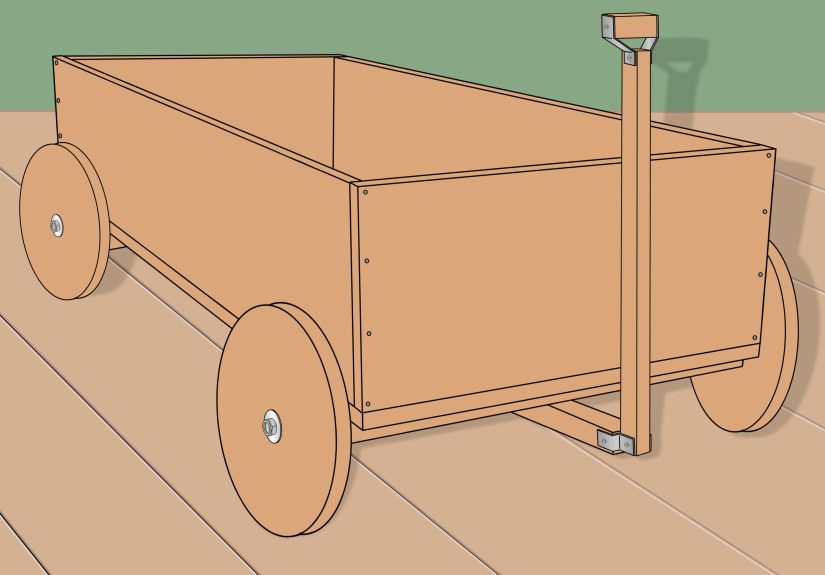
This kid’s wagon plan uses a rectangular wooden box mounted on a reinforced base frame, with two axles, four wheels, and a pull handle. The finished size can be adjusted, but a practical starting point is about 30 inches long, 16 inches wide, and 12 inches tall. That size is large enough for useful hauling but small enough to manage in a garage, garden path, or driveway.
Recommended Skill Level
Beginner to intermediate. If you can measure carefully, make straight cuts, drill clean holes, and drive screws without turning them into modern art, you can build this wagon. Adults should handle power saws, drilling, axle installation, and load testing. Kids can help with sanding, choosing paint colors, applying decals, or naming the wagon something dramatic like “The Snack Express.”
Estimated Time
One full weekend is realistic. You can build the structure in a day, then spend the second day sanding, painting, curing, assembling wheels, and testing. Rushing the finish is tempting, but sticky paint and wagon rides are not a friendship anyone needs.
Estimated Cost
Expect to spend roughly $75 to $180 depending on wheel quality, wood choice, hardware, and finish. Pneumatic all-terrain wheels cost more but roll better on grass and gravel. Solid rubber or plastic wheels are usually cheaper and work well on patios, sidewalks, and indoor floors.
Materials You Will Need
- One sheet of 1/2-inch or 3/4-inch plywood for the base and panels
- Two 1×4 boards for side rails or trim
- Two 2×2 boards for the underside frame
- Four wheels, 8 to 10 inches wide for outdoor use or smaller wheels for indoor use
- Two steel axle rods or heavy-duty axle bolts sized to match the wheels
- Washers, lock nuts, cotter pins, or axle caps
- Wood screws, 1 1/4-inch and 2-inch
- Wood glue suitable for indoor/outdoor use
- One wooden dowel or metal handle bar
- Eye bolts, clevis pin, or a wagon-handle bracket
- Sandpaper in 80-, 120-, and 220-grit
- Child-safe paint, exterior enamel, or clear finish after full curing
Tools You Will Need
- Measuring tape and pencil
- Carpenter’s square
- Circular saw, jigsaw, or table saw
- Drill/driver and drill bits
- Clamps
- Random-orbit sander or sanding block
- Wrench or socket set
- Safety glasses, hearing protection, and dust mask
Good tools make the project cleaner, but careful setup matters even more. Clamp your boards before cutting, support large plywood pieces, and keep the work area clear. A wagon project includes several small pieces of hardware, and the garage floor loves eating washers like popcorn.
Step 1: Choose a Safe Wagon Design
Start with the purpose. Will the wagon mostly carry toys? Will it roll across grass? Will it be used for garden helpers, beach trips, or porch storage? A wagon for hauling stuffed animals can be lighter than one intended to carry a seated child on flat ground under adult supervision.
For a practical family wagon, use a low center of gravity. Keep the floor close to the wheels rather than building tall sides on a narrow base. Wider wheel spacing improves stability. Rounded corners and smooth rails matter because children will touch every surface, including the one you thought was “probably fine.”
A smart DIY target is a conservative working load of 60 to 80 pounds unless every partwheels, axles, frame, fasteners, and handle hardwareis rated and tested for more. Commercial wagons often publish weight limits, but your handmade wagon needs its own cautious testing because homemade assemblies vary.
Step 2: Cut the Wagon Base
Cut the wagon floor from plywood to 30 inches by 16 inches. This creates a compact but useful platform. If you want a larger wagon, increase width carefully; do not simply make the sides taller and call it a day. A wagon that is too tall and narrow can tip more easily on uneven ground.
After cutting, mark the underside for the support frame. The frame should sit slightly inside the outer edges so the side panels can attach cleanly. A simple frame uses two long 2×2 runners and three crosspieces: one near the front, one near the back, and one in the center.
Step 3: Build the Underside Frame
Cut two 2×2 boards to about 28 inches and three crosspieces to about 13 inches. Dry-fit them under the plywood base in a ladder-like layout. Apply wood glue, clamp the pieces, and drive screws through the plywood into the 2×2 frame. Pre-drill pilot holes to prevent splitting.
This frame is the wagon’s backbone. It distributes weight across the floor and gives the axles a stronger place to mount. If you attach wheels only to thin plywood, the wagon may feel flimsy over time. A reinforced frame keeps the ride smoother and helps the wagon survive the intense engineering standards of children, who believe every object is also a climbing structure.
Step 4: Add the Side Panels
Cut two long side panels to 30 inches by 10 inches and two end panels to 16 inches by 10 inches. You can keep them rectangular or cut a gentle curve along the top edge for a classic wagon look. If you use curves, draw them with a flexible strip of wood or a large round object, then cut with a jigsaw.
Attach the panels to the base with glue and screws. Reinforce the inside corners with short blocks of 1×2 or 2×2. These corner blocks make the box stronger and reduce side-to-side flex. If you want removable side rails, use bolts and threaded inserts instead of permanent glue, but make sure no hardware creates sharp edges or snag points.
Optional: Slatted Sides
For a vintage look, build the sides from horizontal slats instead of plywood panels. Use 1×3 boards with small gaps between them. Slats reduce weight and look charming, but they require more sanding and careful spacing. Avoid gaps large enough for little feet or fingers to get trapped.
Step 5: Sand Every Edge Like You Mean It
Sanding is not the glamorous part of building a kid’s wagon, but it may be the most important. Start with 80-grit sandpaper to remove saw marks, move to 120-grit to smooth the surfaces, and finish with 220-grit on touch points. Round over the top rails, corners, handle edges, and wheel-area surfaces.
Run your hand slowly over every exposed edge. If it feels sharp to you, it will feel sharper to a child. If it catches a cloth, it may catch skin or clothing. You can use a router with a round-over bit for a professional finish, but hand sanding works if you are patient.
Step 6: Install the Axles and Wheels
The easiest axle setup uses two straight steel rods running under the wagon, one in front and one in back. Mark the axle positions carefully so the wheels sit parallel. If one axle is crooked, the wagon will pull like a shopping cart with a grudge.
Drill mounting holes through axle blocks or metal brackets attached to the underside frame. Slide the axle rod through, add washers, install the wheels, then secure them with lock nuts, cotter pins, or axle caps. Each wheel should spin freely without wobbling. Add washers between the wheel and frame to prevent rubbing.
For grass, gravel, or bumpy sidewalks, choose larger rubber or pneumatic wheels. For indoor playrooms or smooth patios, smaller solid wheels are fine. Whatever you choose, check the manufacturer’s load rating and match the axle diameter correctly.
Step 7: Build the Pull Handle
A wagon handle should be sturdy, comfortable, and free of pinch points. A simple handle can be made with two wooden arms and a dowel grip. Cut two handle arms about 28 to 34 inches long, round the ends, and drill holes for a dowel grip at the pulling end. At the wagon end, connect the handle using an eye bolt, clevis pin, or metal bracket that allows the handle to pivot.
Do not attach a long cord as the main pull handle for younger children. Long cords can create tangling hazards. A rigid handle gives better control and is less likely to wrap around feet, wheels, or playground equipment.
Test the handle by pulling the empty wagon in a circle. It should turn smoothly without scraping the front panel. Then test with a small load, gradually increasing weight while watching the handle bracket and front frame for stress.
Step 8: Paint or Finish the Wagon
Choose a finish based on how the wagon will be used. For outdoor use, a high-quality exterior paint or exterior clear coat helps protect the wood from moisture. For a natural look, use a finish appropriate for children’s furniture or toys and allow it to cure completely before use. Dry to the touch does not always mean fully cured.
Bright red is the classic wagon color, but you can also try forest green, navy blue, sunny yellow, or a two-tone design with natural wood rails. Add your child’s name, racing stripes, stars, animal decals, or a tiny license plate. Just make sure decorations are firmly attached and not small pieces that could come loose.
Step 9: Test Before the First Ride
Before any child sits in the wagon, test it like a cautious engineer. Place a bag of soil, books, or another stable weight inside the wagon. Pull it slowly across flat ground. Check for wheel wobble, axle movement, handle looseness, panel flex, and tipping.
Then test turns. A wagon should not feel like it wants to flip when turned gently. If it does, widen the wheel stance, lower the floor, reduce side height, or limit the wagon to cargo use only. Safety is not where you want to “see how it goes.”
How to Use a DIY Kid’s Wagon Safely
Use the wagon on flat, dry surfaces away from traffic, stairs, steep driveways, pools, and crowded areas. Always supervise children. Do not let kids stand in the wagon while it is moving. Do not use the wagon for downhill riding, towing behind a bike, or pulling with a motorized vehicle. A homemade wagon is not a stroller replacement unless it has been designed, tested, and equipped for that purpose.
Inspect the wagon often. Tighten nuts, check wheel movement, look for cracks, and sand any rough spots that appear. Outdoor wagons take more abuse from moisture and dirt, so clean and dry them after messy use.
Common Mistakes to Avoid
Using Wheels That Are Too Small
Small wheels look cute, but they struggle on grass, gravel, and sidewalk cracks. Larger wheels roll more smoothly and reduce strain on the handle and frame.
Skipping Pilot Holes
Screws can split wood, especially near edges. Pilot holes make the build cleaner and stronger.
Leaving Corners Sharp
Kids lean, climb, grab, bump, and occasionally use furniture like a professional wrestling prop. Rounded corners are worth the extra sanding time.
Painting Too Soon
If paint or finish has not cured, it may stay tacky, smell strong, or scuff easily. Follow the finish manufacturer’s curing instructions before handing the wagon over to its new manager.
Customization Ideas
Once the basic wagon is complete, you can customize it in several practical ways. Add a removable cushion with washable fabric. Install small side pockets for water bottles or sidewalk chalk. Build a removable canopy frame for shade, but keep it lightweight and secure. Add reflective tape if the wagon will be used during evening walks, though it should still stay away from roads.
You can also create a themed wagon. A garden wagon might have green paint and flower decals. A beach wagon might use larger wheels and a sealed plywood floor. A birthday wagon might include a removable banner holder. The best customization is one that makes the wagon more useful without adding loose parts, sharp hardware, or unnecessary weight.
Real-World Experience: What Building a Kid’s Wagon Teaches You
Building a kid’s wagon sounds simple until the first wheel spins perfectly and the second one behaves like it has personal problems. That is part of the charm. This project teaches patience in a way few flat-pack purchases can. You quickly learn that measuring twice is not just a phrase people put on coffee mugs; it is the difference between a wagon that rolls straight and one that slowly migrates toward the neighbor’s flower bed.
One of the most useful lessons is that children notice details adults overlook. You may be proud of the reinforced frame, but the child may be thrilled because the wagon has a yellow handle and a place for a dinosaur sticker. That does not mean the engineering is wasted. It means the magic happens when strength and personality meet. A well-built wagon should feel solid to the adult and exciting to the child.
Another experience worth mentioning is the sanding stage. At first, sanding feels like punishment for deciding to build something with corners. But once the edges become smooth, the whole wagon changes. It stops feeling like a box on wheels and starts feeling like a finished object. For projects made for kids, sanding is not cosmetic. It is care made visible. Every rounded edge says, “Someone thought about the small hands that would hold this.”
The wheel installation phase often teaches the biggest practical lesson: hardware matters. Cheap wheels may save money, but they can make the wagon noisy, shaky, or hard to pull. Good washers, straight axles, and properly tightened nuts make the difference between a wagon that glides and one that complains every three feet. If the budget is tight, spend less on decorative extras and more on wheels and axle hardware.
Painting is where families usually have the most fun. A child may choose a color combination no design magazine would approve, and that is perfectly fine. Purple sides, orange rails, and a blue handle? Congratulations, you have created limited-edition backyard couture. The important part is using a suitable finish, allowing it to cure, and keeping painted surfaces smooth. A handmade wagon should be durable enough for play, but personal enough to feel special.
The final experience comes during the first test pull. When the wagon rolls straight, the handle feels firm, and the wheels turn quietly, the project becomes more than wood and bolts. It becomes proof that useful things can be made by hand. It also becomes a small family story: the afternoon of sawdust, the debate over paint colors, the missing washer that somehow appeared inside a sneaker, and the first official cargousually a stuffed animal placed inside with great ceremony.
That is the real value of building your own kid’s wagon. You save some money, maybe. You customize the size, definitely. But more than that, you create an object with memory built into it. Store-bought wagons can be wonderful, but a handmade wagon carries something extra before anything is even placed inside.
Conclusion
Learning how to build your own kid’s wagon is a rewarding DIY project that combines woodworking, practical design, and family creativity. The best wagon is not the fanciest one; it is the one that rolls smoothly, feels sturdy, has no sharp edges, and fits the way your family will actually use it. Start with a stable base, reinforce the frame, choose strong wheels, sand thoroughly, and use a safe, fully cured finish.
Whether your finished wagon becomes a toy hauler, garden helper, picnic cart, or neighborhood parade float, build it with safety first and personality second. The result will be more than a weekend project. It will be a handmade little vehicle for big childhood memories.






 Close
Close