
Table of Contents >> Show >> Hide
- 1. Cappadocia, Turkey: The Land of Fairy Chimneys and Floating Balloons
- 2. Salar de Uyuni, Bolivia: The World’s Largest Sky Mirror
- 3. Zhangjiajie, China: Stone Pillars Rising Through the Mist
- 4. Antelope Canyon, Arizona: A River of Light in Stone
- 5. Waitomo Glowworm Caves, New Zealand: A Galaxy Underground
- 6. Grand Prismatic Spring, Yellowstone, USA: A Rainbow Painted by Heat
- 7. Pamukkale, Turkey: White Terraces Filled With Blue Water
- 8. Lençóis Maranhenses, Brazil: A Desert That Dreams of Water
- 9. Socotra, Yemen: The Island From Another Planet
- 10. Wadi Rum, Jordan: A Red Desert Written in Stone
- How to Experience Dreamlike Places Without Ruining the Magic
- Final Thoughts: The World Is Weirder Than Fiction
Some places look so unreal that your brain quietly opens a complaint form: “Excuse me, Earth, are you sure this isn’t concept art?” Yet these dreamlike destinations are very real. They are shaped by volcanoes, wind, water, salt, limestone, microbes, ancient cultures, and the occasional geological plot twist. From glowing caves to rainbow hot springs and deserts that turn into mirrors, the world is far strangerand prettierthan any screensaver has permission to be.
This guide explores 10 incredible real places straight out of a dream, with practical travel insight, vivid details, and enough wonder to make your bucket list start doing push-ups. These are not fantasy kingdoms, movie backdrops, or AI-generated landscapes. They are actual places you can research, visit, photograph, and remember foreverpreferably without dropping your phone into a hot spring.
1. Cappadocia, Turkey: The Land of Fairy Chimneys and Floating Balloons
Cappadocia looks like nature hired a sculptor with a very active imagination. Located in central Turkey, this region is famous for its “fairy chimneys,” tall cone-shaped rock formations carved by erosion from soft volcanic stone. The result is a landscape of honey-colored towers, cave houses, rock-cut churches, and valleys that seem to belong in a bedtime story told by a geologist.
The most iconic experience is a sunrise hot air balloon ride over Göreme. As dozens of balloons rise into pink morning light, the rocky valleys below look like a dream slowly waking up. Even if you stay firmly on the groundperfectly acceptable for anyone whose relationship with heights is “no, thank you”watching the balloons drift over the chimneys is unforgettable.
Why It Feels Dreamlike
Cappadocia blends surreal nature with human history. Ancient communities carved homes, chapels, monasteries, and even underground cities into the soft rock. You can walk through landscapes that feel lunar, then step into a centuries-old cave church decorated with faded frescoes. It is part fantasy, part history lesson, and part “how did humans even think of this?”
2. Salar de Uyuni, Bolivia: The World’s Largest Sky Mirror
Bolivia’s Salar de Uyuni is the kind of place that makes photographers forget how to breathe politely. It is the world’s largest salt flat, a vast white crust stretching across the high-altitude Andes. During the dry season, the surface forms geometric salt polygons that look like nature’s own tile floor. During the rainy season, a thin layer of water transforms the salt flat into a giant mirror reflecting the sky.
When conditions are right, the horizon disappears. Clouds float above and below you. People appear to walk across the heavens. It is one of the few places on Earth where you can stand still and feel like you have accidentally wandered into the loading screen between worlds.
Best Time to See the Mirror Effect
The mirror effect usually happens during the rainy season, often from January to March, though exact timing varies. Travelers should plan with flexibility because too much water can make some areas inaccessible, while too little water means no mirror. In Salar de Uyuni, the dream is realbut it likes to check the weather first.
3. Zhangjiajie, China: Stone Pillars Rising Through the Mist
Zhangjiajie, part of the UNESCO-listed Wulingyuan Scenic Area in China’s Hunan Province, is a forest of towering quartz sandstone pillars. Thousands of narrow rock columns rise from misty valleys, many topped with trees that cling dramatically to the stone. The scenery feels vertical, mysterious, and slightly impossible, as if mountains decided to become skyscrapers.
This place is often associated with floating-mountain imagery because the pillars seem detached from ordinary gravity when clouds wrap around them. Walkways, cable cars, glass bridges, and viewpoints give visitors dramatic angles over the landscape. Bring a camera, comfortable shoes, and a respectful acceptance that your photos may still not capture how strange and beautiful it feels in person.
What Makes It Unique
The combination of height, density, mist, forest, and erosion gives Zhangjiajie its dreamlike personality. It is not just one amazing formation; it is an entire city of stone towers. Some views are peaceful and green, while others look like a fantasy battlefield where dragons are definitely hiding off-camera.
4. Antelope Canyon, Arizona: A River of Light in Stone
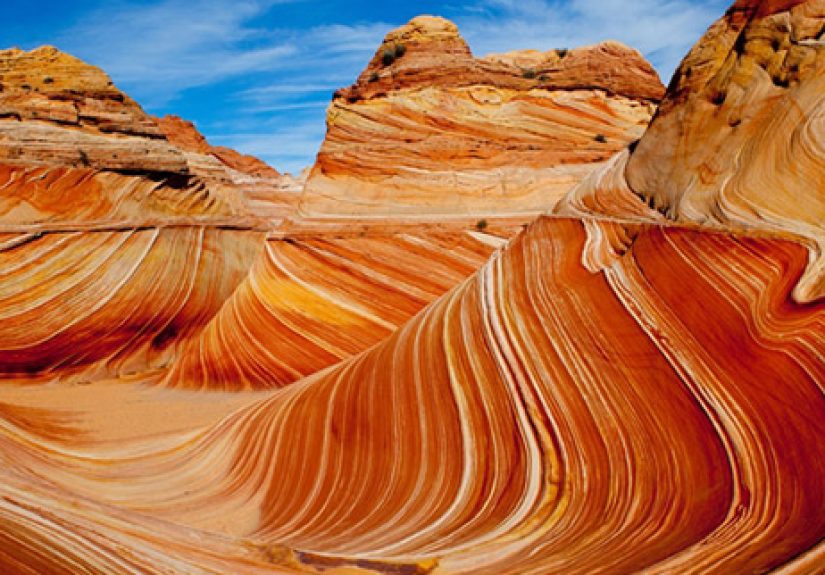
Antelope Canyon in northern Arizona is one of the most famous slot canyons in the world. Located on Navajo land near Page, it is known for narrow sandstone passageways shaped by flash floods and erosion. The walls curve like waves, twisting in shades of orange, red, gold, and purple depending on the light.
At certain times of day, beams of sunlight pierce the narrow opening above and fall into the canyon like stage lighting from the universe’s most dramatic theater department. The experience is quiet, glowing, and almost liquid, even though you are walking through rock.
Important Travel Note
Visitors must go with authorized guides, which helps protect the canyon and supports safe access. Flash floods can be dangerous even when the sky above seems clear, so guided tours are not just a formality. They are part of experiencing Antelope Canyon responsibly.
5. Waitomo Glowworm Caves, New Zealand: A Galaxy Underground
Imagine floating silently through a dark cave while thousands of tiny blue-green lights glow above you like stars. That is the magic of the Waitomo Glowworm Caves on New Zealand’s North Island. The “stars” are glowworms, specifically a species found in New Zealand, creating one of the most enchanting natural light shows on Earth.
Guided boat tours move through the glowworm grotto with minimal noise, letting visitors experience the ceiling of living lights. It feels less like sightseeing and more like drifting through a secret night sky hidden inside the planet.
Why It Belongs on a Dream List
Waitomo is not loud or dramatic in the usual sense. Its beauty is delicate. The best moment is when everyone gets quiet, the boat glides forward, and the glowworms shimmer overhead. It is proof that nature can be spectacular without raising its voice.
6. Grand Prismatic Spring, Yellowstone, USA: A Rainbow Painted by Heat
Grand Prismatic Spring in Yellowstone National Park looks like a giant eye made of turquoise, gold, orange, and deep blue. It is Yellowstone’s largest hot spring and one of the most recognizable geothermal features in the United States. The colors come from heat-loving microorganisms that live around the spring’s edges, while the deep center appears intensely blue.
From ground level, the steam and colors are mesmerizing. From the overlook trail, the full circular pattern becomes clearer, and the spring looks like a rainbow dropped into the Earth by mistake. A very beautiful mistake, to be clear.
Safety Is Part of the Experience
Yellowstone’s thermal areas are fragile and dangerous. Visitors should stay on boardwalks and marked trails at all times. The spring is not a swimming pool, not a shortcut, and absolutely not a place to test whether your sneakers are “built different.”
7. Pamukkale, Turkey: White Terraces Filled With Blue Water
Pamukkale means “cotton castle,” and honestly, the name is doing its best. This Turkish landscape is famous for brilliant white travertine terraces formed by mineral-rich thermal waters. From a distance, it looks like snow, clouds, or frozen waterfalls cascading down a hillside. Up close, pools of pale blue water rest inside white mineral basins.
The nearby ancient city of Hierapolis adds another layer of wonder. You can explore ruins, thermal pools, and terraces in one visit, which makes Pamukkale feel like a spa day arranged by the Roman Empire and supervised by a mountain.
How to Visit Respectfully
Some terraces are protected to preserve the natural formations, and visitor access may be limited to designated areas. Following local rules helps keep Pamukkale white, beautiful, and available for future travelers who also want to gasp dramatically at mineral deposits.
8. Lençóis Maranhenses, Brazil: A Desert That Dreams of Water
Lençóis Maranhenses National Park in northeastern Brazil is one of the strangest and most beautiful landscapes on Earth. It looks like a desert, with sweeping white dunes stretching toward the horizon. But during the rainy season, freshwater lagoons form between the dunes, creating pools in shades of turquoise, emerald, and deep blue.
The result is a landscape that seems contradictory in the best possible way: sand and water, desert and lagoon, harsh brightness and soft reflection. From above, it looks like someone spilled jewels across a white silk sheet.
When to Go
The lagoons are usually fullest after the rainy season, often from June through September. Timing matters because the pools shrink and change through the year. A trip here rewards travelers who plan around nature’s schedule rather than expecting nature to check their vacation calendar.
9. Socotra, Yemen: The Island From Another Planet
Socotra is often described as one of the most alien-looking places on Earth, and that is not travel-blog exaggeration. Located in the Arabian Sea, the Socotra Archipelago is known for extraordinary biodiversity and a high number of species found nowhere else. Its most famous symbol is the dragon blood tree, with an umbrella-shaped canopy and red resin.
The island’s landscape includes limestone plateaus, dunes, caves, clear coastlines, and strange plant forms that look as if they were designed for a science-fiction film. Socotra feels ancient, isolated, and wonderfully odd, like evolution had a private sketchbook and did not want anyone peeking.
A Reality Check for Travelers
Socotra is breathtaking, but it is also remote and affected by complicated travel logistics and regional safety concerns. For many people, it remains more of a dream-list destination than a simple vacation. Always check current travel advisories and local conditions before considering a trip.
10. Wadi Rum, Jordan: A Red Desert Written in Stone
Wadi Rum, also known as the Valley of the Moon, is a desert landscape in southern Jordan filled with sandstone mountains, narrow gorges, natural arches, cliffs, and wide red plains. The place feels cinematic because it is cinematic; many films have used its Mars-like scenery. But no screen can fully capture the silence, scale, and changing colors of the desert at sunset.
Beyond its visual drama, Wadi Rum carries deep cultural history. Petroglyphs, inscriptions, and archaeological remains reveal thousands of years of human presence. Travelers can explore by jeep, camel, or guided hikes, often staying overnight in desert camps beneath a star-heavy sky.
Why It Feels Like a Dream
Wadi Rum’s beauty comes from space and stillness. The cliffs glow orange, the sand shifts red and gold, and the sky feels enormous. At night, when the desert cools and the stars sharpen, it becomes clear why people describe this place as otherworldly. It is not empty; it is full of silence.
How to Experience Dreamlike Places Without Ruining the Magic
Dream destinations are exciting, but the best travelers know that wonder comes with responsibility. The goal is not just to arrive, snap a photo, and leave with a camera roll full of proof. The goal is to experience the place with awareness, patience, and respect. In other words, do not be the person who treats a fragile landscape like a theme park with fewer churros.
Go at the Right Time, Not Just the Cheapest Time
Many surreal places depend on timing. Salar de Uyuni needs the right amount of water for its mirror effect. Lençóis Maranhenses is most magical when the lagoons are full. Antelope Canyon changes dramatically with the angle of the sun. Cappadocia balloon flights depend on weather. If the dream image in your head is tied to a specific season or condition, research timing carefully before booking.
Choose Local Guides Whenever Possible
Guides do more than show you where to stand for a good photo. In places like Antelope Canyon, Wadi Rum, Cappadocia, and Waitomo, guides add safety, cultural context, and local knowledge. They know when light is best, which routes avoid crowds, what rules matter, and which stories bring the landscape alive. A good guide turns “pretty place” into “I understand why this place matters.”
Pack for the Place You Are Visiting, Not the Fantasy Version
Dreamlike landscapes still have very real temperatures, dust, altitude, slippery paths, and sun exposure. Salar de Uyuni sits at high elevation. Wadi Rum can be hot by day and cool at night. Yellowstone’s boardwalks can be crowded. Pamukkale may require walking barefoot in designated areas. Bring layers, sun protection, water, comfortable shoes, and humility. Humility is lightweight and fits in every bag.
Respect Fragile Environments
The more magical a place looks, the more tempting it can be for visitors to step where they should not. Resist that urge. Stay on trails, obey guide instructions, avoid touching delicate formations, and never remove rocks, salt, plants, or “tiny souvenirs.” The landscape is not a gift shop. Grand Prismatic Spring’s microbial mats, Pamukkale’s terraces, cave ecosystems, desert surfaces, and rare island plants all depend on careful protection.
Make Room for Quiet Moments
Some travelers rush from viewpoint to viewpoint like they are collecting stamps in a panic. But dreamlike places often reveal themselves slowly. Watch the light move across Wadi Rum’s cliffs. Sit quietly in Cappadocia after the balloons disappear. Listen to the hush inside Waitomo. Notice how the colors change at Grand Prismatic Spring when steam shifts. The best travel memories are not always the loudest ones.
Final Thoughts: The World Is Weirder Than Fiction
The most incredible real places straight out of a dream remind us that Earth has a flair for drama. It builds stone forests in China, paints hot springs in Yellowstone, fills Brazilian dunes with blue lagoons, grows umbrella-shaped trees on remote islands, and turns a Bolivian salt flat into the sky’s personal mirror. No fantasy novel has a monopoly on wonder.
Whether you are planning an actual trip or building the ultimate bucket list, these destinations prove that reality can be astonishing when you know where to look. Travel slowly, respect local cultures, protect fragile landscapes, and leave each place as beautiful as you found it. The dream may be real, but keeping it dreamlike is everyone’s job.
Note: This article is written for web publication and is based on real destinations, established geographic information, and widely documented travel experiences. Visitors should always verify current access rules, seasonal conditions, permit requirements, safety notices, and local travel advisories before planning a trip.






 Close
Close