
Table of Contents >> Show >> Hide
- What “Sales Efficiency” Really Means (And Why $10m ARR Exposes It)
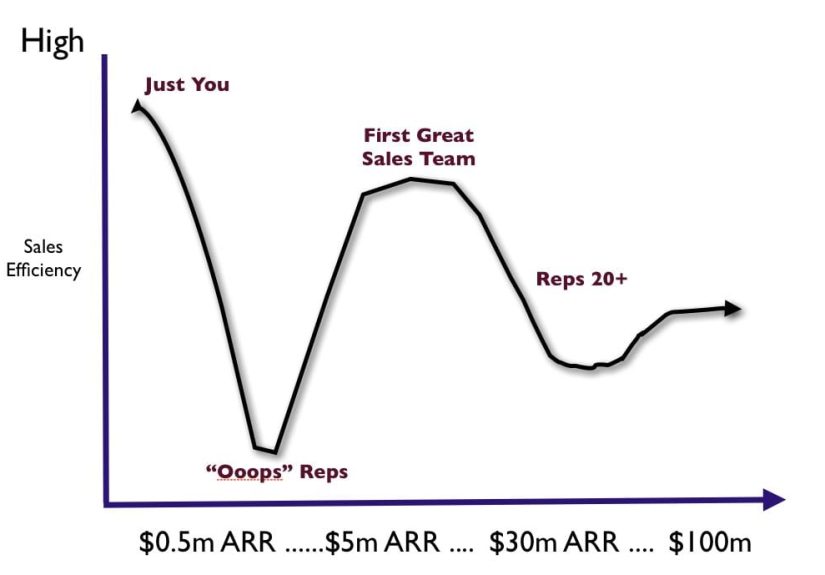
- Why Sales Efficiency Typically Drops as You Approach $10m ARR
- 1) You run out of “easy mode” revenue
- 2) Headcount ramps slower than your plan deck pretends
- 3) Your go-to-market system gets “real,” and real systems are expensive
- 4) Pipeline math gets unforgiving
- 5) Competition catches up, and differentiation gets harder
- 6) Retention and expansion start mattering as much as new logo growth
- The $10m ARR Planning Principle: “Hire for the Quarter After Next”
- How to Keep the Efficiency Dip From Becoming a Death Spiral
- Step 1: Build a capacity model (simple beats fancy)
- Step 2: Pick 3 efficiency guardrails (and actually use them)
- Step 3: Segment your go-to-market motion before it segments you
- Step 4: Fix the “ramp tax” with enablement that actually ships
- Step 5: Use pricing and packaging to reduce reliance on headcount
- A Concrete Example: Why Efficiency Drops Even When You’re “Doing Everything Right”
- Common Mistakes That Make the Dip Worse
- How to Talk About This With Your Board (Without Sounding Like You Lit Money on Fire)
- Field Notes: 500+ Words of Real-World Experience Patterns From the $10m ARR Zone
- Conclusion
If you’re cruising toward $10 million in ARR, congratulationsyou’ve officially entered the part of the SaaS movie where the soundtrack gets louder,
the camera starts shaking, and someone inevitably says, “Wait… why did our sales efficiency just faceplant?”
Here’s the uncomfortable truth: sales efficiency often gets worse as you scale. Not because you suddenly forgot how to sell, but because the rules
change around youmore headcount, more complexity, fewer “gimme” deals, longer cycles, and higher expectations from everyone (including your own spreadsheet).
This article breaks down why sales efficiency tends to drop near $10m ARR, which metrics actually matter, and how to plan so the dip doesn’t turn into a
crater. We’ll keep it practical, numbers-forward, and only mildly traumatic.
What “Sales Efficiency” Really Means (And Why $10m ARR Exposes It)
In SaaS, “sales efficiency” is a fancy way of asking a blunt question: How many dollars of recurring revenue do we create for every dollar we spend to create it?
There are a few ways to measure this, but most roads lead to some version of the “Magic Number” or payback math.
The SaaS Magic Number (one common version)
One common way to estimate sales efficiency is:
A higher number generally means you’re converting spend into growth efficiently. A lower number means you’re paying a lot for growthor paying for growth that hasn’t shown up yet.
CAC Payback (the “how long until we get our money back?” version)
CAC payback is the time it takes to recoup what you spend acquiring customers. A practical framework used by operators is:
If your payback stretches out while you’re hiring aggressively, your cash needs spikeoften right when you least want surprises.
Why Sales Efficiency Typically Drops as You Approach $10m ARR
1) You run out of “easy mode” revenue
Early growth often comes from the cleanest ICP matches: buyers who already feel the pain, love your positioning, and have budget.
As you scale, you expand outwardnew segments, new industries, new deal sizesand every step away from your core fit costs you efficiency.
2) Headcount ramps slower than your plan deck pretends
Hiring is not instant revenue. New AEs ramp. SDRs ramp. Managers ramp. Even your enablement person ramps (ironically, because they have to learn what you sell).
If you hire a wave of reps and expect immediate output, you’ll temporarily crush your efficiency metricsand your CFO’s will to live.
3) Your go-to-market system gets “real,” and real systems are expensive
Near $10m ARR, you stop being founder-led sales with a few heroic closers. You start building an actual revenue machine:
SDR programs, RevOps, enablement, forecasting, territories, comp plans, onboarding, tooling, pipeline hygiene. These are good investmentsbut they show up as cost
before they show up as ARR.
4) Pipeline math gets unforgiving
At small scale, a couple of deals swinging in can make the quarter. At $10m ARR, you need repeatable pipeline coverage across multiple reps, quarters, segments,
and channels. That usually means higher top-of-funnel investment and tighter processboth of which often reduce near-term efficiency.
5) Competition catches up, and differentiation gets harder
As markets mature, you see more competitors, more “good enough” alternatives, and more procurement friction. Your win rates can fall, cycles can lengthen,
and discounting creeps in. None of those things are friendly to efficiency.
6) Retention and expansion start mattering as much as new logo growth
When acquisition gets pricier, expansion becomes your best friend. If your net dollar retention isn’t solid, your efficiency metrics take a double hit:
you pay more to acquire, and you keep less of what you acquired.
The $10m ARR Planning Principle: “Hire for the Quarter After Next”
The most common mistake in this stage is reacting to the current quarter instead of building capacity for future quarters.
If your reps take months to ramp, then the hires you make today are really for the revenue you need in two quarters.
A useful mental model is to separate:
(1) capacity you already have vs. (2) capacity you are buying.
Capacity you’re buying shows up as cost nowand revenue later.
How to Keep the Efficiency Dip From Becoming a Death Spiral
Step 1: Build a capacity model (simple beats fancy)
You need a model that ties hiring to output with realistic assumptions:
ramp time, quota, expected attainment, churn/attrition, and sales cycle timing.
If you don’t model it, you’ll over-hire, under-hire, or do the classic combo move: over-hire and still miss the number.
At minimum, model these inputs:
- Ramp curve: month-by-month productivity for new reps
- Quota and attainment: what “typical” performance looks like (not just the top rep)
- Sales cycle length: when pipeline becomes revenue
- Pipeline coverage: how much qualified pipeline supports quota
- Attrition: reps leaving, underperformance churn, territory reshuffles
Step 2: Pick 3 efficiency guardrails (and actually use them)
You can track 47 metrics. You will. But pick three that run your week-to-week decisions:
| Metric | What it tells you | Why it matters near $10m ARR |
|---|---|---|
| CAC Payback | How quickly you get acquisition spend back | Hiring waves can quietly extend payback and strain cash |
| Sales Efficiency / Magic Number | Growth output per S&M input | Shows whether spend is translating into ARR (or just payroll) |
| Net Dollar Retention (NDR) | Whether customers expand faster than they churn | Expansion becomes a major lever when new logo CAC rises |
Step 3: Segment your go-to-market motion before it segments you
A big reason efficiency tanks is treating every buyer like the same buyer. By $10m ARR, segmentation isn’t “nice to have.”
It’s how you stop wasting expensive sales time on cheap dealsor forcing self-serve buyers through a heavyweight enterprise process.
Practical segmentation dimensions:
- ACV bands: SMB vs mid-market vs enterprise motions
- Sales cycle length: fast transactional vs multi-stakeholder
- Implementation burden: low-touch vs high-touch onboarding
- Expansion potential: land-and-expand vs one-and-done
Step 4: Fix the “ramp tax” with enablement that actually ships
If ramp time is long, your efficiency suffers twice: you pay comp while output is low, and you miss pipeline creation windows.
That’s why onboarding and enablement are not “HR stuff.” They are efficiency levers.
High-leverage enablement basics:
- A clearly defined ICP + disqualification rules (saving time is a revenue strategy)
- Talk tracks by persona (not one pitch deck to rule them all)
- Deal review cadence focused on stage conversion, not vibes
- Competitive positioning that fits on one page
Step 5: Use pricing and packaging to reduce reliance on headcount
When you’re scaling, it’s easy to think “more reps” is the answer. Sometimes the answer is “better monetization.”
Small improvements in price, packaging, or expansion paths can improve LTV/CAC and shorten payback without adding headcount.
A Concrete Example: Why Efficiency Drops Even When You’re “Doing Everything Right”
Let’s say you’re at $6m ARR and aiming for $10m ARR in the next 12 monthsso you need roughly $4m net new ARR.
You currently have 4 AEs producing $700k each annually in new ARR (call it $2.8m total).
You might think: “We just need 2 more AEs.” But here’s what your model might reveal:
- New AEs ramp over ~6 months before reaching full productivity.
- Average attainment is not 100%it’s often closer to “some hit, many don’t.”
- Pipeline created this quarter converts next quarter (or later).
So to reliably produce $4m net new ARR, you may need more than 2 hires, and you may need them earlier than you want.
In the short term, S&M spend rises immediately, while ARR lags. Your Magic Number falls and your CAC payback lengthens
even if the strategy is correct.
This is the “efficiency dip” in action: a predictable, survivable valleyif you budget for it.
Common Mistakes That Make the Dip Worse
- Hiring ahead of clarity: scaling headcount before ICP and messaging are tight
- Over-crediting early efficiency: assuming founder-led efficiency will hold at scale
- Ignoring ramp math: treating new hires as instant capacity
- Misreading pipeline: celebrating “pipeline created” when stage conversion is broken
- Churn blindness: not realizing retention problems are quietly taxing acquisition
- One-size-fits-all GTM: forcing every segment into the same motion
How to Talk About This With Your Board (Without Sounding Like You Lit Money on Fire)
The trick is to frame efficiency changes as planned investment with leading indicators.
Bring a model, show assumptions, and report the indicators that precede revenue:
- Time-to-first-meeting and time-to-first-opportunity for new reps
- Stage conversion rates and cycle times
- Pipeline coverage by segment
- Ramp progress vs expected productivity curve
- CAC payback trend and cash runway impact
This shifts the conversation from “Why did efficiency drop?” to “Is the investment producing the system we need to win the next 24 months?”
Field Notes: 500+ Words of Real-World Experience Patterns From the $10m ARR Zone
While every company’s journey is different, revenue leaders tend to describe remarkably similar “oh wow” moments as they approach $10m ARR.
Think of these as the recurring scenes in the scale-up sitcomexcept the laugh track is your burn rate.
First pattern: the founder closes less than they think they will. Early on, founder-led sales can feel like a superpower: fast cycles,
high trust, lots of “yes” from your network, and a product narrative that lands because you invented it. Then the calendar fills up with hiring, board prep,
customer escalations, and internal decisions. Suddenly the founder is in fewer deals, later in the cycle, and the close rate dropsnot due to skill,
but due to attention. Teams that plan for this transition early (by building repeatable discovery and qualification, not just heroic closing) tend to weather
the efficiency dip better.
Second pattern: SDR productivity looks great until it doesn’t. Many teams hit a stride where one channel worksan event series, a webinar loop,
outbound sequences, or a partner that keeps feeding meetings. Then saturation hits or competition copies the playbook. Meeting volume stays high,
but qualified pipeline quality declines. The trap is celebrating activity metrics while stage conversion quietly deteriorates. The teams that recover fastest
are the ones that treat pipeline quality as a product: tight definitions, fast feedback loops from AEs, and ruthless disqualification rules that protect selling time.
Third pattern: “process” arrives before “truth.” As you layer on tooling and dashboards, it’s easy to create the appearance of control without
real insight. Forecast calls become theater. CRM fields multiply like rabbits. Meanwhile, the actual blockers remain simple: the ICP is fuzzy, pricing doesn’t match value,
onboarding is heavier than promised, or implementation delays push revenue recognition and renewals. Operators who keep asking “What decision does this metric change?”
avoid drowning in data while missing the obvious.
Fourth pattern: comp plans and territories become strategy. At small scale, you can “just do what works.” At $10m ARR, the way you assign accounts,
define territories, and set quotas shapes behavior more than your inspirational Slack messages ever will. Small misalignments create expensive consequences:
reps chase low-ACV deals because they’re easy; enterprise reps ignore expansion because it’s messy; SDRs book meetings that don’t fit the ICP because they’re paid on volume.
Teams that iterate comp plans with a clear theory (“we are optimizing for X”) tend to regain efficiency faster than teams that treat comp as an annual ritual.
Fifth pattern: the most efficient growth lever is often retentiononce you can measure it cleanly. Many founders talk about NRR/NDR,
but the operational shift happens when customer success, product, and sales agree on who owns expansion and how it’s tracked. When that alignment clicks,
the company often discovers a “hidden” growth engine already sitting inside the customer base. The best part: expansion ARR usually has lower acquisition cost
than new logo ARR, which improves overall efficiency even when new logo CAC rises.
The big takeaway from these patterns is not “scaling is hard” (everyone knows). It’s that the efficiency dip is often predictable.
If you plan capacity ahead, monitor payback and conversion rates, and stay brutally honest about what’s driving wins, you can treat the dip like a planned investment phase
not a crisis.
Conclusion
Near $10m ARR, sales efficiency often drops because your company is transitioning from “selling” to “building a repeatable selling machine.”
The cure isn’t panic-cutting spend or endlessly hiring more reps. It’s planning the lag, modeling capacity, tightening segmentation, and managing payback like your runway depends on itbecause it does.





 Close
Close