
Table of Contents >> Show >> Hide
- Why This Problem Matters More Than Most People Realize
- What Forward Osmosis and Reverse Osmosis Actually Do
- How the Proposed EVA Suit System Would Work
- Why This Could Be a Big Deal for Lunar and Mars Missions
- The Engineering Challenges Are Real
- Would Astronauts Really Drink This Water?
- What This Innovation Really Represents
- Experience-Based Scenarios: What This Could Feel Like in Real Missions
- Conclusion
- SEO Tags
Space exploration has a talent for making hard things look glamorous. A moonwalk? Iconic. Floating over Earth with a wrench in one hand and the planet in the other? Legendary. But one part of the astronaut experience has never exactly screamed “hero poster material”: going to the bathroom inside a spacesuit.
That awkward reality is exactly why a new idea has captured so much attention. Researchers have proposed using forward osmosis and reverse osmosis inside or alongside astronaut EVA suits so urine can be turned into fresh drinking water during a spacewalk. Yes, it sounds like science fiction wearing a lab coat. But it is rooted in real engineering, real human-performance needs, and a very practical question: if astronauts are already carrying water, producing waste, and pushing their bodies for hours in harsh environments, why not close the loop right there in the suit?
The concept is both elegant and slightly humbling. It says, in effect, that the suit should stop acting like a sealed costume and start behaving more like a tiny spacecraft with a smarter plumbing system. And honestly, that is exactly what a modern EVA suit needs to be.
Why This Problem Matters More Than Most People Realize
Current EVA suits are marvels of engineering, but their approach to waste and hydration is not exactly futuristic. Astronauts typically rely on an in-suit drink bag for water and an absorbent waste-management garment for urine. That setup works, technically. But “technically works” is not always the same as “good enough for the Moon, Mars, and long-duration exploration.”
During a short mission, discomfort can be tolerated. During long EVAs, it turns into a real performance issue. A spacewalker who is trying to conserve water, avoid urinating, or endure skin irritation is not operating at their best. That matters when the person in question is repairing hardware, collecting geology samples, or navigating a dangerous terrain where one mistake can ruin a mission.
The issue gets bigger as missions get bigger. Future lunar exploration is built around longer, more demanding EVAs than the quick “hop out, wave at the flag, and head home” image many people still associate with moon missions. NASA’s long-term plans point toward extended surface work, more mobility, and more time in the suit. In that context, every pound of carried water and every preventable source of discomfort starts to look like bad mission design.
In plain English, astronauts need a better answer than “wear the diaper and try not to think about it.” Space history deserves better copy than that.
What Forward Osmosis and Reverse Osmosis Actually Do
To understand why this concept is clever, it helps to break down the two filtration steps.
Forward Osmosis: Let Chemistry Do the First Round of Heavy Lifting
Forward osmosis uses a concentration difference to pull water across a semipermeable membrane. On one side is the “feed” liquid, which in this case is urine. On the other side is a draw solution with a stronger osmotic pull. Water naturally moves toward the more concentrated side, while many contaminants stay behind.
This is useful because forward osmosis can be gentler and more energy-efficient than pressure-heavy systems when used as a first step. It also helps reduce fouling pressure compared with asking one membrane stage to do everything all at once. Think of it as the calm, strategic teammate in the filtration duo.
Reverse Osmosis: The Cleanup Specialist
Reverse osmosis then steps in to separate clean water from the draw solution. Unlike forward osmosis, reverse osmosis uses pressure to push water through a membrane while rejecting salts and many dissolved contaminants. It is already famous on Earth for desalination and high-purity water treatment, and it has a long heritage in space-water discussions too.
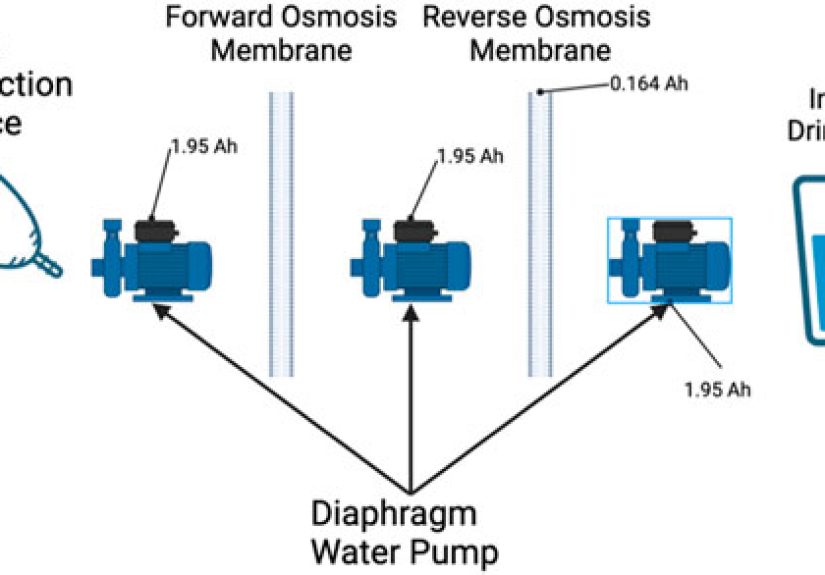
Put the two together, and you get a system with a sensible division of labor. Forward osmosis extracts water from the urine into a controlled solution. Reverse osmosis then refines that water into something suitable for drinking. The pairing is not magic. It is membrane engineering with good teamwork.
How the Proposed EVA Suit System Would Work
The proposed design starts with collection, because no filtration system can shine if the first step is sloppy. The concept uses a vacuum-assisted external catheter and collection cup integrated into an undergarment. The cup is designed differently for different anatomies, which is important because “one shape fits all” is a fantastic slogan for socks and a terrible one for spacesuit hygiene.
Moisture detection helps trigger the pumping process. Once urine is collected, it moves through antimicrobial layers and into the filtration unit. From there, the forward-osmosis and reverse-osmosis stages work in sequence to recover water, strip out unwanted materials, and route purified water back into the astronaut’s drink bag.
One of the most interesting details is that the purified water would be rebalanced with electrolytes before the astronaut drinks it. That matters because ultra-pure water alone is not ideal for a sweating, working human inside a pressure suit. A drink that supports hydration and performance is much more useful than water that is merely technically wet.
Reported design expectations suggest the system could process a typical 100 to 500 milliliter urination event in about five minutes, with recovery efficiency around the high-80% range. The hardware is also designed to fit into a relatively compact pack with a mass of roughly eight kilograms. In other words, the goal is not a giant sci-fi backpack that looks cool in a movie trailer and impossible in real life. The goal is a manageable add-on that solves a very human problem.
Why This Could Be a Big Deal for Lunar and Mars Missions
The biggest benefit is obvious: more usable water without carrying all of it from the start. Every bit of water recovered inside the suit is water that does not need to be loaded as extra consumable mass before the EVA. That is helpful in low Earth orbit, but it becomes even more important on the Moon or Mars, where logistics are harder and mission planners count resources like misers counting quarters.
There is also the comfort factor, which sounds small until you remember that astronauts are doing precision work in physically punishing conditions. Reduced urine contact time could lower hygiene risks and skin problems. Better hydration could support cognitive performance, physical endurance, and thermal regulation. Less distraction means better decision-making. Better decision-making in space is one of those things people tend to appreciate after a mission, but engineers have to plan for before it.
And then there is the strategic value. NASA already recycles water aboard the International Space Station using much larger life-support systems. So the broader idea is not radical at all. What is radical is shrinking that logic into a suit-scale system that works during EVA rather than after the crew returns. It is basically the difference between having a city water plant and carrying a tiny, smart water plant on your back.
That kind of miniaturization matters for deep-space exploration. Mars missions, for example, will reward hardware that closes loops locally and punishes systems that assume easy resupply. A suit that can reclaim part of its own hydration supply is not just convenient. It is philosophically aligned with the future of exploration.
The Engineering Challenges Are Real
This is the part where the article stops grinning at the cleverness and puts on a hard hat.
First, membrane fouling is a serious issue. Urine is not just water with bad public relations. It is chemically messy. Salts, urea, microbes, and organic material can stress membranes, reduce performance, and create maintenance headaches. A lab win is not the same as a suit-ready win.
Second, power always matters in EVA systems. Even efficient filtration is not free. Pumps, sensors, controls, and monitoring all draw energy. In a spacesuit, battery capacity is precious, and every new subsystem must justify itself.
Third, safety margins have to be excellent. Astronaut water cannot be “probably fine.” It must be reliably potable under a range of mission conditions. That means robust monitoring, redundancy, contamination control, failure handling, and testing under simulated microgravity and realistic movement conditions.
Fourth, human fit and usability are non-negotiable. A technically brilliant collection cup that is uncomfortable, leaks during movement, or works poorly across body types is not a solution. It is a very expensive way to make astronauts annoyed.
Finally, there is maintenance and operational simplicity. Space hardware succeeds when crews can trust it, understand it, and recover from minor issues without turning a moonwalk into a plumbing internship.
Would Astronauts Really Drink This Water?
Here is the psychological hurdle: many people hear “water from urine” and imagine a cartoonish straw stuck into a terrible idea. That is not what this is.
Water recycling on the ISS already proves the basic point that properly reclaimed water is just water. Once contaminants are removed and quality standards are met, the starting source matters a lot less than the final chemistry. The future suit system simply tries to do a version of that process closer to the body and closer to the moment of need.
In practice, acceptance will still matter. Taste, smell, trust in sensors, crew training, and even the addition of electrolytes all influence whether astronauts feel comfortable using the system the way engineers intend. Human factors are not a side note here. They are part of the technology.
But if the system works as designed, astronauts may view it less as “drinking recycled urine” and more as “extending my safe work time with water my suit recovered for me.” Those are very different stories, and the second one is the story that wins missions.
What This Innovation Really Represents
At a deeper level, this concept is about closing loops wherever possible. Exploration systems become more powerful when waste turns into resource, when dead mass becomes useful mass, and when the suit itself becomes smarter about supporting the person inside it.
That is why the forward-osmosis and reverse-osmosis pairing is so compelling. It is not merely a quirky headline generator. It represents the larger engineering mindset needed for sustainable human exploration: reclaim, purify, reuse, repeat. Space is not kind to wastefulness.
If this technology matures, it could mark a quiet but meaningful shift in spacesuit design. The suit would no longer be just armor plus air. It would become a more complete survival system, one that actively manages hydration, hygiene, and endurance in real time.
And frankly, that sounds like a much better future than asking astronauts to do cutting-edge science while dressed like geniuses trapped inside very expensive discomfort.
Experience-Based Scenarios: What This Could Feel Like in Real Missions
Imagine a future lunar EVA near the Moon’s south pole. Two astronauts are moving between sampling sites, climbing, kneeling, drilling, and documenting terrain in extreme lighting conditions. In older suit logic, hydration is a countdown clock. Every sip comes from a fixed bag, and every bodily need is something to manage, postpone, or quietly suffer through. With an in-suit FO-RO recovery system, the experience changes. The astronaut does not become magically carefree, but the mission shifts from resource depletion toward resource recovery. That psychological change alone matters. Instead of thinking, “I am running down my water,” the astronaut can think, “My suit is helping me stay in balance.”
Now picture the same system during training on Earth. Engineers watch for leaks, monitor pump timing, evaluate motion during crouching and ladder movement, and ask test subjects brutally honest questions no glamorous press conference ever includes. Does the cup chafe? Does the vacuum engage fast enough? Is the taste of the re-mineralized water acceptable after hard exertion? This is where futuristic concepts earn their paycheck. Not in dramatic renderings, but in awkward, useful feedback from people sweating through simulations.
There is also a medical and hygiene angle that deserves more attention. Long suit wear is not just annoying; it can create skin issues, discomfort, distraction, and secondary health concerns. A system that reduces prolonged contact with urine may improve crew wellbeing in ways that never make the movie version of a mission but absolutely matter in operations. Astronauts do not need a heroic suffering contest. They need hardware that respects the fact that the human body comes along on every mission whether mission planners like it or not.
Mission control would experience the change differently. Flight surgeons, suit engineers, and planners would see a more resilient EVA profile. Hydration margins might improve. Consumables planning could become more flexible. Longer excursions could feel a little less punishing. That does not mean teams suddenly get reckless with timelines. It means they gain breathing room, and breathing room in space operations is almost always worth gold.
Even from the astronaut’s perspective, the emotional effect could be surprisingly large. Spacewalks already involve enough complexity without adding silent misery to the checklist. A suit that quietly collects, purifies, replenishes electrolytes, and returns drinkable water to the user is doing more than filtration. It is restoring dignity, confidence, and concentration. That may sound soft compared with engineering metrics, but it is not soft at all. It is performance design. The best space hardware does not just keep people alive. It helps them work well, think clearly, and stay comfortable enough to do extraordinary things without being sabotaged by utterly ordinary biology.
Conclusion
Using forward and reverse osmosis to let astronaut EVA suits produce fresh water from urine is one of those ideas that sounds funny for about five seconds and smart for everything after that. It attacks three problems at once: limited hydration, uncomfortable waste management, and inefficient resource use. That alone makes it worth serious attention.
The concept is not fully mission-ready yet, and it still needs extensive testing, refinement, and validation. But the direction is exactly right. Future exploration will depend on systems that recycle more, waste less, and treat the spacesuit as an active life-support platform rather than a passive shell.
If humanity wants longer EVAs, tougher missions, and more capable astronauts on the Moon and beyond, then turning waste into water is not gross. It is good engineering. Space may be unforgiving, but at least the next generation of suits might finally stop making astronauts choose between hydration and dignity.





 Close
Close