
Table of Contents >> Show >> Hide
- What Is a Time Lapse of the Sun?
- Why the Sun Looks So Alive in Time-Lapse Videos
- NASA’s Solar Time Lapses: Turning Data Into Awe
- Types of Sun Time Lapse You Can Create
- How to Make a Better Time Lapse of the Sun
- What Time-Lapse Videos Teach Us About the Sun
- Creative Ideas for a Sun Time-Lapse Project
- Common Mistakes to Avoid
- Experience Notes: What It Feels Like to Capture a Time Lapse of the Sun
- Conclusion
A time lapse of the Sun can make our nearest star look like a living, breathing creaturerolling, glowing, flaring, and tossing loops of plasma into space like it has a very dramatic personality. In real time, the Sun often seems calm. It rises, it sets, it politely ruins your phone screen visibility at noon. But speed up hours, days, months, or even years, and the Sun becomes one of the most fascinating moving subjects in the solar system.
Whether you are watching a NASA solar time-lapse video, photographing a sunrise from your backyard, or trying to understand why sunspots crawl across the solar disk, time-lapse imagery reveals what ordinary eyesight misses. It turns slow motion into story. It compresses change, makes patterns visible, and reminds us that the “same old Sun” is not the same from one day to the next.
What Is a Time Lapse of the Sun?
A time lapse of the Sun is a sequence of images taken at regular intervals and played back as a video. Instead of watching the Sun move across the sky over twelve hours, you might see that daily journey in twelve seconds. Instead of waiting eleven years to observe a full solar cycle, you can watch sunspot activity rise and fall during a single lunch breakpreferably not while spilling soup on your keyboard.
The basic idea is simple: take many photos, space them out over time, and combine them into a video. The magic comes from choosing the right interval. A sunrise time lapse might use one photo every few seconds. A year-long solargraph can record the Sun’s changing path across the sky over seasons. A spacecraft observing the Sun can collect images constantly, turning invisible ultraviolet activity into breathtaking visual science.
Why the Sun Looks So Alive in Time-Lapse Videos
The Sun is not a solid ball of fire. It is a massive sphere of hot plasma, shaped by gravity, magnetism, rotation, and constant energy release. Its visible surface, called the photosphere, is the layer we usually think of as the “surface” of the Sun. Above it are the chromosphere, transition region, and corona, where magnetic activity creates some of the most dramatic solar scenes.
In time lapse, sunspots appear to drift across the solar disk because the Sun rotates. Unlike Earth, the Sun does not rotate as one solid object. Its equator rotates faster than its polar regions, a behavior known as differential rotation. This is one reason solar features can stretch, twist, and evolve in complex ways over time.
Sunspots: The Freckles With Attitude
Sunspots are darker-looking regions on the photosphere caused by intense magnetic activity. They look dark because they are cooler than surrounding areas, although “cooler” on the Sun is still not exactly sweater weather. Sunspots often appear in groups, and their number changes with the roughly 11-year solar cycle.
During solar minimum, the Sun may look relatively blank and quiet. During solar maximum, sunspots become more common, and solar flares and coronal mass ejections are more likely. In a long-term time lapse, these changes create a powerful visual rhythm: quiet years, busy years, then quiet again.
Solar Flares and Coronal Mass Ejections
Solar flares are sudden bursts of energy from the Sun’s atmosphere. Coronal mass ejections, often shortened to CMEs, are huge expulsions of plasma and magnetic field from the corona. When these eruptions are aimed toward Earth, they can contribute to geomagnetic storms, affect radio communication, and create beautiful auroras.
In a solar time-lapse video, these events can look like flashes, arcs, loops, or waves racing away from the Sun. They are visually stunning, but they are also scientifically important because they help researchers study space weather and better understand how the Sun affects Earth.
NASA’s Solar Time Lapses: Turning Data Into Awe
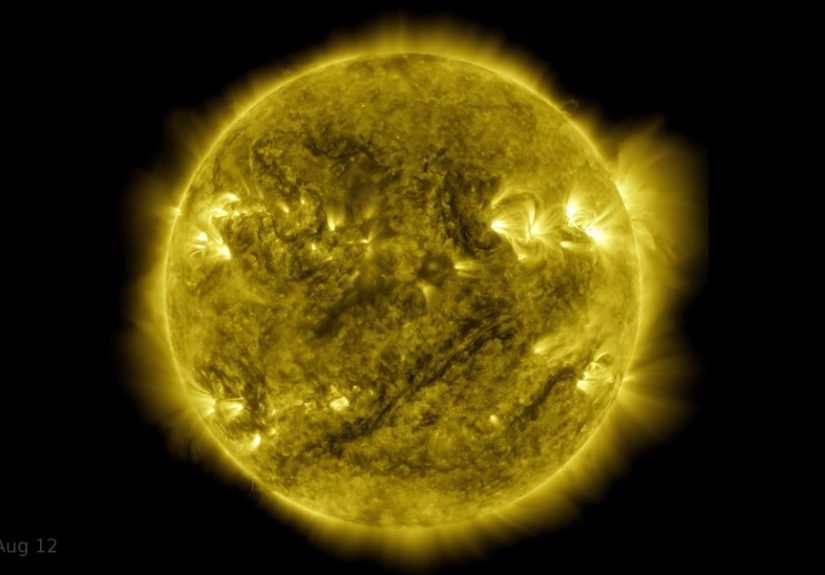
NASA’s Solar Dynamics Observatory, commonly called SDO, has become one of the most important sources of modern solar time-lapse imagery. Launched in 2010, SDO watches the Sun continuously and captures it in multiple wavelengths of light. Different wavelengths reveal different solar features, such as the corona, active regions, and hot magnetic loops.
One of the most famous examples is NASA’s “A Decade of Sun,” a 10-year time lapse created from SDO imagery. It used one image per hour to condense ten years of solar activity into about an hour. The result is more than just a pretty space video. It shows the rise and fall of the solar cycle, sunspots rotating into view, eruptions bursting from the corona, and even occasional planetary transits.
This kind of time lapse works because spacecraft can observe the Sun in ways humans cannot. Extreme ultraviolet imagery, for example, lets scientists see hot solar material in the corona. To our eyes, the Sun is a bright disk. To SDO, it is a layered, magnetic, constantly changing system.
Types of Sun Time Lapse You Can Create
Not every Sun time lapse requires a spacecraft, a mission control room, or a coffee mug labeled “Actually, I am a heliophysicist.” Many beautiful solar time-lapse projects can be made from Earth with a camera, smartphone, tripod, and a little patience.
1. Sunrise Time Lapse
A sunrise time lapse captures the transition from darkness to daylight. The best scenes often include foreground elements such as trees, buildings, mountains, water, or clouds. Clouds are especially helpful because they show motion and give the sky texture. Without clouds, a sunrise time lapse can still be beautiful, but with clouds, the sky becomes a full cast of supporting actors.
2. Sunset Time Lapse
Sunset time lapses are popular because the light changes quickly and dramatically. The color shift from gold to orange to pink to blue can make even an ordinary street corner look like it is auditioning for a movie poster. A steady tripod is essential, because the tiniest camera shake becomes painfully obvious when hundreds of frames are stitched together.
3. Solar Path Time Lapse
A solar path time lapse shows the Sun moving across the sky during the day. This can be done safely by pointing the camera at the landscape rather than directly at the Sun, especially during wide-angle scenes where the Sun is part of the sky rather than the main magnified subject. Over a full day, you can see shadows stretch, shrink, and swing like clock hands.
4. Analemma and Solargraphy Projects
An analemma is the figure-eight pattern the Sun appears to trace in the sky when photographed from the same location at the same clock time over a year. Solargraphy uses long exposure methods, often with a pinhole camera, to record the Sun’s path over weeks or months. These projects are slow, poetic, and slightly absurd in the best way. They are photography for people who can wait longer than a loading screen.
How to Make a Better Time Lapse of the Sun
The difference between a shaky collection of bright frames and a smooth solar time lapse often comes down to planning. Choose a strong location, check the weather, frame your shot carefully, and decide what story you want the Sun to tell. Are you showing sunrise over a city skyline? Shadows crossing a room? A golden sunset behind ocean waves? The Sun is the star, but the scene gives it context.
Use a Stable Setup
A tripod is your best friend. A wobbly camera turns a peaceful sunrise into a tiny earthquake documentary. Lock your framing, avoid touching the camera during capture, and make sure wind cannot move your gear. If you are using a phone, a small tripod or clamp can make a huge difference.
Choose the Right Interval
For sunrise or sunset, an interval of 2 to 10 seconds often works well, depending on how fast the light is changing and how long you want the final video to be. For slow-moving shadows or a full day of sunlight, longer intervals may be better. The more frames you capture, the smoother the finished video can look.
Control Exposure
Automatic exposure can cause flickering because the camera keeps adjusting brightness from frame to frame. If possible, use manual exposure or lock exposure on your phone. This helps the light change naturally instead of jumping around like the camera is nervous.
Protect Your Eyes and Equipment
Never look directly at the Sun through a camera, binoculars, telescope, or optical viewfinder without proper solar filtering. Regular sunglasses are not safe for direct solar viewing. For direct solar observation, use certified solar viewers or proper solar filters designed for the equipment. Safety is not the place to improvise. The Sun is wonderful, but it is also a nuclear furnace with no customer service department.
What Time-Lapse Videos Teach Us About the Sun
A good time lapse does more than look cool. It helps us understand motion, scale, and change. When we watch solar features evolve, we see that the Sun is dynamic. Magnetic loops rise and collapse. Active regions rotate into view. The corona changes shape. Sunspots form, split, fade, and reappear.
Time-lapse imagery also helps explain why scientists monitor the Sun so closely. Solar activity can influence satellites, GPS systems, radio communication, power grids, and astronauts in space. While most solar events do not create major problems on Earth, strong space weather can matter. That is why organizations such as NASA and NOAA track solar activity and issue space weather updates.
Creative Ideas for a Sun Time-Lapse Project
If you want a project that feels more original than “camera points at bright thing,” try adding a human-scale story. Record the Sun rising over a bedroom wall as light slowly fills the room. Capture the shadow of a plant moving across a desk. Film a city waking up as sunlight spills between buildings. Show a beach umbrella shadow crawling across the sand. These small details make a solar time lapse feel personal.
You can also create seasonal comparisons. Shoot the same location at sunrise in spring, summer, fall, and winter. The changing angle of sunlight will show how Earth’s tilt affects the Sun’s apparent path. A simple backyard can become a miniature observatory if you return to it with curiosity.
Common Mistakes to Avoid
The first mistake is ignoring safety. Direct solar viewing requires proper protection, especially with lenses or magnification. The second mistake is forgetting the battery. Time lapse can drain devices quickly, so start fully charged and bring a power bank if needed. The third mistake is poor storage planning. Hundreds or thousands of photos can fill memory faster than expected.
Another common issue is boring framing. The Sun alone can be interesting in scientific imagery, but for everyday photography, foreground elements usually make the video stronger. Clouds, silhouettes, reflections, architecture, trees, and moving shadows all help viewers feel the passage of time.
Experience Notes: What It Feels Like to Capture a Time Lapse of the Sun
Making a time lapse of the Sun is one of those experiences that sounds simple until you actually do it. You think, “I’ll just set up the camera and let nature handle the rest.” Then the wind arrives. A bird lands exactly where you do not want it. A cloud parks itself in front of the Sun like it has paid rent. Your battery percentage drops with the emotional timing of a horror movie. Suddenly, you are not just recording the Sunyou are negotiating with the universe.
The best experience usually starts before the Sun appears. For a sunrise time lapse, arriving early matters. The sky begins changing long before the bright disk crosses the horizon. There is a quiet blue period, then a pale glow, then the first warm colors. If you wait until the Sun is already visible, you miss the slow reveal. The drama is not only the entrance; it is the entire stage lighting up.
One memorable setup is a simple window time lapse. Place a camera or phone where morning light falls across a wall, floor, or table. Instead of pointing directly at the Sun, record what sunlight does. Watch a rectangle of light slide across the room. Watch dust sparkle. Watch shadows from leaves tremble and shift. It is ordinary, but when compressed into seconds, it feels like time itself has become visible.
Outdoor shoots have their own personality. A sunset beside water can be spectacular because the reflection doubles the color. A city skyline adds structure, turning the Sun into a glowing background performer. A mountain scene gives the Sun a grand entrance or exit. Even a parking lot can become cinematic if clouds, shadows, and warm light cooperate. The secret is not always finding the perfect place; it is noticing what the light is already doing.
Patience is the real skill. During capture, nothing much seems to happen. You stand there, checking the camera, pretending not to worry about exposure, and wondering whether the final video will be amazing or merely a folder full of disappointment. Then you play it back, and suddenly the sky blooms, shadows race, clouds swirl, and the Sun glides through the frame. That is the reward: time becomes visible, and the familiar becomes surprising.
A time lapse of the Sun also changes how you look at daylight afterward. You start noticing where shadows fall at breakfast, how golden hour moves through your neighborhood, how clouds can turn a plain sky into a moving painting. The project may begin as a video, but it ends as a habit of attention. The Sun has been performing every day; time lapse simply teaches you how to watch the show.
Conclusion
A time lapse of the Sun is both art and science. It can be a simple sunrise video made with a phone, a year-long record of the Sun’s changing path, or a spacecraft-powered view of solar storms in extreme ultraviolet light. At every level, the idea is the same: compress time, reveal motion, and let the Sun show its personality.
The Sun may look steady from day to day, but time-lapse imagery proves otherwise. It rotates, flickers, erupts, brightens, darkens, and follows long cycles of activity. For photographers, it is a source of endless visual drama. For scientists, it is a key to understanding space weather and the star that powers life on Earth. For the rest of us, it is a reminder that even the most familiar view in the sky still has secrets worth watching.







 Close
Close