
Table of Contents >> Show >> Hide
- Welcome to Doom Town: The Atomic Suburb in the Desert
- Inside the Atomic Neighborhood: Mannequins, Groceries, and Bomb Shelters
- Big Bang in the Burbs: Operation Doorstep, Operation Cue, and Apple-2
- Testing, Television, and Cold War Spin
- The Fallout: Real People, Real Consequences
- From Fake Neighborhood to Cautionary Tale
- What It’s Like to Stand Where a Fake Neighborhood Met a Real Bomb
- Conclusion: A Town Built to Die, and a World Still Living With the Consequences
If you’ve ever watched a disaster movie and thought, “There’s no way they blew up a whole town just to see what happens,” the U.S. government has some news for you. During the Cold War, officials literally built fake neighborhoods in the Nevada desert, filled them with furniture, food, cars, and mannequin families, and then parked nuclear weapons next door to see who – or what – would survive.
These eerie model suburbs earned names like “Doom Town” and “Survival Town.” On black-and-white newsreels, they looked like any other 1950s subdivision: neat streets, tidy lawns, and cheerful pastel kitchens. The only difference was that minutes later, a blinding flash and a shock wave traveling faster than any SUV on the interstate would turn those dream homes into kindling.
This is the strange, very real story of how the U.S. government created a fake neighborhood to test out nuclear weapons, what they learned from blowing it up, and why the fallout – literal and political – still matters.
Welcome to Doom Town: The Atomic Suburb in the Desert
Why Nevada, and Why a Neighborhood?
By the early 1950s, the United States had gone from inventing the atomic bomb to stockpiling ever more powerful weapons. The government needed a domestic testing ground that was remote, controlled, and (from their perspective) expendable. Enter the Nevada Test Site, about 65 miles northwest of Las Vegas, where more than 900 nuclear tests would eventually be conducted between 1951 and the early 1990s.
Officials weren’t just interested in how bombs behaved in a vacuum. They wanted to know how a nuclear blast would affect the world Americans actually lived in: houses, power lines, cars, canned soup, clothing, and, most importantly, people. Instead of using real communities (thankfully), federal civil defense planners decided to build their own.
The result was a series of purpose-built “atomic suburbs” in Frenchman Flat and Yucca Flat, complete with small streets, wood-frame houses, brick structures, trailers, and utility lines. To make the tests more realistic, the neighborhoods were fully furnished and wired for electricity, radio, and even television.
Building the Perfect 1950s Test Suburb
If you walked through one of these towns the night before a test, you’d see a strangely idealized slice of mid-century life. Kitchens were stocked with canned goods and boxed mixes. Living rooms held radios, couches, and patterned curtains. Closets contained suits, dresses, and children’s clothing in different fabrics, carefully chosen to see which materials burned or melted fastest.
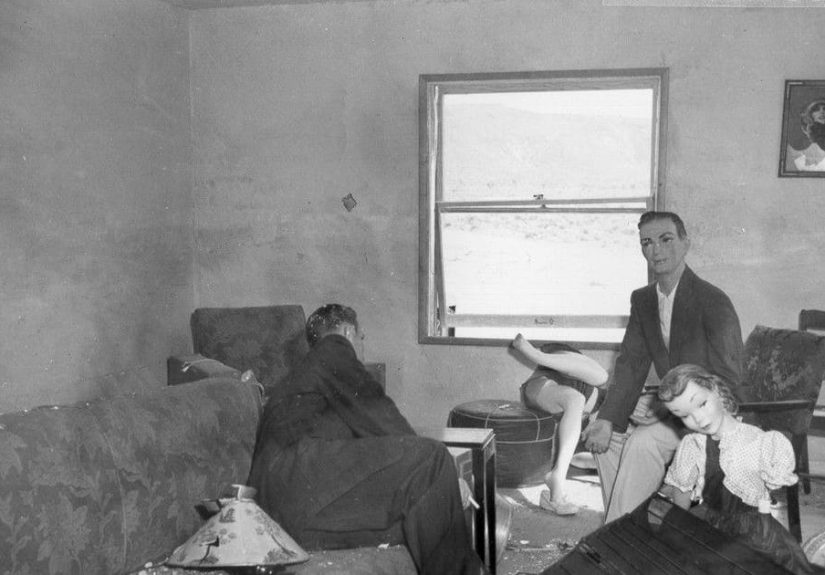
The star residents were mannequins: eerily lifelike “nuclear families” posed around dinner tables, sitting in armchairs, or tucking children into bed. Outside, more mannequins stood in yards, sat in cars, or lounged on lawn chairs to test how exposure varied at different distances from the blast.
It was part science experiment, part advertising reel for the American Dream. The same cozy suburb being sold in magazine ads and TV commercials was also being used as a disposable test subject for atomic weapons.
Inside the Atomic Neighborhood: Mannequins, Groceries, and Bomb Shelters
Meet the “Families” of Doom Town
The mannequin families weren’t just randomly dressed. Civil defense planners worked with clothing manufacturers and department stores to outfit them in specific fabrics and colors. By studying burns, rips, and blast damage, the government hoped to offer advice like “cotton fares better than rayon at this distance” or “dark colors absorb more heat.” It sounds like a twisted version of a fashion guide, but the stakes were deadly serious.
After each test, inspectors combed through the ruins, documenting how mannequins fared in basements, on sofas, behind windows, or in open yards. Photographs from these inspections – mannequins scorched, twisted, or blasted across rooms – became some of the most haunting images of the nuclear age.
Houses, Cars, and Backyard Shelters
The houses in these fake neighborhoods weren’t all the same. Engineers built different construction types – wood-frame, brick, concrete-block – and placed them at varying distances from ground zero. The idea was to see which materials and designs withstood blast pressure, thermal radiation, and flying debris a little better than others.
Cars were parked along streets and in driveways, their windows rolled up or down to test shattering patterns. In some tests, underground or backyard bomb shelters were added behind the houses, stocked with supplies, to see whether “average families” could realistically survive if they made it inside in time.
From today’s perspective, it can feel surreal that planners were trying to engineer surviving suburbs in the shadow of weapons designed to annihilate cities. But to Cold War civil defense officials, anything that promised a few more survivors – and a little more public confidence – was worth studying.
Big Bang in the Burbs: Operation Doorstep, Operation Cue, and Apple-2
The 1953 “Doorstep” Test
One of the most famous early experiments was Operation Doorstep in 1953, part of the Upshot-Knothole test series. A 16-kiloton device – roughly the size of the bomb dropped on Hiroshima – was detonated near houses, cars, mannequins, and backyard shelters. Observers watched from a safe distance (and “safe” is being generous by today’s standards) as a bright flash turned night into day and a shock wave rolled across the model suburb.
In the aftermath, some houses were flattened, others gutted by fire, and a few remained standing but badly scarred. Mannequins close to the blast were charred or shredded. Those farther away survived with singed clothing and glass injuries – the kind of outcomes civil defense planners would later use in films and pamphlets to argue that survival was possible if you were far enough from ground zero and took cover quickly.
Operation Cue and the Apple-2 Shot
The atomic suburb reached peak spectacle with Operation Cue in 1955, which included the Apple-2 shot, a roughly 29-kiloton detonation. Again, a carefully arranged town – sometimes called Survival Town – was built in the desert, complete with nineteen structures, mannequin families, and stocked pantries.
Reporters, civil defense officials, and VIPs were invited to witness the test. Cameras rolled as the bomb detonated. A blistering flash ignited window curtains and siding; then the blast wave ripped roofs from walls, snapped power poles, and hurled debris through living rooms. Some more distant houses remained technically “standing,” though any real family would have been in shock – and probably the emergency room.
After the test, inspectors wandered through the ruins, filming and photographing dryly labeled scenes like “Living Room, 7,500 Feet From Ground Zero.” In one house, a mannequin mother sat upright but scorched; in another, a child mannequin lay amid shattered glass, a chilling stand-in for a real child who might have been nearby in an actual attack.
Testing, Television, and Cold War Spin
When Nuclear Tests Became a Media Event
It might sound unthinkable now, but some of these tests were treated as must-see TV. Newsreels and civil defense films showed the model houses exploding in grainy slow motion, followed by matter-of-fact narration explaining which walls held up and why you should keep your basement stocked “just in case.”
For Americans watching at home, the message was mixed. On one hand, the footage emphasized the terrifying power of nuclear weapons. On the other, it tried to sell a comforting idea: that smart building choices, duck-and-cover drills, and well-designed shelters could give you a fighting chance.
Critics later argued that this kind of coverage bordered on propaganda, downplaying the long-term health effects of radiation and the sheer scale of destruction modern nuclear war would cause. But at the time, “Doom Town” footage became part of the cultural wallpaper of the Cold War, appearing in classrooms, news programs, and even Hollywood productions.
From Science to Symbol
The fake neighborhoods quickly took on symbolic weight far beyond their original technical purpose. To some, they represented scientific ingenuity and a hard-headed effort to understand the unthinkable. To others, they embodied the dark absurdity of the era: a government blowing up perfect little suburbs while assuring citizens everything was under control.
Over the decades, images of scorched mannequins and collapsing houses have appeared in documentaries, art projects, and academic studies. They’ve been referenced in films (including a certain archaeologist’s unfortunate fridge-jumping scene) and used as visual shorthand for Cold War anxiety and nuclear hubris.
The Fallout: Real People, Real Consequences
Downwinders and Lingering Radiation
While the mannequin families were created for sacrifice, the real tragedy played out beyond the test site’s boundaries. Radioactive fallout from atmospheric detonations drifted over parts of Nevada, Utah, and other downwind communities. Residents recalled “snow” that wasn’t snow, contaminated milk, and dust that glowed faintly under Geiger counters.
In the decades that followed, scientists and health officials documented elevated rates of certain cancers and other illnesses in some downwind populations and even among test participants, leading to compensation programs and long-running debates about how much the government knew – and when.
So while Doom Town itself was uninhabited, the larger experiment was not victim-free. The fake neighborhood absorbed the blast, but real families bore the long-term costs.
A Landscape of Ghosts
Today, many of the original houses are gone, but a few damaged structures and test artifacts still stand on the Nevada National Security Site. On rare, tightly controlled tours, visitors can see warped buildings, leftover shelters, and the scarred desert where blasts once turned sand into glass.
The scene is strangely calm now – blue sky, dry air, and the skeleton of a house that once rode out a 29-kiloton shock wave. It’s a powerful reminder that beneath the abstractions of “deterrence” and “strategy,” nuclear tests had real, physical impacts on landscapes and lives.
From Fake Neighborhood to Cautionary Tale
Looking back, the fake nuclear neighborhoods in Nevada might be the most literal metaphor for the Cold War: a carefully staged normal life, framed by picket fences and consumer goods, with annihilation quietly wired into the foundation.
On one level, the tests produced useful data about building codes, shelter designs, and emergency planning. On another, they helped normalize the idea that nuclear war was survivable, even manageable, as long as you took the right precautions – an assumption many scientists and activists strongly questioned then and now.
Today, Doom Town and Survival Town live on as cautionary tales. They remind us that technology doesn’t exist in a vacuum; it’s built into homes, cities, and everyday routines. And while we’ve thankfully paused atmospheric testing, the weapons that made those towns necessary still exist, quietly demanding our attention.
What It’s Like to Stand Where a Fake Neighborhood Met a Real Bomb
So what does all of this feel like up close? Imagine you’re on a sanctioned tour of the Nevada National Security Site. The bus hums along a dusty road, and your guide’s voice floats over the intercom, describing megatons and kilotons as if they’re weather reports. You step out into the bright desert light, and there it is: a test house.
At first glance, it looks almost ordinary – like a slightly beat-up farm building you’d see on a back road anywhere in the American West. But the details give it away. The windows are warped, frames twisted from blast pressure. The siding doesn’t line up quite right. A brick chimney leans at an angle that would make any building inspector break out in a cold sweat.
Your guide explains that this particular house once stood several thousand feet from ground zero during a 1955 test. Instruments inside recorded pressure, heat, and structural movement as the shock wave hit. The entire foundation shifted, yet the building remained standing – barely. Engineers studied every crack and splinter to refine their understanding of how nuclear blasts move through real-world structures.
Inside, the emptiness is loud. The furniture is gone now, but photos on display show what it looked like: floral curtains, a formica table, a couch where a mannequin family once “watched” TV. In one image, a mannequin woman sits in a chair, her dress scorched, her face oddly intact. In another, a child mannequin lies in a bed sprayed with shattered glass. These aren’t movie props; they’re artifacts from a government-run experiment on what would happen to families like yours.
Later, you might visit the National Atomic Testing Museum in Las Vegas, where mannequins from Doom Town and Survival Town are preserved behind glass. Up close, they’re more unsettling than any horror-movie monster. Their frozen smiles clash with the singed clothing and missing limbs. It’s hard not to imagine real people in their place – parents trying to protect kids, neighbors checking on each other, all facing a flash brighter than the sun.
The emotional whiplash is real. Part of you is fascinated by the engineering: the precision of the blast measurements, the creativity of shelter designs, the way modern building codes quietly incorporate lessons learned from these tests. Another part of you is unsettled by how calmly the whole operation was presented – as if vaporizing a neighborhood, even a fake one, was just another day at the office.
That’s the lasting lesson many visitors describe: perspective. Standing where a “practice” suburb was built to die, you suddenly feel the distance between Cold War abstractions and human reality shrink. Terms like “deterrence” and “second-strike capability” begin to sound different when you’re staring at a doorframe that bent under a nuclear shock wave.
And yet, there’s also a strange sense of responsibility. Doom Town is gone, but the decisions that created it aren’t just history; they’re part of an ongoing conversation about how nations wield power, manage risk, and weigh human lives against national security. The fake neighborhood in the desert may have been built for a single terrible moment, but the questions it raises are still very much alive.
As you head back toward Las Vegas, past neon lights and busy freeways, it’s hard not to think about how fragile our everyday routines really are. Somewhere under all the convenience and comfort, the story of that fake neighborhood quietly reminds us: technology is only as wise as the people who use it.
Conclusion: A Town Built to Die, and a World Still Living With the Consequences
The U.S. government’s decision to create a fake neighborhood to test out nuclear weapons produced some of the most iconic – and unsettling – images of the atomic age. On the surface, Doom Town and Survival Town were scientific experiments designed to save lives by improving building standards and civil defense planning. But they also helped sell the idea that nuclear war could be analyzed, managed, and maybe even survived.
Decades later, the mannequin families are in museums, the test houses are crumbling, and atmospheric nuclear testing is banned. Yet the weapons that leveled those model suburbs still exist in arsenals around the world. The story of the fake neighborhood in the Nevada desert isn’t just a quirky historical footnote; it’s a reminder that the choices we make about technology, safety, and security echo far beyond the test site fence.
If there’s one takeaway from Doom Town, it’s this: when you build an entire neighborhood just to blow it up, you’d better learn something profound – and never forget what it cost to find out.





 Close
Close