
Table of Contents >> Show >> Hide
- Why Soup Terms Get So Confusing
- Broth vs. Stock: The Most Important Difference
- Bisque: The Smooth Operator
- Chowder: Hearty, Chunky, and Proud of It
- Consommé: Clear, Concentrated, and Slightly Show-Offy
- Cream Soups, Puree Soups, Bouillon, and Gazpacho
- So Which One Should You Use?
- Common Mistakes People Make With Soup Types
- Final Thoughts
- Kitchen Experience Notes: What These Soup Types Feel Like in Real Life
If soup had a family reunion, it would be chaos. Broth would show up in a sensible sweater. Stock would quietly judge everyone’s texture. Bisque would arrive overdressed and fabulous. Chowder would bring potatoes and a lot of opinions. And consommé? Consommé would stand in the corner looking crystal-clear and slightly superior.
That is exactly why so many home cooks get tripped up by soup terminology. Menus, cookbooks, and grocery cartons often use these words loosely, but they do not all mean the same thing. Understanding the differences between bisque, broth, stock, and other soup types can make you a better cook, a smarter shopper, and a lot less likely to dump the wrong liquid into dinner and wonder why it tastes like disappointment.
Here is the practical guide: what each soup type actually is, how it is traditionally made, how modern cooking bends the rules, and when each one makes the most sense in your kitchen.
Why Soup Terms Get So Confusing
The confusion starts because culinary tradition and modern usage are not always on speaking terms. In classical cooking, soup categories were more precise. Clear soups, thick soups, bisques, chowders, and consommés each had their own methods and identities. In everyday American cooking, though, the lines have softened. A carton labeled “stock” may behave like broth. A tomato bisque may not contain shellfish. A chowder may be creamy, tomato-based, or brothy depending on where you are and who is stirring the pot.
So the smartest way to think about soup is not as a set of rigid labels, but as a spectrum of texture, richness, ingredients, and purpose. Some soups are designed to be sipped. Some are built to support sauces and braises. Some are silky and pureed. Others are chunky enough to qualify as dinner with a spoon.
Broth vs. Stock: The Most Important Difference
Let’s start with the pair that causes the most kitchen arguments: broth and stock. People use the terms interchangeably all the time, and to be fair, they are close cousins. But if you want the cleanest distinction, stock is generally bone-driven, while broth is generally meat-driven.
What Is Stock?
Stock is usually made by simmering bones with aromatics such as onions, carrots, celery, herbs, and sometimes tomato paste or acid. The long simmer pulls collagen and gelatin from the bones, which gives stock body, viscosity, and that lovely “this feels expensive” texture. Good stock often has a richer mouthfeel than broth, and when chilled, it may jiggle like culinary confidence.
Because stock is prized for structure as much as flavor, it is often used as a foundation. It gives sauces more silkiness, risotto more depth, braises more backbone, and soups more substance. If broth is ready for the spotlight, stock is backstage running the entire production.
What Is Broth?
Broth is usually lighter and more directly savory. It is often made from meat, sometimes with bones, plus vegetables and seasonings. Since it tends to have a cleaner, more immediately pleasant flavor, broth is more likely to be served on its own or used in dishes where you want the liquid to taste good right out of the gate.
Chicken broth is the classic example. It is familiar, flexible, and comforting in a way that feels like someone has handed your nervous system a blanket. Because broth is often seasoned more assertively than stock, it is also common in soups meant to be eaten as is.
Where Bone Broth Fits In
Bone broth is where the grocery aisle starts playing semantic dodgeball. In many cases, bone broth is functionally closer to a long-simmered stock because it relies heavily on bones and collagen extraction. The big difference is usually positioning: bone broth is often seasoned and marketed as a drinkable product rather than just a cooking ingredient.
So yes, bone broth exists, but in practical cooking terms, it often behaves like a stock that got a wellness rebrand and a better publicist.
Bisque: The Smooth Operator
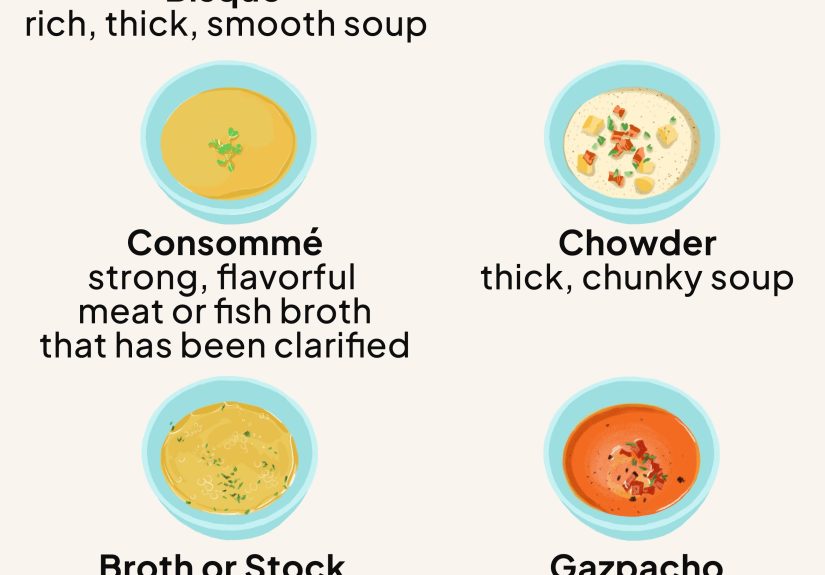
Bisque is one of the easiest soup types to recognize because texture is the whole point. A bisque is rich, smooth, thick, and usually pureed or strained to achieve a velvety finish. Traditionally, bisque is associated with shellfish such as lobster, crab, shrimp, or crayfish. Classical versions often used shells to build flavor and relied on rice or another thickener before being strained into something luxuriously silky.
Modern American cooking has relaxed those rules. Today, you will see tomato bisque, squash bisque, corn bisque, and all sorts of plant-forward versions. Purists may raise an eyebrow at a “bisque” with no shellfish, but in everyday usage the term now signals a soup that is creamy, smooth, and elegant rather than chunky or brothy.
That is why bisque feels different from regular soup. It is not just about ingredients. It is about finish. Bisque should feel refined, almost polished, like the soup went to finishing school and came back with better posture.
Chowder: Hearty, Chunky, and Proud of It
If bisque is silk pajamas, chowder is a wool fisherman’s sweater. Chowder is thick, hearty, and usually chunky. It commonly includes potatoes, onions, and seafood, though corn, chicken, bacon, and other ingredients are fair game. The essential idea is substance. A chowder should feel robust, not delicate.
The classic American example is New England clam chowder, with clams, potatoes, onions, and a creamy base. But chowder has regional variations that prove soup can absolutely start a family feud.
New England, Manhattan, and Rhode Island Chowder
New England clam chowder is the one most Americans picture first: creamy, pale, rich, and full of clams and potatoes. Manhattan clam chowder swaps the cream for a tomato-based broth, which immediately starts debates in certain zip codes. Rhode Island clam chowder goes with a clear broth, giving the clam flavor more room to shine.
That means chowder is not defined by one ingredient alone. It is defined by heartiness and texture. In most traditional versions, chowder should have body and visible ingredients. If you can drink it through a straw, something has gone terribly, terribly off-script.
Consommé: Clear, Concentrated, and Slightly Show-Offy
Consommé is the fancy one. It is a clarified stock or broth that has been refined to remove impurities, resulting in a crystal-clear liquid with concentrated flavor. The clarification process often uses egg whites to create a “raft” that traps particles as the liquid simmers.
The result is not just clear soup. It is deeply flavored clear soup. That is an important difference. Consommé is prized for both its clarity and its intensity. It is often served with a minimal garnish because the whole point is to let the liquid do the talking.
Think of consommé as the culinary equivalent of a white shirt that somehow survives spaghetti night. Getting it right takes skill, patience, and a refusal to stir when every instinct says, “Maybe just one little stir.”
Cream Soups, Puree Soups, Bouillon, and Gazpacho
Beyond the big names, several other soup types deserve a spot in the lineup.
Cream Soups
Cream soups are thick soups enriched with dairy. Many are built from vegetables cooked in liquid, then thickened with starch and finished with cream, milk, or butter. Cream of mushroom and cream of celery are classic examples. Not every creamy soup is a bisque. A cream soup can be rich without aiming for that ultra-refined, bisque-like smoothness.
Puree Soups
Puree soups rely on the texture of blended ingredients, often starchy vegetables or legumes. Think split pea soup, black bean soup, or pureed butternut squash soup. These can be smooth and satisfying without being heavy on dairy. In other words, a puree soup is thick because of the ingredients themselves, not because someone threw a quart of cream at the problem.
Bouillon
Bouillon usually refers to a clear broth or, in many modern kitchens, the dehydrated cubes, powders, or granules used to create an instant broth-like liquid. It is convenient, useful, and often quite salty. Bouillon is the emergency contact of the soup world: not always glamorous, but very available when needed.
Gazpacho
Gazpacho is a chilled soup, traditionally made with raw vegetables such as tomatoes, peppers, cucumbers, and onions. It proves that soup does not need to be hot, creamy, or winter-approved to count. Gazpacho is bright, refreshing, and the answer to the question, “Can soup also be air-conditioning?”
So Which One Should You Use?
The best choice depends on what the dish needs.
- Use stock when you want body, richness, and a strong cooking foundation for sauces, braises, gravies, and full-flavored soups.
- Use broth when you want a lighter, more directly seasoned liquid that can be sipped or used in quick soups, grains, and simple cooking.
- Choose bisque when the goal is a smooth, luxurious soup with a creamy finish.
- Choose chowder when you want a hearty bowl with chunks, texture, and enough substance to qualify as a meal.
- Choose consommé when elegance, clarity, and concentrated flavor matter more than volume or heft.
Common Mistakes People Make With Soup Types
One common mistake is assuming every carton labeled “stock” will act differently from every carton labeled “broth.” In reality, commercial products often overlap. Sodium level, ingredient list, and flavor matter more than the front label. If you are reducing a liquid in cooking, low-sodium or unsalted options are usually safer.
Another mistake is using “bisque” to mean any creamy soup. A creamy soup can be a cream soup, a puree soup, or a bisque depending on its method and texture. Similarly, not every seafood soup is a chowder, and not every clear soup is consommé. If it has not been clarified, it is just a clear soup with excellent manners.
And then there is the final trap: underestimating texture. In soup, texture is not a side note. It is identity. Smooth, chunky, brothy, gelatinous, velvety, creamy, rustic, and crystal-clear are not just adjectives. They are clues.
Final Thoughts
The differences between bisque, broth, stock, and other soup types come down to four things: ingredients, technique, texture, and purpose. Stock is the deep, bone-built base. Broth is the lighter, meatier liquid. Bisque is smooth and rich. Chowder is hearty and chunky. Consommé is clarified and concentrated. Cream soups and puree soups fill out the broader category, while bouillon and gazpacho remind us that soup can be both practical and wildly adaptable.
Once you know the logic behind the labels, soup names stop sounding like culinary trivia and start sounding like useful kitchen shorthand. And that is the real win. Because when you know what is in the pot, you cook smarter, shop better, and sound impressively calm when someone asks, “Wait, is this a bisque or a chowder?”
The correct answer, of course, is: “Taste it and respect the texture.”
Kitchen Experience Notes: What These Soup Types Feel Like in Real Life
One of the most relatable experiences with soup happens in the grocery store, standing in front of a shelf packed with cartons labeled stock, broth, bone broth, sipping broth, and probably something that sounds like it was named by a focus group wearing scarves. A lot of home cooks grab one at random and assume they are all basically the same. Then dinner happens. The rice turns out richer than expected, or the soup ends up saltier than planned, or the pan sauce feels thin and a little sad. That moment teaches a useful lesson fast: soup labels may look similar, but they do not always cook the same way.
Another common kitchen experience is discovering texture the hard way. Someone orders lobster bisque at a restaurant, falls in love with the silky richness, and then goes home expecting clam chowder to deliver the same experience. Instead, chowder shows up with potato chunks, bacon, clams, and enough heft to make a spoon stand at attention. Neither soup is wrong. They are just aiming at completely different pleasures. Bisque is about smooth luxury. Chowder is about comfort with substance. It is the difference between velvet and flannel.
There is also the moment many cooks realize why stock matters. A homemade stock made from roasted bones, onions, celery, and carrots does not just taste stronger. It feels different. It gives soup body. It helps sauces cling to food. It turns a simple pot of beans or rice into something that tastes like more effort happened than really did. That experience can be mildly life-changing, or at least weeknight-changing, which is close enough.
Broth brings its own kind of satisfaction. A well-seasoned chicken broth is one of the few foods that can feel both minimal and deeply comforting. It is what people reach for when they want warmth without heaviness. It is also what many cooks learn to appreciate when someone in the house is under the weather and the goal is not culinary fireworks, but calm, savory reassurance in a mug.
Then there is consommé, which tends to create a very specific experience: respect mixed with impatience. Anyone who has watched a liquid clarify slowly knows the feeling. You want to stir it. You absolutely should not stir it. And when it finally becomes clear and beautiful, the result feels absurdly elegant for something that began as humble stock. It is soup with discipline.
In the end, the experience of learning soup types is really the experience of becoming a more observant cook. You stop asking only, “What is this called?” and start asking better questions: Is it meant to be sipped or used as a base? Is the texture smooth or chunky? Is the richness coming from cream, gelatin, pureed vegetables, or all three? That shift makes every bowl more understandable and every pot more intentional. Also, it makes you much more dangerous in soup conversations, which is a niche skill, but still a satisfying one.







 Close
Close