
Table of Contents >> Show >> Hide
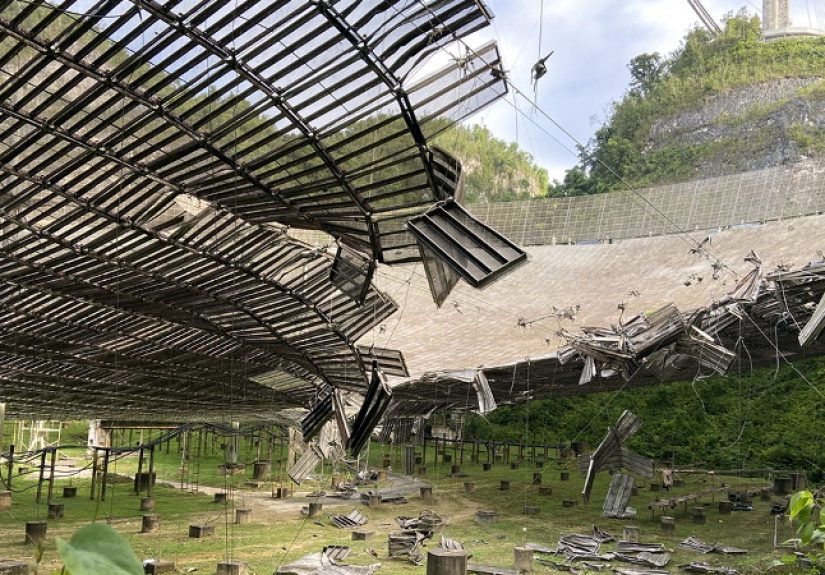
If astronomy had a heartbreak soundtrack, the Arecibo Observatory would have cued it up the moment that second cable failed. The giant radio telescope in Puerto Rico had already taken one brutal hit in August 2020, when an auxiliary cable slipped from its socket and ripped a long gash through the famous dish. That was bad enough. Then came the November shocker: a main cable snapped. Suddenly, the mood around Arecibo changed from “this will be an ugly repair job” to “everybody back away from the giant science machine immediately.”
The title of this story may sound like a suspense thriller, and honestly, that is not far off. Arecibo was not just another research instrument sitting quietly in a field. It was one of the most recognizable observatories on Earth, a scientific workhorse with a resume longer than some galaxies feel. It studied pulsars, mapped planets, tracked asteroids, probed Earth’s ionosphere, and helped turn radio astronomy into a public fascination instead of a niche hobby for people who enjoy spreadsheets and quasars in equal measure.
After the second failed cable, tensions ran high for good reason. Engineers were staring at a structure suspended by huge steel lines over a 1,000-foot reflector dish, and the numbers were no longer behaving like polite numbers. The situation had become a blend of physics, fear, and grim realism. And once those ingredients are in the pot, nobody wants to be the chef.
A Night When a Giant Shuddered
What failed, and why the second break changed everything
When the second cable failed in November 2020, it was not simply a repeat of the August accident. That distinction matters. The first incident involved an auxiliary cable that slipped out of its socket and tore into the dish. It was dramatic, costly, and deeply alarming, but there was still room for hope. Repair plans were being discussed. Replacement parts were being prepared. Engineers were assessing the structure and working through options.
Then the second cable broke, and this time it was a main cable. That is the kind of update that makes every engineer in the room stop blinking. Instead of a detached line, this was a snapped structural element that had been expected to hold. It crashed into the reflector below and caused additional damage, while also raising a nightmare question: if a cable that should have been well within safe load limits could fail, what did that say about the rest of the system?
That question turned the Arecibo crisis from a difficult repair project into a major safety emergency. The second break suggested the remaining cables might be weaker than assumed. In other words, the structure was no longer just damaged. It was unpredictable. And unpredictability is not a charming personality trait in a suspended 900-ton instrument platform hanging hundreds of feet above the ground.
The tension around Arecibo was not media hype. It was structural math with consequences. Once engineers concluded that additional failures were possible, every decision became shaped by worker safety. Repairing a beloved telescope is noble. Sending people into a collapse zone because optimism is running hot is not.
Why Arecibo Mattered So Much
The scientific legacy behind the panic
People did not react so strongly to Arecibo’s second cable failure just because the observatory looked iconic in photos, though it absolutely did. They reacted because this telescope had been doing first-class science for decades. Arecibo helped researchers make landmark observations in radio astronomy, planetary science, and atmospheric physics. Losing it was never going to feel like retiring old lab furniture. It felt like misplacing a cathedral that also happened to detect cosmic secrets.
Arecibo played a role in the discovery of the first binary pulsar, a milestone that helped confirm predictions tied to gravitational radiation and eventually led to a Nobel Prize. It was also connected to the first confirmed planets found beyond our solar system, around a pulsar in the early 1990s. Long before “exoplanet” became mainstream dinner conversation for science fans, Arecibo was already helping astronomers spot worlds beyond Earth’s neighborhood.
The observatory also excelled at planetary radar. It contributed to radar studies of Mercury and helped refine knowledge about the planet’s behavior and surface properties. It played a major role in tracking near-Earth asteroids, improving orbital estimates and helping researchers understand the shapes and spin states of rocky visitors that occasionally wander a bit too close for comfort. If you enjoy the idea of planetary defense involving actual data instead of cinematic shouting, Arecibo was your kind of place.
And then there was the broader cultural legend. In 1974, Arecibo transmitted the famous interstellar message aimed at the globular cluster M13, a symbolic hello from humanity that still occupies a weirdly delightful corner of science history. It was part ceremony, part flex, part cosmic postcard. Arecibo had that effect on people. It made the universe feel both enormous and somehow addressable.
Beyond the headline-grabbing discoveries, Arecibo’s instruments contributed to geospace and ionospheric research with remarkable sensitivity. Scientists used the site to study Earth’s upper atmosphere in ways that mattered for both basic science and practical understanding of how our planet interacts with solar activity. So when the second cable failed, researchers were not just watching an engineering problem unfold. They were watching a multi-purpose scientific powerhouse slide toward the edge.
From Damage Control to Dread
How the engineering picture got darker
After the first cable failure, the working assumption was that the observatory had suffered a severe injury but not a death sentence. That is an important part of the story because it explains why the second failure hit so hard. The August accident was terrible, yet there was still momentum toward stabilization and repair. The second break crushed that optimism.
Independent engineering assessments eventually pointed toward a reality nobody wanted to hear: the structure could not be safely stabilized without putting workers at serious risk. One especially troubling finding was that the snapped main cable had failed at roughly 60 percent of what should have been its minimum breaking strength. That detail landed like a cold meteor. It suggested hidden weakness, not merely visible damage. And hidden weakness is how structures go from “troubled” to “treacherous.”
Once that became clear, the conversation shifted. No longer was the question, “How do we patch the dish and replace a cable?” The real question became, “How do we prevent an uncontrolled collapse from hurting people and destroying even more of the site?” That is a very different meeting agenda, and a much sadder one.
The National Science Foundation eventually announced that the 305-meter telescope would be decommissioned because repairs could not be made safely. It was a brutal conclusion, but not an irrational one. People sometimes imagine scientific institutions as emotionally detached places where everyone calmly accepts outcomes with robotic grace. In reality, scientists can be deeply attached to their instruments, and engineers can be painfully aware of what is being lost. The choice to step back from repair was not a shrug. It was an acknowledgment that gravity does not care about nostalgia.
A Blow to Puerto Rico, Not Just Astronomy
The observatory’s role beyond research papers
Arecibo mattered scientifically, but it also mattered locally and culturally. For Puerto Rico, the observatory was a symbol of intellectual ambition, international visibility, and long-term scientific excellence. It gave students, educators, and residents a place where world-class research was not happening somewhere far away on a glossy brochure. It was happening right there, in the hills, under the dish, in a place that could inspire kids to look up and think, “Maybe I belong in science too.”
That is why so much of the reaction to Arecibo’s crisis carried a personal tone. The observatory was not merely a machine; it was part landmark, part laboratory, part memory bank. Families visited it. Scientists built careers around it. Students found direction because of it. Visitors who might not remember a single equation still remembered the feeling of standing beneath that enormous suspended platform and realizing that human beings are wonderfully strange creatures who build giant bowls in tropical landscapes to listen to the cosmos.
National Geographic’s personal reflection on Arecibo captured this emotional dimension well: for many people, the site was woven into family history, scientific identity, and a sense of place. That helps explain why the second cable failure produced more than technical concern. It produced grief in slow motion. Everyone knew that once the structure crossed into unsafe territory, sentiment would not be enough to save it.
Could Arecibo Have Been Saved?
The painful answer is why the tension remained so high
It is tempting to ask whether more money, faster intervention, or a bolder rescue plan could have changed the outcome. That question still lingers because Arecibo was too important for people to let go easily. But the key issue after the second cable failure was not a lack of affection or even a lack of effort. It was the rapidly worsening risk profile.
Engineers explored possibilities. Officials did not leap to surrender. There were discussions about stabilization, replacement cables, and repair approaches. Yet the second failure revealed that the structure’s condition was more dangerous than earlier evaluations had suggested. Once multiple assessments concluded that additional work could expose staff and contractors to life-threatening hazards, the argument for saving the telescope ran into an unavoidable wall.
This is the miserable part of infrastructure stories: sometimes the thing you love becomes the thing you cannot safely approach. Arecibo’s second cable failure was the moment when hope collided with liability, and liability won. Not because science stopped mattering, but because human lives mattered more.
The Experience of Watching Arecibo Slip Away
Five hundred words on the human side of the crisis
To understand why tensions ran so high after the second failed cable at Arecibo, you have to imagine the emotional geometry of the place. Arecibo was huge, yes, but it was also intimate in the way only legendary scientific sites can be. People who worked there did not see a tourist attraction with bolts. They saw a companion in discovery. Every platform, every cable, every panel in the dish was tied to real effort, real memory, and real purpose.
For scientists, the second cable failure felt like the moment a patient’s condition changes from serious to unstable. Before that, there was room for strategic thinking, technical planning, and cautious optimism. Afterward, the vocabulary became grim. Researchers had to confront the possibility that projects would be interrupted, instruments lost, and decades of accumulated capability wiped away not by scientific obsolescence, but by structural failure. That lands differently. It does not feel like retirement. It feels like being cut off mid-sentence.
For engineers and site managers, the experience was probably even harsher. Their job was not to admire the telescope from a poetic distance. Their job was to assess whether it could kill someone. That creates a terrible tension between devotion and duty. You can love a structure, understand its value, and still know that you cannot send people into danger to save it. There is no triumph in that conclusion. There is only responsibility, and responsibility can be a very lonely room.
For Puerto Rican students and families, the unfolding crisis carried another layer. Arecibo was proof that world-class science was not reserved for distant institutions on the mainland. It stood as a local monument to curiosity and expertise. Watching it move from damage to danger to decommissioning meant watching a source of pride become a source of helplessness. The second cable failure sharpened that feeling because it made the loss seem immediate and harder to reverse. Hope stopped sounding sturdy. It started sounding fragile.
Even for ordinary visitors, Arecibo had a way of sticking in the mind. Plenty of people remember the first sight of the dish the way others remember a canyon, a cathedral, or the ocean. It was one of those places that made scale feel personal. You stood there and grasped, all at once, that science is not only equations and grants and conference talks. Sometimes it is physical, dramatic, and almost theatrical. Arecibo had stage presence. The second cable failure made people realize the stage might soon go dark.
That is why the public response was not just technical concern dressed up as nostalgia. It was a collective realization that some places become bigger than their hardware. Arecibo represented discovery, ambition, and continuity. When the second cable broke, the anxiety was not only about steel and load-bearing capacity. It was about what happens when a civilization loses one of the instruments it built to ask the universe bigger questions. And that, frankly, is enough to make anyone a little tense.
Conclusion
The second failed cable at Arecibo was the turning point that transformed a terrible accident into a historic scientific loss. It exposed deeper structural weakness, forced a painful safety reckoning, and signaled that one of the world’s most beloved radio telescopes was running out of runway. The tension after that failure was not melodrama. It was the sound of astronomy, engineering, and public memory colliding in real time.
Arecibo’s story remains bigger than its collapse. Its discoveries still shape modern astronomy. Its radar work still echoes through planetary science. Its influence still lives in Puerto Rican science education, in the careers it launched, and in the imagination of anyone who ever looked at that dish and thought humanity might actually be capable of grand, useful weirdness. The structure may have failed, but the legacy absolutely did not.





 Close
Close