
Table of Contents >> Show >> Hide
- Why Frozen Soap Bubbles Look So Mesmerizing
- The Science Inside a Soap Bubble
- What Happens When a Bubble Meets -15 Celsius Air
- Why Warsaw Is Such a Perfect Backdrop
- How to Appreciate the Scene Like a Scientist and a Photographer
- What the Frozen Bubble Teaches Us About Winter
- Experience: Watching Soap Bubbles Freeze in Warsaw at -15 Celsius
- Conclusion
There are winter moments that feel less like weather and more like a magic trick. A soap bubble drifting through air at -15 Celsius in Warsaw, Poland, is one of them. For a few seconds, it floats like a tiny planet. Then the surface begins to shimmer, faint crystal veins start crawling across the film, and the whole sphere turns into an icy ornament that looks as if a snow globe had a very ambitious art director.
That is the charm of freezing soap bubbles: they are delicate, dramatic, and just science-y enough to make everyone nearby suddenly act like a physicist with cold fingers. One minute you are blowing bubbles like a child on a school holiday. The next minute you are watching heat transfer, surface tension, crystallization, and freezing fronts put on a live performance in the open air. Warsaw’s deep winter cold simply gives the show a better stage.
This strange little spectacle is not just pretty. It also reveals how water behaves in bitter cold, why soap bubbles can survive long enough to freeze, and why the resulting patterns look so much like miniature frost forests. At around 5 degrees Fahrenheit, or -15 Celsius, the conditions are cold enough that a bubble can begin freezing rapidly, especially if it lands on a chilled surface like snow, ice, or a railing that has already been outdoors long enough to mean business.
Why Frozen Soap Bubbles Look So Mesmerizing
Frozen bubbles are beautiful because they combine two things humans are terrible at ignoring: perfect spheres and moving patterns. A bubble begins as a nearly round film because surface tension pulls the liquid into the smallest area possible for the volume of air trapped inside. In other words, the bubble is doing geometry without bragging about it.
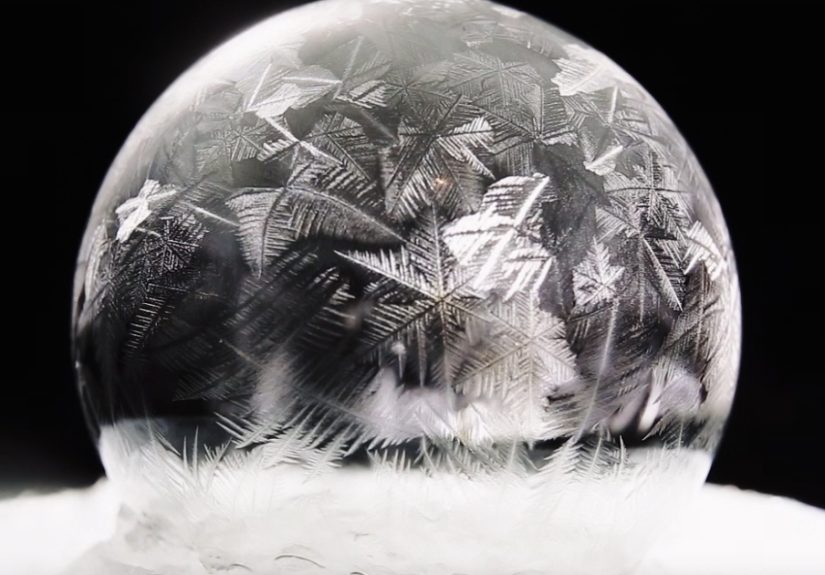
Once the air is cold enough, the watery film on that sphere starts to freeze. But it does not usually go from clear to solid in one boring snap. Ice crystals often spread in branching, feathery, lace-like forms. That is why a freezing bubble looks alive. It seems to grow its own frost garden in real time.
The effect is even more dramatic in strong cold because the crystal growth becomes easier to see. Instead of simply popping, the bubble can stiffen into a semi-rigid shell, hold its shape a bit longer, and crack or collapse in slow motion. It is winter theater, except the lead actor is a soap film thinner than a good excuse.
The Science Inside a Soap Bubble
Soap Makes the Bubble Possible
Plain water is not very good at being a bubble. Water molecules cling tightly to one another, creating strong surface tension. Soap changes that. Soap molecules wedge themselves between water molecules and reduce the pull at the surface, allowing a thin film to stretch without instantly snapping back into a droplet. That is why bubble solution can form those floating spheres while plain water mostly refuses to cooperate like a stubborn cat being asked to take a bath.
That thin film is typically water mixed with surfactants and, in many bubble mixtures, stabilizing ingredients such as glycerin, sugar, or corn syrup. These additions help the film drain more slowly and survive long enough for the cold to work on it. Without a stable film, the bubble would burst before freezing had a chance to become photogenic.
Why the Bubble Is Round
Soap bubbles tend toward a spherical shape because surface tension acts like a stretched elastic skin. A sphere encloses the greatest volume with the smallest surface area, so nature picks the efficient option. This is the same reason tiny droplets and bubbles look round unless gravity, wind, or contact with a surface starts interfering with the plan.
That roundness matters when freezing begins. A bubble is not a thick blob of water like a droplet. It is a very thin curved film with air both inside and outside. That unusual geometry changes how heat moves through it, how freezing fronts travel, and why the crystal show can look different from the freezing of a puddle or a raindrop.
What Happens When a Bubble Meets -15 Celsius Air
Supercooling Starts the Drama
Water does not always freeze the instant it touches 0 Celsius. Under the right conditions, it can remain liquid below its normal freezing point. This is called supercooling. In a bubble film, that means some of the water can be colder than freezing but still stay liquid until a crystal nucleus forms and the freezing process begins.
At -15 Celsius, the air is cold enough to pull heat from the bubble quickly. If the bubble lands on snow or ice, freezing often starts from the point of contact and moves upward. The crystal front spreads through the film, and the branching patterns become visible almost immediately. In especially favorable conditions, you can watch the whole surface transform in seconds.
Ice Crystals Create the “Snow Globe” Effect
One of the coolest findings from research on freezing soap bubbles is that the process is not always a single front creeping upward in a neat line. Under very cold, roughly isothermal conditions, ice crystals can detach and swirl through the bubble film, helping it freeze from multiple fronts at once. This is why some frozen bubbles look as if a tiny blizzard broke loose inside them. Science gave this behavior a proper explanation, but visually it still looks like the bubble got enchanted by winter.
That movement is tied to temperature differences and surface-tension-driven flow, often called Marangoni flow. As freezing releases latent heat locally, the balance of temperature and surface tension shifts across the film. That can set liquid motion in action, and that motion can carry crystals around the bubble. The result is a dynamic crystal dance rather than a static freeze.
Why Some Frozen Bubbles Crack Instead of Pop
Once the film solidifies, the air inside the bubble still has opinions. Gases respond to temperature, pressure, and diffusion, and the frozen shell is no longer as flexible as the liquid film that came before it. Instead of bursting cleanly, the bubble may sag, fracture, or collapse with delicate cracking lines. That is part of what makes frozen bubbles so different from ordinary bubbles. They do not always die fast; sometimes they fail with flair.
Why Warsaw Is Such a Perfect Backdrop
Cold Is Essential, but Calm Air Helps Just as Much
Temperature gets the headlines, but wind quietly decides whether you get a masterpiece or a two-second disappointment. Cold, calm air gives a bubble a better chance to hold together, land gently, and begin freezing. Even light breeze can ruin the moment by distorting the film or knocking the bubble into something unhelpful.
That is why a still winter morning in Warsaw can feel ideal. Streets are quieter, snow-covered surfaces are already chilled, and the city’s cold air gives the bubble an environment where the freeze can begin before the bubble bursts. The scientific advice and practical photography advice agree on this point: calm conditions are your friend, and wind is the villain nobody invited.
Surfaces Matter More Than People Expect
A bubble drifting through open air may start to crystallize, but the effect is often easier to see when it lands on a surface that is already very cold. Snow, frost, or ice can trigger freezing right at the contact point. That is one reason frozen-bubble photos often feature bubbles perched on snowbanks, wooden rails, or icy branches.
In a city like Warsaw, winter offers plenty of naturally chilled textures: park benches with frost along the edges, iron fences with a dusting of snow, or quiet courtyard walls that have been radiating heat into the night sky for hours. The colder the surface, the more likely the bubble is to settle, freeze, and become a tiny sculpture before it collapses.
How to Appreciate the Scene Like a Scientist and a Photographer
Look for Patterns, Not Just the Bubble
Most people fixate on the fact that the bubble freezes at all, which is fair. That is a strong opening act. But the real wonder is in the patterns. Some crystals spread like fern leaves. Others form cloudy patches, branching stars, or delicate frost fans. Temperature, humidity, mixture, surface conditions, and airflow can all influence how the patterns develop.
That means no two frozen bubbles look exactly the same. The comparison to snowflakes is not accidental. Ice crystals respond to environmental conditions, and small differences can lead to surprisingly different structures. So while the bubble may seem simple, the freezing pattern is a tiny record of the environment wrapped around a sphere.
Patience Beats Force
If you try to chase the perfect frozen bubble, winter will humble you quickly. Breath is warm. Gloves are clumsy. Wind appears exactly when you do not need it. Several bubbles may pop before one survives long enough to freeze beautifully. That is normal. The process rewards patience more than brute force.
The funniest part is that success often looks accidental to everyone nearby. You can spend ten careful minutes adjusting your position, shielding the bubble wand, and choosing the right surface, only for a stranger to think you are just playing in the cold. They are not wrong. You are also conducting a small public demonstration of phase change.
What the Frozen Bubble Teaches Us About Winter
A freezing soap bubble is a simple object that reveals big ideas. It shows that freezing is not always instantaneous, that water can be supercooled, that crystal growth can travel through a surface in visible ways, and that the behavior of a thin film is different from the behavior of a bulk liquid. It also reminds us that winter is not just a season of static white landscapes. It is a season of active physics.
At -15 Celsius in Warsaw, you are not just seeing cold air. You are watching energy move, surfaces change, and matter reorganize itself into a solid structure. That is why the sight sticks with people. The bubble begins as something playful and familiar, then turns into something fragile, strange, and almost architectural.
And maybe that is the real appeal. A soap bubble is usually the most temporary thing in the room. In bitter cold, it briefly becomes the most intricate. Winter takes the flimsiest object imaginable and gives it structure, detail, and a few unforgettable seconds of dignity before gravity and time reclaim the stage.
Experience: Watching Soap Bubbles Freeze in Warsaw at -15 Celsius
Standing outside in Warsaw at -15 Celsius changes the way you notice everything. The cold has a sound to it, or maybe more accurately, a lack of sound. Cars seem farther away. Footsteps become sharper. Your breath hangs in front of you like a private weather system, and every exhale feels as though the air has turned visible just to prove a point. In that kind of cold, blowing a soap bubble does not feel like a summer game misplaced by accident. It feels like a dare.
The first bubble usually disappears too fast. It drifts, wobbles, and pops as if offended by the temperature. The second one lasts longer, and that is when the mood changes. You stop thinking about bubbles in the ordinary sense and start watching the surface the way you would watch a window frosting over from the edges inward. The sphere lands on a little patch of snow, and suddenly a silver-white pattern begins to crawl across it. It does not rush. It advances with confidence, like winter signing its name.
What makes the experience unforgettable is how strange the bubble feels emotionally. It is tiny and playful, but once the crystals start spreading, it looks serious, almost ceremonial. The surface catches the weak winter light and throws back blues, grays, and a faint pearl sheen. For a moment, it resembles a miniature planet with weather of its own. If the day is still enough, you can kneel down and watch the structure change second by second. It is one of those rare scenes that makes people go quiet without being asked.
There is also something very Warsaw about the setting. The city in deep winter has a way of making old stone, metal railings, bare branches, and pale skies feel especially dramatic. A frozen bubble perched on a snowy ledge looks almost theatrical against that background, as if the city had prepared a stage set for a performance lasting less than a minute. The contrast is part of the pleasure: a childlike object in a serious winter city, a playful experiment in a landscape that feels stern and historical.
Your hands, of course, are less poetic about the whole situation. Even inside gloves, the cold starts negotiating aggressively. Your nose objects. Your breath keeps trying to sabotage the bubble by warming the air too much. If you are taking photos, the process becomes a comedy of tiny frustrations: fogged lenses, awkward angles, and the constant fear that the best bubble of the day will freeze beautifully while you are blinking or fumbling with your settings. Winter does not care about your timing.
But when it works, it really works. The best frozen bubbles are not just seen; they are felt. You feel the stillness required for them. You feel the brittle dryness in the air. You feel the weird satisfaction of catching something fragile at the exact moment it becomes intricate. Even the bubble’s collapse can be beautiful. Sometimes it cracks like thin glass. Sometimes it slumps inward as though the tiny world inside it gave up. Either way, it leaves behind that peculiar mix of delight and disbelief that good winter moments often carry.
And that is the part people remember. Not just the science, though the science is wonderful. Not just the photo, though the photo can be stunning. It is the experience of standing in fierce cold and watching something as ordinary as soap and water become briefly extraordinary. In a season people often describe as gray, frozen bubbles prove winter still knows how to show off.
Conclusion
Soap bubbles freezing at -15 Celsius in Warsaw, Poland, are more than a pretty winter curiosity. They are a vivid little lesson in surface tension, supercooling, crystal growth, and the surprising ways cold air can transform a fragile film into a fleeting sculpture. The beauty is real, the science is real, and the experience sits perfectly at the intersection of play and physics.
If you ever find yourself in a brutally cold city morning with a bubble wand and a little patience, do not treat it like a childish distraction. Treat it like front-row access to one of winter’s smartest performances. The bubble may only last seconds, but those seconds are packed with enough detail to make the whole freezing season feel newly interesting.






 Close
Close