
Table of Contents >> Show >> Hide
- What Happened in the Video That Sparked So Much Concern?
- Why Britney Spears Posts Instantly Trigger Bigger Reactions
- The Messy House Became a Symbol, Not Just a Detail
- Why the “She Needs Intervention” Narrative Is So Loaded
- Britney’s Social Media Has Become Its Own Genre
- The Bigger Context: Memoir, Freedom, and the Difficulty of Reinvention
- What Fans Are Really Reacting To
- A Smarter Way to Read Moments Like This
- Experiences Around This Story: Why So Many People Felt Something Personal
- Conclusion
Britney Spears has spent most of her adult life doing two jobs at once: being a pop icon and being a public Rorschach test. Every dance clip, every cryptic caption, every sideways camera angle somehow turns into a global debate. So when a recent video showed Spears singing inside a cluttered room at home, the internet did what the internet does best: it grabbed a flashlight, shouted “something is wrong,” and ran straight into the comment section.
The reaction was immediate, loud, and deeply familiar. Some viewers said the clip was unsettling. Others argued people were projecting old narratives onto a woman who has long been denied the right to be messy, eccentric, spontaneous, or just plain human. And in true social media fashion, a few people jumped from “this room looks chaotic” to “she needs intervention” faster than you can say Oops!… I Posted Again.
But the real story is bigger than one video from one house on one day. This moment tapped into years of public concern, media overreach, fan protectiveness, and unresolved discomfort about what freedom is supposed to look like for Britney Spears after the end of her conservatorship. The result is a celebrity story that says as much about us as it does about her.
What Happened in the Video That Sparked So Much Concern?
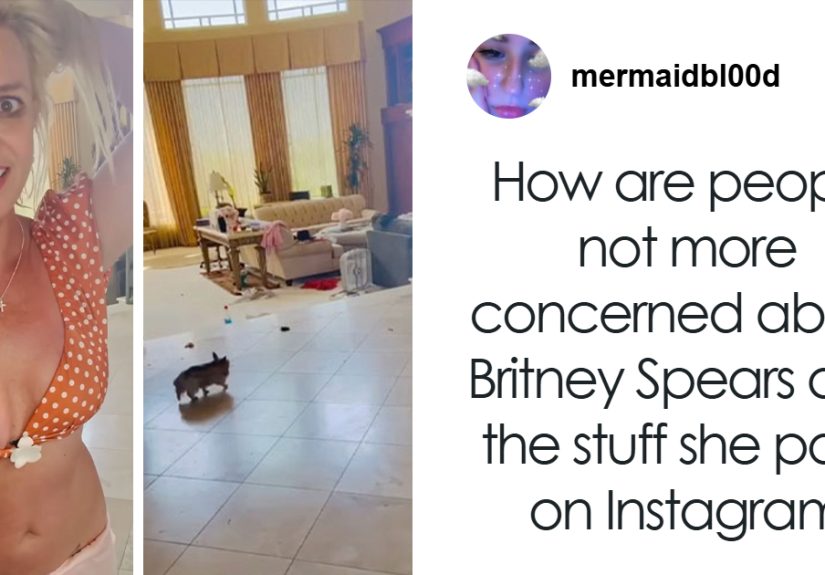
The post that set off the latest wave of chatter showed Spears singing Rihanna’s “Unfaithful” while moving around a visibly cluttered space in her home. She captioned the video with a line about “messing around with lighting” and cleaning her house “like no tomorrow,” which made the whole thing feel casual, improvised, and very much in line with the spontaneous tone of many of her recent social posts.
Viewers quickly zeroed in on the background. There were scattered items, general household disorder, and what some online observers believed looked like pet mess on the floor. That visual detail drove much of the conversation, because the internet has a long tradition of spotting one thing in the background and deciding it deserves its own press tour.
Then came the second layer: Spears’ delivery. Some fans described the singing as playful; others thought it sounded off-key or unusually theatrical. Her use of a partial British accent added another element that people either read as quirky performance or as cause for alarm. In other words, the same video produced two wildly different interpretations: performance art to one crowd, distress signal to another.
That split is important. It shows how Britney Spears no longer posts into a neutral audience. She posts into a deeply conditioned public that has been trained, for years, to view everything she does through the lens of crisis.
Why Britney Spears Posts Instantly Trigger Bigger Reactions
There is no way to discuss public reaction to Britney Spears without acknowledging the historical baggage. For more than a decade, Spears lived under a conservatorship that controlled major parts of her personal and financial life. The arrangement ended in 2021, but the cultural aftershocks did not. A lot of people still watch her social media as if they are scanning a weather radar for another storm.
That hypervigilance comes from a real place. Fans spent years rallying behind the #FreeBritney movement, pushing back on a system they believed stripped Spears of autonomy. When her conservatorship ended, many supporters celebrated not just a legal win, but a moral one. The public had finally, loudly admitted that Britney Spears deserved control over her own life.
And yet freedom is complicated in the age of Instagram. Once the legal restrictions disappeared, the scrutiny did not. If anything, it intensified. People who once argued she should be free now often seem uncomfortable with what her freedom looks like in practice: unscripted videos, odd captions, emotional swings, sudden disappearances, and posts that do not fit the tidy, PR-polished celebrity template.
That contradiction sits at the center of this story. The public wanted Britney outside the cage, but some viewers still want her behavior to look reassuring, controlled, and easy to explain. The moment it does not, the old panic returns.
The Messy House Became a Symbol, Not Just a Detail
Let’s be honest: celebrity homes are supposed to look like museum exhibits with better lighting. We are used to seeing polished kitchens, spotless counters, and neutral-toned sofas that have clearly never met a potato chip. So when Spears appeared in a room that looked actually lived in, people reacted as if they had just discovered chaos itself.
But the house was never just about the house. In stories like this, clutter becomes metaphor. A messy room turns into a messy life. A strange caption becomes emotional evidence. A casual video becomes a supposed warning sign. That leap is what powers tabloid culture, and Britney has been one of its favorite subjects for decades.
To be fair, some fans were not mocking her. They sounded genuinely worried. Their concern came from years of watching a superstar move through public trauma while millions of strangers turned her most vulnerable moments into content. For them, the clutter was not just visual noise. It felt like one more sign that Spears might still be struggling to find peace in private life.
Still, concern becomes slippery when it is performed online. Public compassion can easily slide into amateur diagnosis, moral panic, and the bizarre internet habit of treating a celebrity’s living room like a courtroom exhibit.
Why the “She Needs Intervention” Narrative Is So Loaded
The phrase “she needs intervention” sounds simple, but it carries a lot of baggage. It implies certainty. It suggests outsiders know what is happening inside a person’s life better than that person does. And in Britney Spears’ case, it echoes a history in which institutions, relatives, media figures, and commentators routinely claimed they knew what was best for her.
That does not mean all public concern is fake or malicious. It means the language matters. Saying “I hope she has support” is very different from declaring that she should be controlled. One is empathy. The other starts edging toward authority.
This is part of why Britney remains such a flash point in celebrity culture. Her story has taught audiences to be suspicious of exploitation, but not necessarily to stop consuming it. People know the old machinery was cruel. They just keep rebuilding smaller versions of it in real time, one viral reaction at a time.
There is also a gendered angle here that should not be ignored. Women in pop culture, especially those who rose to fame young, are often judged by a bizarre double standard. They must seem spontaneous, but not too strange; sexy, but not unsettling; vulnerable, but not disorganized; authentic, but only in ways that remain aesthetically pleasing. That is an impossible script for anyone, let alone someone whose adulthood has unfolded under international surveillance.
Britney’s Social Media Has Become Its Own Genre
Part of the reason reactions are so intense is that Spears’ online presence does not behave like standard celebrity branding. There is no polished influencer rhythm, no carefully spaced rollout, no obvious attempt to smooth every rough edge. Her posts can feel funny, impulsive, chaotic, sincere, theatrical, or all four at once before breakfast.
For some fans, that unpredictability feels refreshing. It reads as proof that Spears is finally operating on her own terms. For others, it feels unsettling precisely because it resists easy explanation. In a culture obsessed with curation, Britney’s feed often feels like raw nerve endings and ring-light improvisation.
That difference in interpretation explains why every new post produces the same tug-of-war. One side sees liberation. The other sees instability. Both groups believe they are reading the truth. Neither group actually has access to the full picture.
And that is the key problem: strangers on the internet are reacting to fragments. They are not reacting to a complete life, only a public sliver of one.
The Bigger Context: Memoir, Freedom, and the Difficulty of Reinvention
Britney Spears is not only a tabloid figure; she is also a woman trying to author her own story after years of being narrated by everyone else. Her memoir, The Woman in Me, became a major publishing success and helped reframe her public image around voice, memory, and agency. A film adaptation of that memoir is also in development, keeping her story firmly planted in the cultural conversation.
That matters because the public is not reacting to one odd video in a vacuum. It is reacting to a figure whose life has already been turned into courtroom drama, documentary material, fan activism, family conflict, and now prestige-adjacent adaptation territory. Britney is not just living her life. She is living it under the weight of a narrative industry.
Even her smaller social posts now land inside that machinery. A singing video becomes “proof.” A caption becomes “cryptic.” A cluttered corner becomes “disturbing living conditions.” The language gets more dramatic because the market rewards drama. The more emotional the framing, the faster it spreads.
That is why stories like this need more restraint than spectacle. Public interest is inevitable. Public cruelty is not.
What Fans Are Really Reacting To
When people say they are worried about Britney Spears, they are often reacting to more than the video in front of them. They are reacting to memory. They remember 2007. They remember headlines that treated pain like entertainment. They remember the fight over her freedom. They remember the years when concern and control became tangled together in ugly ways.
So when a new clip looks unusual, all of that history rushes back in at once. The reaction is emotional because the cultural memory is emotional. Britney Spears is one of the few celebrities whose public image carries both nostalgia and unresolved guilt. People grew up with her music, watched the media devour her, then later realized the joke had never been funny.
That mix of affection, grief, protectiveness, and curiosity creates a strange audience experience. Fans want her to be okay, but they also keep watching for signs that she is not. The result is a cycle that can look caring from a distance while still feeding the same machine that has followed her for years.
A Smarter Way to Read Moments Like This
The better question is not “Does Britney Spears need intervention?” The better question is: what do we actually know, and what are we projecting? We know she posted a video in a cluttered room. We know some viewers found it concerning. We know others defended her right to be unconventional online. We know her life story makes people unusually reactive to anything that feels off.
Beyond that, a lot of the strongest claims are speculation dressed up as certainty.
It is possible to hold two ideas at once. Yes, public concern can come from genuine empathy. And yes, that same concern can become invasive, sensational, and dehumanizing when it turns a celebrity’s private mess into communal theater. The internet struggles with nuance, but nuance is exactly what this story requires.
Britney Spears may always inspire intense reaction because her image sits at the intersection of fame, freedom, trauma, performance, and memory. But viewers do not have to add more damage to that equation. Sometimes the most responsible response is also the least flashy one: care without certainty, empathy without possession, and curiosity without turning someone’s personal life into a spectator sport.
Experiences Around This Story: Why So Many People Felt Something Personal
One reason this story traveled so fast is that Britney Spears does not feel distant to a lot of people. She feels familiar. Fans did not just stream her songs; many of them grew up with her as a soundtrack to childhood, middle school, high school, first heartbreaks, and that very specific era when a CD booklet felt like sacred literature. So when they see a jarring clip from her home, they are not reacting to a random celebrity. They are reacting to someone tied to their own timeline.
That makes the experience unusually emotional. For older millennial fans and plenty of Gen X viewers, Britney represents a whole chapter of pop culture that was fun on the surface and brutal underneath. They remember the shiny music videos, but they also remember the late-night monologues, paparazzi swarms, and tabloid covers that treated a young woman’s pain like a punch line. Watching her now can feel like watching unfinished history.
There is also the uncomfortable experience of realizing how public perception changes with age. Back in the 2000s, a lot of people consumed celebrity chaos as entertainment because that was the media culture they were handed. Today, many of those same people feel regret. They see a new Britney clip and feel not just concern, but guilt. It is the guilt of hindsight, the kind that whispers, “We should have been kinder then, so maybe we should be more careful now.”
For some fans, her videos create a different feeling entirely: relief. They see spontaneity, weird humor, and a woman who no longer looks packaged for public approval. To them, the imperfect room and unfiltered energy are not red flags. They are proof that she is not performing corporate wellness for strangers. That experience matters too, because it explains why defense of Britney can be so fierce. People are not only defending her actions; they are defending her right to be imperfect in public.
And then there are casual viewers, the people who do not follow every legal twist or every Instagram caption. Their experience is often simpler but still powerful: confusion. They stumble across a video, notice the clutter, hear the odd cadence, read the comments, and get pulled into the emotional tone of the crowd. In digital culture, concern is contagious. A few dramatic reactions can make everyone feel like they are witnessing an emergency, even when they are really just witnessing a fragment.
That is what makes Britney Spears such a uniquely charged public figure. Different people are watching different stories at the same time. Some see resilience. Some see warning signs. Some see a survivor reclaiming her voice. Some see a celebrity still trapped in the afterlife of fame. The shared experience is not agreement; it is intensity.
Maybe that is the real lesson here. Britney stories rarely stay small because people are not only looking at Britney. They are looking at memory, media, gender, fame, and the uncomfortable question of how much access the public thinks it deserves to another human being’s life. That is a heavy load for any person, and it helps explain why even a quick home video can feel less like a post and more like a cultural mirror.
Conclusion
The latest Britney Spears video sparked major worry because it landed on top of years of public history, not because a messy room automatically tells a complete story. Fans saw clutter, unusual delivery, and familiar unpredictability, then filled in the blanks with old fears and fresh assumptions. But that is exactly why this moment deserves a calmer reading.
Britney Spears remains one of the most watched women in pop culture, and every post she shares now gets filtered through memory, trauma, and tabloid reflex. The smarter response is not blind dismissal or dramatic certainty. It is context, restraint, and the simple recognition that concern becomes harmful when it turns into control.






 Close
Close