
Table of Contents >> Show >> Hide
- What You’ll Learn
- Why Phone Interviews Matter (and What They’re Really Testing)
- Before the Call: Prep Like a Pro (Without Turning Into a Robot)
- 1) Confirm the details like you’re the CEO of your own calendar
- 2) Research the company, then go one layer deeper
- 3) Build a “cheat sheet” that keeps you crisp
- 4) Practice out loud (because your brain lies to you silently)
- 5) Set up your environment like it’s a tiny recording studio
- 6) Dress a little sharper than you think you need to
- During the Call: Sound Confident, Clear, and Human
- 1) Start strong with a friendly, professional opening
- 2) Use the “headline + proof + tie-back” answer format
- 3) Control pacing: pause before you answer
- 4) Active listening is your secret weapon
- 5) Notes are allowed. Page shuffling is not.
- 6) Ask questions that prove you’re already thinking like an employee
- 7) Close with clarity and confidence
- Common Telephone Interview Questions (and How to Answer Them)
- “Tell me about yourself.” (Use Present–Past–Future)
- “Why do you want this job?” (Make it about them and you)
- Behavioral questions (“Tell me about a time when…”) (Use STAR, but don’t narrate your entire life)
- “What are your salary expectations?” (Stay calm, stay prepared)
- “Do you have any questions for me?” (Yes. Always yes.)
- Phone Interview Mistakes That Quietly Get You Cut
- After the Call: Follow Up Like a Professional Adult
- Quick Phone Interview Checklist (Copy/Paste Friendly)
- Bonus: Real-World Phone Interview Experiences
- Conclusion: Turn the Phone Screen Into a Second-Round Invite
A phone interview is a little like a first date where you can’t see the other person, you’re trying not to
sound weird, and you’re praying your neighbor doesn’t choose this exact moment to start leaf-blowing
directly into your soul.
But here’s the good news: phone screens are one of the most “winnable” parts of the hiring process. You can
prep your stories, keep notes nearby, and control your environment way more than you can in a conference room
with a squeaky chair and a mystery smell.
In this guide, you’ll get practical, recruiter-tested phone interview tips (plus scripts, examples, and a
quick checklist) so you can sound confident, clear, and genuinely likablewithout turning into a robotic
audiobook version of your resume.
Why Phone Interviews Matter (and What They’re Really Testing)
Most phone interviewsespecially the first oneare “screens.” Translation: the company wants to confirm you’re a
real person who can communicate clearly, understands the role, and isn’t wildly misaligned on basics like
location, schedule, pay range, or core requirements.
Think of it as the hiring team asking, “Should we invest more time here?” Your job is to make that answer an
easy yes by showing three things:
- Fit: You understand what the role needs and you match it.
- Clarity: You can explain your work and results without rambling.
- Energy: You sound engagedbecause bored-sounding candidates rarely move forward.
And yes, you can absolutely show energy over the phone. (Pro tip: your face affects your voice. Smiling isn’t
“fake”; it’s basically an audio upgrade.)
Before the Call: Prep Like a Pro (Without Turning Into a Robot)
1) Confirm the details like you’re the CEO of your own calendar
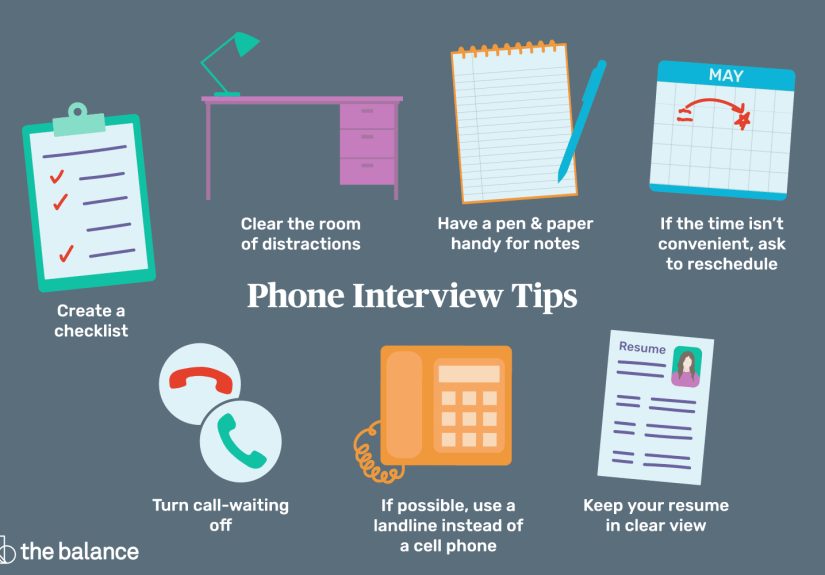
Confirm time zone, the number they’re calling from, whether you call them,
and how long the call should last. Put it on your calendar with a 10-minute reminder. The goal is to answer
like a calm professionalnot like someone sprinting across a parking lot whisper-yelling, “HELLO?!”
2) Research the company, then go one layer deeper
Basic research is table stakes: what the company does, who they serve, and what this role is responsible for.
The “one layer deeper” is where you stand out. Try:
- Read the job description and highlight the top 5 must-haves.
- Find one recent product update, initiative, or business focus you can reference naturally.
- Scan the team’s structure (if visible) so you understand how the role fits.
You’re not trying to deliver a TED Talk about the company. You’re aiming for two or three specific references
that signal: “I did my homework and I actually want this.”
3) Build a “cheat sheet” that keeps you crisp
One of the best perks of a telephone interview? Notes. The trap? Reading them like a dramatic audiobook.
Keep your cheat sheet simple:
- Role match bullets: 3–5 ways your experience maps to their requirements.
- Metrics: 2–4 numbers that prove impact (revenue, time saved, accuracy, growth, cost reduction).
- Stories: 3 STAR stories (Situation–Task–Action–Result) for behavioral questions.
- Questions to ask: 5 thoughtful questions (more on this below).
- Close: A 15-second closing pitch and a polite next-steps question.
Print it if you canpaper doesn’t pop up notifications or accidentally close mid-sentence like a panicky browser tab.
4) Practice out loud (because your brain lies to you silently)
Reading your answers in your head feels smooth. Saying them out loud is when you discover you’ve built a
90-second sentence with no oxygen breaks. Practice these out loud:
- Your “Tell me about yourself” answer (60–90 seconds).
- Your top 2–3 accomplishments (each under 60 seconds).
- Your STAR stories (each 60–90 seconds).
- Your salary expectations phrasing (calm, not defensive).
5) Set up your environment like it’s a tiny recording studio
Choose a quiet space, silence notifications, and tell anyone nearby that you’re “in a meeting.” If you have pets,
plan accordinglytreats, a closed door, or strategic bribery. Use headphones if they improve clarity. Keep water nearby.
Also: check your phone battery, your reception, and your backup plan. A dropped call isn’t a moral failing, but
being unprepared for it can make you sound rattled.
6) Dress a little sharper than you think you need to
You don’t need a tuxedo. But getting out of pajama-mode helps your posture, confidence, and tone. A simple rule:
if you’d wear it to a casual in-person interview, it’s good enough for a phone screen. Stand up if it helps your voice.
During the Call: Sound Confident, Clear, and Human
1) Start strong with a friendly, professional opening
When you answer, smile (yes, really), then say:
Example: “Hi [Name], this is [Your Name]. Thanks for callinghow are you today?”
You’re setting tone and pacing. A warm opening reduces awkwardness and makes the call feel like a conversation,
not an interrogation.
2) Use the “headline + proof + tie-back” answer format
This is the easiest way to sound structured without sounding scripted:
- Headline: Answer the question in one sentence.
- Proof: Give 1–2 supporting details (ideally with a metric or outcome).
- Tie-back: Connect it to the role you’re discussing.
Example (strengths): “My strength is cross-functional problem solving. In my last role I led a
workflow redesign that cut turnaround time by 22%. That’s why I’m excited about this positionyour team’s scaling
phase needs that kind of operational clarity.”
3) Control pacing: pause before you answer
A short pause makes you sound thoughtful, not slow. It also prevents you from interrupting or answering the wrong question.
If you need clarity, ask:
Example: “Great questiondo you mean [option A] or [option B]?”
4) Active listening is your secret weapon
Because there’s no eye contact, listening becomes the loudest signal of professionalism. Use quick verbal nods:
“That makes sense,” “Got it,” “Absolutely,” and brief paraphrases:
Example: “So it sounds like the priority is improving onboarding speed while keeping quality consistentdid I capture that?”
5) Notes are allowed. Page shuffling is not.
Glancing at your cheat sheet is fine. Reading full paragraphs is where candidates start sounding flat, slow, and
weirdly… laminated. Keep notes as bullets. If you hear paper noise, you’re doing too much.
6) Ask questions that prove you’re already thinking like an employee
The fastest way to level up from “applicant” to “potential teammate” is to ask smart questions. Try:
- Success definition: “What would success look like in the first 60–90 days?”
- Priorities: “What are the biggest challenges you’d want this person to tackle first?”
- Team dynamics: “Who would I work with most closely, and how does the team collaborate day-to-day?”
- Growth: “What skills tend to help someone thrive on this team?”
- Process: “What are the next steps and timeline?”
7) Close with clarity and confidence
Don’t just say “Thanks.” Add a short closing pitch that connects your value to their needs.
Example: “Thanks again for your time. Based on what you sharedespecially the need for
[priority]I’m confident my experience with [relevant skill/results] would help. What are the next steps from here?”
Common Telephone Interview Questions (and How to Answer Them)
“Tell me about yourself.” (Use Present–Past–Future)
Keep it tight and relevant. A great structure is:
Present (what you do now), Past (how you got here), Future
(why this role).
Example: “Currently, I’m a customer success specialist focused on retention and onboarding for
mid-market accounts. Before that, I worked in support and learned the product inside-out, which helped me move into
a more strategic role. Now I’m looking for a position where I can own larger accounts and partner cross-functionally,
and that’s what drew me to this opportunity.”
“Why do you want this job?” (Make it about them and you)
Aim for one “them” reason and one “you” reason:
- Them: something specific about the company/team/role.
- You: a skill or motivation you’ll bring that matches the need.
Example: “I’m excited about the role because your team is scaling the product into new markets.
I’ve done that kind of process-building work before, and I enjoy turning messy growth into repeatable systems.”
Behavioral questions (“Tell me about a time when…”) (Use STAR, but don’t narrate your entire life)
STAR works best when you keep the Situation and Task short and spend most of your time on Action and Result.
Think: 20% setup, 60% action, 20% results/learning.
Mini-example (conflict): “We had a disagreement on priorities (S). I needed alignment to hit a
deadline (T). I scheduled a 20-minute decision meeting, brought two options with tradeoffs, and asked for a final
call (A). We shipped on time and reduced rework in the next sprint by 15% (R).”
“What are your salary expectations?” (Stay calm, stay prepared)
If you can share a range, do itbased on your research and experience levelwhile staying flexible.
Example: “Based on the role scope and market ranges I’ve seen, I’m targeting something in the
$X to $Y range. That said, I’m flexible depending on the full compensation package and growth opportunitycan you
share the range budgeted for this position?”
“Do you have any questions for me?” (Yes. Always yes.)
Saying “No, I’m good” ends calls fastand not in a fun way. Ask at least 2–3 questions even if you think you’re
being polite by “not taking up their time.” A short list signals seriousness.
Phone Interview Mistakes That Quietly Get You Cut
- Taking the call somewhere noisy (coffee shop chaos, traffic, barking dog karaoke).
- Multitasking (typing loudly, checking email, “uh-huh” while your brain is elsewhere).
- Rambling (answers that become a limited series).
- Sounding disengaged (flat tone, low energy, monotone “sure”).
- Trashing your last employer (even if they deserve itsave it for your group chat).
- Not knowing your own resume (dates, titles, basic scope).
- No plan for disconnects (no backup number, no quick recovery script).
- A chaotic voicemail greeting (“Yo, what’s up? Leave it.” …please don’t.)
If one of these happens, don’t spiral. Recover fast:
“It looks like we got disconnectedthanks for your patience. I’m back and ready when you are.”
After the Call: Follow Up Like a Professional Adult
A simple thank-you note can reinforce interest and remind the interviewer of your strongest point. Send it within
24 hours (same day is even better). Keep it short:
Thank-you email mini-template:
- Thank them for their time.
- Mention one specific topic you discussed.
- Reiterate why you’re a strong fit.
- Ask (politely) about next steps if they weren’t clear.
Example: “Thanks again for speaking today. I enjoyed learning more about how the team is approaching
[specific priority]. The role feels like a great match for my experience with [relevant skill/result]. If helpful,
I’m happy to share a quick example of [related work]. Looking forward to the next steps.”
Quick Phone Interview Checklist (Copy/Paste Friendly)
- ✅ Confirm time zone, number, and call length
- ✅ Charge phone + test reception/headset
- ✅ Quiet space + notifications off + water ready
- ✅ Resume + job description + cheat sheet printed
- ✅ 3 STAR stories prepared
- ✅ “Tell me about yourself” practiced out loud
- ✅ Salary range phrasing prepared (if appropriate)
- ✅ 5 questions ready to ask
- ✅ Closing pitch + next steps question ready
- ✅ Thank-you email drafted (send within 24 hours)
Bonus: Real-World Phone Interview Experiences
Let’s talk about the stuff that doesn’t show up in most “how to prepare for a phone interview” articles: real life.
The phone rings. Your brain forgets English. Your cat chooses violence. And somehow, people still get hired every day.
One of the most common experiences job seekers describe is the “perfect prep, terrible first 30 seconds” moment.
You answer too fast, your voice comes out an octave higher than usual, and you open with a panicked “HELLO??”
like you’re responding to a hostage negotiation. If this happens, don’t assume the interview is ruined. A simple,
steady reset works: slow down, smile, and say, “Hi [Name], great to speak with youthanks for calling.”
Your tone in the next 20 minutes matters far more than your first half-second.
Another classic: the “I can hear your life happening” background noise problem. Maybe it’s a roommate,
a barking dog, or the neighbor’s lawn equipment that sounds like it was engineered by a supervillain.
The key lesson here is that you’re allowed to be proactive. If you realize it’s noisy, say:
“I’m hearing some unexpected background noisewould you mind if I moved to a quieter spot? It’ll take me 10 seconds.”
Interviewers are human. They’d rather wait 10 seconds than struggle for 20 minutes.
Then there’s the “notes betrayal” experience: you wrote amazing bullets, but mid-call you start reading them
word-for-word and suddenly you sound like a customer service script that gained sentience. The fix is easy:
design your notes like prompts, not paragraphs. Use keywords like “challenge → action → metric”
so you speak naturally. If you catch yourself reading, pause, take a breath, and rephrase in your own words.
A tiny imperfectionlike saying “Let me think for a second”often makes you sound more authentic, not less.
A surprisingly positive experience many candidates report is how much better they perform when they treat the call
like a conversation instead of a performance. They stop trying to “win” every question and start trying
to “understand.” They ask clarifying questions. They mirror the interviewer’s language. They connect their examples to the
company’s needs. And the call becomes collaborativealmost like future coworkers solving a problem together.
That shift alone can change your outcomes.
Finally, there’s the experience of getting tripped up by the salary question. The lesson: you don’t need a perfect number.
You need a calm, prepared approach. Even if you’re unsure, you can say: “I’m still learning more about the role scope,
but based on what I know so far and market ranges, I’m targeting around $X to $Y. I’m open to discussing depending on total
compensation.” That one sentence signals maturity and flexibilitytwo things hiring teams love almost as much as “can start soon.”
Real phone interviews are messy. Your goal isn’t perfection. It’s presence: clear answers, steady tone, and thoughtful questions.
Do that, and your odds of moving to the next round go up dramatically.
Conclusion: Turn the Phone Screen Into a Second-Round Invite
The best phone interview tips aren’t magic tricksthey’re repeatable habits: confirm details, prep a smart cheat sheet,
practice out loud, control your environment, and answer with structure. Add genuine curiosity, a calm pace, and a strong close,
and you stop sounding like “one of many applicants” and start sounding like someone the team wants to work with.
You don’t have to be the loudest voice on the call. You just have to be the clearest, most prepared, and most
thoughtfully engaged. That’s how you get hiredone ring at a time.





 Close
Close