
Table of Contents >> Show >> Hide
When a family arrangement blows up online, the internet usually does what it does best: argue loudly, choose sides quickly, and type like its keyboard is on fire. But in this case, a surprising number of people landed in the same place. They supported a single mom who told her niece she would need to move out after deciding she no longer wanted to work as the family’s live-in nanny.
At first glance, the situation sounds cold. A niece needs affordable housing near college. Her aunt is a widowed mom trying to keep life from turning into a daily circus without a ringmaster. They make a deal that seems practical, even sweet: the niece gets a free place to stay and pay for childcare work, and the aunt gets reliable help with her kids. Then the niece lands an internship, says she is done nannying, and expects to stay anyway. That is where the internet collectively put down its coffee and said, “Hold on a second.”
The strong public reaction was not really about cruelty, eviction, or family disloyalty. It was about boundaries, fairness, labor, and the uncomfortable truth that childcare is expensive, emotionally loaded, and often balanced on arrangements that work beautifully right up until they don’t. The story struck a nerve because it sits right at the intersection of modern parenting, family obligation, and the age-old problem of people wanting the perks of an agreement after retiring from the job part.
The Story That Got People Talking
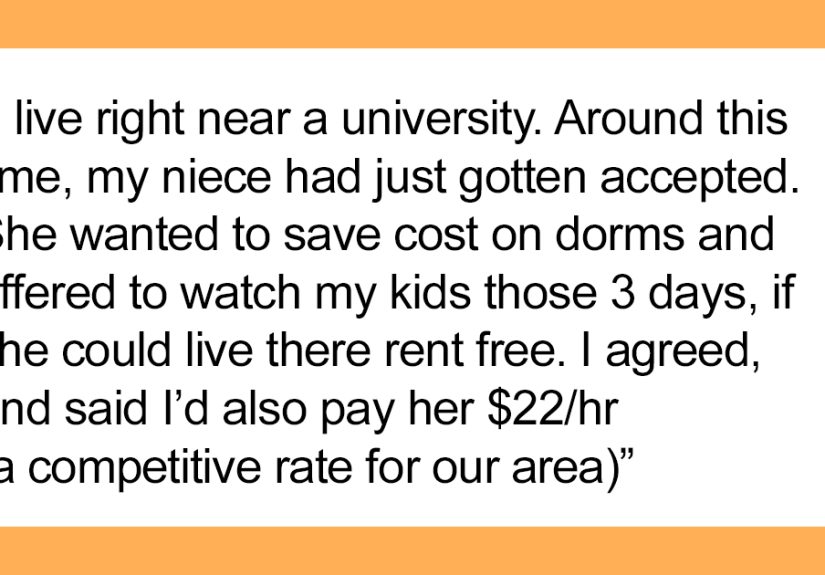
According to the original online post, the mom was raising two school-age children on her own while working long nursing shifts that stretched into the night. Because she needed dependable care after school and late into the evening, a live-in childcare arrangement made practical sense. Around the same time, her niece had been accepted to a nearby university and wanted to save money on housing. So the two made a deal: the niece would help care for the kids several days a week, and in return she would receive room, board, and pay.
For two years, the setup worked. That detail matters. This was not framed as a disaster from day one, nor was it a case of someone being tricked into unpaid labor. It was a functional, mutually beneficial arrangement. The niece had a stable place to live close to school. The aunt had someone she trusted caring for her children during the hours when many babysitters would rather be at home in sweatpants eating cereal over the sink.
Then life changed. The niece got an internship connected to her major and said she could no longer watch the children. Her aunt congratulated her, which is already more mature than many family group chats manage on a good day. But the aunt also explained that if the niece was no longer serving as the live-in nanny, she would need to move out so the room could go to someone who could fill that role.
That is the point where the online debate could have turned into a free-for-all. Instead, many commenters backed the mom. Why? Because to them, the issue was not “Should a struggling student get housing help?” It was “Can you end your side of a work-for-housing agreement and still expect the housing to remain untouched?” For a lot of people, the answer was a pretty firm no.
Why So Many People Sided With the Mom
The arrangement was a job, not unlimited charity
This is the biggest reason public opinion leaned toward the mom. The niece was not simply a relative crashing in the guest room because life had gotten expensive. She was living there under a specific agreement tied to childcare. Once that childcare ended, the logic of the living arrangement changed too.
That difference matters more than people sometimes admit. When family members help one another, emotions can blur the edges of the agreement. Suddenly a work arrangement gets treated like a lifelong moral debt. But housing in exchange for labor is still an exchange. Remove one side, and the whole thing stops being balanced.
Many readers seemed to view the aunt’s decision not as punishment, but as a practical response to a practical problem. She still needed nighttime childcare. She still had only one extra room. She still had children whose routine depended on a caregiver being present. Her niece’s new internship was good news for the niece, but it did not magically erase the aunt’s childcare needs. Bills do not pay themselves, and six-year-olds do not tuck themselves in with a polite handshake and a tax receipt.
Single parents often do not have the luxury of vague plans
This story also resonated because single parents, especially those working long or unpredictable shifts, rarely get to operate on wishful thinking. They need childcare that is reliable, safe, and realistic. That sounds obvious, but the internet recognized something important here: “Just find someone else” is easy advice when you are not the person trying to secure late-night care for two kids on a nurse’s schedule.
In the abstract, a live-out nanny might sound fine. In real life, late-night transportation, caregiver safety, fatigue, aftercare pickup, and routine consistency all matter. The mom was not asking for luxury. She was asking for coverage that matched her work hours and her children’s needs.
That is a big reason the niece’s suggestion did not land well online. Many people saw it as a solution optimized for the niece’s housing savings, not for the parent’s actual family logistics. And once the public framed it that way, sympathy shifted fast.
The internet has become much more sensitive to invisible caregiving labor
Another reason the story found support is that people are increasingly alert to the way caregiving labor gets minimized, especially when it happens inside families. For generations, relatives, particularly women, have been expected to absorb childcare, eldercare, emotional labor, scheduling labor, and general life-glue labor without much recognition. That does not mean every request for help is exploitative. It does mean people are more likely now to ask: Who is carrying the real weight here?
In this case, many readers concluded that the mom was not exploiting her niece. If anything, they thought the original arrangement had been generous. What triggered support for the mom was the perception that the niece wanted to keep receiving the housing benefit while stepping away from the labor that justified it. Once that happened, the internet’s fairness radar started blinking like a smoke alarm with a grudge.
Boundaries are not cruelty, even when family gets dramatic about them
Let’s say it plainly: boundaries often look rude to the person who benefits from there being none. That is part of why this story hit such a nerve. The mom’s choice felt harsh only if you ignore the context and focus solely on the words “move out.” But boundaries are not the same thing as rejection. Sometimes they are simply the adult version of saying, “This arrangement no longer works, and pretending otherwise will only make the mess bigger.”
That message especially resonated with parents, caregivers, and anyone who has ever been volunteered by their own relatives for labor they did not sign up for. Online support for the mom reflected a broader cultural shift: more people now recognize that preserving your household’s stability is not selfish. It is responsible.
Why the Situation Still Feels Emotionally Messy
Of course, just because the internet sided with the mom does not mean the niece became a cartoon villain twirling a mustache over a rent-free bedroom. Her side makes emotional sense too. She is young, in school, trying to build a future, and likely terrified of watching her savings disappear into rent, utilities, and other delightful rites of adulthood. To her, the aunt’s decision may have felt like support being withdrawn right when opportunity arrived.
That is what makes the story compelling. Both women were responding to real pressure. The niece wanted to take an important step forward professionally. The aunt needed to keep her children safe and her household functioning. Neither problem was fake. The conflict came from the fact that both needs could no longer fit inside the same one-bedroom arrangement.
And then there are the kids. Children get attached to caregivers. Even when a family makes the correct logistical decision, that does not mean the transition is painless. Kids may feel confused, clingy, sad, or unsettled when a familiar adult disappears from the daily routine. That emotional reality makes parents even more protective of stability. In other words, the aunt was not just filling a staffing slot. She was preserving the rhythm of her children’s lives.
What This Story Says About Modern Family Life
This was never just a juicy online family dispute. It reflects a bigger truth about modern American life: childcare is brutally expensive, single-parent households often carry enormous strain, and relatives frequently become part of the safety net whether or not everyone clearly defines the terms at the start.
That last part is where things usually go sideways. Families are great at creating flexible arrangements and terrible at documenting what happens when those arrangements end. Everyone is warm and collaborative when the setup is working. Then someone gets a new job, changes schools, starts dating, moves cities, or simply burns out. Suddenly the family is no longer discussing kindness. It is debating contracts in the emotional tone of a reality show reunion special.
The strongest lesson here is not that people should avoid helping relatives. It is that help needs structure. If housing is tied to childcare, say so clearly. If the role ends, define how much notice is expected. If children are attached to the caregiver, talk about transition plans early. If money is involved, be honest about what is pay, what is support, and what is temporary.
Put simply, family love and logistical clarity are not enemies. They are roommates. And if either one moves out, the whole household gets weird.
How Families Can Avoid This Kind of Blowup
- Define the arrangement in writing. Hours, duties, pay, housing terms, notice periods, and what happens if school or work schedules change should all be clear.
- Separate love from labor. You can adore a relative and still acknowledge that childcare is work. The two ideas can coexist without exploding.
- Plan the exit before the crisis. The best time to discuss “What happens if this stops working?” is before anyone is emotional, offended, or holding a suitcase.
- Think about the children, not just the adults. Stability matters. Caregiver changes should be explained calmly and gradually whenever possible.
- Do not confuse guilt with fairness. Feeling bad is not proof that a boundary is wrong. Sometimes it is just proof that a hard decision is, well, hard.
Experiences Families Quietly Recognize in Stories Like This
One reason this story spread so widely is that it feels familiar even to people who have never hired a nanny or offered a niece a guest room. A lot of families have lived some version of this tension. Maybe it was not a live-in childcare setup. Maybe it was a grandmother who became the default daycare plan, a sibling who always “just happened” to be free after school, or a college student relative who moved in “temporarily” and slowly became part-time caregiver, part-time household furniture, and full-time source of confusion about expectations.
Many parents know what it feels like when a childcare plan looks solid on paper and then collapses because someone’s schedule changes. A new job, an internship, a breakup, a commute, burnout, an evening class, or a simple shift in priorities can unravel the whole thing. For single parents, that kind of change does not just create inconvenience. It can threaten income, work performance, sleep, and the basic ability to get through the week without feeling like a human spreadsheet with anxiety.
There is also a very common experience hiding under the surface of this debate: the emotional weirdness of mixing family and employment. The moment money, housing, or childcare gets attached to a relative relationship, people start hearing different things. One person hears “agreement.” Another hears “support.” One hears “temporary.” Another hears “home.” One hears “job duties.” Another hears “but we’re family.” That mismatch is where resentment breeds like it pays rent.
Young adults may especially identify with the niece’s side of the story. College is expensive. Housing is expensive. Internships are often treated like golden tickets, and nobody wants to feel punished for pursuing one. It is easy to imagine a student thinking, “I’m finally getting career experience. Why does that mean I also lose my housing?” That feeling is real, even if the aunt’s decision was still the more reasonable one.
Parents, meanwhile, may recognize the aunt’s exhaustion immediately. There is a specific kind of panic that comes from realizing your childcare plan has an expiration date while your job remains extremely not optional. Add children who need dinner, homework help, supervision, bedtime, emotional consistency, and someone awake enough to function after dark, and suddenly this stops looking like a family misunderstanding and starts looking like an operations problem with tiny humans attached.
Another deeply relatable piece is the outside commentary from relatives who do not have to solve the problem themselves. Almost every family has at least one person who specializes in offering generous solutions that require someone else’s time, room, labor, sleep, or money. “Can’t you just make it work?” is a wonderful sentence when you are not the one making it work.
And then there are the kids, who often understand much less than the adults but feel much more than anyone realizes. When a caregiver leaves, children may not know the backstory about internships, rent, or scheduling conflicts. They only know that a person who used to pick them up, make dinner, or tuck them in is suddenly gone. That kind of change can hit hard, even in households where the adults made the right call.
That is why so many readers responded strongly to this story. It was not just about one mom and one niece. It was about the fragile, improvised systems families build to survive, and how quickly those systems can wobble when one piece changes.
Final Thoughts
In the end, people online supported the single mom because they saw a parent trying to protect her household, not a villain tossing a niece out into the cold for sport. The core logic was simple: if the room existed to support a childcare arrangement, and the childcare arrangement ended, the room had to serve the family’s current needs. That may not be cozy, but it is coherent.
The real takeaway is bigger than the viral headline. Family help can be beautiful. It can also become messy when affection replaces clarity and everyone assumes they mean the same thing. They often do not. The healthiest arrangements are the ones that respect both generosity and limits.
So yes, the internet backed the mom. Not because people have suddenly become anti-niece, anti-student, or pro-drama. They backed her because raising kids alone requires structure, childcare is real labor, and boundaries are sometimes the only thing standing between a functioning household and absolute chaos wearing tiny sneakers.







 Close
Close