
Table of Contents >> Show >> Hide
- Meet the Marble Teapot: When Craft Becomes Crush
- Why the Astier de Villatte Marble Teapot Has Design Icon Energy
- How to Style the Marble Teapot at Home
- Practical Notes (Because Beauty Still Has to Function)
- Get the Look (If the Real Thing Is Out of Reach)
- Conclusion: A Modern Classic Worth Obsessing Over
- Living with Desire: Experiences Around the Marble Teapot
Some pieces are just things. And then there are objects so charming, so unapologetically extra,
they flirt with you from the screen until you start calculating your bank balance in teapots.
The Marble Teapot from Astier de Villattecanonized by Remodelista as an “Object of Desire”is exactly that:
part sculpture, part heirloom, part “I have my life together” flex sitting quietly on your kitchen shelf.
Handcrafted in Paris, swirled with vintage-inspired marble patterns, and priced firmly in the
“this is art, not cookware” category, this teapot has become a cult favorite for design lovers who want
their tea ritual to feel as considered as their interiors. Let’s unpack why this marbled beauty has such
a grip on stylists, collectors, and anyone who has ever whispered, “I probably deserve this.”
Meet the Marble Teapot: When Craft Becomes Crush
A Parisian Original with Serious Pedigree
Astier de Villatte is renowned for its ethereal ceramics: hand-formed pieces made from dark terracotta clay,
finished with milky white or delicately patterned glazes, each signed by the artisan who shaped it. The marble
teapot sits squarely in this tradition. It’s crafted in their Paris workshop using old-world techniques:
stamping, molding, and hand-finishing rather than industrial mass production. The result is what devotees call
“perfectly imperfect”subtle variations in shape, glaze, and pattern that make every teapot feel one-of-a-kind.
The marbled exterior draws from 19th-century marbled papers and antique imagerybrought into the collection
through collaborations with New York design icon John Derian and a shared obsession with historical print
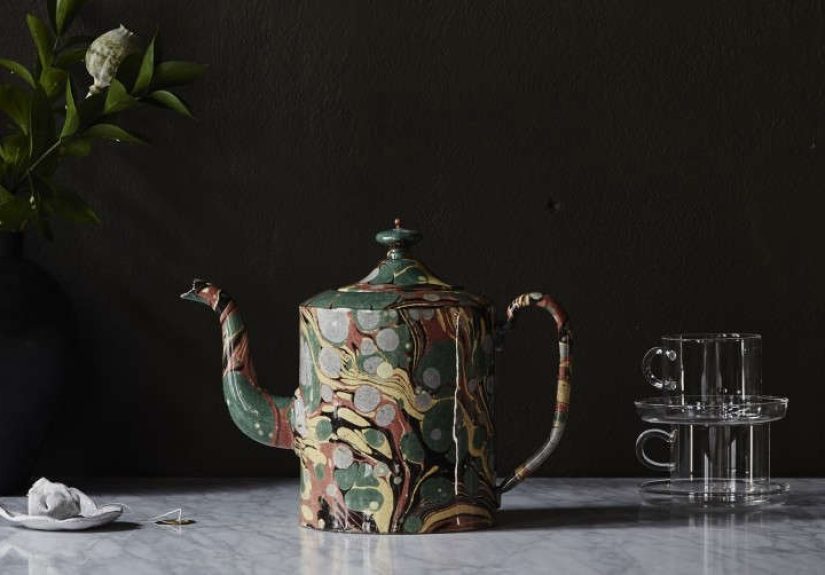
motifs. Think richly veined swirls of green, yellow, rust, blue, or red flowing across a sculptural silhouette:
an everyday vessel styled like a collectible.
The Marbleized Finish: Vintage Soul, Modern Drama
Unlike a simple solid-color glaze, the marble finish turns the teapot into a conversation piece. Each pattern
is slightly different, echoing hand-marbled book edges and old stationery. On a shelf, it reads as a design
object. On a tea tray, it quietly upstages everything else. It’s maximalist and refined at the same time:
a small-scale artwork that still knows how to pour.
Thoughtful Details that Make It Collectible
- Material: Dark terracotta clay with a marbleized glazed exterior and a light, food-safe interior.
- Craft: Hand-molded, hand-glazed, and stamped with the Astier de Villatte monogram and artisan initials.
- Look: Soft, organic form; generous handle; elegant spout; swirling pattern that never repeats exactly.
- Positioning: Sits in the same tier as artful tabletop pieces you buy once and then brag about forever.
Historically, versions of this teapot have been offered through curated retailers and galleries at luxury price
points. This is not the impulse purchase at the supermarket checkout. It’s the slow-burn,
“I stalked it online for weeks before committing” kind of acquisition.
Why the Astier de Villatte Marble Teapot Has Design Icon Energy
1. It Nails the “Useful Sculpture” Brief
Good design doesn’t just sit there; it changes how you experience a daily ritual.
This teapot does exactly that. Its rounded body and painterly surface give it the presence of an art object,
but it’s still a functioning teapot. On a credenza, it’s a focal point. On a table, it anchors the scene.
In photos, it reads as “editor-approved taste” without a single logo screaming for attention.
2. Perfect for Quiet Luxury (With a Wink)
The marble teapot fits beautifully into the quiet luxury aesthetic: soft forms, tactile finishes, an emphasis
on craftsmanship over branding. But it’s not boring. The marbled glaze has personalityalmost mischievous
which keeps it from feeling sterile or overly serious. It’s the piece that tells guests,
“Yes, I care about artisanship, but I also know how to have fun.”
3. A Natural Fit for Curated, Layered Interiors
Whether your space leans Scandinavian, Parisian bohemian, California casual, or Brooklyn industrial,
this teapot plays well with others. Pair it with linen tablecloths and vintage silverware,
or set it beside minimalist stoneware mugs and a brutalist tray. It holds its own without clashinga rare
quality in statement pieces.
How to Style the Marble Teapot at Home
On Open Shelving
Place the teapot at eye level on open kitchen shelves alongside white ceramics, clear glassware, and a few
well-thumbed cookbooks. The marbling becomes the visual “break” that keeps the shelf from feeling flat.
Let it sit slightly off-center, like it just landed there casually (we both know you measured the spacing).
On a Tea or Coffee Station
Use the teapot as the anchor of a dedicated tea corner: stacked cups, a linen napkin, a small jar of loose-leaf
tea, maybe a brass spoon. The mix of everyday accessories against the richly patterned teapot creates a
boutique-hotel vibe at homeminus the resort fee.
Styled as an Object, Even When It’s Empty
Not brewing? No problem. The Marble Teapot can moonlight as a prop on a console table, alongside candles,
flowers, or art books. Because it’s sculptural and painterly, it works like a small ceramic artwork.
If you’re the type who rotates decor with the seasons, this piece transitions effortlessly from cozy winter
teatime to colorful summer brunch.
Layered with Other Astier de Villatte Pieces
If you already collect Astier de Villatte, the marble teapot is a charismatic outlier that still fits in.
Its pattern brings subtle drama next to the brand’s classic white pieces, giving your collection visual rhythm:
calm, calm, calm… and then: boom, marbled glory.
Practical Notes (Because Beauty Still Has to Function)
Care & Use
The Marble Teapot is designed more like fine tableware than hard-wearing camp gear. Gentle handwashing is
recommended; treat it like you would a piece of hand-painted china. Avoid thermal shock, abrasive scrubbers,
and the microwave. It’s durable for normal, thoughtful usebut if you’re boiling it dry on high heat,
this is not the teapot for you.
Is It Worth the Investment?
Let’s be honest: you can absolutely make tea in a $20 stainless steel kettle. The reason people choose an
Astier de Villatte marble teapot has less to do with necessity and more to do with values:
supporting traditional craftsmanship, living with handmade objects, and turning a daily habit into a small,
beautiful ritual.
As a design investment, it checks the right boxes:
- Timeless form that won’t date quickly.
- Recognizable design house with strong collector appeal.
- Limited production and hand-finishing, which support long-term desirability.
- Versatility: display, serve, style, photograph.
If your home philosophy leans toward “buy fewer, better things,” this teapot fits.
It’s not an impulse buy; it’s a deliberate choice that brings daily delight.
Get the Look (If the Real Thing Is Out of Reach)
Not ready to commit to the real Astier de Villatte piece yet? You can nod to the same aesthetic by:
- Choosing marbled or painterly-glazed teapots from smaller artisanal ceramicists.
- Mixing a neutral tea set with one boldly patterned hero piece.
- Incorporating marbled trays, paper, or linens to echo the motif without copying it literally.
But if you ever do decide to invest in the original, it will slide seamlessly into your setup and instantly
elevate everything around it.
Conclusion: A Modern Classic Worth Obsessing Over
The Marble Teapot from Astier de Villatte earns its “Object of Desire” status because it lives at the intersection
of story, craft, and sheer visual joy. It’s rooted in real technique, real artisans, and real historyand yet it
feels lighthearted, whimsical, and utterly of-the-moment. Whether you’re a stylist, a collector, a design-obsessed
homebody, or simply someone who believes tea tastes better from something beautiful, this piece is designed to
delight you every single time you reach for it.
sapo:
The Marble Teapot from Astier de Villattecelebrated by Remodelista as a true “Object of Desire”is more than a vessel for hot water. It’s a hand-crafted Parisian art piece, swirled with vintage-inspired marble patterns, beloved by stylists, collectors, and design lovers worldwide. From its terracotta core and painterly glaze to its quiet-luxury presence on your table or shelf, this teapot turns the simple act of making tea into a curated ritual. Here’s what sets it apart, how to style it, and why it just might be the one indulgent object you never regret.
Living with Desire: Experiences Around the Marble Teapot
What happens after the moment you finally bring this teapot homeafter the late-night scrolling, the saved posts,
the “should I, shouldn’t I” math you definitely did on your phone calculator?
Owners often describe a very particular shift: the teapot stops being “precious” in a fragile way and becomes
precious in an everyday way. It’s the piece they reach for when a friend comes over, the one they gently rinse
by hand while the kitchen is quiet, the still life that makes chaotic countertops look intentional.
Picture this: a Saturday morning, sunlight coming in at a smugly flattering angle, coffee table stacked with
Remodelista-style interiors books, a linen runner doing its effortless-wrinkle thing. The Marble Teapot sits
in the center with a few mismatched cups. Nobody comments at first. Then someone picks it up, notices the weight,
the smoothness of the glaze, the little variations in the marble. They flip it slightly, spot the mark of the
workshop and the artisan initials. You get The Look: “Okay, this is special.”
In real homes, this teapot tends to trigger micro-rituals. People start brewing loose-leaf tea instead of using
teabags. They slow down long enough to pour properly. They take more photos of their table.
They start editing out ugly packaging and plastic from their counters because suddenly, this one beautiful object
raises the standard for everything around it. It’s not about perfection; it’s about intention.
Stylists who work with high-end interiors often use the Marble Teapot as a kind of shorthand. Place it in a shot,
and instantly the scene signals “curated,” “global,” “collected over time.” It pairs as naturally with
flea-market silver as with designer flatware. In minimalist spaces, it breaks the monotony; in maximalist homes,
it harmonizes with color and pattern instead of fighting it.
Interestingly, many people who invest in it don’t reserve it for special occasions. They use itwith care, yes,
but without fear. They pour everyday breakfast tea from it. They bring it out on random Tuesdays. That’s where its
real value shows up: an object of desire that doesn’t stay trapped behind glass, but participates in your life.
Over time, it absorbs memorieslate-night talks, solo afternoons, holiday breakfastsand becomes less of a
styled accessory and more of a personal emblem of how you choose to live.
And that’s the quiet magic: the Marble Teapot from Astier de Villatte doesn’t just decorate a room.
It subtly upgrades your habits, your rituals, and your sense of what “everyday luxury” can look like.
If an object can make you slow down, pour carefully, and enjoy your own home morethat desire starts to feel
completely justified.







 Close
Close