
Table of Contents >> Show >> Hide
- What “Hands-Free” Really Means Here (And Why That’s Still Awesome)
- Meet the Robo-Recorder: The Build That Sparked the Buzz
- Why the Recorder Is Sneaky-Hard to Automate
- Under the Hood: How the Hardware Stack Works (Without the Smoke)
- The Software: Turning Songs Into Hole Patterns
- Why Build This at All? Because It’s Useful in More Ways Than One
- If You Want to Make One Better, Here’s Where Builders Usually Go Next
- The Bigger Trend: Musical Robots Are a Whole Genre Now
- Conclusion
- Hands-Free Recorder Robot: Real-World Experiences (500+ Words)
If the word “recorder” instantly transports you back to elementary schoolwhere you confidently blasted out
“Hot Cross Buns” like it was your world tourcongrats, you’ve got the same musical origin story as about
a billion other humans. The recorder is simple, cheap, and surprisingly capable… which is exactly why it’s
also the perfect instrument to strap to a robot and turn into a tiny wind-powered science experiment.
Enter the hands-free recorder robot: a mechanical helper that handles the finger holes for you, leaving you
to focus on the one job a robot still can’t do as naturally (yet): making musical breath behave. It’s funny,
clever, andunexpectedlyan excellent lesson in why wind instruments are a lot more complicated than they look.
What “Hands-Free” Really Means Here (And Why That’s Still Awesome)
Let’s clear up the headline magic. This kind of build doesn’t usually replace the lungsat least not in its
first version. Instead, it replaces your fingers. A typical soprano recorder has eight tone holes (seven on
top and one thumb hole underneath). Cover and uncover those holes in specific patterns, and you get notes.
Do it quickly and accurately, and you get melodies. Do it slightly wrong, and you get… the sound that makes
family members suddenly remember they “left something in the car.”
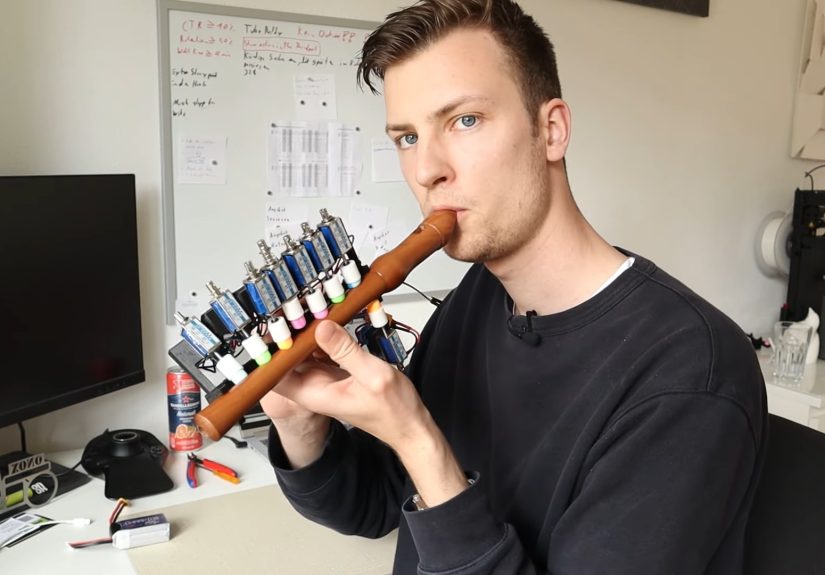
A recorder-playing robot attacks the “accurate finger placement” part with pure determination: eight actuators
(often solenoids) mounted on a frame, each one assigned to a hole. The microcontroller tells them when to press
down and when to release. Your hands can hold the instrument, hold a mic, conduct dramatically, or just exist
peacefully without doing recorder gymnastics.
Meet the Robo-Recorder: The Build That Sparked the Buzz
One widely shared example comes from maker Luis Marx, who built a recorder “helper robot” after deciding
that building a piano-playing finger exoskeleton was… a bit too ambitious for a casual afternoon. The recorder,
in comparison, is a tidy target: fewer moving parts, simpler mechanics, and a clear rule set (holes open/closed).
Still, “simpler” does not mean “easy.”
The short version of the hardware
- Eight solenoids mounted on a 3D-printed frame, one per hole
- Foam earplugs used on the solenoid tips to help create an airtight seal
- An Arduino Nano controlling the sequence of presses/releases
- MOSFET driver modules to handle the current that solenoids demand
- A small LiPo battery powering the whole “tiny robot bandmate” setup
The result: the robot can play recognizable melodies while you supply the airflow. It’s a great “why didn’t I
think of that?” projectright up until you try to make it sound in-tune, consistently, for more than five notes.
Why the Recorder Is Sneaky-Hard to Automate
1) Airtight matters more than you think
On a recorder, a tiny leak is a big deal. If a hole isn’t fully sealed, the pitch can wobble or go outright
wrong. Humans automatically compensate with soft fingertips, micro-adjustments, and a lifetime of not being
made of metal. Solenoids don’t naturally do “soft.” They do “thunk.”
That’s why soft interfaceslike foam tipsare such a smart move. Foam compresses slightly, conforms to small
imperfections, and helps seal holes even when alignment isn’t perfect. In other words: it’s a cheap, brilliant
substitute for a fingertip you can buy in bulk.
2) Wind instruments are not just “buttons”
A recorder’s sound isn’t only about which holes are closed. Breath pressure and articulation matter. Notes can
crack, go sharp, go flat, or jump octaves depending on airflow. That’s why many recorder robots start as “finger
robots” and leave “breath robot” for a later upgrade (usually after the builder recovers emotionally).
3) The upper register demands finesse
If you’ve ever played beyond beginner tunes, you know the thumb hole becomes a whole situation. Many recorder
notes in higher registers require the thumb hole to be partially uncovered (“half-holing”), plus changes in breath
pressure. A simple open/close actuator can handle basic melodies, but advanced range and chromatic flexibility
quickly turn into a control problemmechanical and musical.
4) Noise and timing are part of the instrument now
Solenoids are honest. They announce themselves. For percussion robots, that click can blend into the vibe. For a
recorder, you might not want your melody accompanied by eight tiny door knocks. Timing also matters: actuators need
consistent response times so notes start cleanly. Small delays can smear fast passages into something that sounds
like a robot trying to text while running.
Under the Hood: How the Hardware Stack Works (Without the Smoke)
Solenoids as “robot fingers”
Solenoids are popular in musical robots because they’re straightforward: energize the coil, the plunger moves.
That motion can press a key, tap a drum, or (in this case) seal a tone hole. The tradeoffs: they can be power-hungry,
they can heat up, and they can be loud. Picking the right stroke length and mounting geometry is everything.
Drivers, power, and why MOSFETs show up everywhere
An Arduino pin can’t safely drive a solenoid directly. Solenoids draw far more current than a microcontroller can
supply, and they generate voltage spikes when switched off. That’s why builders use driver circuitsoften MOSFETs
with protection componentsto safely switch the solenoids while keeping the Arduino from having a dramatic,
one-time-only performance.
3D printing solves the “Where do the fingers go?” problem
The recorder’s holes aren’t laid out to be friendly to off-the-shelf brackets. A 3D-printed frame lets you place
actuators precisely, create guides, add adjustment points, and hold everything rigidly enough to keep alignment
stable. Bonus: it makes the whole thing look like a legitimate invention instead of “eight solenoids held on by
vibes and zip ties.” (Zip ties are still allowed, though. We’re not monsters.)
The Software: Turning Songs Into Hole Patterns
At a basic level, the software’s job is to flip eight outputs on and off at the right times. But musically, what
you’re really doing is mapping notes → fingerings → solenoid states → timed actions.
If you hardcode a melody, you can get something playable quickly. If you want to play any song on demand,
you eventually want a standard input formatmost commonly MIDI.
Hardcoded melodies: quick win, limited playlist
Hardcoding is exactly what it sounds like: the program contains a list of notes (or hole patterns) and durations.
It’s perfect for proving the concept and demoing familiar tunes. The downside is obvious: every new song becomes a
mini coding project.
MIDI control: the glow-up upgrade
MIDI is basically sheet music for electronics: “play note X now, for Y long, at velocity Z.” It’s used everywhere,
from keyboards to DAWs. A recorder robot that accepts MIDI becomes a lot more flexible: you could feed it a MIDI
file, play from a phone or laptop, or even perform live with a controller.
A simple mapping concept (human-readable)
The idea can be represented like this:
The real-world complication is that recorder fingerings can vary slightly by instrument and style, half-holing may
be needed for some notes, and breath control influences pitch and tone. But for a first pass focused on beginner
melodies, a fixed fingering table can get you surprisingly far.
Why Build This at All? Because It’s Useful in More Ways Than One
It’s a fantastic learning tool
This project is basically a crash course in mechanics, electronics, and musical logic. You’re solving alignment,
force, timing, and control problemsand you get instant feedback because the output is literally audible. If it
sounds wrong, something is wrong. Engineering doesn’t always come with a soundtrack, so enjoy it.
It can support accessibility and adaptive music-making
Hands-free (or hands-light) musical interfaces can matter for people with limited finger mobility. There are also
adaptive recorders and accessories designed to make hole coverage easier. A robotic helper adds another pathway:
rather than modifying the instrument for the player’s hands, you let the player control the instrument through a
different input methodbuttons, foot pedals, switches, or a simplified controller.
Importantly, this isn’t about “replacing” musicianship. It’s about expanding who gets to participate and how.
Music isn’t a club where the entry fee is perfect finger dexterity.
It’s performance art in the best way
A recorder robot is inherently entertaining. It’s nostalgic, slightly ridiculous, and oddly impressiveespecially
when it plays something recognizable. Add a MIDI interface and suddenly you’ve got an instrument you can sequence,
remix, and choreograph. It’s equal parts music tech demo and “I cannot believe this works.”
If You Want to Make One Better, Here’s Where Builders Usually Go Next
1) Improve sealing and alignment
Airtight seals are the difference between “Hey, that’s a melody!” and “Is your robot ok?” Soft tips, adjustable
mounts, and guides that keep plungers centered over holes are the practical upgrades that pay off immediately.
2) Reduce mechanical noise
Adding damping materials, experimenting with softer contact surfaces, or using different actuator types can make
the robot sound more like an instrument and less like a tiny office stapler orchestra.
3) Add MIDI (or at least a more flexible song input)
MIDI unlocks rapid song changes and integration with music software. It also opens the door to quantization,
tempo control, and composing specifically for what the robot can do well.
4) Automate breath (carefully)
The next leap is airflow controlusing a small pump, bellows, or pressure-regulated air source. But breath control
isn’t just “more air = louder.” It shapes intonation, attacks, and register changes. Done well, it turns the robot
from a novelty into a genuinely expressive instrument. Done poorly, it turns it into a whistle with opinions.
The Bigger Trend: Musical Robots Are a Whole Genre Now
Solenoid-driven instruments show up all over maker culture: drum bots, robotic pianos, bottle percussion rigs,
and kinetic installations that play physical objects like they’re synthesizers you can touch. The recorder robot
stands out because flute-family instruments demand both precise hole control and nuanced airflowso even a “basic”
version teaches a ton about the boundary between mechanical control and musical expression.
And honestly? That’s the charm. A recorder robot is a reminder that music is physics wearing a party hat. Sometimes
the party hat is 3D-printed.
Hands-Free Recorder Robot: Real-World Experiences (500+ Words)
The most interesting thing about a recorder robot isn’t the first time it plays a noteit’s everything that
happens around that moment. Makers who attempt a hands-free recorder build often describe a three-phase
journey: the “this will be easy” phase, the “why is it always out of tune?” phase, and finally the “okay, it’s
playing a real melody and I feel like a wizard” phase.
In the early stage, the experience is delightfully straightforward. You mount an actuator over a hole, toggle it,
and you immediately hear the pitch change. It’s the kind of instant feedback that makes you feel like you’re
speedrunning an engineering degree. But then reality shows up with a clipboard. A hole that’s almost sealed is
still a leak, and leaks are brutally audible. Many builders report that their first “song” sounds like a familiar
tune being played through a screen doorrecognizable, but wobbly, airy, and slightly haunted.
That’s usually when the build becomes less about “robotics” and more about “tiny, obsessive mechanical alignment.”
You start shimming brackets, adjusting angles by millimeters, and realizing that your instrument is not perfectly
symmetrical because it was made for squishy human fingers, not metal plungers. Soft tipsfoam, rubber, silicone
feel like a small detail until you try them and the pitch suddenly stops misbehaving. The experience is a classic
maker lesson: sometimes the magic isn’t in the microcontrollerit’s in the material that touches the thing.
Then there’s the breath side of the experience, which is where “hands-free” turns into “hands-free but not
brain-free.” People who demo these robots often notice that the robot can nail the fingering pattern and still
sound wrong if the airflow is inconsistent. Blow too hard, and notes can squeal or jump. Blow too softly, and the
tone gets weak or unstable. Some builders end up practicing breath control more seriously than they ever did in
school, because now they’ve got a robot that refuses to take blame for bad phrasing. (Robots are like that.)
In classroom demos, the experience tends to be hilarious and surprisingly educational. Students who roll their
eyes at “music theory” suddenly care a lot when a robot is involved. The robot becomes a visual explanation of
fingering: “This pattern of closed holes makes this pitch.” It can also spark conversations about acoustics,
control systems, and why musical performance isn’t just pressing the right buttons. A music teacher can use it to
show that “correct notes” and “good sound” are related but not identicalbecause humans shape tone with breath,
timing, and subtle motion that a simple actuator rig doesn’t automatically replicate.
For accessibility-focused experimentation, the experience can be genuinely moving in a practical way. A hands-free
fingering system suggests a future where someone who can’t reliably cover tone holes could still participate in
recorder-based music-making using alternate controlslike larger buttons, switches, or a simplified interface.
Even when a prototype is clunky, it can demonstrate a powerful idea: musical participation can be redesigned.
The “right way” to play isn’t always the only way to play.
And finally, there’s the performance experiencebecause yes, people perform with these. The best reactions happen
when the audience hears the first clean phrase and realizes it’s not a prank sound effect. It’s a physical
instrument being played by a physical machine in real time. The clicks and whirs become part of the character,
like a drummer’s sticks or a guitarist’s fret noise. It’s a reminder that every instrument has mechanicssome
instruments just admit it louder.






 Close
Close