
Table of Contents >> Show >> Hide
- What Is KM3NeT, and Why Is It Under the Sea?
- The Record-Breaking Event: KM3-230213A
- Why Neutrinos Are Called “Ghost Particles”
- How a Deep Sea Telescope Detects a Particle From Space
- Why 220 PeV Is Such a Big Deal
- Where Did the Most Energetic Cosmic Neutrino Come From?
- Why One Event Can Still Change the Conversation
- KM3NeT vs. IceCube: Two Giant Neutrino Eyes
- What This Means for Neutrino Astronomy
- Why the Mediterranean Sea Is a Perfect Science Partner
- Specific Examples That Show Why This Discovery Matters
- What Scientists Still Need to Learn
- Experiences and Reflections: What KM3-230213A Teaches Us About Looking at the Universe
- Conclusion: A Ghost Particle With a Giant Message
- SEO Tags
Somewhere under the Mediterranean Sea, in a place where sunlight gave up several kilometers ago and fish probably mind their own business, a telescope caught a visitor from the deep universe. Not a comet. Not a meteor. Not a dramatic alien postcard. It was a neutrino: one of the strangest, shyest, most slippery particles known to physics.
The event, named KM3-230213A, was detected by the KM3NeT deep sea telescope through its ARCA detector on February 13, 2023. After extensive analysis, scientists reported that the particle was consistent with a cosmic neutrino carrying an estimated energy of about 220 petaelectronvolts, or 220 PeV. That is not just high energy. That is “somebody call the universe’s insurance company” energy.
This discovery became a landmark in neutrino astronomy because it opened a new observational window into the extreme universe. The neutrino likely came from far beyond the Milky Way, possibly from an environment where black holes, cosmic rays, magnetic fields, and violent astrophysical engines behave like nature’s most overqualified particle accelerators.
What Is KM3NeT, and Why Is It Under the Sea?
KM3NeT stands for Cubic Kilometre Neutrino Telescope. It is a massive European research infrastructure built on the floor of the Mediterranean Sea. Unlike ordinary telescopes that stare at visible light, KM3NeT watches for tiny flashes of blue light produced when high-energy particles move through seawater faster than light can travel through that medium.
This light is called Cherenkov radiation. Think of it as the optical version of a sonic boom. When a neutrino interacts near the detector, it can produce a charged particle, often a muon, that streaks through the water and leaves behind a faint trail of light. KM3NeT’s job is to catch that trail, reconstruct the particle’s path, and estimate the energy of the original neutrino.
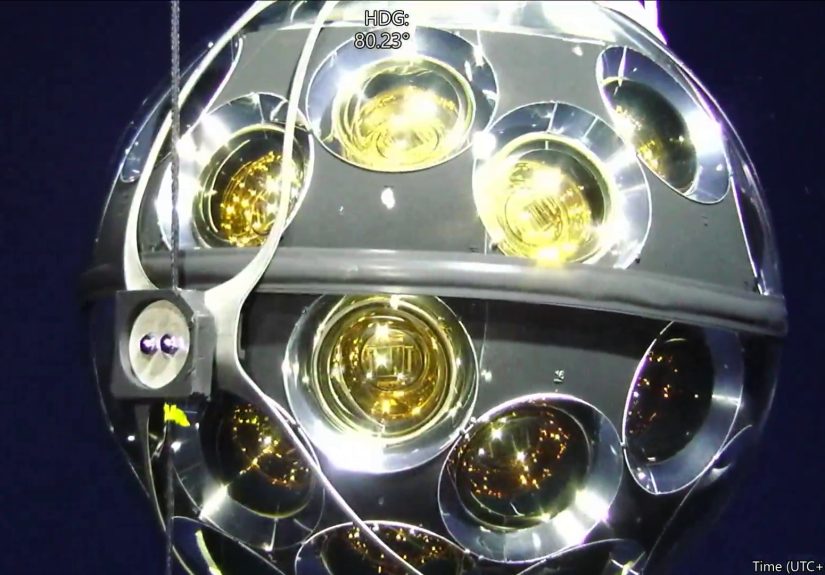
The detector uses long vertical lines anchored to the seabed. These lines hold spherical optical modules packed with light-sensitive photomultiplier tubes. Each module acts like a patient underwater eye, waiting in darkness for a blink of evidence from the cosmos.
The Record-Breaking Event: KM3-230213A
The star of this scientific drama is KM3-230213A. On February 13, 2023, the ARCA detector recorded an extremely energetic muon crossing the detector. The track was reconstructed as nearly horizontal, suggesting that the muon was not a typical atmospheric background event but was probably produced by a cosmic neutrino interacting near the detector.
The muon itself was estimated to carry around 120 PeV of energy, with substantial uncertainty. From that, researchers inferred that the parent neutrino had a likely energy of roughly 220 PeV. For perspective, one PeV equals one quadrillion electronvolts. So 220 PeV is 220 million billion electronvolts. This is the kind of number that makes calculators sit quietly and reconsider their career choices.
Before this detection, the highest-energy neutrinos observed were far lower in energy. KM3-230213A was reported as roughly 20 to 30 times more energetic than previous record-setting neutrino detections. That matters because it moves neutrino astronomy into a regime that scientists had long predicted but had not clearly observed.
Why Neutrinos Are Called “Ghost Particles”
Neutrinos are fundamental particles with almost no mass and no electric charge. They are produced in nuclear reactions, supernovae, black hole environments, particle collisions, and interactions involving cosmic rays. Trillions of low-energy neutrinos pass through your body every second, which sounds dramatic until you realize they almost never interact with anything.
That is why neutrinos are nicknamed ghost particles. They can cross planets, stars, and enormous stretches of space without being deflected by magnetic fields or easily absorbed by matter. For astronomers, this is excellent news. Light can be blocked by dust. Charged cosmic rays can be bent by magnetic fields. Neutrinos, however, travel in a straighter line from their source, carrying information from places that ordinary telescopes may struggle to see.
The problem is that catching a neutrino is like trying to catch a rumor with a fishing net. You need huge detectors, incredibly sensitive instruments, clean detection environments, and lots of patience. KM3NeT uses the Mediterranean Sea itself as part of the detector, turning deep water into a gigantic scientific listening device.
How a Deep Sea Telescope Detects a Particle From Space
The phrase “deep sea telescope” sounds like it should be used to watch squid with mysterious hobbies. But KM3NeT is not looking at marine life. It is using the deep sea because water is transparent, dark, naturally shielded from many surface disturbances, and available in enormous volume.
When a high-energy neutrino interacts with matter near the detector, it can create a muon. The muon travels through seawater and emits Cherenkov light. KM3NeT’s optical modules record the timing and brightness of that light. Scientists then use those data points to reconstruct the particle’s direction, path, and energy.
In the case of KM3-230213A, the signal was powerful enough to be seen by a significant portion of the active detector. Even more remarkable, ARCA was still under construction. At the time of the event, it had only a fraction of its final planned detection lines installed. In other words, KM3NeT caught a record-breaking cosmic messenger before the full telescope was even complete. That is like landing a championship shot during warmups.
Why 220 PeV Is Such a Big Deal
A 220 PeV neutrino is not “energetic” in the everyday sense. It will not heat your coffee, charge your phone, or push your bicycle uphill. But for a single subatomic particle, this energy is astonishing. Particle physicists compare such energies with those reached in human-made accelerators, and the comparison makes Earth’s biggest machines look modest.
The Large Hadron Collider is the most powerful particle accelerator ever built by humans. Yet this neutrino’s inferred energy was thousands of times greater than the energy scale of individual particle collisions at the LHC. Nature, as usual, has been running the deluxe version of physics without asking for a building permit.
This energy range is important because it may connect neutrino astronomy with the mystery of ultra-high-energy cosmic rays. Cosmic rays are high-energy particles, often protons or atomic nuclei, that bombard Earth from space. Scientists still do not fully know what accelerates the most extreme cosmic rays. Ultra-high-energy neutrinos could be clues left behind by those same cosmic accelerators.
Where Did the Most Energetic Cosmic Neutrino Come From?
The honest answer is: scientists do not know yet. And in science, “we do not know yet” is not a weakness. It is often where the good stuff begins.
The neutrino likely came from outside the Milky Way. Possible sources include active galactic nuclei, blazars, gamma-ray bursts, supermassive black holes, or interactions between ultra-high-energy cosmic rays and background radiation spread across the universe. Each idea has strengths, but no single source has been confirmed.
Could It Be From a Blazar?
Blazars are galaxies with supermassive black holes launching jets of energetic particles almost directly toward Earth. They are among the universe’s most dramatic engines, which is another way of saying they are black holes with a megaphone. Because blazars can accelerate particles to extreme energies, they are natural suspects in the hunt for high-energy neutrino sources.
Could It Be Cosmogenic?
Another exciting possibility is that KM3-230213A could be a cosmogenic neutrino. These are expected to form when ultra-high-energy cosmic rays interact with background photons, including ancient light left over from the early universe. Detecting cosmogenic neutrinos would help scientists understand where the most powerful cosmic rays come from and what they are made of.
Could It Point to New Physics?
Some researchers are also exploring whether this event could challenge current models or hint at physics beyond the standard explanations. That does not mean the discovery automatically proves exotic new particles or wild cosmic scenarios. It means the event is energetic enough, rare enough, and unusual enough to make scientists ask bigger questions.
Why One Event Can Still Change the Conversation
In everyday life, one data point is usually not enough. If one person says your cooking is good, they may be polite. If twenty people ask for seconds, you may have evidence. Physics is similar: one event is powerful, but repeated detections are needed to build a full picture.
Still, KM3-230213A is not just any single event. It sits in a previously unexplored energy range. It confirms that neutrinos with energies around hundreds of PeV can be detected. It also suggests that the universe may produce more ultra-high-energy neutrinos than some models expected.
This is why the discovery matters. It does not close the case. It opens the file, highlights three pages, and leaves a sticky note saying, “Something very interesting is happening here.”
KM3NeT vs. IceCube: Two Giant Neutrino Eyes
KM3NeT is not the only major neutrino observatory in the world. The IceCube Neutrino Observatory at the South Pole has played a leading role in high-energy neutrino astronomy. IceCube uses Antarctic ice instead of seawater, but the basic idea is similar: detect Cherenkov light from charged particles produced by neutrino interactions.
Together, IceCube and KM3NeT give scientists complementary views of the neutrino sky. IceCube observes from deep ice in Antarctica, while KM3NeT observes from deep water in the Northern Hemisphere. This global coverage matters because the universe is not polite enough to send particles from convenient directions.
KM3NeT’s record-setting detection is especially exciting because it occurred while the detector was still growing. As more detection lines are installed, its sensitivity should improve, giving astronomers a better chance of catching additional ultra-high-energy neutrinos and possibly tracing them to their sources.
What This Means for Neutrino Astronomy
Astronomy used to be mostly about light. Then came radio waves, X-rays, gamma rays, gravitational waves, cosmic rays, and neutrinos. Modern astronomy is increasingly multi-messenger astronomy, which means scientists combine different signals to understand the same cosmic events.
A neutrino like KM3-230213A is valuable because it may come from a place where particles are accelerated to energies beyond anything we can produce on Earth. If scientists can connect future neutrinos with gamma-ray observations, gravitational waves, or known active galaxies, they may finally identify the engines that power the most extreme cosmic rays.
The detection also helps refine models of the high-energy universe. If more neutrinos appear at similar energies, physicists may need to update predictions about cosmic ray sources, particle acceleration, and the density of high-energy neutrino events. If they do not appear, KM3-230213A may remain a rare but important clue.
Why the Mediterranean Sea Is a Perfect Science Partner
The Mediterranean may be famous for beaches, history, seafood, and postcards that make office workers question their life choices. But for physicists, it also offers a deep, dark, transparent environment suitable for neutrino detection.
KM3NeT’s underwater location provides shielding from many forms of noise while allowing the detector to monitor a huge volume. The deep sea also lets scientists build a three-dimensional array of sensors across long distances. When a particle passes through, the timing of light flashes across many modules becomes a cosmic breadcrumb trail.
Maintaining such a detector is not easy. Saltwater, pressure, marine activity, cables, deployment logistics, and remote operations all add complexity. This is Big Science with a scuba-diving personality: part astrophysics, part engineering, part “please let the underwater electronics behave today.”
Specific Examples That Show Why This Discovery Matters
Example 1: Cosmic Ray Origins
The highest-energy cosmic rays arrive at Earth with incredible energy, but because many are charged particles, magnetic fields bend their paths. That makes it hard to trace them back to their sources. Neutrinos do not have electric charge, so they can travel straighter paths. A neutrino like KM3-230213A may help identify the cosmic machines that accelerate matter to extreme energies.
Example 2: Black Hole Jets
Supermassive black holes can launch jets that stretch across enormous distances. If particles inside those jets collide with radiation or matter, they may produce neutrinos. Detecting ultra-high-energy neutrinos gives researchers a new way to test how powerful those jets really are.
Example 3: Early-Universe Background Light
If the event is cosmogenic, it may be connected to interactions between cosmic rays and ancient background radiation. That would make the neutrino not only a particle but also a messenger carrying information about cosmic history, particle composition, and the long journey across intergalactic space.
What Scientists Still Need to Learn
The biggest unanswered question is the source. Scientists need more events with similar energies, better directional information, and coordinated observations from other telescopes. A single spectacular neutrino is thrilling, but a pattern would be transformative.
Researchers also need to understand how common these events are. If KM3NeT detects more ultra-high-energy neutrinos, then current models may need to be adjusted. If similar events remain extremely rare, scientists will need to explain why this one appeared when it did, especially while ARCA was only partially built.
Either way, the discovery has already done something important. It proved that the deep sea can catch particles from some of the universe’s wildest environments, and it showed that neutrino astronomy is entering a more powerful phase.
Experiences and Reflections: What KM3-230213A Teaches Us About Looking at the Universe
One of the most fascinating things about the KM3NeT discovery is how it changes the emotional experience of astronomy. Most people imagine space science as looking upward: telescopes on mountaintops, observatories in orbit, people staring at the night sky with coffee and questionable sleep habits. KM3NeT flips that picture upside down. To study the most energetic cosmic neutrino ever observed, scientists looked downdeep into the sea.
That contrast is beautiful. A particle may have crossed millions or billions of light-years, passed through galaxies, avoided countless collisions, entered Earth, and then revealed itself in the darkness of the Mediterranean. The universe whispered, and the ocean heard it.
For science communicators, this story is a gift. It has everything: ghost particles, black holes, deep-sea technology, record-breaking energy, and a mystery source. It is also a reminder that discovery is rarely neat. KM3-230213A did not arrive with a label saying, “Hello, I came from this exact blazar, please update your models accordingly.” Instead, it left a track, a flash, and a puzzle.
That is often how real science feels. It is not a straight road from question to answer. It is a strange hike through uncertainty, where every clue helps but no clue explains everything. Scientists must compare models, test backgrounds, estimate uncertainty, and resist the temptation to declare victory too early. The excitement is real, but so is the caution.
The event also gives readers a useful way to understand scale. Human technology is powerful, but the cosmos operates on levels that humble us. We build accelerators, detectors, satellites, and supercomputers, and then nature casually sends a particle with energy far beyond what our machines can produce in a single particle. It is not insulting. It is inspiring. The universe is not showing off; it is inviting us to keep up.
There is also a practical lesson in patience. KM3NeT was not fully complete when the event appeared. That means years of planning, engineering, funding, deployment, calibration, and collaboration were already paying off before the final structure was in place. Big discoveries often depend on systems built by people who may not know exactly when the breakthrough will arrive. They build anyway.
For students and curious readers, KM3-230213A is a perfect example of why physics is not just equations on a chalkboard. It is engineering in saltwater. It is software reconstructing nanosecond timing differences. It is international teamwork. It is a detector at the bottom of the sea listening for particles from beyond our galaxy. It is the kind of story that makes the phrase “real science” feel larger than any textbook page.
Most importantly, this discovery reminds us that the universe still has surprise left in it. Even after centuries of astronomy and decades of particle physics, a single neutrino can arrive and make experts pause. That pause matters. It is the moment before new questions form, before new instruments improve, before new theories compete, and before the next messenger arrives.
Conclusion: A Ghost Particle With a Giant Message
The most energetic cosmic neutrino ever observed by the KM3NeT deep sea telescope is more than a record. It is evidence that the universe can produce neutrinos at energies previously beyond direct observation. It is a clue about cosmic accelerators, a challenge to existing models, and a preview of what next-generation neutrino astronomy may uncover.
KM3-230213A may have come from a black hole jet, a hidden cosmic accelerator, a cosmogenic process, or something scientists have not yet fully understood. For now, its exact origin remains unknown. But that uncertainty is not disappointing. It is the reason the discovery is so exciting.
Somewhere in the darkness under the Mediterranean, a detector caught a flash from a particle that had crossed the universe almost untouched. That tiny flash became a giant scientific signal. And if KM3NeT continues to grow as planned, it may soon catch more of these ghostly messengerseach one carrying another clue from the most extreme places in the cosmos.







 Close
Close