
Table of Contents >> Show >> Hide
- Why Mindy’s Barn in West Marin Stands Out
- The West Marin Setting Does Half the Work
- Restoration by Instinct, Memory, and Good Taste
- The Design Language: Rustic, Resourceful, and Actually Relaxed
- How the Barn Reflects West Marin Values
- Food, Landscape, and the Pleasure of Nearby Things
- Why the Story Still Works Years Later
- A 500-Word Experience of Mindy’s Barn in West Marin
- Conclusion
Mindy’s Barn in West Marin is the kind of place that makes glossy, over-designed houses look a little overdressed. It has history in its beams, weather in its bones, and enough personality in its salvaged details to make a brand-new “rustic” remodel seem like a costume party. Set in one of Northern California’s most quietly magnetic landscapes, the barn is more than a pretty structure with good views. It is a lesson in how to restore a place without sanding off its soul.
At the center of the story is Mindy Marin, a longtime Hollywood casting director with a sharp eye for character. That eye clearly does not clock out when the workday ends. In West Marin, she found a ramshackle old barn on a ridge with ocean views and saw not a problem, but a possibility: a retreat, a refuge, and eventually a place where writers could come work with nature as their backdrop. That vision matters, because it explains why the barn feels so alive. It was not restored to impress strangers. It was restored to be used, loved, and slowly understood.
Why Mindy’s Barn in West Marin Stands Out
There are many beautiful barns in California. There are also many conversions that take a perfectly honest agricultural building and turn it into a luxury showroom with a chandelier problem. Mindy’s Barn avoids that trap. What makes it memorable is not polish but restraint. The restoration respects what the building already knew how to do: hold light, frame landscape, and keep people close to wood, weather, and fire.
The barn was originally built in 1886 as a stagecoach stop, which immediately gives it more narrative backbone than most homes built in the age of app-controlled espresso machines. Rather than burying that past, the renovation keeps it visible. Original rafters remain overhead. An old hay bale pulley still hangs from the ceiling. The wide-plank Douglas fir floor was kept, even where it had worn thin, with tin patches added instead of a total replacement. That choice says everything. This is a place that values continuity over perfection.
And that, really, is the genius of Mindy’s Barn in West Marin: it does not chase authenticity. It already has it.
The West Marin Setting Does Half the Work
You cannot separate the barn from West Marin itself. The region has long been defined by rolling pasture, coastal weather, ranch roads, working land, and a kind of anti-showiness that feels almost rebellious in modern California. West Marin is rural, scenic, and culturally distinct, with tiny communities, open agricultural land, and the rare ability to make people lower their voices without being asked.
Point Reyes and greater West Marin are shaped by ranching history, coastal fog, and a food culture that has become famous for oysters, artisan cheese, and farm-driven hospitality. That means the barn sits in a landscape where practical beauty is not a trend. It is just how life works. Fences, sheds, barns, mudrooms, and weathered tables are not “aesthetic” here first. They are useful. The style grows out of use, which is why it looks so convincing.
The climate contributes its own design notes. West Marin fog can roll in hard, cool the air dramatically, and soften every edge in sight. In a place like that, heavy wood, layered textiles, wood stoves, and comfortable seating are not merely decorative choices. They are survival strategies wearing nice shoes. The barn’s cozy atmosphere is not accidental; it is a regional response.
Restoration by Instinct, Memory, and Good Taste
One of the most appealing things about Mindy’s approach is that it feels more intuitive than programmatic. Instead of talking like a contractor’s brochure, the space seems to say: keep what matters, reuse what tells a story, and let the light make the introductions.
She Followed the Light
Mindy reportedly opened up what had been a warren of smaller rooms, removed ceilings, and exposed the original structure. Her philosophy was simple: follow the light and let it in. That is excellent design advice and surprisingly decent life advice too. The result is a barn that feels airy without losing its weight. The large original window, the exposed beams, and the open layout allow the building to breathe while keeping its history visible.
She Used What She Had
If there is a single motto that defines Mindy’s Barn in West Marin, it may be this: use what you have. A fish from her family’s Malibu home sits by the wood-burning stove. A round table was made from redwood recycled from an old water tank on the property. An old door found on-site became a table. A branch from a felled walnut tree now hangs pots and pans in the kitchen. A stove from her parents’ guest house became a side table. Even a glass lamp cover from a gate at her parents’ home was transformed into a vase.
This is not random accumulation. It is editing with emotional intelligence. Each piece carries utility, memory, or both. The barn feels personal because the objects are not anonymous. They come with fingerprints, family lore, and a second act.
She Let Wear and Tear Stay in the Room
Modern renovations often behave as if age were a scandal. Mindy’s barn takes the opposite position. Paint splatters remain on the floor from the building’s pottery studio years. The original chalk paint on the barn walls still matters. A strangely placed sink was kept because, once lived with, it proved useful. Even the lack of insulation becomes part of the story, solved not with denial but with practical comfort, including mosquito netting over the bed to deal with the occasional critter. Glamorous? Not in the usual way. Real? Extremely.
The Design Language: Rustic, Resourceful, and Actually Relaxed
Too many interiors marketed as “farmhouse” end up looking like they were assembled by a committee of distressed wood wholesalers. Mindy’s Barn in West Marin is better because it is not trying to perform a genre. It is simply leaning into what the building, the site, and the owner make possible.
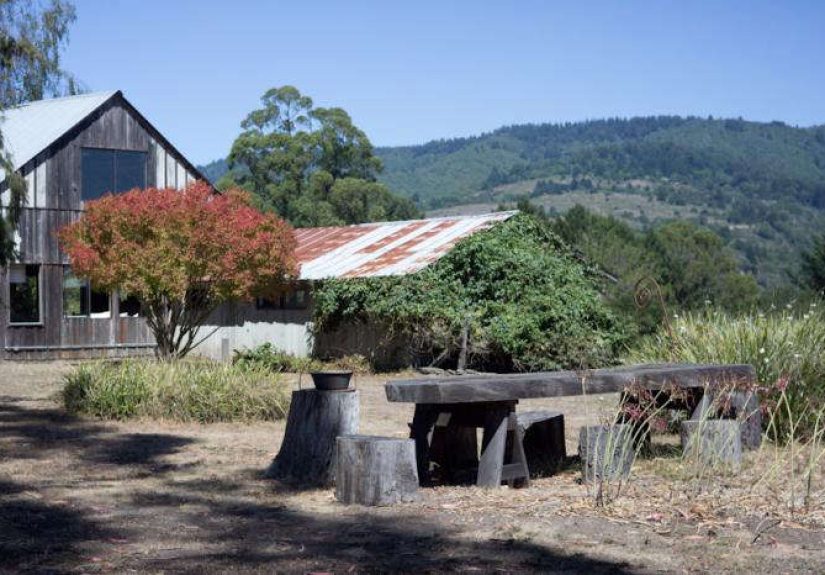
The furniture is soft where the architecture is rough. Slipcovered seating, built-in benches with linen cushions, and outdoor areas anchored by stump seating or simple surfaces keep the place grounded. The famous outdoor “power table,” made from a large slab of wood set on sawhorses, sums up the whole project: dramatic but unfussy, communal but not precious. It invites conversation, meals, notebooks, and maybe the kind of wildly optimistic rural planning that always starts with “What if we hosted everyone here next month?”
There is also a subtle California blend at work: flea-market romance, ranch practicality, coastal weather awareness, and a little old-Malibu nostalgia. The barn is not austere. It has warmth, humor, and the occasional poetic flourish. But it never floats away from the ground.
How the Barn Reflects West Marin Values
Mindy’s Barn resonates because it mirrors broader West Marin values: conservation, craft, stewardship, and a distrust of unnecessary flash. This is a region where protected farmland matters, where the agricultural landscape is not just scenery but livelihood, and where local identity is tied to both ecology and working land. The best buildings in such a place do not dominate the environment. They belong to it.
That belonging is visible in the materials. Reclaimed wood, repaired floors, inherited cast iron, old benches, salvaged sinks, and handmade details all fit naturally into a region where repair still carries dignity. The barn does not feel imported into West Marin. It feels translated from it.
Even the dream of turning the property into a retreat for writers makes sense in this context. West Marin has long attracted artists, makers, and people looking for space to think. Not perform thinking. Actually think. There is a difference. The barn’s appeal lies partly in that promise: a place where creative work might become quieter, deeper, and a little less addicted to notifications.
Food, Landscape, and the Pleasure of Nearby Things
Part of the romance of Mindy’s Barn in West Marin is what surrounds it. This is a region known for local oysters, cheese, pasture-raised products, farm tours, and scenic drives that somehow make you feel both hungry and philosophical. The nearby food culture is not a side note; it amplifies the barn’s appeal. A place with tree stumps for seating and a weathered wooden table practically begs for bread, cheese, oysters, olive oil, and a bottle of something local.
That connection between home and landscape is one reason the story remains so sticky in the imagination. The barn is not just a shelter with nice styling. It is part of a complete sensory world: marine air, wood smoke, old floors, cool mornings, coastal light, and meals that taste like the map around you.
Why the Story Still Works Years Later
The original profile of Mindy’s Barn appeared years ago, but the place still feels relevant because it answers a very current question: what does real luxury look like now? Increasingly, the best answer is not more technology, more square footage, or more decorative drama. It is more meaning. More calm. More connection to place. More rooms that know how to age.
Mindy’s Barn in West Marin offers exactly that. It suggests that the most compelling homes are not built from scratch so much as revealed through patience. It proves that a room can be humble and unforgettable at the same time. And it reminds us that good design is often less about buying the right object than about recognizing the value in what is already there.
In other words, the barn has character because it was allowed to keep some.
A 500-Word Experience of Mindy’s Barn in West Marin
To imagine the experience of Mindy’s Barn in West Marin, start with the drive. The road narrows, the landscape opens, and the whole world begins to look edited down to essentials: grass, sky, fence lines, weather, water. West Marin has a way of making urban habits feel faintly ridiculous. By the time you arrive, you are already less interested in your inbox and more interested in whether that patch of fog will lift before sunset.
Then the barn appears, not like a grand estate making an announcement, but like a place that has been standing there long enough to know introductions are overrated. The exterior carries the quiet confidence of old structures that have survived because they were built to work. Nothing about it screams for attention. That is exactly why you pay attention.
Inside, the first impression is texture. Old wood overhead. Wide floors underfoot. Light moving across surfaces that are imperfect in the best possible way. You notice that the room does not feel over-composed. It feels inhabited. A table made from reclaimed material is not trying to become a conversation piece; it already is one. The same goes for the old stove used as a side table, the found door turned into furniture, the branch repurposed as a pot rack. Everywhere you look, there is evidence that usefulness and beauty got along just fine here.
The barn also feels emotionally layered. Some objects come from the property itself, others from family history, others from flea-market luck or practical salvage. Together they create the sensation that the house was assembled by memory rather than shopping spree. That is a rare pleasure. You are not just standing in a pretty room. You are standing in a room with continuity.
Walk outside and the mood shifts again. The view does what West Marin views tend to do: it makes people pause mid-sentence. Rolling hills tilt toward the sea. Wind moves through the grasses. Maybe there is a distant animal, maybe just the suggestion of one. The famous outdoor table makes immediate sense. Of course people would gather here. Of course lunch would run long. Of course somebody would say they only meant to stay for an hour and then accidentally stay until the light changed color.
As evening comes on, the barn would be at its best. The air cools. The stove becomes less decorative and more persuasive. Slipcovered seating starts to look like a very intelligent decision. The mood is part writer’s retreat, part ranch shelter, part old California dream that escaped the makeover circuit. And that is the real experience of Mindy’s Barn in West Marin: not luxury in the flashy sense, but richness in the deeper one. It is the feeling of being somewhere that has been repaired instead of erased, loved instead of polished to death, and shaped by a landscape that still knows how to make people slow down.
Conclusion
Mindy’s Barn in West Marin endures as a design story because it is really a place story. Yes, the interiors are memorable. Yes, the reclaimed details are charming. Yes, the views are enough to make a person consider quitting several unnecessary obligations. But the lasting power comes from something bigger: the barn embodies the values of its region. It respects history, weather, working land, and the intelligence of simple materials. It feels handmade, even where professionals were clearly involved, because the guiding spirit is so personal.
In an era of algorithmic sameness, that matters. The barn reminds us that homes become extraordinary not when every surface is perfected, but when they carry evidence of thought, memory, and adaptation. West Marin supplies the landscape, the climate, and the culture; Mindy supplies the eye, the nerve, and the willingness to leave well enough beautifully alone. Together, they create a retreat that feels less like a trend and more like a truth.






 Close
Close