
Table of Contents >> Show >> Hide
- The Viral Story That Felt Cute Until You Thought About It for Five More Seconds
- Why the Internet Melted Over the Dog Part
- Why Homeowners Did Not Find It Charming
- The Bigger Lesson About Kids, Dogs, and Familiar Spaces
- The Parenting Piece Everyone Notices but Few Say Nicely
- Why This Story Went Viral in the First Place
- Experiences This Story Reminds People Of
- Final Thoughts
There are viral stories that make the internet laugh, viral stories that make it cry, and viral stories that make everyone say, “Well, that is both adorable and deeply alarming.” This one lands squarely in category three, wearing muddy sneakers and helping itself to a popsicle.
The headline practically writes itself: a young boy, unsupervised and apparently powered by pure canine enthusiasm, entered a couple’s home not once but twice because he wanted to play with their dogs. On one level, it sounds like a sitcom cold open. On another, it sounds like the exact reason door locks, fences, and neighborly boundaries were invented in the first place.
That tension is what makes the story so clickable. It is funny in a “kids are tiny chaos goblins with no concept of property lines” sort of way. But it is also a story about home security, child supervision, pet safety, and the uncomfortable truth that a situation can be both cute and not okay at the same time.
And honestly, that is why this story stuck. Because beneath the viral weirdness and dog-loving innocence is a very modern neighborhood dilemma: what happens when one person’s wholesome kid moment becomes another person’s absolutely-not-in-my-living-room problem?
The Viral Story That Felt Cute Until You Thought About It for Five More Seconds
According to the viral account that circulated online, the couple lived on a rural property with dogs and farm animals, far enough from neighbors to expect a fairly peaceful routine. Then a young boy from down the road wandered onto their property and into their home without permission. The first incident was unsettling enough. The second one turned the story from odd to unforgettable.
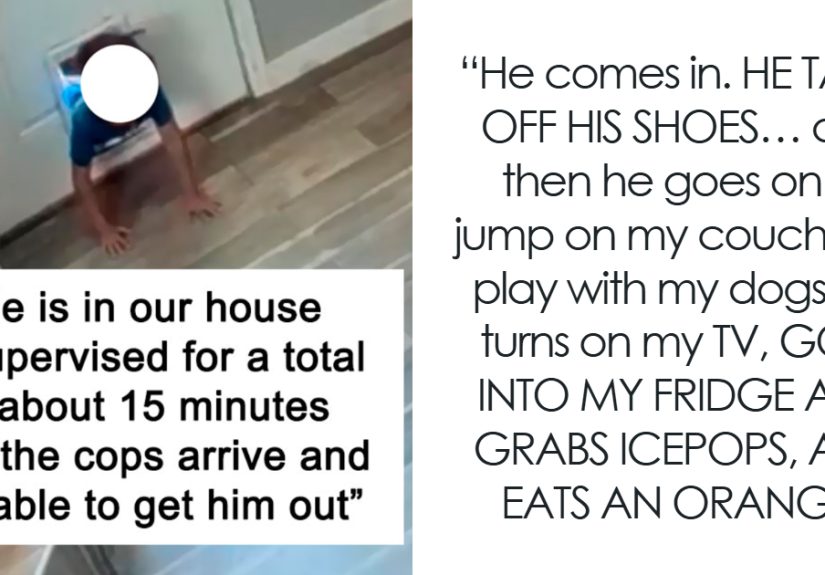
The post describes the child returning later, approaching the front door, finding it locked, and then crawling through the dog door instead. That detail alone is the sort of sentence that causes homeowners everywhere to sit bolt upright and stare at their pet flap like it just betrayed the family. Once inside, the child reportedly let the dogs in too, took off his shoes, hopped on the couch, turned on the TV, raided the fridge, and settled in as though he had a standing playdate approved by management. He had not. There was no management.
That bizarre confidence is part of what made the story explode online. Kids often move through the world with the swagger of people who have never paid a mortgage and therefore fear nothing. To the boy, the house may not have registered as a stranger’s private space. It was the place where the fun dogs lived. End of analysis. Case closed. Brain fully occupied by wagging tails.
But for the homeowners, the experience was not heartwarming. It was invasive, confusing, and full of risks. They did not know where the child had come from, why he was there, or what might happen next. In the original account, police were called, the parents were eventually contacted, and the whole situation was waved off with the now-viral phrase that inspired the headline: just a kid being a kid.
Which, to be fair, is true in one sense. Children do impulsive, strange, boundary-ignoring things all the time. But it is also not a magic phrase that turns a serious safety problem into an adorable anecdote. A kid being a kid is drawing a dinosaur on the wall. A kid being a kid is not entering someone else’s house through the dog door like a very small and emotionally motivated burglar.
Why the Internet Melted Over the Dog Part
Let’s be honest: people will forgive an almost unreasonable amount of nonsense when dogs are involved. The human-animal bond is powerful, and when kids connect with pets, the result often looks pure, funny, and a little cinematic. There is a reason similar stories have gone viral for years. Americans love tales of children who see dogs not as pets, but as furry best friends with excellent ears.
That appeal is not entirely imagined. Health and child development experts have long noted that pets can help children learn empathy, routines, responsibility, boundaries, and emotional connection. Dogs can lower stress, encourage social interaction, and become major figures in a child’s emotional world. In plain English, kids don’t just like dogs. Sometimes they absolutely, spectacularly, irrationally love them.
That helps explain the emotional logic of this story. To an adult, the house belongs to the couple. To a kid fixated on the dogs, the house may have seemed like an annoying architectural wrapper around the real attraction. He was not casing the place for jewelry. He was trying to get to the four-legged celebrities who lived there.
There is also something deeply recognizable about the setup. Every neighborhood seems to have one dog that becomes a local icon. Maybe it is the giant golden retriever who leans against the fence like a retired mayor. Maybe it is the farm dog who escorts bike riders like an unpaid crossing guard. Maybe it is the rescue mutt who looks like a dust mop with opinions. Kids notice those dogs. They remember them. They build tiny emotional mythologies around them.
So yes, the instinct makes sense. The method absolutely does not.
Why Homeowners Did Not Find It Charming
Because “harmless” and “safe” are not the same thing
The biggest problem with this story is not that the child wanted to pet dogs. It is that he was unsupervised in an unfamiliar home full of unpredictable variables. That is where the viral sweetness ends and reality walks in carrying paperwork.
Children are more likely than adults to be bitten by dogs, and injuries can be more severe. Even more important, many bites involving children happen during ordinary interactions with familiar dogs, not dramatic encounters with some foam-flecked movie villain of a mastiff. That means the danger does not always arrive wearing obvious warning signs. It can show up during play, excitement, crowding, grabbing, startling, or simple misunderstanding.
And that is what makes the “he just likes the dogs” defense so flimsy. Plenty of children like dogs. Dogs, meanwhile, are living animals with moods, instincts, thresholds, and occasionally a strong desire not to be turned into the star of someone else’s surprise visit. Even a well-loved family dog can react badly when startled, cornered, overexcited, or pulled into chaos.
Now add the house itself. Most homes are not childproofed for mystery visitors. Cleaning products, medications, tools, hot appliances, breakables, electrical cords, unsecured gates, livestock, roads, and random household hazards all become relevant the second an unsupervised child enters the picture. In the viral account, the homeowner even mentioned a flamethrower on the kitchen table. That is not a sentence anyone expects to write in a discussion about dogs and neighborhood etiquette, but here we are.
Because liability is a very unfunny word
The other part people quickly understood was the legal and financial risk. If a child is hurt on someone’s property, the situation can become messy fast. Dog-related injury claims cost homeowners insurers a staggering amount of money, and even when coverage exists, no one wants to test the theory in real life because a kindergartner decided your dog door looked like a personal invitation.
Homeowners should not have to choose between owning dogs and living in fear that an unsupervised child might wander inside, get hurt, and create a nightmare for everyone involved. That is not neighborly living. That is accidental chaos management.
The Bigger Lesson About Kids, Dogs, and Familiar Spaces
Familiar dogs are still dogs
One of the most persistent myths in pet safety is that the danger comes from strange dogs and the safety comes from familiar ones. Real life is messier than that. Pediatric and veterinary guidance has repeated the same point for years: children are often injured during routine interactions with dogs they know well. The family dog. The neighbor’s dog. The dog next door with the sweet face and the tennis-ball obsession.
That does not mean dogs are secretly villains. It means familiarity can make adults sloppy. Kids feel comfortable. Grown-ups assume everything is fine. Someone misses the signs of stress, overexcitement, resource guarding, or rough play, and suddenly everybody is learning an awful lesson the hard way.
That is why experts keep hammering home the same boring but correct advice: supervise child-dog interactions, teach kids to respect space, and never assume a dog owes anyone unlimited access just because it has previously tolerated nonsense with admirable grace.
A dog door is not a neighborhood guest entrance
The second big lesson is about home design. Dog doors are convenient. They are also, by definition, holes in your house. Modern versions may be safer and smarter than the old floppy flap of suburban legend, but the concern remains obvious: pet doors can create security and safety issues if homeowners do not plan around them.
This story turns that abstract concern into a perfect real-world example. The couple did not have a break-in because of criminal masterminds or a Hollywood burglary crew. They had a break-in because a determined little boy saw a dog door and thought, “Excellent. VIP access.” That is funny on the internet and terrible in practice.
So the viral story also works as an accidental PSA. If you use a dog door, think about fencing, locks, sensors, placement, and whether there is any chance a child, animal, or other uninvited explorer could use it in a way you never intended. Convenience is great. Surprise houseguests are less great.
The Parenting Piece Everyone Notices but Few Say Nicely
There is another reason this story sparked such strong reactions: it put parental supervision under a harsh spotlight. The child was not described as malicious. The real concern was that he kept having the opportunity to do this at all.
Children wander. Children fixate. Children escape through windows, gates, and whatever loophole they discover between breakfast and lunch. None of that is especially shocking. What people found hard to ignore was the repeated gap between the child’s disappearance and the adults noticing, responding, and preventing another round.
That is the part that turns a quirky story into a serious one. Because if a child can make it into a neighbor’s house, he can also make it into a road, a pond, a barn, a construction site, or the home of someone far less patient than a dog-loving rural couple. The issue is not merely manners. It is vulnerability.
And that is what makes “just a kid being a kid” feel so incomplete. Sure. But a kid being a kid still needs adults being adults.
Why This Story Went Viral in the First Place
Stories like this hit the internet sweet spot because they contain contradiction. It is a trespassing story without villain energy. A child safety story with sitcom visuals. A home security story featuring popsicles, couch cushions, and dogs who probably thought the entire event was a pretty decent Tuesday.
It also taps into a cultural truth: Americans are obsessed with stories where dogs expose who we really are. Some people see danger. Some see innocence. Some see legal liability. Some see a future children’s book called The Boy Who Entered Through the Dog Door. The reality, of course, is that all those readings can exist at once.
That complexity is why the best response is not outrage or mushy sentimentality. It is perspective. Yes, the child’s affection for the dogs is touching. No, that does not make the situation acceptable. Yes, it is funny that he took off his shoes before making himself at home. No, that does not cancel out the fact that he had entered a private residence uninvited.
In other words, the internet was right to laugh a little and worry a lot.
Experiences This Story Reminds People Of
What makes this headline feel so strangely familiar is that many people have lived through smaller versions of it. Maybe not the full dog-door entry and fridge raid, but definitely the weird neighborhood moment where a child’s love for an animal bulldozes adult expectations.
Plenty of homeowners know what it is like to have local kids orbit their yard because the dog is more popular than anyone in the house. A child on a scooter slows down to wave at the Labrador. A teenager “just happens” to walk past at the exact time the shepherd gets taken out. Somebody’s little cousin asks every single Saturday if the beagle can come out and play. It starts sweet. It often stays sweet. But it also requires boundaries, because children tend to mistake familiarity for permission.
Parents have their own version of this experience too. Many have had the heart-stopping moment where a child becomes suspiciously quiet, then turns up somewhere wildly unexpected because an idea entered their head and immediately became a mission. Kids do not think in liability language. They think in destination language. Dog. Pond. Trampoline. Chickens. Ice cream truck. Goal identified. Risk assessment not invited.
Pet owners understand another side of it. They know that dogs can become neighborhood magnets. Some dogs adore the attention and greet children like furry mayors running for reelection. Others tolerate it until they do not. And some become overstimulated even when they look happy, which is why responsible owners can seem “overprotective” when they insist on rules. No hugging. No climbing. No surprise visits. No entering the yard unannounced. Those rules are not killjoy behavior. They are what keep a cute dog story from turning into an emergency room story.
Then there is the awkward social layer. Anyone who has ever had a neighbor issue knows the emotional math: you want to be kind, but you also want to be safe; you do not want to overreact, but you definitely do not want to underreact; you want to preserve peace, but not at the cost of pretending this is fine. That balancing act is exhausting. It is even more exhausting when the “issue” is a small child who means no harm but keeps acting like your home is the unofficial clubhouse for his favorite dogs.
That is why this story landed so hard online. It is not just one weird tale. It is a magnified version of something many people recognize: affection without boundaries, innocence without supervision, and adults left trying to clean up the emotional and practical mess. The boy’s behavior reads as sincere. The homeowners’ fear reads as sincere too. And that combination is exactly what makes the whole thing feel both human and unsettling.
In the end, the lasting lesson is simple. It is wonderful when children love animals. It is wonderful when dogs are a source of comfort, joy, and neighborhood connection. But those good feelings only stay good when adults build the structure around them. Ask first. Supervise closely. Respect homes, fences, and animals. Because the line between heartwarming and hazardous is a lot thinner than a dog flap.
Final Thoughts
“Just a kid being a kid” is not wrong. It is just incomplete. This story is about a child acting on affection, curiosity, and impulse. It is also about adults being forced to confront all the things that impulse can accidentally wreck: privacy, safety, trust, and peace of mind.
The internet loves to flatten stories into one emotional button. Cute. Creepy. Funny. Bad parenting. Good dogs. Weird kid. But the real reason this headline works is that it resists flattening. It is funny. It is uncomfortable. It is tender. It is reckless. It is, in the most internet-ready way possible, a story about how love for dogs can temporarily short-circuit common sense.
Still, the homeowners were right to take it seriously. A child should not be wandering into private homes to visit pets, no matter how wholesome the motivation sounds. Good intentions do not childproof a kitchen. Tail wags do not erase liability. And a dog door, despite what one determined little visitor apparently believed, is not an open invitation to the neighborhood.
So yes, let kids adore dogs. Encourage that bond. Teach it with warmth. But pair it with the lessons that matter just as much: ask permission, respect boundaries, stay supervised, and understand that even the nicest house with the nicest dogs is still somebody else’s home.







 Close
Close