
Table of Contents >> Show >> Hide
- Why the Criterion Channel Picked Jackass: The Movie
- The Online Joke That Refused to Die
- Jackass as Slapstick, Documentary, and Pain Ballet
- Why Criterion Recognition Feels So Funnyand So Right
- The Cultural Impact of Jackass: The Movie
- From Controversy to Reappraisal
- Why Jackass Belongs in Serious Film Conversation
- The Difference Between the Criterion Channel and the Criterion Collection
- Experiences Related to the Topic: Watching the Joke Become Real
- Conclusion
Jackass and Criterion were never supposed to share the same sentence unless someone on the internet was trying to start a fight. One is associated with restored world cinema, director-approved editions, and the kind of shelves that make guests say, “Ah, so you own Seven Samurai.” The other is associated with Johnny Knoxville smiling politely before something terrible happens to his body. And yet, here we are: Jackass: The Movie was programmed by the Criterion Channel as part of its December 2024 MTV Productions collection, giving a long-running online joke the closest thing it has had to official validation.
To be clear, this does not mean Jackass: The Movie received a numbered Criterion Collection Blu-ray with a linen-bound essay booklet, a scholarly commentary track on shopping-cart trauma, and a restoration supervised by the man who got hit in the groin. The embrace came through the Criterion Channel, Criterion’s streaming service, where films are grouped thematically and contextually. Still, for fans who have spent years joking that Jackass belongs beside classic slapstick, experimental documentary, and culturally important American cinema, the moment felt deliciously absurd. It was not exactly the Louvre hanging a skateboard ramp in the Renaissance wing, but it was close enough to make cinephiles spit out their espresso.
Why the Criterion Channel Picked Jackass: The Movie
Criterion’s December 2024 lineup placed Jackass: The Movie inside a collection devoted to MTV Productions, alongside Beavis and Butt-Head Do America, Election, and The Original Kings of Comedy. That context matters. The point was not simply, “Look, gross-out comedy exists.” The point was that MTV helped define a specific turn-of-the-century American media moment, when youth culture, music television, alternative comedy, skateboarding, celebrity satire, and mainstream theatrical distribution collided in one loud, questionable, unforgettable package.
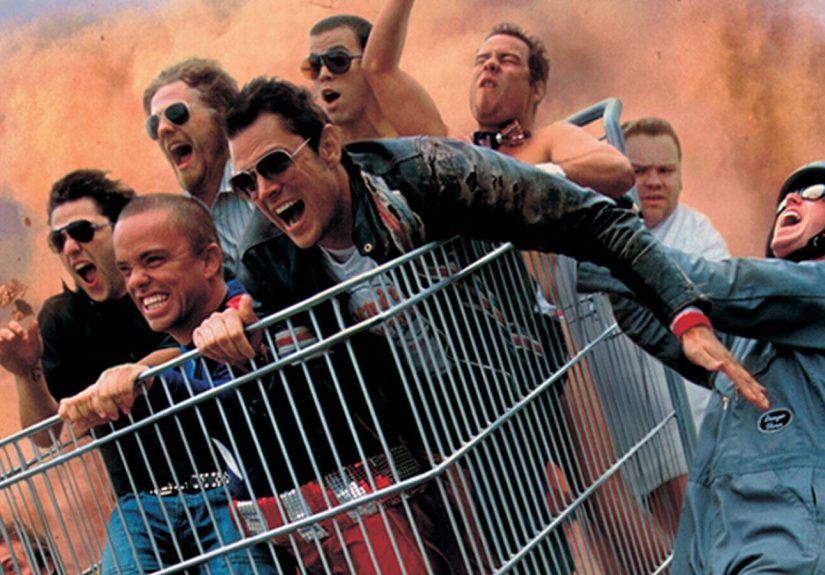
In that sense, Jackass: The Movie is not an accidental curiosity. Released in 2002 and directed by Jeff Tremaine, the film translated the short-form chaos of the MTV series into an 85-minute theatrical experience. It kept the show’s structure: stunt, reaction, injury, laughter, repeat. But the movie screen made everything bigger, louder, and more communal. Watching someone willingly suffer in a living room is one thing. Watching it with a packed audience is something else entirely. Suddenly the groans, shrieks, and guilty laughter became part of the soundtrack.
The Online Joke That Refused to Die
For years, film fans have joked about Jackass joining the Criterion Collection. The gag works because it sounds ridiculous on first contact. Criterion is commonly associated with international auteurs, restored classics, and major works of film history. Jackass is commonly associated with paper cuts, bodily fluids, and men doing things that make insurance companies develop facial tics.
But the joke endured because it was not entirely a joke. The more people revisited the franchise, the more they noticed that Jackass has genuine cinematic and cultural value. It is documentary, performance art, slapstick comedy, stunt cinema, reality television, underground skate video, and social experiment all at once. It has no traditional plot, but it has rhythm. It has no conventional character arcs, but it has personalities so recognizable that a single grin from Knoxville can function like foreshadowing in a thriller.
The internet loves ironic campaigns, but the “Jackass belongs in Criterion” idea became stronger because irony eventually gave way to sincerity. Fans were not only saying, “Wouldn’t it be funny?” They were also saying, “Actually, this captures something real about American culture.” That is how the joke became a debate, and how the debate became oddly persuasive.
Jackass as Slapstick, Documentary, and Pain Ballet
One reason Jackass fits more comfortably into film history than its critics might expect is that physical comedy has always involved bodies taking punishment. Silent-era comedians built entire careers around falls, crashes, chases, and near-disasters. Buster Keaton, Harold Lloyd, Charlie Chaplin, and Jackie Chan turned danger into choreography. The difference is that Jackass strips away the elegance and leaves the bruise.
Instead of pretending the pain is fictional, Jackass makes the impact the point. The camera does not hide the setup, the hesitation, the fear, or the aftermath. We see the performers psych themselves up, we see their friends laughing too hard to be useful, and we see the moment when a bad idea becomes an irreversible event. It is slapstick with the safety padding removed, then probably used as a prop in another stunt.
As documentary, Jackass: The Movie also captures a specific subculture: skate crews, pranksters, daredevils, oddballs, and friends who communicate affection through humiliation. Its form is loose, but not careless. The editing creates rhythm. The framing often highlights anticipation as much as impact. The best segments work because the audience understands the premise instantly and then waits, with horrible delight, for gravity, animals, machinery, or human foolishness to complete the sentence.
Why Criterion Recognition Feels So Funnyand So Right
The humor of Criterion embracing Jackass comes from the collision of reputations. Criterion has spent decades presenting important classic and contemporary films with careful attention to technical quality, supplements, and context. Jackass looks, on the surface, like the opposite of careful. It appears proudly crude, aggressively unserious, and allergic to prestige.
Yet Criterion has never been only about polite cinema. Its world includes art films, cult films, genre films, documentaries, provocations, comedies, and movies that were misunderstood in their own time. A movie does not need to wear a tuxedo to matter. Sometimes it can wear a cup, a helmet, and the expression of a man who knows he has made a terrible career decision.
Jackass: The Movie earned its place in the conversation because it did what durable cinema often does: it preserved a mood, a moment, and a mode of performance that cannot be separated from its era. Early-2000s MTV culture was fast, loud, immature, musical, and weirdly democratic. It made stars out of people who looked like they had wandered into fame through the back door carrying fireworks. Jackass was one of that era’s purest artifacts.
The Cultural Impact of Jackass: The Movie
Financially, Jackass: The Movie was a classic low-budget success story. It cost only a fraction of a typical studio comedy and opened strongly in October 2002, proving that the MTV audience would follow the franchise into theaters. That mattered. The film showed that a television property built from short stunts and personality-driven chaos could become a profitable big-screen event without pretending to be something more respectable.
Culturally, its influence is even larger. Long before TikTok challenges, YouTube prank channels, and influencer stunt culture became everyday entertainment, Jackass had already shown how a camera, a reckless idea, and a group of fearlessor at least temporarily unreasonablefriends could generate viral energy. The franchise anticipated modern internet video while still belonging to the analog-ish age of cable, camcorders, DVDs, and word-of-mouth schoolyard mythology.
That is why the Criterion Channel programming feels more like historical correction than random trolling. Jackass did not merely reflect youth culture; it helped shape the visual grammar of recorded misbehavior. Its influence can be seen in prank videos, stunt channels, challenge culture, reality television editing, and the strange modern expectation that embarrassment is not fully real until it is shareable.
From Controversy to Reappraisal
When Jackass first aired on MTV in 2000, it was controversial for obvious reasons. The show involved dangerous stunts, crude pranks, and disclaimers practically begging viewers not to imitate what they were about to see. Parents worried. Politicians complained. Teenagers, naturally, watched harder.
Over time, however, the conversation changed. What once looked like disposable shock entertainment began to look like a key text in the evolution of reality comedy. Critics revisiting the franchise have emphasized its camaraderie, vulnerability, and strange tenderness. The pain is real, but so is the affection. The performers laugh at one another, but they also rush in after the stunt ends. The group dynamic is the emotional glue that keeps the whole enterprise from feeling purely cruel.
This is especially clear in later films such as Jackass Forever, where aging bodies and accumulated injuries add unexpected melancholy. The franchise’s funniest moments often sit right next to reminders that time is undefeated. Knoxville’s white hair, the absence of Ryan Dunn, and the complicated history around Bam Margera all make the laughter feel more layered than it did in 2002. The joke remains stupid. The feelings around it are not.
Why Jackass Belongs in Serious Film Conversation
Taking Jackass seriously does not mean pretending it is secretly a solemn masterpiece about the human condition. It means recognizing that comedy, especially physical comedy, can reveal truths without behaving respectably. Jackass is about friendship, fear, masculinity, spectacle, consent, performance, endurance, and the ridiculous ways people try to feel alive.
Its structure also challenges traditional definitions of cinema. There is no plot in the usual sense, but there is escalation. There is no fictional protagonist, but there is a rotating ensemble of performers with established screen identities. There is no polished visual style, but there is an instantly recognizable aesthetic: handheld immediacy, nervous laughter, hard cuts, and the sacred pause before impact.
In another context, a group of artists using their bodies to test social limits, provoke audiences, and document extreme behavior might be discussed as performance art. In Jackass, because the performers wear goofy outfits and sometimes make jokes involving toilets, viewers have been slower to grant that status. Criterion’s programming choice did not magically make the film “art,” but it did invite audiences to look again.
The Difference Between the Criterion Channel and the Criterion Collection
For SEO clarity and cinephile peacekeeping, this distinction is important: Jackass: The Movie appeared on the Criterion Channel, not as a physical Criterion Collection edition. The Channel often licenses films temporarily for themed programming. A numbered Criterion disc release is a different thing, usually involving a curated package of restoration work, essays, interviews, and supplements.
Still, Criterion Channel placement carries symbolic weight. It says a film is worth contextualizing. It places Jackass in conversation with other works instead of leaving it in the cultural junk drawer labeled “things we laughed at and then felt weird about.” The MTV Productions collection positioned the movie as part of a broader media history, which is exactly where it belongs.
Experiences Related to the Topic: Watching the Joke Become Real
The funniest thing about the Criterion embrace is how familiar the emotional journey feels. Many viewers first encountered Jackass in the least scholarly settings imaginable: late-night cable, a friend’s basement, a scratched DVD, a dorm room, or a living room where someone’s parents walked in at precisely the wrong moment. Nobody paused the movie to discuss documentary ethics. Nobody said, “Observe the formal tension between anticipation and bodily consequence.” People mostly yelled, laughed, covered their eyes, and asked, “Why would anyone do that?” Then they kept watching.
Years later, those same viewers grew up, bought bookshelves, developed opinions about aspect ratios, and somehow found themselves reading Criterion essays. That is where the experience becomes funny in a more personal way. The people who once laughed at Jackass as pure chaos are now old enough to see its structure. The stunts that seemed random reveal timing. The friendships that seemed immature reveal trust. The low-resolution footage that once looked cheap now looks like a historical texture from a pre-smartphone era, when stupidity had to be planned with heavier cameras and fewer monetization strategies.
There is also a special pleasure in watching cultural gatekeeping fail gracefully. For years, “serious film” and “lowbrow comedy” were treated like separate neighborhoods. Criterion’s nod to Jackass does not erase that boundary entirely, but it pokes a shopping cart through it. It reminds viewers that taste can expand without collapsing. You can admire Tarkovsky and still laugh when a grown man makes a decision that no reasonable adult should make. The human brain contains multitudes, and some of those multitudes are wearing crash pads.
For fans, the Criterion Channel moment felt like a shared wink. It rewarded a long-running online joke while also validating the sincere argument beneath it. It gave people permission to say, without quite whispering, that Jackass: The Movie is not just funny; it is important. Maybe not important in the same way as a restored silent classic or a landmark international drama, but important as a record of American media, friendship, risk, and turn-of-the-century comic energy.
The experience also shows how movies change as audiences change. In 2002, Jackass looked like a dare. In the 2020s, it looks like a time capsule. The soundtrack, the clothes, the camcorder grit, the MTV attitude, the unfiltered public pranks, and the reckless trust among the cast all belong to a media environment that no longer exists in the same way. Modern stunt content is often optimized, branded, algorithmic, and self-conscious. Jackass was commercial, yes, but it still felt like a gang of friends smuggling their bad ideas into pop culture before anyone could stop them.
That may be why Criterion’s embrace landed so well. It did not turn Jackass into something refined. It simply placed a frame around the chaos and allowed viewers to notice the craft, influence, and emotional weirdness that had been there all along. The joke came true because the joke was smarter than it looked. Very Jackass, really.
Conclusion
Jackass: The Movie being embraced by the Criterion Channel is funny because it sounds wrong, and satisfying because it feels right. The film remains crude, painful, juvenile, and proudly ridiculous. But it is also a vital artifact of MTV culture, early-2000s comedy, stunt performance, and the evolution of reality-based entertainment. Criterion did not need to polish Jackass into respectability. The better move was to recognize that some cultural objects matter precisely because they refuse to behave.
The long-running online joke has not ended with a deluxe box set, at least not yet. But the Criterion Channel programming gave fans a wonderful half-victory: proof that a movie about absurd stunts, bodily humiliation, and reckless friendship can sit inside a serious film conversation without losing its grin. Somewhere, a cinephile is adjusting their glasses. Somewhere else, Johnny Knoxville is probably saying, “Hi, I’m Johnny Knoxville,” and making that person nervous.







 Close
Close