
Table of Contents >> Show >> Hide
- What Is a Tokamak, and Why Does It Need Giant Magnets?
- Meet the Central Solenoid: ITER’s “World’s Most Powerful Magnet”
- How a Superconducting Magnet This Big Actually Works
- The Support Structure: The Magnet Needs a “Cage”
- How This Magnet Helps ITER Reach Fusion-Relevant Goals
- Is It Really the “World’s Most Powerful Magnet”?
- What Happens Next: Assembly, Commissioning, and the Long Road to Results
- Why This Magnet Matters Beyond ITER
- Experiences: What It Feels Like to Orbit the “World’s Most Powerful Magnet” (Without Touching It)
- Conclusion
If you’ve ever looked at a refrigerator magnet and thought, “Cute… but can it start a star?”welcome to ITER.
The international ITER tokamak (under assembly in southern France) is basically humanity’s biggest “let’s try this carefully” experiment:
hold a sun-like plasma in place long enough to learn how fusion could work at power-plant scale. And at the center of this donut-shaped
science machine sits a headline-grabbing piece of hardware: the Central Solenoidoften described (accurately, with important nuance) as the
world’s most powerful magnet in its class.
“Most powerful” here doesn’t mean “highest magnetic field ever achieved in any lab.” Instead, it means a truly wild combination of
size, pulsed power, stored energy, and superconducting musclea magnet system designed
to push a tokamak plasma to industrial-scale conditions for hundreds of seconds. In other words: it’s not just a magnet. It’s the
heartbeat that helps ITER’s plasma come alive.
What Is a Tokamak, and Why Does It Need Giant Magnets?
A tokamak is a device that confines super-hot, electrically charged gas (plasma) in a ring shape using magnetic fields. The goal is to
keep that plasma stable and insulated from the machine walls long enough to reach fusion conditionswhere hydrogen isotopes can fuse and
release energy. Since plasma is made of charged particles, magnets aren’t optional accessories; they’re the steering wheel, guardrails,
and “do not touch” sign all at once.
Tokamaks use a combination of magnetic fields:
- Toroidal field (around the long way of the donut) for primary confinement
- Poloidal field (around the short way) to shape and help stabilize the plasma
- A twisted combined field that guides particles in helical paths so they don’t smack into the walls
One of the key tricks is that a tokamak typically drives a strong electric current through the plasma itself. That current helps heat the plasma
and contributes to the confining magnetic geometry. And that’s where the Central Solenoid enters the chat, wearing a cape made of superconducting cable.
Meet the Central Solenoid: ITER’s “World’s Most Powerful Magnet”
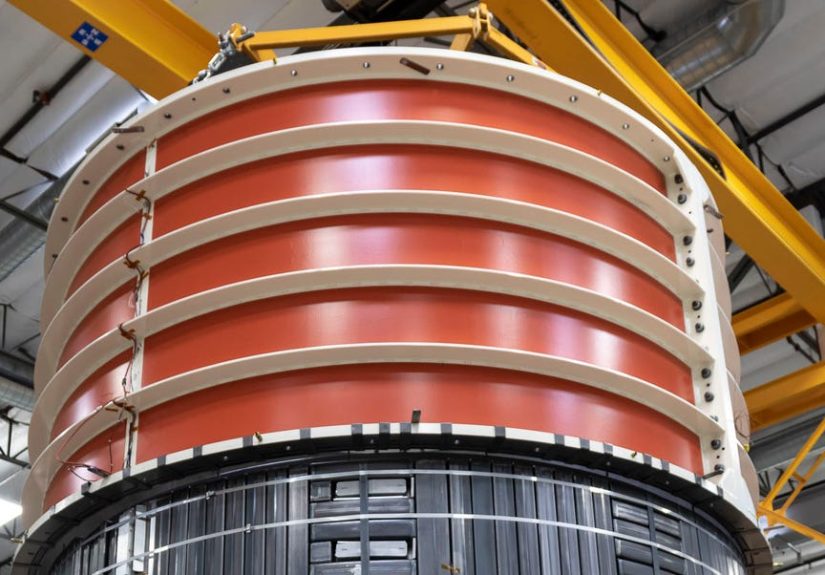
The ITER Central Solenoid is a massive pulsed superconducting electromagnet built as a stack of coil modules. The United Statesthrough the
US ITER Project Office (managed by Oak Ridge National Laboratory) and industrial partners like General Atomicshas led the design, fabrication,
testing, and delivery of these modules.
Think of the Central Solenoid as the tokamak’s transformer core. By changing the magnetic flux through the tokamak, it induces a powerful current
in the plasmahelping to start each plasma pulse and sustain the plasma current during long discharges. If the plasma is the “campfire,” the
solenoid is the part that strikes the match and keeps feeding the flame (without, you know, using actual matches).
Central Solenoid Specs (The “Okay, That’s Absurd” Section)
Numbers vary slightly depending on the fact sheet version and operating scenario, but the headline figures are consistently huge:
- Height: about 18 meters (around 60 feet), roughly a five-story building
- Total weight: about 1,000 tons (classically described as ~1,000 tonnes)
- Peak magnetic field: about 13 tesla (often cited around 13–13.1 T)
- Stored magnetic energy: on the order of ~6 gigajoules (commonly cited ~6.4 GJ for the system)
- Plasma current enabled: around 15 megaamps, sustained for roughly 300–500 seconds in long-pulse operation
- “Fun comparison”: strong enough (in principle) to lift an aircraft carrieryes, that aircraft carrier
In practical terms, this magnet has to be both extraordinarily powerful and extraordinarily disciplined. It must generate enormous forces
and then survive them repeatedly, all while staying superconducting at cryogenic temperatures. Fusion engineering is basically the art
of doing extreme things calmly.
How a Superconducting Magnet This Big Actually Works
Regular copper magnets get hot when you run high current through them (resistance turns electricity into heat). Superconductors, when cooled
sufficiently, can carry huge currents with essentially zero electrical resistancemaking them ideal for high-power magnets.
Superconducting Materials: Why Niobium-Tin (Nb3Sn) Matters
ITER’s Central Solenoid uses a superconducting material called niobium-tin (Nb3Sn). Nb3Sn can handle high magnetic
fields better than some other superconductors, but it’s also famously demanding to manufacture and handle. The conductor is built as
cable-in-conduit conductor (CICC): many strands of superconductor cabled together inside a strong metal jacket.
That conduit isn’t just a fancy wrapper. It helps the conductor survive the immense electromagnetic forces and provides channels for
helium cooling. Fusion magnets don’t just “hold” plasma; they hold back physics that would really like to rearrange your machine into a modern sculpture.
Cryogenics: Fusion’s Least Glamorous Superpower
To stay superconducting, the magnet modules are tested and operated at cryogenic temperaturesonly a few degrees above absolute zero.
That means a serious cryogenic system, careful thermal design, and the kind of insulation strategy that makes your best winter coat look like a napkin.
During testing, modules have been powered at cryogenic temperatures (around 4–4.5 K) with currents on the order of tens of thousands of amps.
That’s the level of “cold and controlled” needed to qualify hardware for ITER-like conditions.
Quenches: When a Superconductor Has a Bad Day
A “quench” happens when part of a superconducting magnet stops being superconducting and becomes resistive. If you don’t detect and manage it fast,
you risk heating and damage. So the Central Solenoid needs robust quench detection and protection systemsbecause even the world’s most powerful
magnet should not be allowed to throw a tantrum unsupervised.
Designing quench detection for a giant pulsed system is especially tricky: the system naturally produces big inductive voltages during ramp-up and
ramp-down, and the protection system has to distinguish “normal operation” from “uh-oh, we have resistance where we shouldn’t.”
The Support Structure: The Magnet Needs a “Cage”
The Central Solenoid doesn’t float in the tokamak like a peaceful sci-fi relic. It’s held in place by a complex support structureessentially an
exoskeleton or cagethat keeps the stacked modules aligned within millimeter tolerances and withstands massive forces during operation.
At peak moments, the vertical force on the module stack can climb to tens of meganewtons. This is why the support structure is a major engineering
achievement in its own right, involving thousands of parts and multiple U.S. suppliers. In fusion, “holding still” is a serious job.
How This Magnet Helps ITER Reach Fusion-Relevant Goals
ITER’s purpose is scientific and technical demonstration, not electricity production. The project aims to explore “burning plasma” physicswhere the
fusion reactions contribute substantial self-heatingand to demonstrate integrated technologies needed for future fusion power plants.
The Central Solenoid supports these goals by enabling:
- Reliable plasma start-up: inducing the plasma current that helps initiate each discharge
- Long pulses: sustaining high plasma current for hundreds of seconds
- Stability and control: working with other coil systems to shape and stabilize the plasma configuration
- Power-plant-relevant operating conditions: the kind of “big machine” environment that smaller experiments can’t fully replicate
In short: without the Central Solenoid, ITER isn’t a tokamak. It’s just an extremely expensive donut-shaped building.
Is It Really the “World’s Most Powerful Magnet”?
This is the part where science politely asks marketing to define its terms.
The Central Solenoid is commonly described as the world’s most powerful magnet because it’s the
largest and most powerful pulsed superconducting magnet system built for fusionan extraordinary combination of scale, stored energy,
and performance. But if you define “powerful” as “highest magnetic field ever achieved,” then other devices (including specialized research magnets)
can reach higher field strengths.
What makes the Central Solenoid special is that it delivers fusion-grade performance at an almost comically large scale:
high field, huge current, massive stored energy, pulsed operation, and stringent reliability requirements. It’s like comparing a drag racer
to a freight train. The drag racer is faster; the freight train is moving a city.
What Happens Next: Assembly, Commissioning, and the Long Road to Results
The Central Solenoid modules are shipped to Europe and stacked at the ITER site to form the full magnet. From there, the project transitions
from “build giant parts” to the even harder phase: assemble, integrate, commission, and operate a system where everything affects everything else.
ITER’s schedule has evolved over time (as mega-project schedules tend to do when reality shows up). Public reports describe a revised pathway in which
research operations and later deuterium-tritium “burning plasma” operation are targeted further out than earlier baselines. The important point for
readers is this: the magnet milestone matters regardless of schedule shifts because it proves the supply chain and engineering can deliver
reactor-scale superconducting systemsknowledge future fusion facilities will need.
Why This Magnet Matters Beyond ITER
Even if you never plan to build a tokamak in your backyard (please don’t), ITER’s magnet story matters because it demonstrates several
“future-fusion” realities:
- Fusion is an engineering problem now, not just a physics one. Building the hardware is part of the science.
- Superconducting manufacturing at scale is possible. It’s hard, expensive, and slowbut doable.
- Industrial learning is transferable. Advanced cryogenics, precision fabrication, quality assurance, and high-current testing
will feed into future devices. - Collaboration is the whole point. ITER forces countries and companies to standardize, integrate, and solve problems that
no single lab could “just handle” alone.
Today, fusion progress isn’t only measured by plasma temperature records. Sometimes it’s measured by whether a 60-foot superconducting magnet can be
built, tested, shipped, and assembled without turning into a very expensive cautionary tale. On that score, the Central Solenoid is a major win.
Experiences: What It Feels Like to Orbit the “World’s Most Powerful Magnet” (Without Touching It)
“Experience” around ITER’s Central Solenoid doesn’t usually mean standing next to the full magnet while it’s running (unless you enjoy the idea of
being politely escorted away). Instead, the most vivid experiences come from following the magnet’s journeyfrom fabrication floors in the U.S. to
the giant assembly halls in Franceand from seeing how fusion engineering looks up close.
1) Watching a magnet go on a road trip.
One of the most memorable mental images is the shipment process. A single module is not a “crate and a label” situationit’s a specialized heavy haul,
planned like a small military operation. Press photos and descriptions show modules leaving manufacturing sites on massive transport vehicles, heading
to ports, and then crossing the Atlantic. If you’ve ever watched a house get moved down a street, it’s that vibeexcept the “house” is a precision
superconducting component that will eventually help confine plasma hotter than the core of the Sun. The contrast is part of the charm: cutting-edge
physics traveling by very practical logistics.
2) Touring fusion facilities and realizing the “boring” systems are the heroes.
People who visit tokamak labs (in the U.S., that can include national labs and large university programs) often walk in expecting dramatic sci-fi visuals:
glowing rings, lightning, maybe a dramatic hum that suggests imminent warp speed. What they notice instead is the real star of the show:
infrastructurepower systems, cooling loops, cryogenic equipment, diagnostics racks, and endless safety procedures. It’s an engineering ecosystem.
The Central Solenoid story fits right in: the magnet gets the headline, but it only works because of cryogenics, structural support, quench protection,
power conversion, and testing protocols that are relentlessly unglamorous and absolutely essential.
3) Experiencing “precision” at industrial scale.
Fusion magnets don’t just need to be bigthey need to be exact. Reading about millimeter-level alignment requirements on components that weigh
over 100 tons is oddly humbling. Engineers describe winding and handling conductor with extreme care, sometimes having to unwrap, insulate, and
reassemble conductor runs while keeping tight tolerances. It’s the kind of precision you associate with watchmaking, except the “watch” is the size of a
building and the “spring” is miles of superconducting cable. If you’ve ever built something fiddlylike a PC, a bike, or a model kityou can relate to
that moment when one tiny mismatch becomes a big problem. Now scale that feeling up to a national-lab-and-industry collaboration and you’re in the
neighborhood of Central Solenoid manufacturing.
4) The emotional experience: pride, patience, and a lot of coffee.
Fusion timelines can test anyone’s attention span, but the magnet milestones create a tangible sense of progress. For engineers and technicians,
completion isn’t just “we finished a part”it’s “we solved problems that didn’t have off-the-shelf solutions.” There’s pride in building something first-of-its-kind,
patience in reworking designs when testing reveals surprises, and a steady acceptance that you don’t rush superconducting systems that store gigajoules
of energy. Even as the broader project schedule shifts, the lived experience around this magnet is forward motion: design, fabricate, test, ship, stack,
integraterepeat. Fusion isn’t one breakthrough. It’s thousands of hard-won steps that eventually start to look like a staircase.
In the end, the Central Solenoid’s “experience” is a reminder that fusion progress is real even when it’s not flashy. Sometimes the most exciting thing
in energy science is a magnet that behaves exactly as expectedquietly, reliably, and at a scale that makes your brain do a double take.
Conclusion
ITER’s Central Solenoid earns the “world’s most powerful magnet” nickname because it represents a rare feat: a pulsed superconducting magnet system
with enormous size, field strength, and stored energybuilt to drive and sustain tokamak plasmas for hundreds of seconds. It’s a cornerstone of ITER’s
mission to explore burning plasma physics and to prove that reactor-scale fusion technology can be built, integrated, and operated.
Fusion still has hard problems aheadmaterials, reliability, cost, and full-system efficiency among them. But the Central Solenoid shows that a key
enabling technology is no longer theoretical. The magnet exists. It has been tested. It can be shipped and assembled. And that’s a very big deal,
even if it arrives at the port without dramatic theme music.






 Close
Close