
Table of Contents >> Show >> Hide
- What Is the Distance Formula?
- Why the Distance Formula Works
- How to Use Distance Formula to Find the Length of a Line: 7 Steps
- Example 1: Finding the Length of a Line Segment
- Example 2: A Horizontal Line Segment
- Example 3: A Vertical Line Segment
- Common Mistakes When Using the Distance Formula
- When Should You Use the Distance Formula?
- Distance Formula vs. Slope Formula
- How to Check Your Answer
- Practice Problems
- Real-Life Uses of the Distance Formula
- Extra Experience: Learning to Use the Distance Formula Without Fear
- Conclusion
- SEO Tags
Finding the length of a line segment on a coordinate plane may sound like something only a geometry textbook could love, but the distance formula is actually one of the friendliest tools in math. It takes two points, does a little subtraction, invites the Pythagorean theorem over for coffee, and gives you the exact length of the line segment between them. No ruler required. No guessing. No squinting at graph paper like a detective in a math mystery.
In simple terms, the distance formula helps you find the straight-line distance between two points on a coordinate plane. If you know the endpoints of a line segment, such as (x1, y1) and (x2, y2), you can calculate the length of that segment using one neat formula:
d = √[(x2 – x1)² + (y2 – y1)²]
This guide breaks the process into seven easy steps, with examples, common mistakes, and practical tips. By the end, you will know how to use the distance formula confidently, whether you are solving homework, preparing for a test, or trying to prove that math is less scary when it behaves itself.
What Is the Distance Formula?
The distance formula is a coordinate geometry formula used to calculate the length of a line segment between two points. It is based on the Pythagorean theorem, which says that in a right triangle, a² + b² = c². On a coordinate plane, the horizontal change between two points acts like one leg of a right triangle, and the vertical change acts like the other leg. The line segment connecting the two points becomes the hypotenuse.
In other words, the distance formula is not a random math spell someone found under a dusty calculator. It is just the Pythagorean theorem wearing coordinate-plane sneakers.
The Distance Formula
d = √[(x2 – x1)² + (y2 – y1)²]
Here is what each part means:
- d means distance, or the length of the line segment.
- (x1, y1) is the first point.
- (x2, y2) is the second point.
- x2 – x1 measures horizontal change.
- y2 – y1 measures vertical change.
Why the Distance Formula Works
Imagine plotting two points on graph paper. Unless the line between them is perfectly horizontal or vertical, measuring it directly can be awkward. The clever trick is to create an invisible right triangle. Draw a horizontal line from one point and a vertical line from the other until they meet. Now your original line segment is the diagonal side of that triangle.
The horizontal side has a length of |x2 – x1|, and the vertical side has a length of |y2 – y1|. Since both values are squared in the formula, negative signs disappear faster than snacks at a study group. Then you take the square root to get the actual distance.
How to Use Distance Formula to Find the Length of a Line: 7 Steps
Step 1: Identify the Two Endpoints
Start by finding the coordinates of the two endpoints of the line segment. A line segment has two endpoints, and each endpoint is written as an ordered pair: (x, y). The x-value tells you how far left or right the point is, while the y-value tells you how far up or down it is.
For example, suppose your line segment has endpoints A(2, 3) and B(8, 11). These are the two points you will plug into the distance formula.
It does not matter which point you call Point 1 and which point you call Point 2. The formula will give the same distance either way, as long as you keep the x-values and y-values matched correctly.
Step 2: Label the Coordinates Clearly
Next, label each coordinate so you do not accidentally mix them up. Let:
x1 = 2, y1 = 3, x2 = 8, and y2 = 11.
This small step prevents one of the most common mistakes: subtracting an x-value from a y-value. That is like trying to make a sandwich with one slice of bread and a calculator. Technically possible to hold, but not useful.
Step 3: Write Down the Distance Formula
Before substituting numbers, write the formula:
d = √[(x2 – x1)² + (y2 – y1)²]
Writing the formula first helps you stay organized. It also shows your work, which teachers tend to appreciate because it proves you did not simply whisper “math magic” and write an answer.
Step 4: Substitute the Coordinates
Now replace the variables with the coordinates from your two points:
d = √[(8 – 2)² + (11 – 3)²]
Notice that x-values are subtracted together, and y-values are subtracted together. Keep the order consistent inside each pair of parentheses. If you use x2 – x1, then use y2 – y1 as well.
Step 5: Subtract Inside the Parentheses
Simplify the differences:
8 – 2 = 6
11 – 3 = 8
Now the formula becomes:
d = √[(6)² + (8)²]
These numbers represent the horizontal and vertical distances between the two endpoints. The line segment itself is the diagonal path connecting them.
Step 6: Square the Differences and Add
Square each difference:
6² = 36
8² = 64
Add them together:
36 + 64 = 100
Now your formula looks like this:
d = √100
Squaring is important because distance is always positive. Even if one subtraction gives a negative value, squaring turns it positive. A line segment cannot have a negative length. If your answer is negative, something has gone dramatically wrong, and your calculator may need a pep talk.
Step 7: Take the Square Root
Finally, take the square root:
√100 = 10
So, the length of the line segment from (2, 3) to (8, 11) is:
d = 10 units
That is the final answer. Always include units if the problem gives them. If the coordinate plane does not specify inches, feet, meters, or miles, simply write “units.”
Example 1: Finding the Length of a Line Segment
Find the distance between A(-4, 1) and B(5, 7).
Use the distance formula:
d = √[(5 – (-4))² + (7 – 1)²]
Simplify:
5 – (-4) = 9
7 – 1 = 6
Now square and add:
d = √[9² + 6²]
d = √[81 + 36]
d = √117
Since 117 is not a perfect square, you can leave the answer as √117 units or simplify it:
√117 = √(9 × 13) = 3√13
Approximate decimal form:
3√13 ≈ 10.82 units
Example 2: A Horizontal Line Segment
Find the distance between (-3, 4) and (6, 4).
Both points have the same y-coordinate, so the line segment is horizontal. You could simply find the absolute difference between the x-values:
|6 – (-3)| = 9
The distance is 9 units. The distance formula also works:
d = √[(6 – (-3))² + (4 – 4)²]
d = √[9² + 0²]
d = √81 = 9
For horizontal lines, the y-change is zero. The formula does not mind; it just calmly does its job.
Example 3: A Vertical Line Segment
Find the distance between (2, -5) and (2, 8).
Both points have the same x-coordinate, so the line segment is vertical. Find the absolute difference between the y-values:
|8 – (-5)| = 13
The distance is 13 units. Using the full formula:
d = √[(2 – 2)² + (8 – (-5))²]
d = √[0² + 13²]
d = √169 = 13
Vertical lines are not a special emergency. They are just line segments where the horizontal change is zero.
Common Mistakes When Using the Distance Formula
Mistake 1: Mixing Up x-Values and y-Values
The formula only works when x-values are subtracted from x-values and y-values are subtracted from y-values. Do not cross the streams. In math, as in ghost-hunting movies, that usually causes trouble.
Mistake 2: Forgetting Parentheses Around Negative Numbers
If a coordinate is negative, use parentheses when substituting it into the formula. For example, write 5 – (-4), not 5 – -4 floating around like it lost its backpack.
Mistake 3: Adding Before Squaring
Follow the order of operations. First subtract, then square, then add, then take the square root. Do not add the differences first unless you enjoy getting answers that look confident but are completely wrong.
Mistake 4: Forgetting the Square Root
After adding the squared differences, you must take the square root. If you stop at 100 instead of √100 = 10, you have found the square of the distance, not the distance.
When Should You Use the Distance Formula?
Use the distance formula whenever you need to find the length of a line segment between two points on a coordinate plane. It is especially helpful when the segment is diagonal and cannot be measured by simply counting spaces horizontally or vertically.
You may see the distance formula in algebra, geometry, analytic geometry, standardized tests, map problems, physics applications, computer graphics, architecture, and navigation. Anytime a problem gives you two points and asks for the distance between them, the distance formula is probably waiting nearby, wearing sunglasses and pretending not to be obvious.
Distance Formula vs. Slope Formula
Students sometimes confuse the distance formula with the slope formula because both use two points and both involve subtracting coordinates. The difference is simple:
- Distance formula finds the length of a line segment.
- Slope formula finds the steepness of a line.
The slope formula is:
m = (y2 – y1) / (x2 – x1)
The distance formula uses squares and a square root because it measures actual length. Slope uses a ratio because it measures rise over run. One tells you how far. The other tells you how steep. Both are useful, but they are not twins; they are more like cousins who show up to the same family barbecue.
How to Check Your Answer
A good way to check your distance formula answer is to estimate the distance from the graph. If your points are (2, 3) and (8, 11), the horizontal change is 6 and the vertical change is 8. A diagonal across a 6-by-8 right triangle should be longer than 8 but not wildly huge. An answer of 10 makes sense.
You can also check whether your answer is positive. Since distance measures length, it should never be negative. If you get a negative distance, look back at your square root, subtraction, or calculator entry.
Practice Problems
Problem 1
Find the distance between (1, 2) and (4, 6).
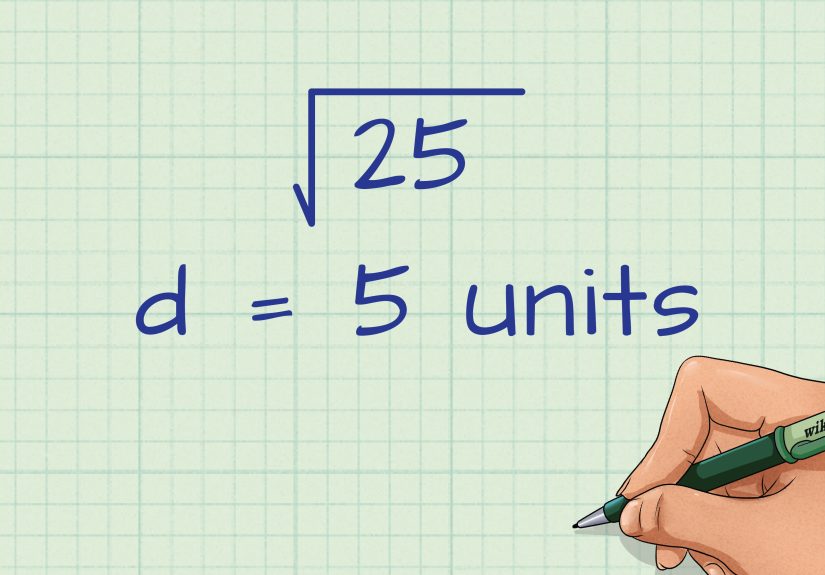
Answer: √[(4 – 1)² + (6 – 2)²] = √[3² + 4²] = √25 = 5 units
Problem 2
Find the distance between (-2, -3) and (3, 9).
Answer: √[(3 – (-2))² + (9 – (-3))²] = √[5² + 12²] = √169 = 13 units
Problem 3
Find the distance between (7, -1) and (7, 5).
Answer: Since the x-values are the same, the segment is vertical. |5 – (-1)| = 6 units
Real-Life Uses of the Distance Formula
The distance formula is more than a classroom exercise. It appears in real-world situations whenever we need to measure straight-line distance between two positions. A map app, for example, may use coordinate-based calculations to estimate how far one location is from another. Engineers can use coordinate geometry when designing structures, measuring layouts, or checking dimensions. Computer graphics use distance calculations to position objects, detect collisions, and create realistic movement.
In sports analytics, coordinates can describe player movement on a court or field. In robotics, distance calculations help machines understand how far they need to move. In video games, distance formulas help determine whether a character is close enough to pick up an item, open a door, or dramatically miss a jump while the player blames the controller.
Extra Experience: Learning to Use the Distance Formula Without Fear
One of the best experiences students can have with the distance formula is realizing that it is not a giant formula to memorize blindly. It is a story about movement. You move sideways, you move up or down, and then you find the diagonal distance between where you started and where you ended. Once that idea clicks, the formula becomes much easier to remember.
A practical way to learn it is to begin with graph paper. Plot two points such as (1, 1) and (5, 4). Count the horizontal change: 4 spaces. Count the vertical change: 3 spaces. Then draw the diagonal line segment connecting the two points. You can see a right triangle with legs of 3 and 4. The distance is 5. This familiar 3-4-5 triangle helps make the formula feel less like a mystery and more like a shortcut.
Another useful experience is comparing easy cases with harder ones. Start with horizontal and vertical line segments, because those are simple to count. Then move to diagonal segments where counting alone is not enough. This shows why the distance formula exists. It solves the problem that your eyes and graph paper cannot always solve accurately.
When practicing, write every step even if the problem seems easy. Label the points, substitute carefully, simplify inside parentheses, square the results, add, and take the square root. This routine builds accuracy. It also helps you catch small mistakes before they turn into full-grown answer disasters.
Students often improve faster when they say the process out loud: “Change in x, change in y, square both, add, square root.” It may sound silly, but it works. Math has rhythm. Sometimes the brain remembers a sentence more easily than a symbol-packed formula.
Calculator use is also worth practicing. Many errors happen not because students misunderstand the formula, but because they type it incorrectly. Negative numbers need parentheses. Square roots need the entire sum inside them. If your calculator gives a strange answer, rewrite the expression step by step before blaming technology. The calculator is powerful, but it has no idea what you meant. It only knows what you typed.
Finally, connect the distance formula to real situations. Imagine two points as locations on a map, corners of a room, or positions in a video game. The more you connect the formula to actual distance, the more natural it becomes. The goal is not just to pass a quiz; it is to understand how coordinates can describe space. Once you see that, the distance formula stops being “that thing from geometry class” and becomes a reliable tool you can use whenever two points need a little mathematical matchmaking.
Conclusion
The distance formula is a powerful and practical way to find the length of a line segment when you know its two endpoints. By using d = √[(x2 – x1)² + (y2 – y1)²], you can calculate the straight-line distance between any two points on a coordinate plane. The seven-step process is simple: identify the endpoints, label the coordinates, write the formula, substitute values, subtract, square and add, then take the square root.
The more you practice, the more natural the formula becomes. Just remember that the distance formula is really the Pythagorean theorem in coordinate form. Once you understand that connection, the formula feels less like memorization and more like common sense with a square root.






 Close
Close