
Table of Contents >> Show >> Hide
- Can You Really Tell a Turtle’s Exact Age?
- Step 1: Identify the Turtle Species First
- Step 2: Check for Records, Photos, or Known History
- Step 3: Count Shell Growth Rings Carefully
- Step 4: Measure the Shell and Compare It to Growth Expectations
- Step 5: Look for Signs of Physical Maturity
- Step 6: Ask a Reptile Veterinarian or Wildlife Expert
- Common Mistakes When Guessing a Turtle’s Age
- How Old Is My Turtle? Quick Age Clue Chart
- Examples: Estimating Turtle Age in Real Life
- Experience-Based Notes: What Turtle Owners Often Learn the Hard Way
- Conclusion
Trying to tell a turtle’s age can feel a little like asking a mountain how many birthdays it has had. Turtles are famously long-lived, slow-growing, and wonderfully unbothered by our human need for exact numbers. Unless you have a hatch date, breeder record, rescue file, or long-term photo history, you usually cannot know a turtle’s exact age just by looking at it. Still, you can make a smart, careful estimate by studying its species, shell, size, growth patterns, and overall maturity.
This guide explains how to tell a turtle’s age in six practical steps. It also clears up one of the biggest myths in turtle care: counting shell rings is not the same as counting tree rings. Growth rings can sometimes help with young turtles, but they are not a magical birthday calculator. Nature, as usual, did not include a barcode.
Whether you have a pet red-eared slider, a box turtle in your yard, a rescued tortoise, or a mystery shelled roommate who arrived with zero paperwork and maximum attitude, these steps will help you estimate age more responsibly.
Can You Really Tell a Turtle’s Exact Age?
The honest answer is: sometimes, but usually not with perfect accuracy. The most reliable way to know a turtle’s age is to know when it hatched. That information might come from a reputable breeder, rescue organization, zoo record, wildlife study, or long-term owner documentation.
Without records, age estimation becomes detective work. You can look at shell size, scute growth lines, body condition, species-specific growth rates, sexual maturity, and signs of long-term wear. These clues can suggest whether a turtle is a hatchling, juvenile, young adult, mature adult, or older individual. But they rarely tell you, “This turtle is exactly 17 years, 4 months, and emotionally suspicious of lettuce.”
That said, an educated estimate is still useful. Age range can help you choose the right diet, enclosure size, UVB lighting setup, veterinary care schedule, and long-term plan. Many turtles live for decades, and some species can outlive several generations of furniture, smartphones, and houseplants.
Step 1: Identify the Turtle Species First
Before estimating a turtle’s age, identify the species. This is the foundation of the entire process because different turtles grow at different speeds, reach maturity at different ages, and have very different adult sizes.
For example, a young red-eared slider may grow quickly during its first few years, while a box turtle grows more gradually. A sulcata tortoise can become impressively large in only a few years, while many smaller aquatic turtles remain modest in size for life. Sea turtles, snapping turtles, tortoises, sliders, painted turtles, musk turtles, and box turtles all follow different growth timelines.
Look for species clues
To identify the species, study the turtle’s shell shape, shell color, head markings, foot structure, tail length, and habitat needs. Aquatic turtles often have webbed feet and flatter shells for swimming. Tortoises usually have sturdy, elephant-like feet and domed shells built for land. Box turtles have a hinged plastron, which allows them to close their shell tightly like a tiny armored suitcase.
Species matters because a 6-inch turtle might be a young individual in one species and a full adult in another. Without species identification, size-based age estimates can go very wrong. It is like guessing someone’s age by shoe size. Interesting? Sure. Reliable? Not exactly.
Step 2: Check for Records, Photos, or Known History
The best age clue is not on the shell. It is in the paperwork. If the turtle came from a breeder, rescue, pet store, veterinarian, school program, or previous owner, ask for any available history. Even a rough adoption date can help create a timeline.
Useful records include hatch certificates, purchase receipts, veterinary files, rescue intake notes, old photos, microchip information, and previous enclosure records. If a turtle was already large when adopted 15 years ago, you know it is at least older than that. If there are photos showing it as a hatchling in 2019, you have a much stronger estimate.
Create a turtle timeline
If you own the turtle now, start documenting from today. Take clear photos of the shell from above, below, and the side. Measure the straight carapace length, which is the shell length from front to back in a straight line. Record weight, diet, basking habits, shedding patterns, veterinary visits, and major health changes.
This will not tell you the turtle’s past age, but it will make future estimates more accurate. In five years, you will thank yourself. Your turtle will not thank you, because turtles are not known for writing appreciation cards, but the record will still be valuable.
Step 3: Count Shell Growth Rings Carefully
Many people hear that you can tell a turtle’s age by counting the rings on its shell. This idea contains a small grain of truth wrapped in a big tortilla of misunderstanding.
Turtle shells are covered with plates called scutes. As a turtle grows, rings or lines may form on the scutes. In some young turtles, these growth rings can roughly correspond to growth periods. Researchers have studied scute rings in certain species and found they may help estimate age in younger individuals. However, this method becomes less reliable as turtles age.
Why shell rings are not perfect
Growth rings do not always form once per year. They can reflect changes in food availability, temperature, growth speed, illness, stress, drought, seasonal activity, or captive care conditions. A turtle that grows quickly because it is overfed may form different shell patterns than a turtle growing slowly in the wild. False rings can also appear, and older turtles may have worn, smooth, damaged, or faded scutes.
To examine rings, look at several scutes on the carapace, especially the central and side scutes. Count visible rings on more than one scute and compare patterns. If the turtle is young, the count may suggest a rough age range. If the turtle is older, treat the rings as a clue, not a conclusion.
A practical way to use this method is to say, “This turtle appears young, possibly within a few years,” rather than, “This turtle is exactly six.” Precision is wonderful, but overconfidence is how people end up arguing with reptiles.
Step 4: Measure the Shell and Compare It to Growth Expectations
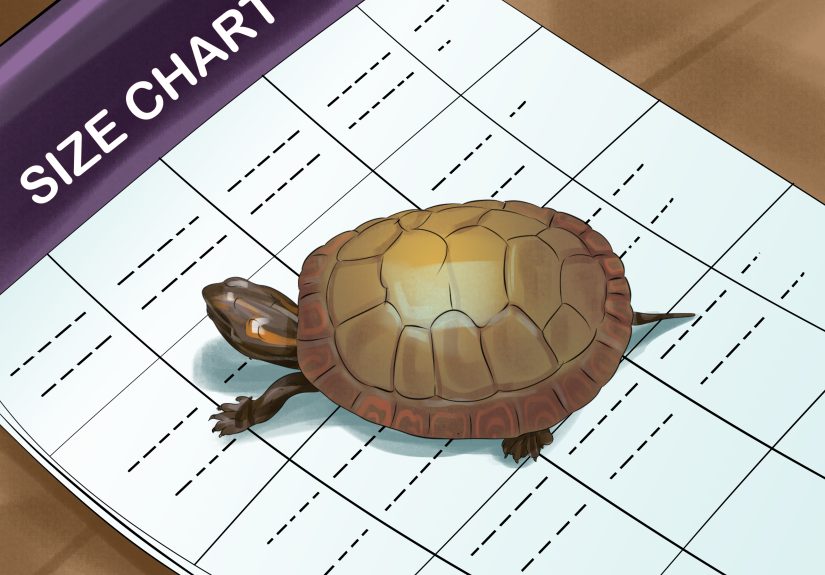
Shell length is one of the most useful age clues, especially when combined with species identification. Use a ruler or measuring tape to measure the straight carapace length. Do not curve the tape over the dome of the shell. Measure from the front edge of the carapace to the back edge in a straight line.
Then compare the measurement with reliable species-specific growth information. A red-eared slider, for instance, may grow quickly when young and later slow down. Females often become larger than males. A box turtle may reach adult size more slowly, and tortoises can vary dramatically depending on species and care.
Why size alone can mislead you
Size is helpful, but it is not a standalone answer. Diet, UVB exposure, temperature, enclosure space, calcium intake, hydration, genetics, illness, and seasonal activity all affect growth. A poorly cared-for turtle may be small for its age. An overfed turtle may grow too fast and develop shell problems such as pyramiding in some tortoises.
This is why shell length should be used together with other clues. Think of it as one witness in the case, not the entire courtroom.
Step 5: Look for Signs of Physical Maturity
Another way to estimate a turtle’s age is to look for signs of maturity. Many turtle species show physical changes as they reach reproductive age. These changes vary by species and sex, but they can help separate juveniles from adults.
Adult males in some aquatic turtle species develop longer front claws, thicker tails, or a cloacal opening farther from the shell. Female turtles may become larger-bodied, especially in species where females need more room for eggs. Male box turtles may show traits such as redder eyes, a more concave plastron, or a longer tail, depending on the species.
Maturity is not the same as old age
A turtle that is sexually mature is not necessarily elderly. It may simply be an adult. Many turtles reach maturity after several years, but the exact timing depends on species, size, climate, and living conditions. In some species, body size matters more than calendar age.
Physical maturity helps you decide whether a turtle is likely a juvenile, subadult, or adult. It cannot usually tell you whether an adult turtle is 12, 25, or 45 years old. Once a turtle reaches adult size, visible age clues become more subtle.
Step 6: Ask a Reptile Veterinarian or Wildlife Expert
If age matters for medical care, breeding decisions, legal ownership, wildlife rehabilitation, or conservation work, ask a reptile veterinarian or qualified wildlife expert. A professional can evaluate the turtle’s species, size, weight, shell condition, reproductive maturity, diet history, and health signs more accurately than a casual online guess.
Veterinarians may also check for health problems that mimic age-related changes. A dull shell, poor growth, soft areas, swelling, overgrown beak, cloudy eyes, or low activity may not mean the turtle is old. It may mean the turtle needs better nutrition, UVB lighting, cleaner water, warmer basking temperatures, or medical treatment.
Advanced age methods are mostly for research
In scientific settings, researchers may use long-term mark-recapture records, growth studies, skeletal analysis, or other specialized methods to estimate turtle age. These are not practical for ordinary pet owners and should never involve harming an animal just to satisfy curiosity.
For pet owners, the best professional approach is a noninvasive exam and a realistic age range. A vet might say the turtle appears to be a young adult, mature adult, or senior based on multiple signs. That may not sound as satisfying as a birthday cake with numbered candles, but it is usually the most honest answer.
Common Mistakes When Guessing a Turtle’s Age
Mistake 1: Believing every shell ring equals one year
This is the most common mistake. Shell rings can reflect growth periods, but growth does not always follow a neat annual schedule. Food, temperature, health, and environment can all affect ring formation.
Mistake 2: Using size without identifying the species
A 5-inch turtle may be young, adult, or nearly full-grown depending on species. Always identify the turtle before comparing size to age expectations.
Mistake 3: Assuming a worn shell always means old age
Shell wear may suggest time and environmental exposure, but it can also come from poor habitat, injury, rough surfaces, shell rot, or previous neglect.
Mistake 4: Comparing turtles from different living conditions
A wild turtle and a captive turtle may grow differently. A turtle with excellent lighting and diet may grow faster than one with poor care. Growth rate is not universal.
Mistake 5: Forgetting that turtles live a very long time
Many turtles live for decades. Some box turtles, tortoises, and aquatic turtles can live far longer than people expect. Buying or adopting a turtle is not a weekend hobby; it is more like entering a long-term lease with a quiet dinosaur.
How Old Is My Turtle? Quick Age Clue Chart
| Clue | What It May Suggest | How Reliable Is It? |
|---|---|---|
| Known hatch date or breeder record | Exact or near-exact age | Very reliable |
| Old photos and adoption history | Minimum age or age range | Reliable if dates are clear |
| Shell growth rings | Rough estimate, mostly in young turtles | Moderate to low |
| Shell length | Juvenile, subadult, or adult stage | Useful with species ID |
| Sexual maturity traits | Adult status | Helpful but not exact |
| Shell wear and body condition | Possible maturity or long-term exposure | Supportive only |
| Veterinary evaluation | Best practical age range | Strong when combined with history |
Examples: Estimating Turtle Age in Real Life
Example 1: A small red-eared slider
Suppose you have a red-eared slider with a shell length of about 3 inches. It has bright markings, visible growth lines, and no signs of sexual maturity. If the species identification is correct, this turtle is likely young. However, whether it is one year old or three years old depends on diet, heat, UVB lighting, and past care.
Example 2: A box turtle found in a yard
A box turtle with a worn shell, adult size, and mature features may be many years old, possibly several decades. But counting the shell rings may not be accurate because older box turtles often have smoothed or damaged scutes. If it is a wild turtle, the best action is usually to leave it in its habitat unless it is injured or in immediate danger.
Example 3: A rescue tortoise with no paperwork
A tortoise adopted from a rescue may arrive with an unknown age. Its size, weight, shell condition, and species can help estimate whether it is a juvenile, subadult, or adult. A reptile vet can also check for signs of past poor nutrition, metabolic bone disease, dehydration, or abnormal shell growth that may affect age guessing.
Experience-Based Notes: What Turtle Owners Often Learn the Hard Way
One of the most common experiences among turtle owners is discovering that age estimation sounds easy until the turtle is actually in front of you. A person may read, “Count the rings,” then look at the shell and realize there are clear rings, faint rings, half-rings, scratches, old scute marks, and one mysterious line that may be growth or may be the turtle’s attempt at abstract art.
Owners of aquatic turtles often learn that fast early growth can create confusion. A red-eared slider raised in warm water with plenty of food may grow quickly, while another slider of the same age may stay smaller because it had poor lighting, a weak diet, or colder conditions. Two turtles hatched in the same year can look surprisingly different by year three. This is why experienced keepers pay attention to husbandry history before making age claims.
Box turtle owners often report the opposite problem: the turtle looks ancient no matter what. Box turtles can have weathered shells, missing scute detail, nicks, faded colors, and wise little faces that make them appear as though they personally remember the invention of the wheel. But a worn shell does not automatically prove extreme age. It may show years of outdoor living, but it may also reflect rough habitat, injuries, or past care issues.
Rescue situations are even trickier. A turtle may arrive with pyramiding, an overgrown beak, retained scutes, shell discoloration, or stunted growth. New owners sometimes assume the turtle is old because it looks rough. A reptile veterinarian may explain that the turtle is not necessarily elderly; it may simply have had years of improper diet or lighting. That distinction matters because better care can still improve comfort, activity, shell health, and quality of life.
Another real-world lesson is that turtles are long-term animals. A family may adopt a small turtle thinking it is a short childhood pet, only to discover that many species can live for decades with proper care. Estimating age becomes part of planning: How big will the enclosure need to be? Will this turtle need care after a child leaves for college? Who will care for it during travel? A turtle’s age is not just trivia; it affects responsibility.
People who keep records usually have the easiest time later. A simple folder with photos, measurements, vet receipts, and feeding notes can become surprisingly valuable. After several years, the owner can compare shell growth, weight changes, and health patterns. Instead of guessing from memory, they have evidence. The turtle still will not reveal its secrets, but at least the human side of the investigation becomes less chaotic.
The biggest experience-based takeaway is humility. You can estimate a turtle’s age, but you should avoid pretending a guess is a fact. A careful phrase such as “likely a young adult” or “at least 10 years old based on ownership history” is better than a dramatic but unsupported number. Turtles have survived for millions of years as a group; they are allowed to keep a few mysteries.
Conclusion
Learning how to tell a turtle’s age is really about combining clues. Start with the species, look for records, examine shell growth rings cautiously, measure the carapace, check for maturity signs, and ask a reptile veterinarian when accuracy matters. Shell rings can be useful in some young turtles, but they are not a perfect clock. Size helps, but only when compared with species-specific growth expectations. Physical maturity tells you more about life stage than exact age.
The most reliable age estimate comes from documented history. If you do not have that, aim for a reasonable age range instead of an exact number. Your turtle may not come with a birth certificate, but with good care, proper habitat, and regular health checks, it can still have a long, comfortable life. And honestly, a turtle that refuses to reveal its age may simply be practicing excellent personal branding.





 Close
Close