
Table of Contents >> Show >> Hide
- Turkey Food Safety 101: The Three Rules That Save the Day
- Step 1: Plan Your Timeline (Because Turkey Doesn’t Respect Your Schedule)
- Step 2: Thaw Safely (A.K.A. “Not on the Counter”)
- Step 3: Prep Without Spreading Germs Everywhere
- Step 4: Brining Safely (If You Want Juicy Turkey Without Drama)
- Step 5: Stuffing and FixingsWhere Most People Get Tricked
- Step 6: Cook the Turkey Safely (and Keep It Juicy)
- Step 7: Serve Safely (Buffet Rules Without the Buzzkill)
- Step 8: Store Leftovers Like a Pro (So Tomorrow You Is Happy)
- Food-Safe Fixings: The Usual Suspects
- Quick Troubleshooting (Because Something Always Happens)
- Wrap-Up: Safe Turkey Is the Best Turkey
- Extra: Real-World Turkey Experiences (The Ones You’ll Recognize)
Turkey Day (or any day you decide a whole bird should be your personality) is basically a high-stakes kitchen
group project. The good news: you don’t need a culinary degree to keep dinner delicious and food-safe.
You just need a plan, a thermometer, and the courage to say, “No, I will not thaw this turkey on the counter,
Susan.”
This guide walks you through safe turkey prep, thawing, brining, cooking, serving, and storing leftoversplus
the fixings that love to cause chaos (stuffing, gravy, casseroles, and that one mayo-based “salad” someone
insists is a tradition). You’ll get practical timelines, specific examples, and the “why” behind the rulesso
you can cook with confidence and avoid gifting your guests a stomachache souvenir.
Turkey Food Safety 101: The Three Rules That Save the Day
-
Keep cold foods cold (40°F or below) and hot foods hot (140°F or above).
The “Danger Zone” between 40°F and 140°F is where bacteria throw a party. -
Prevent cross-contamination.
Raw turkey juice is not a seasoning. Keep it away from ready-to-eat foods, clean surfaces, and your dignity. -
Cook turkey to a safe internal temperature165°F.
Not “golden brown,” not “my grandma says it’s done,” not “the pop-up thing popped.” Temperature is the boss.
Step 1: Plan Your Timeline (Because Turkey Doesn’t Respect Your Schedule)
Most turkey “emergencies” are really calendar emergencies. The bird is frozen solid, guests are arriving, and
suddenly you’re Googling “can I speed-thaw a turkey with a hair dryer.” (No. Please don’t.)
Quick planning checklist
- Choose your turkey size: Roughly 1–1.5 pounds per person (more if you want leftovers).
- Decide frozen vs. fresh: Frozen needs thaw time; fresh still needs fridge space and a plan.
- Clear fridge real estate: A turkey is basically a cold-storage couch.
- Get a food thermometer: This is your single best tool for safe, juicy poultry.
Step 2: Thaw Safely (A.K.A. “Not on the Counter”)
Safe thawing keeps the turkey out of the Danger Zone while it defrosts. There are three safe ways to thaw:
refrigerator, cold water, or microwave. Counter thawing is risky,
even if your kitchen “feels cool.”
Method A: Refrigerator thawing (recommended)
This is the most hands-off and safest option. Put the wrapped turkey on a rimmed tray or in a pan (to catch drips)
on the bottom shelf of the fridge.
- Rule of thumb: About 24 hours for every 4–5 pounds.
- Example: A 16-pound turkey needs about 3–4 days (sometimes 4) to thaw in the fridge.
Method B: Cold-water thawing (faster, but you babysit it)
Keep the turkey in leak-proof packaging (or a sealed bag), fully submerge in cold water, and change the water every
30 minutes so it stays cold.
- Rule of thumb: About 30 minutes per pound.
- Example: A 16-pound turkey takes about 8 hours.
- Important: Cook immediately after thawing with this method.
Method C: Microwave thawing (only if it fits, and you cook immediately)
Follow your microwave manufacturer’s instructions (time varies by model). Rotate as directed, and once thawed,
cook right away. Microwave thawing can warm parts of the turkey into the Danger Zone if you pause.
Step 3: Prep Without Spreading Germs Everywhere
Do you wash a turkey?
No. Washing or rinsing raw turkey can splash bacteria around your sink, counters, and nearby foods. Cooking to a
safe temperature kills germswashing just redecorates your kitchen with invisible risk.
Set up a “clean zone” and a “raw zone”
- Use one cutting board (or pan) for raw turkey and a separate one for ready-to-eat items.
- Keep paper towels handy for quick wipe-upsthen toss them immediately.
- Wash hands with soap and water after handling raw turkey and before touching anything else.
- Sanitize sinks, counters, and utensils after turkey prep (hot soapy water first, then sanitize).
Safe seasoning and handling tips
- Pat dry instead of rinse: If you want crispy skin, pat the surface dry with paper towels.
- Avoid “marinade math” on the counter: Marinate in the fridge, not at room temp.
- Don’t reuse raw marinades or brine: If it touched raw turkey, it’s not a finishing sauce.
Step 4: Brining Safely (If You Want Juicy Turkey Without Drama)
Brining can boost moisture and seasoning, but it’s only safe if it stays cold. Brining at room temperature is a
bacteria booster pack.
Wet brine safety
- Brine only a fully thawed turkey.
-
Keep the turkey and brine at 40°F or below the entire timeuse the refrigerator, or a cooler
packed with ice/ice packs and monitored carefully. - Use a food-safe container or brining bag set inside a pan (insurance against leaks).
- After brining, discard the brine and sanitize anything it touched.
Dry brine safety
Dry brining (salting the turkey and letting it rest in the fridge) is often easier and less messy. It still requires
refrigeration and clean handlingbut you don’t have to find a container the size of a toddler bathtub.
Step 5: Stuffing and FixingsWhere Most People Get Tricked
Turkey is the headline act, but the sides are where food safety can quietly unravel. Stuffing, gravy, and casseroles
are dense, moist, and slow to coolaka bacteria’s favorite hangout.
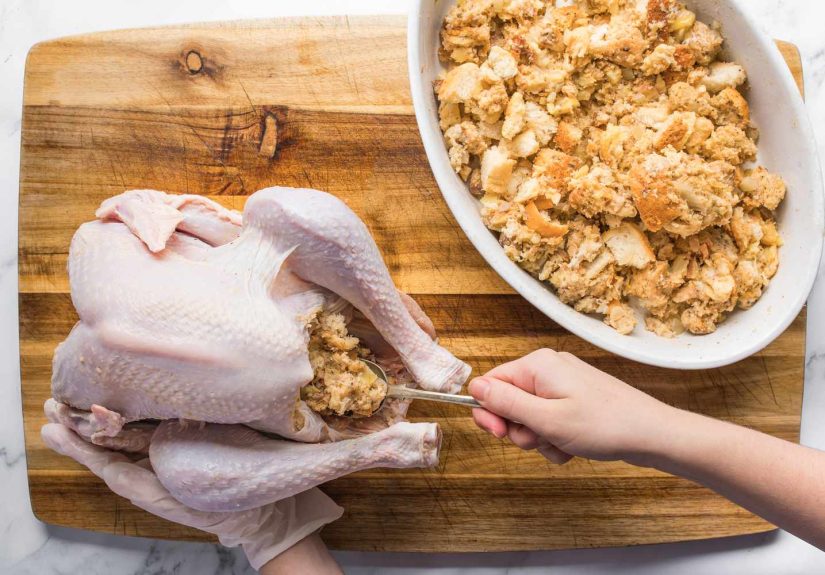
Stuffing: safest move is baking it separately
If you love stuffing (valid), the safest strategy is to cook it in a baking dish so it heats evenly and reaches a
safe temperature. If you cook stuffing inside the turkey, it must still reach 165°Fand that’s
harder because stuffing can lag behind the meat.
If you do stuff the bird, do it safely
- Stuff right before it goes in the oven (not hours earlier).
- Use a thermometer to confirm the center of stuffing reaches 165°F.
-
Let the turkey rest before digging the stuffing outabout 20 minutes helps heat finish
distributing.
Gravy: treat it like the delicious, risky treasure it is
- Bring gravy to a full boil when making it.
- Don’t leave gravy out for long stretchesserve hot, then refrigerate promptly.
- Store gravy in smaller containers so it cools faster.
Step 6: Cook the Turkey Safely (and Keep It Juicy)
There are a million recipes, but food safety boils down to one truth: cook turkey to 165°F in the
right spots. Everything else is technique and preference.
Where to check the temperature
Insert a food thermometer into:
- The thickest part of the breast
- The innermost part of the thigh
- The innermost part of the wing
Avoid touching bone with the thermometer tipbones can give misleading readings. If the turkey is stuffed, the
center of the stuffing must also reach 165°F.
Practical roasting tips that also support safety
- Preheat the oven: Starting in a properly heated oven helps the turkey cook predictably.
- Use a roasting pan with a rack: Better airflow, more even cooking.
- Don’t rely on color: Turkey can brown early and still be undercooked inside.
- Pop-up timers aren’t enough: Use your own thermometer for accuracy.
Resting and carving (the safe way)
Once the turkey hits 165°F, let it rest on the counter while you set up for carving. Resting helps juices
redistribute and makes carving easier. Then carve and servedon’t leave the whole bird sitting out for hours like a
centerpiece that also happens to be perishable.
Step 7: Serve Safely (Buffet Rules Without the Buzzkill)
Serving is where good intentions go to die. People graze, the room is warm, and the turkey starts living in the
Danger Zone. The fix is simple: watch the clock and manage temperatures.
The 2-hour rule (1 hour if it’s very hot)
- Refrigerate leftovers within 2 hours of cooking/serving.
- If food sat out above 90°F (outdoor heat, hot car), the limit is 1 hour.
Keep hot foods hot, cold foods cold
- Use warming trays/slow cookers for hot sides (but stir and monitorsome heat unevenly).
- Serve cold dishes over a bowl of ice if they’ll be out for a while.
- Put out smaller portions and replenish from the fridge/oven as needed.
Step 8: Store Leftovers Like a Pro (So Tomorrow You Is Happy)
The secret to safe leftovers is fast cooling. Big, dense foods (like a whole turkey or a deep casserole) hold heat
in the middle, cooling slowlyprime time for bacterial growth. Your mission: make everything smaller and shallower.
How to cool leftovers quickly
- Carve the turkey: Remove meat from the bones and portion it into smaller containers.
- Use shallow containers: Food cools faster when spread out.
- Refrigerate immediately: You don’t need to “cool it on the counter first.”
- Label and date: Your fridge should not be a mystery novel.
How long leftovers last (fridge vs. freezer)
- Cooked turkey: 3–4 days in the fridge; a couple of months in the freezer for best quality.
- Gravy: About 1–2 days in the fridge (freeze if you won’t use it fast).
- Stuffing and many sides: Often 3–4 days in the fridge (check ingredients and smell/texture).
Reheating: get back to 165°F
Reheat leftovers until they reach 165°F. That includes turkey, stuffing, casseroles, and gravy.
If you microwave, stir and rotate for even heating (microwaves love cold spots).
Food-Safe Fixings: The Usual Suspects
Mashed potatoes
Potatoes are generally safe if handled wellbut keep them hot (or chilled) and don’t let them sit out all evening.
If they contain dairy, treat them as fully perishable.
Green bean casserole
Creamy casseroles are dense and slow to cool. Store in shallow containers and reheat thoroughly to 165°F. When in
doubt, make smaller pans rather than one casserole the size of a mattress.
Cranberry sauce
Cranberry sauce is acidic and often a bit more forgiving than creamy sides, but it’s still perishable once served.
Keep it chilled and return it to the fridge within the 2-hour window.
Rolls, desserts, and the “mostly safe” category
Breads are generally lower-risk. Custard pies and cream-based desserts are notkeep those refrigerated and don’t let
them lounge on the counter.
Quick Troubleshooting (Because Something Always Happens)
“My turkey isn’t thawed and dinner is soon.”
Use cold-water thawing (sealed, submerged, water changed every 30 minutes) or microwave thawing if it fits.
Whichever you choose, cook immediately afterward.
“It’s brown on top but the thermometer says it’s not done.”
Trust the thermometer. Tent the turkey with foil to prevent over-browning and keep roasting until the thickest
parts reach 165°F.
“We ate, talked, and now the turkey has been out for hours.”
Be honest with the clock. If perishable food has been out longer than 2 hours (or 1 hour above 90°F), it’s safest
to discard it. It’s not the fun answer, but it’s the smart one.
Wrap-Up: Safe Turkey Is the Best Turkey
If you remember only four things, make them these: thaw safely, don’t wash the bird, cook to 165°F, and refrigerate
leftovers within 2 hours. Add clean hands, clean surfaces, and a thermometer you trust, and you’ll serve a meal
that’s memorable for the right reasonslike “best gravy ever,” not “group text from urgent care.”
Extra: Real-World Turkey Experiences (The Ones You’ll Recognize)
Most people don’t learn turkey safety from a manualthey learn it from moments. Like the year you discovered
the turkey was still frozen because the neck cavity had the consistency of a glacier. Or the year someone announced,
“I’ll just leave it on the counter overnight,” and three family members transformed into a health department PSA.
One classic experience: the “fridge Tetris” problem. You buy a 16-pound bird with confidence, then open the fridge
and realize you’re already storing a veggie tray, three pies, a gallon of milk, and a mystery container labeled
“soup??” from last week. The turkey won’t fit unless you perform strategic rearranging that feels like moving
apartments. The practical lesson is simple: clear space early and put the turkey on a rimmed tray on the bottom
shelf so any drips can’t contaminate other foods. The emotional lesson: you now understand why some people own a
spare fridge.
Then there’s the “helpful guest” experience. Someone arrives early, sees you prepping, and offers to chop salad
while you handle the raw turkey. That’s a sweet gestureuntil they reach for the same cutting board you used for
the bird. You become a polite bouncer: “Love you, but this board is for raw turkey only. Here’s a fresh one.”
Keeping a designated “raw zone” and “clean zone” isn’t about being controlling; it’s how you keep dinner safe
without turning the kitchen into a hazmat scene.
Stuffing has its own set of relatable moments. Maybe you grew up with stuffing baked inside the turkey, and
changing that tradition feels like telling your ancestors they were “doing it wrong.” The compromise many cooks
land on is making most stuffing in a baking dish (easier to heat evenly), while roasting aromatics in the bird for
flavor. If you do cook stuffing in the turkey, you’ll probably remember the first time you checked temperatures and
realized the meat was done but the stuffing wasn’t. That’s when a thermometer stops being “extra” and becomes your
calm, reliable friend.
Leftovers are where the best memories liveand also where safety gets blurry because everyone is tired. You finish
eating, the table turns into a board game arena, and the turkey sits out like a proud trophy. Two hours can pass
fast when you’re laughing and telling stories. The future-you trick is to set a simple “leftover routine”: carve the
turkey, portion sides into shallow containers, label them, and put them away before the post-meal coma hits. It
takes 15–20 minutes and saves you from playing “is this still good?” three days later.
Another familiar scene: the freezer discovery. You find a labeled bag of turkey from months ago and feel like you’ve
won the lotteryuntil you notice it’s wrapped like a fragile artifact and looks a little dry. That’s freezer burn:
not necessarily unsafe, but definitely not glamorous. The fix is better wrapping (freezer bags, heavy foil, or
freezer paper), squeezing out excess air, and dating packages so you use older ones first. Do that, and leftover
turkey becomes a gift you can turn into soup, tacos, casseroles, or sandwiches that make weekday lunches feel like a
victory lap.
Finally, the most universal turkey experience: the confidence boost. The first time you nail itthawed on time,
cooked to 165°F, juicy slices, sides stored promptlyyou realize turkey isn’t “scary,” it’s just
structured. It’s a project that rewards planning and a thermometer. And once you’ve done it, you can stop
guessing and start enjoying the daybecause the whole point of cooking a turkey is to celebrate, not to stress.






 Close
Close