
Table of Contents >> Show >> Hide
- Why Geometric Canvas Art Works So Well
- Supplies You’ll Need
- Step 1: Choose Your Style Before You Touch the Canvas
- Step 2: Pick a Color Palette That Looks Intentional
- Step 3: Sketch the Design
- Step 4: Tape the Canvas Like You Mean It
- Step 5: Paint in Layers
- Step 6: Remove the Tape Carefully
- Step 7: Finish the Edges and Protect the Painting
- Common Mistakes to Avoid
- Geometric Painting Ideas You Can Try
- How to Make Your DIY Art Look More Expensive
- Real-World Experience: What Making a Geometric Painting Actually Feels Like
- Final Thoughts
Note: This clean HTML body is ready for web publishing and contains no source-link clutter or citation artifacts.
Geometric painting is the art-world equivalent of looking organized even when your closet says otherwise. It feels modern, looks expensive, and can be made with beginner-level skills, a few smart supplies, and the willingness to trust painter’s tape like it’s your personal assistant. If you’ve ever looked at a crisp, color-blocked canvas in a stylish living room and thought, “I could probably make that,” this is your sign to stop probably-ing and start painting.
The best part is that a geometric canvas does not require you to paint realistic flowers, convincing faces, or a horse that actually resembles a horse. Instead, you work with clean lines, bold shapes, balanced color, and a little patience. The result can be minimalist, playful, dramatic, soft, moody, retro, or loud enough to make your beige wall nervous.
In this guide, you’ll learn how to make a geometric painting on a canvas from start to finish, including what materials to use, how to plan a composition, how to get clean edges, what color combinations work well, and how to avoid the classic mistakes that make DIY art look less “gallery chic” and more “middle-school science fair.”
Why Geometric Canvas Art Works So Well
Geometric wall art is popular for a reason. It uses shape and color in a way that feels intentional, even when the process is fairly simple. Triangles, stripes, diamonds, arches, blocks, and overlapping angles create movement without visual chaos. In plain English, it looks like you knew what you were doing.
It also fits almost any room. A black, white, and beige geometric painting can look sleek in a minimalist bedroom. Terracotta, sage, and cream can warm up a living room. Coral, mustard, and navy can make a hallway stop being forgettable. Because geometric painting relies so much on color relationships, you can easily customize it to match your furniture, rug, curtains, or the one accent chair you bought because it made you feel like an adult.
Supplies You’ll Need
Basic materials
- Stretched canvas or canvas panel
- Acrylic paint
- Painter’s tape or artist tape
- Pencil
- Ruler or straightedge
- Paintbrushes in small and medium flat sizes
- Palette or paper plate for mixing paint
- Cup of water
- Paper towels or a clean rag
Optional but useful supplies
- Gesso, if your canvas is unprimed
- Level, for extra-straight lines
- Palette knife
- Acrylic marker for finishing details
- Matte or gloss varnish for protection
Acrylic paint is the easiest choice for this kind of DIY canvas art because it dries relatively quickly, layers well, and works beautifully for flat color blocking. You do not need a giant collection of paint tubes. In fact, limiting your palette often makes the finished geometric painting look more polished.
Step 1: Choose Your Style Before You Touch the Canvas
Before you start taping random triangles like you’re in a race against common sense, decide what kind of geometric painting you want to make. This matters because “geometric” is a wide category. You can go in a lot of directions.
Popular geometric painting styles
- Minimalist blocks: Large shapes, soft neutrals, lots of breathing room
- Sharp modern angles: Crisp triangles and diagonals with strong contrast
- Retro color blocking: Mustard, rust, teal, blush, and cream
- Monochrome design: Different tones of one color family
- Metallic accents: Gold, copper, or silver details for a glam finish
- Geometric landscape look: Polygons inspired by mountains, sunsets, or abstract scenery
If you’re a beginner, start with larger shapes and fewer colors. Tiny, complicated shapes may look impressive on Pinterest, but they also increase the odds that you’ll spend your evening muttering at tape edges.
Step 2: Pick a Color Palette That Looks Intentional
A great geometric canvas painting often succeeds because of the palette more than the pattern. You can have simple shapes and still create a striking piece if the colors work together. The easiest way to do this is to choose one of these approaches:
Easy color strategies
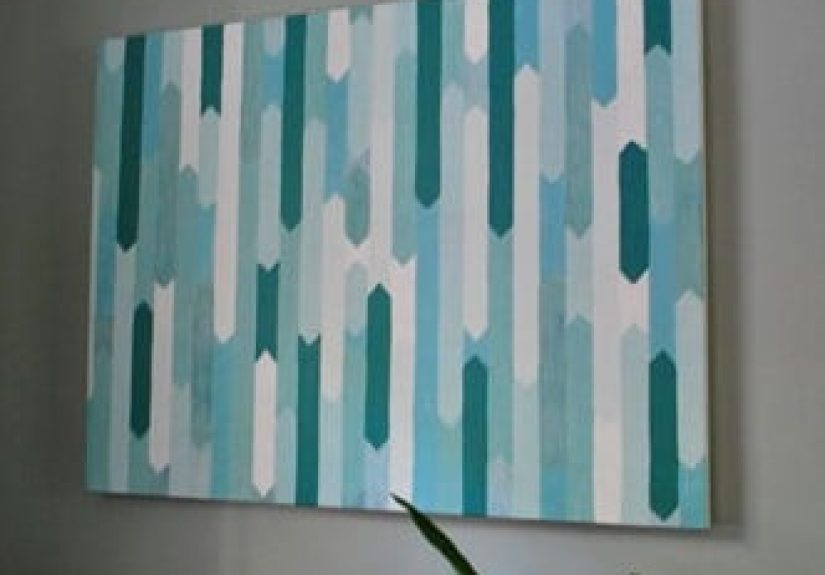
- Analogous palette: Use colors that sit near each other, like blue, teal, and green, for a calm look
- Complementary palette: Pair opposites like blue and orange for drama and contrast
- Neutral plus one pop: Use cream, tan, black, and one bold accent color
- Warm earth tones: Terracotta, clay, beige, rust, and olive
- Cool modern tones: Charcoal, white, dusty blue, and sage
Color can influence the mood of a room, but don’t overthink it like you’re negotiating a peace treaty between mustard and mauve. Start with your space. If your room is full of warm wood and natural textures, earthy tones will probably feel right. If your room leans crisp and contemporary, black, white, gray, and one accent color can look sharp and expensive.
Step 3: Sketch the Design
Now it’s time to map out the composition. Lightly sketch your design with a pencil. Do not press hard. You are making guide marks, not carving your autobiography into the canvas.
Use a ruler to divide the canvas into sections. These sections can be perfectly symmetrical, but they do not have to be. In fact, geometric art often looks more dynamic when it balances order with slight irregularity. You might create a large diagonal line from one corner, add a few intersecting triangles, leave one open area for negative space, and include a small rectangle or circle for contrast.
One of the smartest design tips is to vary the size of your shapes. If every shape is roughly the same size, the painting can look flat and busy. A mix of large, medium, and small sections gives the eye somewhere to rest and somewhere to travel.
A simple beginner layout
- Draw one diagonal line from top left to bottom right
- Add a second diagonal crossing part of the canvas
- Create three to five large shapes
- Add one or two smaller shapes near the edge
- Leave at least one section neutral or unpainted for balance
Step 4: Tape the Canvas Like You Mean It
Painter’s tape is the secret weapon of clean geometric art. Apply the tape along the pencil lines, pressing the edge down firmly. This step matters more than people think. Lazy tape placement leads to fuzzy paint bleed, and fuzzy paint bleed has a way of making you question every life choice that brought you here.
If your design goes to the edge of the canvas, wrap the tape around the sides. That makes the finished artwork look complete from the front and the side, which is a small detail with a surprisingly big impact.
Make sure the canvas surface is clean and dry before taping. If needed, smooth the tape edge with your fingernail, a card, or a flat tool. For ultra-crisp lines, many painters also use thin coats and peel the tape carefully at an angle once the paint has set enough not to smear.
Step 5: Paint in Layers
Start painting one taped section at a time. Flat brushes are ideal for geometric painting because they help distribute color evenly and push paint neatly into corners. Use thin to medium coats rather than thick globs. Thick acrylic may feel satisfying in the moment, but it can create ridges and increase drying time.
If your chosen color looks streaky on the first pass, that is normal. Let it dry, then add a second coat. Many successful DIY geometric paintings are built with two thin coats instead of one heroic, messy one.
Painting tips that make a difference
- Paint from the tape inward, not toward the tape edge
- Use less water so the paint does not seep under the tape
- Let each section dry before painting directly beside it, if possible
- Repeat colors in more than one area for cohesion
- Balance bold areas with lighter or neutral zones
If you want extra depth, you can vary the finish slightly. For example, pair matte-looking neutrals with one more saturated glossy-looking accent. You can also mix a tiny bit of white into one shade to create tonal variation without turning the painting into a rainbow that forgot its schedule.
Step 6: Remove the Tape Carefully
Once the paint has set enough to hold its shape, peel the tape back slowly at an angle. Don’t yank it off like you’re starting a lawn mower. Slow removal helps preserve the clean edge and reduces the chance of lifting dried paint.
This is usually the most satisfying part of the whole process. It’s the DIY version of a dramatic movie reveal. Suddenly your random taped sections become an actual geometric painting, and you get to feel extremely competent for at least ten glorious seconds.
If you notice a minor bleed or uneven edge, do not panic. Let the painting dry completely, then clean up the line with a small flat brush or acrylic marker. Tiny imperfections often disappear once the piece is hanging on the wall and viewed from normal distance rather than from three inches away in a state of emotional overinvestment.
Step 7: Finish the Edges and Protect the Painting
Look at the sides of your canvas. If they are blank, messy, or inconsistent, paint them in a solid coordinating color. Black, white, cream, or one of the main colors in your design usually works well. Painted edges make the artwork feel finished, especially if you plan to hang it without a frame.
After the painting is fully dry, you can leave it as is or apply varnish for protection. A varnish can deepen color slightly and help protect the surface from dust and minor scuffs. If you use varnish, make sure the acrylic painting is thoroughly dry and cured first, especially if you used thick paint layers.
Common Mistakes to Avoid
1. Using too many colors
A five-color palette usually looks more sophisticated than a ten-color free-for-all. When everything is loud, nothing gets to be the star.
2. Making all shapes the same size
Uniform shapes can flatten the composition. Variety adds rhythm and interest.
3. Not leaving negative space
Every inch of the canvas does not need to be busy. Empty or lightly painted areas help the bold shapes stand out.
4. Rushing the drying process
Wet paint and impatience are a dangerous pair. Let sections dry before layering, touching up, or removing tape too aggressively.
5. Ignoring the room where the art will hang
A beautiful painting can still look out of place if the palette clashes with the room. Custom art should feel connected to its space.
Geometric Painting Ideas You Can Try
- A neutral desert palette with arch shapes and sandy beige tones
- A black-and-white striped design with one gold triangle
- A blush, rust, and burgundy composition for a cozy bedroom
- A navy, gray, and white angular design for an office
- A pastel geometric canvas for a nursery or creative studio
- A diptych or triptych using matching colors across multiple canvases
You can also create a geometric landscape by simplifying a mountain range, sunset, or skyline into polygon-like color planes. That style adds a little more personality while still keeping the clean, modern feel that makes geometric wall art so appealing.
How to Make Your DIY Art Look More Expensive
If your goal is less “cute craft night” and more “someone asked where I bought this,” focus on restraint. Use a limited palette, keep edges crisp, repeat colors intentionally, and don’t overcrowd the composition. Scale helps too. A larger canvas often looks more dramatic and designer-like than a tiny one. Even simple shapes can look high-end when the proportions are strong.
Another trick is to echo the colors elsewhere in the room. If your painting includes warm clay, navy, and cream, repeat one of those shades in a pillow, vase, throw, or rug. Suddenly the art doesn’t just hang there. It belongs there.
Real-World Experience: What Making a Geometric Painting Actually Feels Like
The funny thing about learning how to make a geometric painting on a canvas is that the process teaches more than painting. It teaches restraint, decision-making, and the oddly mature skill of not “fixing” something that was already working. The first time many people try this project, they tend to over-design it. More tape. More colors. More shapes. More everything. The canvas starts to look less like modern wall art and more like a traffic map designed by a caffeinated squirrel.
Then experience steps in and politely says, “Maybe calm down.” The best geometric paintings usually come from editing. You realize that one strong diagonal does more than six weak ones. A single block of ochre can make a room glow more effectively than an entire rainbow trying to impress strangers. Negative space stops feeling empty and starts feeling smart. That lesson alone is worth a brush rinse.
There’s also something deeply satisfying about the taping stage. At first it feels technical, almost fussy. You measure, line up edges, press corners, and wonder whether this project is secretly just arts-and-crafts office work. But then the paint goes on, the sections start coming alive, and the structure makes sense. The tape becomes less of a restriction and more of a confidence booster. It gives beginners a way to make clean, modern art without needing advanced brush control.
Color choice is where personality really shows up. Some people discover they love muted tones because they want the painting to feel calm and architectural. Others realize they’ve been waiting their whole lives to put coral next to aubergine and call it self-expression. The process can be surprisingly revealing. You may think you want a minimalist black-and-white canvas, then find yourself sneaking in terracotta because your soul apparently lives in a boutique hotel in Santa Fe.
Another common experience is the “trust the ugly middle” moment. Early on, the canvas can look awkward. The shapes seem random. One color looks too loud. Another looks boring. You start mentally pricing pre-made wall art and wondering whether your talent peaked in elementary school. Then you peel off the tape. Suddenly the crisp lines appear, the palette clicks, and the whole thing looks intentional. This transformation is one of the biggest reasons geometric painting is so rewarding. It often gets dramatically better at the very end.
People also learn quickly that perfection is overrated. Up close, you may notice a tiny wobble in one edge or a small place where the paint coverage is thinner than expected. On the wall, those little flaws usually disappear. In fact, a few handmade quirks can make the work feel more authentic. A geometric painting should look thoughtful, not machine-stamped into existence by a robot with excellent tape discipline.
Over time, many DIY painters develop a personal routine. Maybe they sketch three layouts before choosing one. Maybe they test palette swatches directly on scrap paper. Maybe they always paint the canvas edges first because they learned the hard way that forgetting the sides is irritating. These habits build confidence. What starts as a one-off home decor project can turn into a repeatable creative process.
The most valuable experience, though, is realizing that making art for your home changes the way you see the space. A blank wall becomes an opportunity. A color palette becomes a design tool. A canvas becomes less intimidating because it’s no longer asking for perfection, only intention. And once you make one successful geometric painting, it becomes dangerously easy to think, “Maybe I should make a matching one for the hallway.” That’s how it begins. First a canvas, then a set, then suddenly you have opinions about ochre undertones and tape adhesion.
In the end, geometric canvas art is approachable because it rewards planning without punishing beginners. It offers structure, but still leaves room for style. It’s creative without being chaotic, modern without being cold, and polished without requiring a fine arts degree or a dramatic studio scarf. If you want a DIY project that looks stylish, feels satisfying, and gives you something worthy of hanging on the wall, this is a very good place to start.
Final Thoughts
If you’ve been wondering how to make a geometric painting on a canvas, the answer is refreshingly practical: choose a strong palette, plan a simple composition, tape carefully, paint in thin layers, and let clean lines do the heavy lifting. That’s the magic. You don’t need advanced painting skills to make something beautiful. You just need a clear idea, a little patience, and enough confidence to stop after the painting looks good instead of “improving” it into chaos.
Whether you want modern DIY wall art for your living room, a custom geometric canvas for a bedroom, or a fun weekend painting project that doesn’t require artistic suffering, this method delivers. It’s stylish, flexible, beginner-friendly, and surprisingly addictive. Your walls may never emotionally recover from how good they’re about to look.






 Close
Close