
Table of Contents >> Show >> Hide
- Why the Diagonal Matters in a Rectangle
- How to Find the Area of a Rectangle Using the Diagonal: 8 Steps
- Step 1: Identify What Information You Actually Have
- Step 2: Sketch the Rectangle and Draw the Diagonal
- Step 3: Write the Two Core Formulas
- Step 4: Use the Extra Information to Find a Missing Side
- Step 5: Solve for Both Side Lengths
- Step 6: Multiply Length by Width
- Step 7: Check That the Numbers Make Sense
- Step 8: Use a Shortcut Formula When It Fits
- Examples That Make the Method Click
- Common Mistakes to Avoid
- When the Problem Gets Easier
- Practical Experiences and Lessons From This Topic
- Final Thoughts
At first glance, finding the area of a rectangle using the diagonal sounds like one of those math tasks designed to make students stare at the ceiling and rethink their life choices. After all, the area formula for a rectangle is usually the friendly old classic: length × width. Nice. Predictable. Not dramatic.
But then the diagonal shows up like a plot twist.
Here is the good news: you absolutely can find the area of a rectangle using the diagonal. Here is the slightly less dramatic but very important news: the diagonal alone is usually not enough. To get the area, you need the diagonal and at least one more piece of information, such as a side length, a side ratio, or the angle between the diagonal and a side.
Once you know that, the whole problem becomes much more manageable. In this guide, you will learn the exact logic behind the process, the formulas that make it work, and the most common traps students fall into. We will also walk through clear examples, because math explanations without examples are like sandwiches without bread: technically possible, but not helping anyone.
Why the Diagonal Matters in a Rectangle
A rectangle has four right angles, which is excellent news for anyone who enjoys the Pythagorean theorem. When you draw a diagonal from one corner to the opposite corner, the rectangle is split into two congruent right triangles. That means the diagonal becomes the hypotenuse, and the rectangle’s length and width become the two legs.
If the length is l, the width is w, and the diagonal is d, then:
d² = l² + w²
That single relationship is the engine behind almost every rectangle diagonal formula. The area is still:
A = l × w
So the entire strategy is simple in theory: use the diagonal to help figure out the missing side information, then multiply the side lengths to get the area.
How to Find the Area of a Rectangle Using the Diagonal: 8 Steps
-
Step 1: Identify What Information You Actually Have
Before touching a formula, check the problem carefully. Are you given only the diagonal? A diagonal and one side? A diagonal and a ratio of the sides? A diagonal and an angle? This matters because the diagonal is helpful, but it is not a mind reader.
If you only know the diagonal of a rectangle, there are infinitely many rectangles with that same diagonal but different side lengths, which means different areas. So if the problem gives only the diagonal and nothing else, the area cannot be determined uniquely.
-
Step 2: Sketch the Rectangle and Draw the Diagonal
Draw a simple rectangle. Label the horizontal side l, the vertical side w, and the diagonal d. Even a rough sketch helps prevent silly mistakes, especially when numbers start flying around like they own the place.
That diagonal splits the shape into two right triangles. Once you see the right triangle, the Pythagorean theorem is ready to clock in.
-
Step 3: Write the Two Core Formulas
Keep these two formulas in front of you:
d² = l² + w²
A = l × w
The first formula helps you connect the diagonal to the side lengths. The second formula gives the actual area. Your job is to move from the first formula to the second one without getting ambushed by algebra.
-
Step 4: Use the Extra Information to Find a Missing Side
This is the real turning point. Since the diagonal alone is not enough, you must use the additional clue.
If one side is known, solve for the other side with:
w = √(d² – l²) or l = √(d² – w²)
If a side ratio is known, let the sides be written as multiples of the ratio. For example, if the ratio is 3:4, write the sides as 3k and 4k.
If an angle between the diagonal and a side is known, you can use trigonometry:
l = d cos θ and w = d sin θ
-
Step 5: Solve for Both Side Lengths
Now turn the clue into actual side lengths.
For example, if the diagonal is 10 and one side is 6, then:
w = √(10² – 6²) = √(100 – 36) = √64 = 8
Now the rectangle has side lengths 6 and 8. No mystery remains. The diagonal has done its job and may now retire gracefully.
-
Step 6: Multiply Length by Width
Once you know both side lengths, the area formula becomes easy again:
A = l × w
Using the example above:
A = 6 × 8 = 48
That means the area of the rectangle is 48 square units.
-
Step 7: Check That the Numbers Make Sense
This step saves people from surprisingly common mistakes. Make sure the diagonal is the longest measurement. If your side turns out longer than the diagonal, something went wrong. Probably algebra. It is often algebra.
Also check that your units match. If side lengths are in inches, the area must be in square inches. Not inches. Not “inch-ish.” Square inches.
-
Step 8: Use a Shortcut Formula When It Fits
Some rectangle diagonal problems can be solved faster with direct formulas.
If you know the diagonal d and one side l:
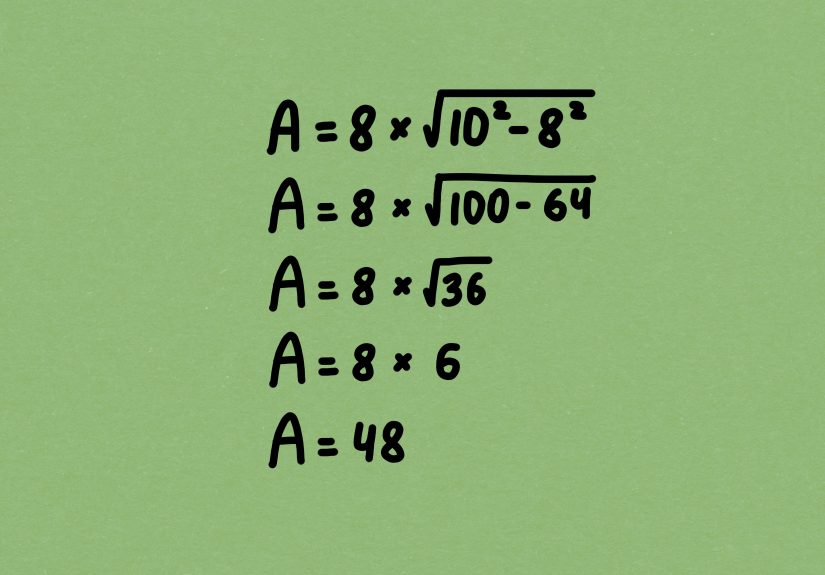
A = l√(d² – l²)
If you know the diagonal d and the angle θ between the diagonal and one side:
A = d² sin θ cos θ
Since 2 sin θ cos θ = sin 2θ, this can also be written as:
A = (d²/2) sin 2θ
If the rectangle is actually a square:
A = d² / 2
That last one is especially useful because squares love showing up in geometry problems wearing rectangle costumes.
Examples That Make the Method Click
Example 1: Diagonal and One Side Are Known
A rectangle has a diagonal of 13 inches and a length of 5 inches. Find the area.
Use the Pythagorean theorem:
w = √(13² – 5²) = √(169 – 25) = √144 = 12
Now find the area:
A = 5 × 12 = 60
Answer: 60 square inches
Example 2: Diagonal and Side Ratio Are Known
A rectangle has side ratio 3:4 and diagonal 10 feet. Find the area.
Let the sides be 3k and 4k. Then:
d² = (3k)² + (4k)² = 9k² + 16k² = 25k²
d = 5k
Since the diagonal is 10:
5k = 10 → k = 2
So the side lengths are 6 and 8.
A = 6 × 8 = 48
Answer: 48 square feet
Example 3: Diagonal and Angle Are Known
A rectangle has a diagonal of 20 meters, and the angle between the diagonal and the base is 30°. Find the area.
Use trigonometry:
l = 20 cos 30° ≈ 17.32
w = 20 sin 30° = 10
Then:
A ≈ 17.32 × 10 = 173.2
Answer: about 173.2 square meters
Example 4: Only the Diagonal Is Given
A rectangle has a diagonal of 10 centimeters. Find the area.
This cannot be determined from the information given. A 6-by-8 rectangle has diagonal 10 and area 48, while a 1-by-√99 rectangle also has diagonal 10 but a very different area. Same diagonal. Different rectangle. Different area. Math can be like that.
Common Mistakes to Avoid
Assuming the Diagonal Alone Is Enough
This is the biggest mistake. Many students think that if the diagonal is known, the area should automatically be knowable. Not so. The diagonal gives a relationship between the sides, not the side lengths themselves.
Mixing Up Rectangle and Rhombus Formulas
Some people remember that one quadrilateral uses diagonals to find area and then accidentally apply the wrong formula. For a rhombus or kite, area can be based directly on diagonals. For a rectangle, that shortcut does not work in general. The rectangle needs more information unless it is specifically a square.
Forgetting the Square-Unit Label
Area is always measured in square units: square inches, square feet, square centimeters, and so on. Leaving off the squared unit is a small detail that can cost points on homework, quizzes, or exams.
When the Problem Gets Easier
There are a few cases where finding the area of a rectangle using the diagonal becomes much simpler.
Case 1: The Rectangle Is a Square
If all sides are equal, then the diagonal formula gives:
d = s√2
So:
s = d / √2
And the area becomes:
A = s² = d² / 2
Very tidy. Almost suspiciously tidy.
Case 2: One Side Is Given
This is the most common classroom version. You use the diagonal and one side to get the other side, then multiply.
Case 3: A Ratio Is Given
This is common in test questions because it blends algebra and geometry. Once you assign the sides as multiples of a variable, the diagonal formula usually simplifies nicely.
Practical Experiences and Lessons From This Topic
One of the most interesting things about learning how to find the area of a rectangle using the diagonal is that students often start the topic feeling confident and end the first attempt looking mildly betrayed. That is because rectangles seem simple. They are the golden retrievers of geometry: friendly, familiar, and usually not the source of drama. But the moment a teacher replaces length and width with a diagonal, the room gets a little quieter.
In practice, this topic teaches more than just one geometry skill. It teaches how math problems often hide useful information inside familiar shapes. A rectangle with a diagonal is really two right triangles waiting to be noticed. Once students start seeing that, their problem-solving improves in a much broader way. They begin spotting hidden triangles in ladders against walls, TV screen measurements, floor plans, map grids, and coordinate geometry questions.
Another common experience is that students remember formulas better when they understand where they come from. Memorizing d² = l² + w² is one thing. Realizing that the diagonal literally creates a right triangle inside the rectangle is something else entirely. That small visual insight often makes the formula stick. Suddenly, the theorem is not random anymore. It has a job, and it is doing that job right in front of you.
This topic also exposes a very human habit: wanting one formula to do everything. Students sometimes look for a direct “rectangle area from diagonal” rule and get annoyed when the answer is, “Well, it depends.” But that is actually a valuable lesson. In real problem-solving, one number rarely tells the whole story. You need context. You need structure. You need the extra clue. Geometry, in this way, behaves a lot like real life and slightly less like a magic trick.
Teachers and tutors also notice that examples with nice numbers, like 6-8-10 or 5-12-13, build confidence fast. Those Pythagorean triples make the process feel clean and satisfying. Once students get comfortable there, they are more willing to tackle ugly decimals, radicals, and angle-based versions. The emotional path matters. Math often gets easier when the first few examples let the learner feel competent instead of ambushed.
There is also a practical side to this concept outside the classroom. Screen sizes are measured diagonally. Construction layouts rely on diagonal checks. Designers use diagonals to confirm rectangular accuracy. Even basic home projects can quietly involve this exact logic. So while the worksheet version may look abstract, the underlying idea is surprisingly useful.
In the end, this topic tends to leave students with a stronger understanding of area, right triangles, and mathematical relationships. It starts with a rectangle, introduces a diagonal, and turns into a lesson about structure, strategy, and patience. Not bad for a shape that usually spends its time being a notebook cover or a phone screen.
Final Thoughts
If you want to find the area of a rectangle using the diagonal, the key idea is simple: turn the rectangle into a right triangle problem first. The diagonal connects the side lengths through the Pythagorean theorem, and from there you can work back to the area. Just remember the one rule that keeps this entire topic honest: the diagonal alone is usually not enough.
Give the problem one extra clue, though, and everything snaps into place. Whether that clue is a side length, a ratio, or an angle, the process becomes logical, repeatable, and much less scary than it first appears. Which is really the best kind of math problem: the kind that looks intimidating until you know the trick.







 Close
Close