
Table of Contents >> Show >> Hide
- Start With the Job Description: Function First, Pretty Second
- Know Your Terms: Buffet vs. Sideboard vs. Credenza
- Choose Your Anchor: Art, Mirror, or “I Can’t Decide” (So Both)
- Build a Styling Skeleton: Height, Layers, and a Visual “Triangle”
- The Core Ingredients: What to Put on a Dining Room Buffet
- Four Foolproof Layout Recipes
- Seasonal Swaps That Don’t Take Over Your Storage Closet
- Common Buffet Styling Mistakes (and How to Fix Them Fast)
- A Quick Checklist Before You Call It Done
- Real-Life Experiences: What Actually Happens When You Decorate a Buffet (and Live With It)
- Conclusion: Your Buffet, Your Stage
A dining room buffet is the overachiever of furniture: it stores your “good plates,” rescues you during holidays, and quietly judges you when you drop your keys on it like it’s a landing pad. The best part? It’s also a built-in styling stage. With a few smart moves, your buffet can look magazine-ready and still be usable when guests show up hungry and slightly early.
This guide breaks down how to decorate a dining room buffet (also called a sideboard or credenza, depending on the shape and who’s trying to sound fancy) with practical, repeatable formulas. You’ll get layout “recipes,” real examples, and easy swaps for seasons and entertainingwithout turning the top into a clutter museum.
Start With the Job Description: Function First, Pretty Second
Before you place a single candle, decide how your buffet needs to work in real life. The styling should support the buffet’s job, not block it.
Ask yourself these three questions
- Is it everyday storage? You’ll want breathing room on top for serving and setting things down.
- Is it your entertaining command center? You’ll need space for trays, drink setup, or a dessert lineup.
- Is it mostly decorative? Greatgo bolder with layered art, lamps, and taller pieces.
A simple rule that keeps you sane: plan to leave at least one-third of the surface open (or more, if you actually use it during meals). That “negative space” makes everything look more intentionaland gives you a place to set down a platter without playing décor Jenga.
Know Your Terms: Buffet vs. Sideboard vs. Credenza
In everyday decorating speak, people use these words interchangeably. But here’s the helpful gist: a sideboard is a long, low storage piece; in a dining room it’s often called a buffet because it can serve food; a credenza is similar but may be sleeker or used in other rooms. Translation: style it the same wayjust don’t block the doors and drawers.
Choose Your Anchor: Art, Mirror, or “I Can’t Decide” (So Both)
The fastest way to make a buffet look finished is to give it a vertical partner. A naked wall above a buffet can make your styling feel like it forgot its pants.
Best anchor options
- One large mirror to bounce light and visually widen the room.
- One oversized piece of art for a bold focal point (especially great in formal dining rooms).
- A pair or trio of frames for a gallery feelmore casual, more flexible.
- Leaning art if you want an effortless, not-too-precious look.
Proportion trick: aim for your anchor piece to be roughly two-thirds the width of the buffet (give or take). If you go tiny above a long buffet, it can look like the wall art got lost and ended up in the wrong house.
Build a Styling Skeleton: Height, Layers, and a Visual “Triangle”
Most buffet styling fails for one reason: everything is the same height. Your eye wants a little skylinetall, medium, lowso the display feels balanced and alive.
The “rule of three” vignette
If you’re stuck, start with three items that each play a different role: one vertical (lamp or tall vase), one horizontal (stacked books or tray), and one sculptural (bowl, candle cluster, small art object). It’s the decorating equivalent of a well-balanced meal: you need more than just bread.
Layer like a stylist (without becoming one)
- Back layer: art/mirror + maybe a tall lamp or branches.
- Middle layer: medium pieces (vases, frames, canisters).
- Front layer: low pieces (tray, bowl, candles) that don’t block the view.
The Core Ingredients: What to Put on a Dining Room Buffet
You don’t need 27 knickknacks. You need a few strong “ingredients” with different shapes and textures. Here are the MVPs.
1) Lighting (the secret sauce)
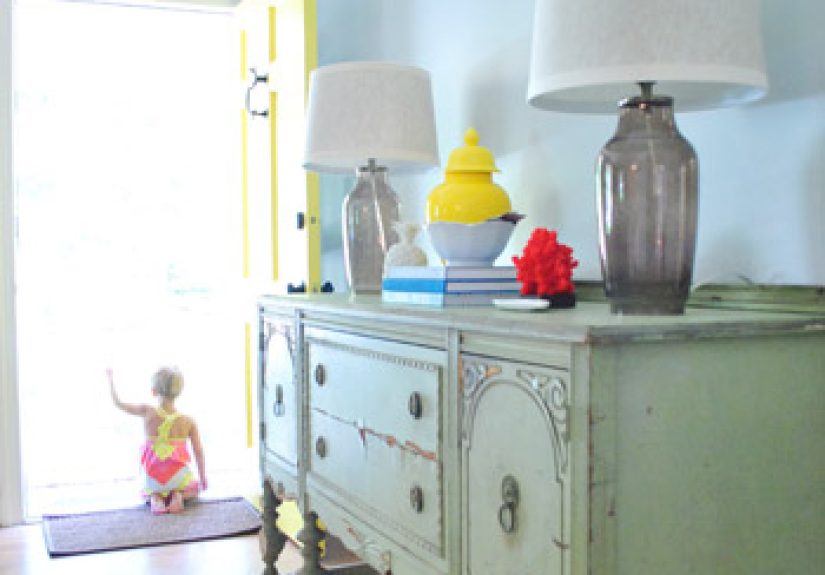
A lamp (or a pair of lamps) adds warmth and makes your buffet feel purposefulespecially in dining rooms that lean formal. If you’re short on surface space, consider wall lighting nearby so the top stays clear and functional.
2) A tray to corral the chaos
Trays are the grown-up version of “put it all in a basket.” They group smaller objects so the buffet looks styled, not scattered. Use a tray for: bar tools, candles, a small vase + matches, or even a catchall bowl for daily items (if you must… we all have our habits).
3) Something living (or at least convincingly green)
Fresh flowers are undefeated, but a good plant or realistic greenery works too. A simple arrangement instantly makes the buffet feel cared forlike you didn’t decorate it in a panic five minutes before guests arrived.
4) Something personal
The best buffets don’t look like a store display. Add one personal piece: a framed family photo (keep it classy), a travel find, a vintage serving piece, or a ceramic bowl you actually love. One good story beats five random objects every time.
5) Texture and contrast
Mix materials so the display has depth: wood + ceramic + glass + metal is a reliable combo. If your buffet is dark wood, brighten with a light runner, pale pottery, or a reflective mirror. If your buffet is light, add contrast with darker frames or a moody lamp base.
6) Practical beauty (aka: the “pretty but useful” items)
- A stack of dinner plates or a cake stand (especially if you entertain often)
- A lidded box for matches, remotes, or random bits
- A small bowl for salt cellars, place card holders, or keys (if it’s near an entry)
Four Foolproof Layout Recipes
Pick one of these arrangements, then tweak the colors and objects to match your room. This is where you get the “designer look” without the designer invoice.
Recipe 1: The Classic Symmetry (timeless, tidy, low-stress)
- Center: large mirror or art
- Left + right: matching lamps (or matching candleholders)
- Front: a tray with 2–3 items (candle + small vase + matches)
Best for traditional dining rooms, formal spaces, and anyone whose brain relaxes when things match.
Recipe 2: The Modern Asymmetry (easy, airy, a little cooler)
- Back: large art leaned slightly off-center
- One side: tall vase with branches or a single sculptural lamp
- Opposite side: a low bowl + stacked books
This looks “effortless,” which is decorating code for “I tried, but I want credit for looking like I didn’t.”
Recipe 3: The Everyday Serve-and-Store (pretty, but buffet-ready)
- Back: mirror or art
- One corner: lamp or tall plant
- One corner: a lidded box or canister for functional items
- Middle: keep open for serving platters
This is the layout for people who actually use their dining room and don’t want to relocate fifteen objects every time they host.
Recipe 4: The “Bar Buffet” (guest-pleasing and surprisingly chic)
- Tray: bottles + bar tools + cocktail napkins
- Pretty glassware (limit to a small cluster so it doesn’t look like a store shelf)
- Lighting: a lamp or two candles for glow
- Optional: a small bowl of citrus or garnish jar
Keep the drink station slightly separate from the main food flow when entertaining, so people can refill without causing a traffic jam.
Seasonal Swaps That Don’t Take Over Your Storage Closet
You don’t need to redecorate from scratch every season. Swap one main element and one accent.
Spring
Trade heavy accessories for lighter ceramics, fresh tulips, or a simple green wreath over the mirror.
Summer
Use a woven tray, bright citrus in a bowl, and breezy artkeep it light and unfussy.
Fall
Add a warm-toned runner, brass candleholders, and branches or dried stems for height.
Winter / Holidays
Think greenery garland (kept low), a few metallic accents, and candles. Leave serving spaceholiday buffets need to work overtime.
Common Buffet Styling Mistakes (and How to Fix Them Fast)
Mistake: Too many small objects
Fix: remove half. Then replace the remaining tiny items with one medium-to-large piece (bigger vase, larger bowl, or a lamp). Bigger pieces look calmer and more intentional.
Mistake: Everything is the same height
Fix: introduce one tall element (lamp, branches, oversized art) and one low anchor (tray or bowl). Instant dimension.
Mistake: The buffet can’t function
Fix: push décor to one side or the back edge. Keep a clear “landing strip” for serving and daily life.
Mistake: The wall above feels disconnected
Fix: scale up your anchor (bigger art/mirror), or create a grouped set of frames. A buffet needs a vertical partner to feel complete.
Mistake: It looks like a showroom, not your home
Fix: add one personal piece with meaning. A vintage platter from family, a framed menu from a favorite trip, a handmade bowlsomething that says “real humans live here.”
A Quick Checklist Before You Call It Done
- Balance: tall + medium + low
- Breathing room: at least one-third of the top left open if it’s functional
- Anchor: mirror/art above to connect the wall and furniture
- Grouping: use a tray or intentional clusters (not scattered singles)
- Texture: mix materials so it doesn’t fall flat
- Reality check: doors/drawers open easilyno décor gymnastics required
Real-Life Experiences: What Actually Happens When You Decorate a Buffet (and Live With It)
Let’s talk about the part that Pinterest rarely shows: you style the buffet, it looks incredible, and then life immediately happens to it. Here are a few real-world scenarios that tend to come upand what usually works best once you’re the one wiping fingerprints off the mirror.
1) The “Small Dining Room, Big Buffet” situation. In tighter spaces, a buffet can feel visually heavy fastespecially if it’s dark wood. What helps most is choosing a mirror above it and keeping the styling lighter and taller rather than wide and bulky. A single lamp on one side, a tall vase with branches on the other, and a low tray in the middle creates height without making the surface feel crowded. Bonus: the mirror bounces light around the room and makes the whole dining area feel less boxed in. If you’re tempted to add lots of little décor to “make it cute,” don’tbigger pieces actually read cleaner from across the room.
2) The “We eat here every day” buffet. The buffet that supports real meals needs a different approach than a purely decorative moment. The most livable setup is to style the back edge and one corner, leaving a clear landing zone. In practice, that might look like: art above, a lamp in the back corner, and a tray that holds a candle and a small vase. That’s it. Because the first time you host tacos or a holiday dinner, you’ll be grateful you’re not relocating a sculpture collection to make room for serving bowls. The funny thing is, once you stop over-styling, the buffet often looks more “designer” anywaybecause it’s calm.
3) The “Kid and pet magnet” buffet. If you have kids, pets, or that one friend who gestures wildly while talking, fragile décor is basically an extreme sport. The best adjustment is swapping breakables for sturdier pieces: a weighted lamp, a wide ceramic bowl, a low arrangement, and a tray that keeps things from sliding around. Candles look greatjust consider flameless versions if the buffet sits in a high-traffic path. And if you love framed photos, lean them or use larger frames; tiny ones get knocked around more easily and look busy when they’re slightly crooked (which they will be).
4) The “I restyled it three times and it still looks off” moment. This is incredibly commonand usually the issue isn’t your taste. It’s scale. The fix is often one of these: go bigger with the art/mirror, add one tall item to change the height profile, or remove the small clutter and group what’s left on a tray. A surprisingly effective trick is to take a photo from across the room. Your camera will instantly reveal what your eyes gloss overlike everything being the same height, or the anchor art being too small for the buffet. After that, the solution becomes obvious (and mildly annoying, because it was obvious to your camera the whole time).
Decorating a dining room buffet is less about buying new stuff and more about arranging what you already have with intention. Once you land on a formula that works for your spacesymmetry, asymmetry, serve-and-store, or bar buffetyou can keep the base and just swap one or two elements as the season changes. That’s the real secret: make it pretty, make it practical, and make it easy enough that you’ll actually maintain it.
Conclusion: Your Buffet, Your Stage
A beautifully decorated dining room buffet doesn’t require a warehouse of accessories or a design degree. Start with function, add a strong wall anchor, build height and layers, and choose a few pieces that mix texture and meaning. Keep it breathable, keep it usable, and don’t be afraid to edit. Your buffet is already doing a lotyour décor should make it look like it’s winning at life.






 Close
Close