
Table of Contents >> Show >> Hide
- Why Cleaning a Crane Cool Mist Humidifier Matters (More Than You Think)
- Before You Start: Supplies Checklist
- Know Your Crane Humidifier Parts (So You Clean the Right Stuff)
- Daily Maintenance: The 2-Minute Routine That Prevents Gross Surprises
- Weekly Cleaning: Descale and De-Gunk with Vinegar (Crane-Friendly Method)
- Disinfecting: When You Should Do It (and How to Do It Safely)
- Deep-Clean the “Mist-Maker” Area Without Damaging It
- Don’t Forget the Water Level Sensor (The “Why Is My Light Red?” Culprit)
- How Often Should You Clean a Crane Humidifier?
- Pro Tips to Keep It Cleaner Longer (Less Work, More Mist)
- Common Mistakes (A.K.A. How Humidifiers Become Gross)
- Troubleshooting After Cleaning
- End-of-Season Storage: Don’t Put It Away Wet
- Real-World Experiences: 6 Very Relatable Crane Humidifier Moments (500+ Words)
- 1) The “Why Does My Nursery Smell Like a Lake?” Episode
- 2) The “White Dust on My Dresser” Mystery
- 3) The “My Mist Output Is Weak and Pathetic” Panic
- 4) The “I Cleaned It… Why Does It Still Smell?” Plot Twist
- 5) The “I Forgot Water in It for a Week” Confession
- 6) The “I Want Cozy Air but Not a Mold Party” Lifestyle Upgrade
- Conclusion
Your Crane cool mist humidifier is basically a tiny indoor weather machine. Treat it well and it rewards you with comfy air and happy sinuses.
Neglect it and it becomes a spa resort for minerals, biofilm, and that mysterious “wet sock” smell that shows up right when guests arrive.
The good news: cleaning a Crane humidifier is simple, fast, and (oddly) satisfyinglike power-washing, but for grown-ups who own vinegar.
This guide walks you through cleaning (removing mineral scale and gunk) and disinfecting (reducing germs) the right way,
with steps that fit most Crane ultrasonic cool mist models (including the popular Adorables line). You’ll also get routines to prevent white dust,
odors, and moldplus real-world “I’ve been there” scenarios at the end.
Why Cleaning a Crane Cool Mist Humidifier Matters (More Than You Think)
Cool mist humidifiers use water to create mistso anything living in that water (or growing on wet surfaces) can end up hitchhiking into the air.
Add minerals from tap water and you get scale buildup that reduces performance and can contribute to “white dust” in ultrasonic units.
Regular maintenance protects your air, your machine, and your sanity.
Signs your Crane humidifier is begging for a cleaning
- Reduced mist output (your “mist cloud” has turned into a shy whisper)
- White crust or chalky spots in the tank or base
- Musty odor or funky smell when running
- Slippery film on parts (biofilm loves a warm, wet hangout)
- White dust showing up on furniture near the unit
Before You Start: Supplies Checklist
Keep it simple. You likely have most of this already:
- White distilled vinegar
- Clean water (distilled or filtered is ideal for rinsing)
- Soft cloths or paper towels
- Soft bottle brush or old toothbrush (gentleno metal scrubbers)
- Optional: 3% hydrogen peroxide (for periodic disinfection)
- Optional: household bleach (only if your specific manual allows it)
- A small bowl/cup for mixing
Two safety rules that save the day
- Unplug first. Always. Water + electricity is a terrible buddy-comedy.
- Never mix vinegar and bleach. That combo can create toxic chlorine gas. If you use one, rinse thoroughly before using the other.
Know Your Crane Humidifier Parts (So You Clean the Right Stuff)
Most Crane cool mist humidifiers share the same core pieces:
- Water tank (the big container you fill)
- Tank cap (often on the bottom; sometimes includes a valve)
- Base (where water collects and the mist is generated)
- Nebulizer/transducer area (the “mist-making” surfacetreat gently)
- Water level sensor/float (helps the unit detect water and shut off safely)
- Fan vent/outlet (keep water away from it)
Important: Do not immerse the base in water, and don’t let liquid drip into vents or electrical openings.
Think of the base like a laptop: it can handle a careful wipe-down, not a bath.
Daily Maintenance: The 2-Minute Routine That Prevents Gross Surprises
If you only do one thing, do this. Daily maintenance dramatically cuts down on microbial growth and mineral buildup.
Daily steps (yes, even when you’re tired)
- Turn off and unplug the humidifier.
- Remove the tank and empty any remaining water from the tank.
- Empty the base (pour away from the fan vent/outlet).
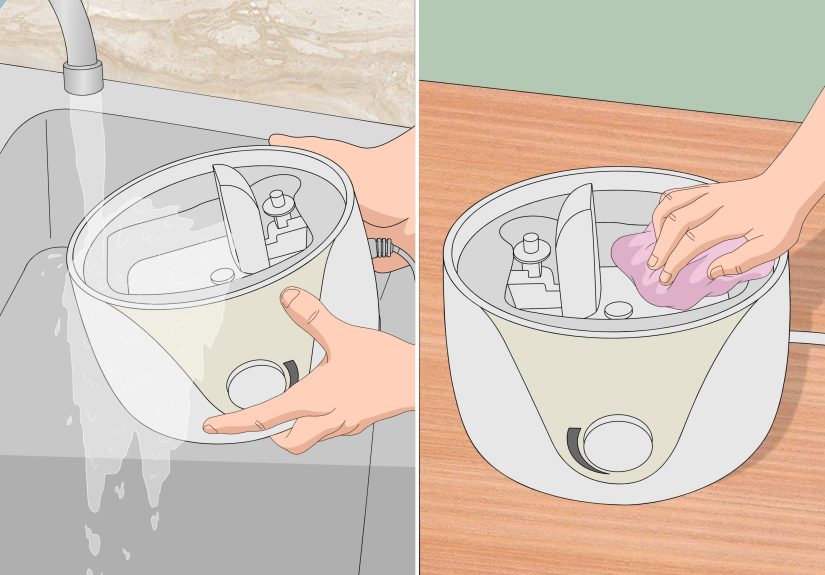
- Quick rinse the tank and base with clean water.
- Air dry: leave the tank cap off and let both tank and base dry fully before refilling.
This routine prevents “standing-water soup,” which is where odors and biofilm start their evil little empire.
Weekly Cleaning: Descale and De-Gunk with Vinegar (Crane-Friendly Method)
Weekly cleaning focuses on removing mineral deposits and film. Crane’s own guidance commonly uses a vinegar-and-water method
because vinegar breaks down scale without leaving detergent residue.
Step 1: Clean the water tank
- Unplug the unit and empty tank/base completely.
-
Add warm water to the tank (about halfway), then add white vinegar.
A common Crane-style ratio is about 2 tablespoons of vinegar for a half-tank of warm water. - Shake vigorously (cap on), then let it sit for ~30 minutes.
- Empty the tank and rinse thoroughly until the vinegar smell is gone.
- Let it air dry with the cap off.
Step 2: Clean the base (the “don’t-get-it-in-the-vent” zone)
- Pour a little warm water into the base (just enough to cover mineral spots).
- Add vinegar (many Crane routines use about 1 tablespoon for the base cleaning mixture).
- Let it sit for ~30 minutes.
-
Use a soft brush or cloth to gently wipe away residueespecially around the mist-making surface.
Don’t scrape with anything sharp. - Carefully empty the base away from vents, then rinse with clean water.
- Wipe dry and allow the base to fully air dry.
Step 3: Clean the tank cap and small parts
The tank cap is the unsung heroand a popular place for buildup.
Soak it in a small bowl of warm water with a splash of vinegar for 10–20 minutes, then scrub gently and rinse.
Disinfecting: When You Should Do It (and How to Do It Safely)
Cleaning removes deposits and film. Disinfecting is for times when you want extra germ reductionlike after an illness in the house,
if you see visible slime, or if the unit sat unused with water inside (a.k.a. “the science experiment you didn’t mean to start”).
Option A: Disinfect using bleach (ONLY if your model’s manual allows it)
Some Crane ultrasonic humidifier manuals include a bleach-water disinfection step (while other Crane materials emphasize vinegar cleaning).
Follow the instructions for your exact model. If bleach is permitted for your model, a commonly cited manufacturer-style method is:
- Mix 1 teaspoon of household bleach into 1 gallon of water.
- Fill the tank with the solution and let it stand for about 20 minutes, shaking gently every few minutes.
- Drain and rinse repeatedly until no bleach smell remains.
-
For the base, do not immerse. Instead, wipe the water basin with a soft cloth dampened with the same solution,
then rinse and dry.
Bleach can be effective, but it’s also strong and can be hard on some plastics and seals. If you use it, keep it diluted, limit contact time,
and rinse like your life depends on it (your nostrils will thank you).
Option B: Disinfect using hydrogen peroxide (gentler, popular alternative)
- Empty and rinse tank/base.
- Pour a small amount of 3% hydrogen peroxide into the tank (enough to coat the interior), swish, and let sit 10–20 minutes.
- Wipe the base with a peroxide-dampened cloth (avoid vents), then rinse thoroughly.
- Air dry completely before reassembling.
Whichever method you choose, the key is thorough rinsing and full drying before you run the humidifier again.
Never run the unit with vinegar, bleach, or peroxide inside.
Deep-Clean the “Mist-Maker” Area Without Damaging It
Your Crane humidifier’s nebulizer/transducer area is delicate. Mineral deposits here can kill mist outputbut aggressive scrubbing can also ruin it.
Use the gentle approach:
- Soak first (vinegar + warm water) to loosen deposits.
- Wipe gently with a soft cloth or soft toothbrush.
- No sharp tools (no knives, pins, metal scrapersthis isn’t archaeology).
- Keep liquids away from vents and electrical parts.
Don’t Forget the Water Level Sensor (The “Why Is My Light Red?” Culprit)
Many Crane cool mist units use a float-style water level sensor. If it gets gunked up, the humidifier may think it’s out of water and refuse to mist.
During weekly maintenance:
- Remove the sensor/float components as your manual shows (often a cap and small float piece).
- Wash gently with warm water (mild suds if allowed), then rinse well.
- Dry and reassemble correctly so the float moves freely.
How Often Should You Clean a Crane Humidifier?
Here’s a practical schedule that aligns with common public-health and manufacturer-style guidance:
Best-practice cleaning schedule
- Daily: Empty, rinse, and air dry tank and base.
- Weekly: Vinegar descaling + scrub small parts.
- Every 2–4 weeks (or after illness): Disinfect (per manual guidance), then rinse and dry thoroughly.
- End of season: Deep clean, dry completely, store with cap loose/off.
If you’re using your humidifier heavily (every night), treat weekly cleaning like brushing your teeth: it’s not “extra,” it’s the deal.
Pro Tips to Keep It Cleaner Longer (Less Work, More Mist)
1) Use better water
Distilled or filtered water reduces mineral buildup and helps prevent “white dust” with ultrasonic humidifiers.
If your Crane model supports an optional demineralization filter, it can also help in hard-water areas.
2) Keep indoor humidity in the sweet spot
Too much humidity can cause condensation and encourage mold growth in the room. Aim for comfortable, moderate humidity and reduce mist output if you see wet windows.
A simple hygrometer can help you avoid turning your bedroom into a rainforest exhibit.
3) Skip the “mystery additives”
Unless your Crane model specifically supports fragrance/oils in a dedicated tray, don’t add essential oils, salt, or medications to the tank.
They can damage the unit, gunk up parts, and create residues that are harder to remove.
4) Dry time is not optional
Microbes love moisture. A fully dry tank and base between uses is one of the simplest, most powerful ways to prevent growth.
Common Mistakes (A.K.A. How Humidifiers Become Gross)
- Leaving water in the tank/base for days (hello, bacterial growth)
- Using detergent inside water-contact areas (residue can interfere with performance)
- Not rinsing thoroughly after cleaning/disinfecting
- Scraping the nebulizer/transducer with something sharp
- Mixing cleaning chemicals (especially vinegar + bleachdon’t do it)
- Cleaning the base by immersing it (water can reach electrical components)
Troubleshooting After Cleaning
No mist after cleaning?
- Confirm the unit is assembled correctly and the tank cap is tight.
- Check that the water level sensor/float moves freely.
- Make sure the base isn’t overfilled and the fan vent isn’t blocked.
- Look for remaining mineral scale on the mist-making surface; repeat gentle vinegar wipe if needed.
Still smells weird?
- Rinse againodor often means leftover vinegar/bleach/peroxide.
- Let the tank air out fully (cap off) for a few hours.
- If odor persists, disinfect (per manual guidance) and rinse thoroughly.
End-of-Season Storage: Don’t Put It Away Wet
Before storing your Crane humidifier:
- Clean and (if needed) disinfect.
- Rinse thoroughly.
- Dry completelytank, cap, base, all of it.
- Store in a dry place with the cap loose/off so seals don’t stick.
Real-World Experiences: 6 Very Relatable Crane Humidifier Moments (500+ Words)
Cleaning guides are great, but real life is messyliterally. Here are some extremely common “Crane cool mist humidifier” experiences
that turn people into weekly-cleaning believers. If you recognize yourself in any of these, congratulations: you’re normal.
1) The “Why Does My Nursery Smell Like a Lake?” Episode
It starts innocently: you run the humidifier nightly because your kid’s nose is drier than a stale cracker. A few days later,
you walk into the room and get hit with a smell that can only be described as “damp outdoors… indoors.” That odor is usually a mix of
standing water, early biofilm, and mineral deposits warming up during use. The fix is surprisingly un-dramatic: dump the tank and base daily,
rinse, and let everything air dry. If the smell already moved in and unpacked its bags, do a vinegar soak (weekly clean) and rinse until the
tank smells like… nothing. “Nothing” is the goal. Nothing is beautiful.
2) The “White Dust on My Dresser” Mystery
Many ultrasonic humidifier owners discover white dust the way archaeologists discover fossils: by finding a weird powder where it shouldn’t be.
If you’re using hard tap water, the humidifier can aerosolize minerals that settle as fine dust. Switching to distilled water often makes an
immediate difference. If you can’t go full distilled all the time, filtered water plus more frequent vinegar descaling helps reduce mineral
buildup inside the unit. Bonus: when the humidifier isn’t fighting scale, it usually produces mist more consistently.
3) The “My Mist Output Is Weak and Pathetic” Panic
When mist output drops, people assume the humidifier is dying. Often it’s just clogged with scale. The most satisfying fix is a proper vinegar
soakespecially on the base area where minerals collect. After 30 minutes, you wipe, rinse, dry, refill with clean water, and suddenly your
humidifier is back to producing a respectable cloud like it has something to prove. If mist is still low, check the water level sensor/float:
a stuck float can make the unit act like it’s out of water. Cleaning that tiny part can feel ridiculous… right up until it works.
4) The “I Cleaned It… Why Does It Still Smell?” Plot Twist
This happens when cleaning solution residue lingers. Vinegar smell in particular can hang around if you don’t rinse thoroughly.
The trick is multiple rinses and a full air-dry. If you used bleach (only if your manual allows), rinse until there is absolutely no bleach odor.
Then rinse once more, just to be dramatic. Many people also forget the tank capits grooves can trap residue and funk. Soak the cap separately,
scrub it gently, rinse well, and let it dry completely.
5) The “I Forgot Water in It for a Week” Confession
Life happens. Travel happens. Brain fog happens. If water sat in the tank or base for days, treat it like a restart. Empty everything, rinse, then do
a full vinegar clean. If there’s visible slime, a disinfecting step may be appropriateagain, following your model’s manual guidance. The big win here
is drying: once you’ve cleaned it, let all parts dry completely before you reassemble and run it. A humidifier that’s stored wet is basically a time
capsule of future grossness.
6) The “I Want Cozy Air but Not a Mold Party” Lifestyle Upgrade
The best long-term experience is the boring one: the humidifier runs quietly, the air feels comfortable, and you almost forget it exists.
The path to that lifestyle is a simple rhythm: daily empty-and-dry, weekly vinegar clean, better water when possible, and humidity output that doesn’t
leave condensation on windows. If you want to be extra, keep a small caddy under the sink with vinegar, a soft brush, and a microfiber cloth.
When cleaning becomes “grab the caddy, do the thing,” it’s easier than ordering takeoutand usually cheaper too.
Conclusion
Cleaning a Crane cool mist humidifier isn’t hardit’s just one of those adult tasks that pays you back immediately.
With a daily empty-and-dry routine, a weekly vinegar clean, and occasional disinfection when truly needed,
you’ll get better mist output, fewer odors, less mineral buildup, and cleaner indoor air. Plus, you’ll never again experience the uniquely humbling
moment of explaining to a friend why your bedroom smells like “wet sidewalk.”







 Close
Close