
Table of Contents >> Show >> Hide
- What Is Average Velocity?
- Average Velocity vs. Average Speed
- How to Calculate Average Velocity: 12 Steps
- Step 1: Read the problem carefully
- Step 2: Identify the initial position
- Step 3: Identify the final position
- Step 4: Choose a positive direction
- Step 5: Calculate displacement
- Step 6: Identify the initial time
- Step 7: Identify the final time
- Step 8: Calculate elapsed time
- Step 9: Divide displacement by elapsed time
- Step 10: Include direction in your answer
- Step 11: Check your units
- Step 12: Decide whether the answer makes sense
- Example 1: Average Velocity in a Straight Line
- Example 2: Average Velocity for a Round Trip
- Example 3: Average Velocity with Negative Direction
- How to Calculate Average Velocity from a Position-Time Graph
- Common Mistakes When Calculating Average Velocity
- When Is Average Velocity Zero?
- Why Average Velocity Matters
- Quick Practice Problems
- Experience-Based Tips for Learning Average Velocity
- Conclusion
Average velocity sounds like one of those physics terms designed to make students stare dramatically out the window. Good news: it is much friendlier than it looks. At its heart, average velocity tells you how quickly an object changes position in a specific direction over a period of time. In plain English, it answers the question: “How far from the starting point did something end up, and how long did it take to get there?”
The most important thing to remember is that average velocity is not the same as average speed. Speed cares about total distance traveled. Velocity cares about displacement, which means the straight-line change from starting position to ending position, including direction. That tiny difference is where many homework mistakes sneak in wearing fake mustaches.
In this guide, you will learn how to calculate average velocity in 12 clear steps, how to avoid common errors, and how to handle real-world examples involving cars, runners, bikes, elevators, graphs, and round trips.
What Is Average Velocity?
Average velocity is the total displacement of an object divided by the total elapsed time. Displacement is the change in position from the beginning to the end of the motion. Because displacement includes direction, average velocity also includes direction.
Formula:
Average velocity = displacement ÷ elapsed time
Using symbols, the formula is usually written as:
vavg = Δx ÷ Δt
Here, vavg means average velocity, Δx means change in position or displacement, and Δt means change in time. If the final position is xf and the initial position is xi, then displacement is:
Δx = xf − xi
If the final time is tf and the initial time is ti, then elapsed time is:
Δt = tf − ti
So the complete version becomes:
vavg = (xf − xi) ÷ (tf − ti)
Average Velocity vs. Average Speed
Average speed and average velocity are close cousins, but they do not share the same personality. Average speed uses total distance traveled. Average velocity uses displacement.
Imagine you run one full lap around a track and finish exactly where you started. Your average speed is not zero because you definitely moved, probably sweated, and maybe regretted your life choices halfway through. But your average velocity is zero because your final position is the same as your initial position. Your displacement is zero.
This is why direction matters. A car traveling 60 miles per hour east and a car traveling 60 miles per hour west have the same speed, but different velocities.
How to Calculate Average Velocity: 12 Steps
Step 1: Read the problem carefully
Before touching a calculator, read the entire problem. Look for position, displacement, distance, time, direction, starting point, ending point, and units. Many average velocity problems are simple, but they hide details in ordinary words like “returns,” “east,” “north,” “from rest,” or “back to the starting point.”
Step 2: Identify the initial position
The initial position is where the object starts. It may be given as a number, such as 0 meters, 5 kilometers, or −20 meters. Sometimes the starting position is not stated directly, so you may choose a convenient reference point. For example, if a runner starts at the starting line, you can call that position 0 meters.
Step 3: Identify the final position
The final position is where the object ends after the time interval. If a cyclist starts at 0 kilometers and ends 12 kilometers east of the starting point, the final position is +12 kilometers. If the cyclist ends 4 kilometers west of the starting point, the final position may be written as −4 kilometers, depending on your chosen direction system.
Step 4: Choose a positive direction
In physics, direction needs a sign. You can choose east, north, upward, or right as positive. The opposite direction becomes negative. This does not mean negative velocity is “bad.” It simply means the object moved in the opposite direction from the one you chose as positive.
For example, if east is positive, then 30 meters east is +30 meters and 30 meters west is −30 meters. The signs keep your work organized and prevent direction from turning into a guessing game.
Step 5: Calculate displacement
Displacement is final position minus initial position:
Displacement = final position − initial position
Example: A skateboarder starts at 2 meters and ends at 14 meters. The displacement is:
14 m − 2 m = 12 m
The skateboarder’s displacement is 12 meters in the positive direction.
Step 6: Identify the initial time
The initial time is when the motion begins. In many school problems, time starts at 0 seconds. However, some problems give a time interval such as “from 3 seconds to 9 seconds.” In that case, the initial time is 3 seconds, not zero.
Step 7: Identify the final time
The final time is when the motion ends. If the problem says a car travels from t = 2 seconds to t = 8 seconds, then the final time is 8 seconds. Do not automatically use the larger number as the answer; you still need to subtract to find elapsed time.
Step 8: Calculate elapsed time
Elapsed time is final time minus initial time:
Elapsed time = final time − initial time
Example: If the motion begins at 3 seconds and ends at 11 seconds, the elapsed time is:
11 s − 3 s = 8 s
Time should usually be positive. If you get negative time, check whether you accidentally reversed the initial and final values.
Step 9: Divide displacement by elapsed time
Now use the formula:
Average velocity = displacement ÷ elapsed time
If an object has a displacement of 40 meters east in 5 seconds, the average velocity is:
40 m ÷ 5 s = 8 m/s east
The unit is meters per second because you divided meters by seconds.
Step 10: Include direction in your answer
Velocity is a vector, so direction belongs in the final answer. You can show direction with words, signs, or compass directions. For example, all of these can be correct depending on the setup:
- 8 m/s east
- −3 m/s
- 15 km/h north
- 2.5 m/s upward
If a problem asks only for magnitude, it may want the size of the velocity without direction. But if it says “average velocity,” include direction unless told otherwise.
Step 11: Check your units
Average velocity units are always distance units divided by time units. Common examples include meters per second, kilometers per hour, miles per hour, feet per second, and centimeters per second.
If displacement is in meters and time is in seconds, your answer is meters per second. If displacement is in kilometers and time is in hours, your answer is kilometers per hour. If the units are mixed, convert them before dividing.
Step 12: Decide whether the answer makes sense
The final step is a reality check. If a person walks 10 meters in 5 seconds, an average velocity of 2 m/s sounds reasonable. If your answer says the person walked 2,000 m/s, your calculator may have betrayed you. Physics loves logic, and logic loves double-checking.
Example 1: Average Velocity in a Straight Line
A car starts at a position of 0 kilometers and ends 120 kilometers east after 2 hours. What is its average velocity?
Step 1: Find displacement.
120 km − 0 km = 120 km east
Step 2: Find elapsed time.
2 h − 0 h = 2 h
Step 3: Divide displacement by time.
120 km ÷ 2 h = 60 km/h east
The average velocity is 60 kilometers per hour east.
Example 2: Average Velocity for a Round Trip
A runner travels 400 meters around a track and finishes at the starting line in 80 seconds. What is the runner’s average velocity?
The total distance is 400 meters, but the displacement is 0 meters because the runner ends where they started.
Average velocity = 0 m ÷ 80 s = 0 m/s
The average velocity is 0 m/s. This does not mean the runner stood still. It means the runner’s overall change in position was zero. Physics can be dramatic like that.
Example 3: Average Velocity with Negative Direction
A toy car starts at +10 meters and moves to −20 meters in 6 seconds. What is its average velocity?
Displacement = −20 m − 10 m = −30 m
Average velocity = −30 m ÷ 6 s = −5 m/s
The average velocity is −5 m/s. If positive direction was chosen to the right, the negative answer means the toy car moved left overall.
How to Calculate Average Velocity from a Position-Time Graph
A position-time graph shows position on the vertical axis and time on the horizontal axis. To find average velocity from the graph, choose two points, calculate the change in position, calculate the change in time, and divide.
The average velocity is the slope of the line connecting those two points. A steeper line means a larger velocity. A flat line means zero velocity because position is not changing. A downward line means negative velocity because position is decreasing over time.
Common Mistakes When Calculating Average Velocity
Using distance instead of displacement
This is the classic mistake. Distance is the total path traveled. Displacement is the change from start to finish. Average velocity uses displacement.
Forgetting direction
An answer like “10 m/s” may be incomplete if the problem asks for velocity. Add direction when possible, such as “10 m/s east” or “−10 m/s.”
Mixing units
If time is in minutes but displacement is in meters, your answer will be meters per minute unless you convert minutes to seconds. Always check what unit the problem expects.
Confusing average velocity with final velocity
Average velocity describes the whole time interval. Final velocity describes motion at the ending instant. They are not always the same.
Using the average of initial and final velocity at the wrong time
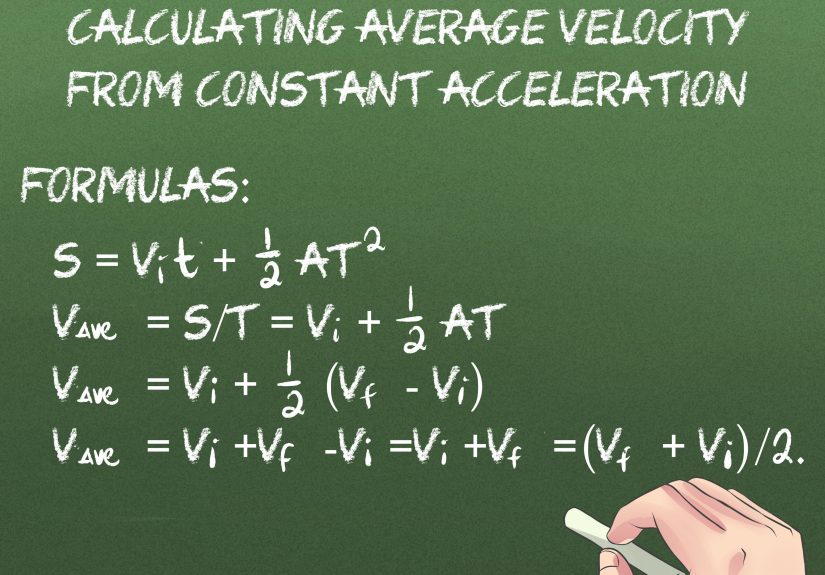
Sometimes students use the formula “initial velocity plus final velocity divided by two.” That shortcut works only in specific situations, especially when acceleration is constant. The general definition of average velocity is always displacement divided by elapsed time.
When Is Average Velocity Zero?
Average velocity is zero when total displacement is zero. This can happen even if the object moved a lot. A swimmer who goes across a pool and comes back to the starting wall has zero average velocity for the full trip. A dog chasing its tail may have impressive energy, but if it ends where it started, the displacement is zero.
Why Average Velocity Matters
Average velocity is useful because it gives a simple summary of motion. Engineers use velocity concepts when designing vehicles, elevators, machines, and transportation systems. Scientists use them to study motion in experiments. Students use them to survive physics quizzes and maybe even impress a teacher without bribing them with coffee.
Average velocity also prepares you for more advanced ideas, including acceleration, instantaneous velocity, vectors, calculus-based motion, and graph interpretation. Once you understand displacement divided by time, many other motion concepts become easier to learn.
Quick Practice Problems
Problem 1
A bicycle moves from 5 meters to 35 meters in 10 seconds. What is the average velocity?
Displacement = 35 m − 5 m = 30 m
Average velocity = 30 m ÷ 10 s = 3 m/s
Problem 2
A student walks 20 meters north, then 20 meters south, ending where they started. The trip takes 40 seconds. What is the average velocity?
Displacement = 0 m
Average velocity = 0 m ÷ 40 s = 0 m/s
Problem 3
An elevator moves from the 2-meter level to the 22-meter level in 5 seconds. What is its average velocity?
Displacement = 22 m − 2 m = 20 m upward
Average velocity = 20 m ÷ 5 s = 4 m/s upward
Experience-Based Tips for Learning Average Velocity
One of the easiest ways to understand average velocity is to stop treating it like a mysterious formula and start treating it like a story. Every motion problem has a beginning, an ending, and a clock. Find those three pieces, and the problem becomes much less intimidating. When students struggle, it is usually not because the math is difficult. It is because they rush past the story and start punching numbers into a calculator like they are trying to unlock a secret vault.
A useful habit is to sketch a quick number line. It does not need to be beautiful. Stick figures are welcome. Mark the starting point, mark the ending point, and draw an arrow showing the overall displacement. This visual trick is especially helpful when negative positions appear. A number like −15 meters can feel strange until you see it on a line to the left of zero. Suddenly, the negative sign stops being scary and starts being useful.
Another practical experience: always separate distance from displacement before calculating. In real life, people often describe motion using distance. “I walked three blocks to the store and three blocks home.” That sounds like six blocks of movement, and for average speed, it is. But for average velocity, the final position is back at home, so the displacement is zero. This difference feels odd at first, but once it clicks, it becomes one of the most satisfying ideas in basic physics.
Students also learn faster when they attach units to every step. Do not write only “40 ÷ 5 = 8.” Write “40 meters ÷ 5 seconds = 8 meters per second.” Units are like labels on leftovers in the fridge. Without them, everything becomes suspicious. With them, you know exactly what you are dealing with.
If you are studying for a test, practice with three types of problems: straight-line motion, round-trip motion, and graph-based motion. Straight-line problems build confidence. Round-trip problems test whether you understand displacement. Graph problems show whether you can connect math to visual information. Master those three, and average velocity becomes much easier.
Finally, say your answer in a sentence. Instead of writing only “−6 m/s,” write, “The average velocity is 6 meters per second in the negative direction.” This forces you to interpret the result rather than simply calculate it. Physics is not just about getting numbers. It is about understanding what those numbers are trying to tell you before they walk away wearing sunglasses.
Conclusion
Calculating average velocity is simple once you know what to look for: displacement and elapsed time. The core formula is average velocity equals displacement divided by time. The trick is remembering that displacement is not always the same as distance. Direction matters, signs matter, and units matter.
To solve average velocity problems correctly, identify the starting position, ending position, starting time, and ending time. Calculate displacement, calculate elapsed time, divide, and include direction. Whether you are studying for physics class, reading a position-time graph, or trying to understand why a round trip can have zero average velocity, the same basic idea applies every time.
Once this concept becomes comfortable, you will be ready for bigger motion topics like acceleration, instantaneous velocity, and kinematic equations. Not bad for one formula that started out looking mildly suspicious.






 Close
Close