
Table of Contents >> Show >> Hide
- Why Build an Adjustable Dog Agility Seesaw?
- Backyard Fun vs. Competition-Style Practice
- Materials for a DIY Dog Agility Seesaw
- Step 1: Build the Teeter Board
- Step 2: Build a Wide, Stable Base
- Step 3: Create the Adjustable Pivot System
- Step 4: Add the Non-Slip Surface
- Step 5: Mark the Contact Zones
- Step 6: Soften the Landing
- Step 7: Test the Balance Before Your Dog Uses It
- Step 8: Introduce Your Dog the Smart Way
- Common Mistakes to Avoid
- Sample Adjustable Height Progression
- Final Thoughts
- Experience-Based Lessons From Backyard Teeter Builds
- SEO Tags
If your dog already treats the backyard like an Olympic venue, building a dog agility seesaw is one of the best ways to channel that energy into something useful, fun, and slightly less destructive than turning your flower bed into a crime scene. A teeter, also called a seesaw or teeter-totter, helps dogs learn body awareness, confidence, control, and contact obstacle skills. The trick is building one that feels solid, safe, and adjustable enough for beginner practice.
That last word matters: adjustable. A fixed teeter can be a little dramatic for dogs who are still deciding whether a moving plank is a clever game or a betrayal. An adjustable design lets you start low, reduce the scary bang, and gradually work toward a more competition-style dog agility teeter once your dog understands the job.
In this guide, you’ll learn how to build an adjustable dog agility seesaw in easy steps, what materials to use, how to add a non-slip surface, and how to introduce your dog to it without creating a four-legged soap opera. Whether you want a backyard training tool or a DIY dog agility equipment project that looks surprisingly legit, this walkthrough will help you get there.
Why Build an Adjustable Dog Agility Seesaw?
A dog agility seesaw is different from static obstacles because it moves, drops, and makes noise. That means your dog is not just learning where to place paws, but also how to stay calm when the world suddenly tips. An adjustable teeter makes this learning curve much kinder.
The big advantages of an adjustable teeter
- Safer training progression: You can begin with a low pivot and raise it as your dog becomes more confident.
- Better confidence building: A lower board feels less intimidating and reduces hard slamming.
- More useful for multiple dogs: A cautious beginner and an experienced agility dog can use the same obstacle at different settings.
- Closer to real agility work: You can create a backyard dog agility course piece that mimics proper contact obstacle habits.
If you want the short version, here it is: fixed teeters are for dogs who already know the plot. Adjustable teeters are for dogs still reading chapter one.
Backyard Fun vs. Competition-Style Practice
Before you grab lumber, decide what you’re building. If you want a casual backyard obstacle, you can make something shorter and lower. But if your goal is serious agility training, it makes sense to build closer to the familiar visual picture dogs see on regulation-style equipment.
A competition-style teeter is typically a 12-foot-long, 12-inch-wide plank with a center height around 24 inches, marked contact zones, and a non-slip surface. Slats are generally not used on the teeter board itself. For beginner training, though, it’s smart to keep the same general board shape while allowing lower settings such as 12, 16, or 20 inches before moving up to full height.
Also, this project is best used with dogs that are physically mature and in good condition. If you have a puppy, a giant-breed adolescent, a senior dog, or a dog with mobility issues, focus on flat foundation work first. A plank on the ground, wobble work, and reward-based confidence games are usually the wiser starting point.
Materials for a DIY Dog Agility Seesaw
There are many ways to build a teeter, but the simplest beginner-friendly version uses an exterior board, a wide wooden base, and a metal axle that can sit at different heights.
Suggested materials
- One 12-foot-long board, 12 inches wide, made from exterior-grade plywood or another properly surfaced outdoor panel
- Two underside stiffeners, such as 2x2s or ripped support strips, to reduce flex
- 2×4 lumber for the base and side uprights
- One galvanized steel pipe or steel rod to act as the axle
- Heavy-duty U-bolts, brackets, or metal straps to secure the axle to the underside of the board
- Bolts, washers, locking nuts, and outdoor screws
- Exterior wood primer or sealer
- Textured anti-slip exterior paint, or exterior paint plus traction additive
- Painter’s tape for marking contact zones
- Rubber mat, stall mat, or dense padding for the landing side
- Optional rubber bumpers or foam strip to soften the drop
Tools you’ll likely need
- Measuring tape
- Circular saw or miter saw
- Drill and bits
- Socket set or wrench set
- Sandpaper or power sander
- Level
- Square
- Paint roller or brush
Step 1: Build the Teeter Board
Start with the board itself. For a full-size DIY dog agility seesaw, cut or purchase a board that measures 12 feet long by 12 inches wide. Smooth the edges well so there are no splinters or sharp corners. Your dog’s paws should meet a training obstacle, not a woodworking revenge project.
Next, reinforce the underside. A long board can flex or twist over time, especially outdoors. Attach two narrow stiffeners lengthwise underneath the plank, leaving the center pivot area clear. Keep the board balanced so neither end becomes unnecessarily heavy.
If your plank feels flimsy when you stand near the end, it needs more support before your dog ever touches it. Human test first, canine star second.
Step 2: Build a Wide, Stable Base
The base is where safety lives. A teeter that rocks side to side is not “advanced.” It’s just annoying and dangerous.
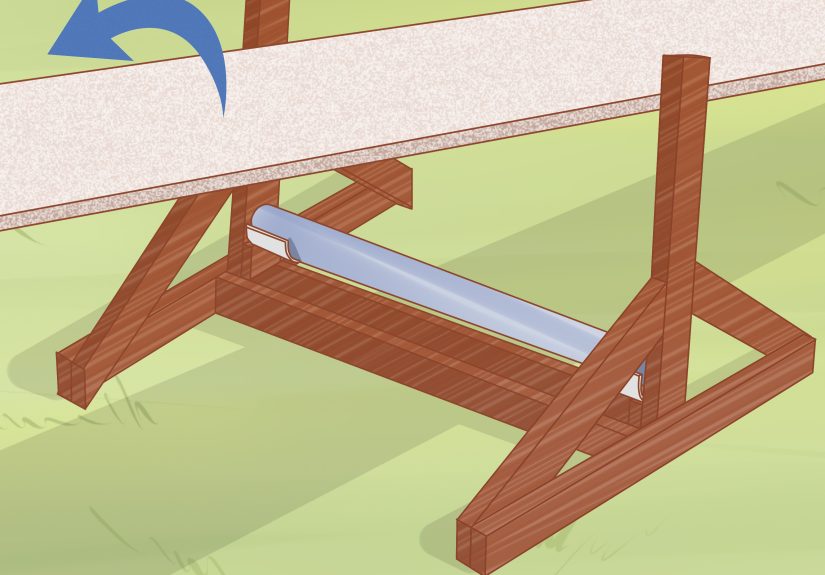
Build a wide rectangular or H-style base from 2×4 lumber. A footprint around 36 to 48 inches wide works well for stability. Add cross braces so the structure does not wobble. The side uprights should sit outside the width of the board, allowing the plank to pivot freely without rubbing.
The simplest design uses two upright support frames connected by lower braces. Think sturdy, low, and boring. In dog agility equipment, boring is beautiful.
Step 3: Create the Adjustable Pivot System
This is the heart of the project. You want the axle to sit at more than one height so the board can start low and gradually rise as your dog improves.
Easy adjustable method
Drill a series of matching holes in the side uprights so the axle can be placed at several heights. Good starting positions are:
- 12 inches
- 16 inches
- 20 inches
- 24 inches
Attach the steel axle under the exact center of the plank using U-bolts or strong metal brackets. Then rest or lock the axle into the chosen hole position on both sides of the support frame. Use bolts, locking pins, or another secure fastening method so the axle cannot shift during use.
Take your time with alignment. If one side sits slightly higher than the other, the board may tilt awkwardly, drag, or create a crooked drop. That is not “custom.” That is “why is my dog giving me side-eye?”
Step 4: Add the Non-Slip Surface
A smooth teeter board is a terrible idea. Dogs need traction whether the weather is dry, damp, or just showing off. The top surface should be rough enough for confident footing without being sharp or abrasive.
Lightly sand the board, seal it, then apply an exterior textured paint or use exterior paint with a traction additive. Another common DIY method is adding sand or grit to the coating so the finished surface stays grippy. Keep the finish matte, not glossy.
Skip raised slats on the seesaw board. They can interfere with footing and do not belong on this obstacle. What you want is secure traction, not tiny speed bumps.
Step 5: Mark the Contact Zones
Contact zones are the painted end sections that teach your dog where to enter and exit with control. On a 12-foot board, many trainers use a clearly marked contrasting contact area on each end. A common practice is to paint the last 42 inches on both ends.
Use painter’s tape, measure carefully, and paint those zones in a contrasting color. Yellow is traditional, but any clearly visible color can work for home practice. The point is visual clarity and consistent training, not winning an interior design award for “Most Decorative Piece of Backyard Lumber.”
Step 6: Soften the Landing
The biggest mistake in a homemade dog agility teeter is letting the board slam hard into the ground. That loud bang can scare dogs, create teeter anxiety, and put extra stress on the obstacle.
Place a rubber mat or dense padding where the descending end lands. You can also add bumpers or cushioning to reduce the shock of impact. Some commercial teeters use speed-limiting features for exactly this reason. Your home version does not need fancy engineering, but it does need a predictable, controlled drop.
If your board sounds like a drum solo every time it lands, keep adjusting until it doesn’t.
Step 7: Test the Balance Before Your Dog Uses It
Once the build is finished, test it without your dog. Walk the board by hand. Raise one end slowly. Let it tip. Watch how it lands. Check the following:
- Does the board pivot smoothly?
- Does the base stay planted?
- Does the landing feel controlled rather than violent?
- Are there any pinch points, loose bolts, or twisting parts?
- Does the painted surface still feel grippy after it dries?
Then add a little weight test. Many official-style teeters are expected to tip in a controlled way rather than hanging forever or dropping like a cartoon trap. Your home goal should be a smooth, predictable motion. If you train a large, fast dog and want something very close to competition performance, consider buying a commercial adjustable teeter instead of guessing your way through advanced mechanics.
Step 8: Introduce Your Dog the Smart Way
Building the seesaw is only half the job. Training the seesaw matters just as much.
How to start
- Set the board at the lowest height.
- Reward your dog for simply stepping on and off.
- Practice calm movement across the plank with the board stabilized if needed.
- Let your dog hear a small amount of motion and sound before asking for a full ride-down.
- Reward heavily for confidence, balance, and touching the down contact zone.
Do not force your dog across the teeter. Do not drag, push, or perform the classic human move known as “helping” when it is actually just pressure in a baseball cap. Nervous dogs learn best when they feel safe and in control. If your dog startles, lower the difficulty and make the game easier again.
A helper can be valuable during early sessions. One person can reward while the other gently controls the movement of the board so it does not bang unexpectedly. Short sessions work best. Quit while your dog still thinks the game is brilliant.
Common Mistakes to Avoid
- Using indoor wood or poor-quality hardware: outdoor exposure will destroy it faster than your dog can learn “wait.”
- Making the base too narrow: if it wiggles, rebuild it.
- Skipping traction: a slick board is a no.
- Raising the height too quickly: confidence disappears fast when the obstacle suddenly feels twice as dramatic.
- Training puppies on full-height contact equipment: foundation is fine, but heavy contact work should wait for physical maturity.
- Ignoring the landing noise: sound sensitivity is a real teeter problem.
Sample Adjustable Height Progression
Here is one simple example of how you might use your adjustable dog agility seesaw over time:
- Week 1: 12-inch setting, board movement controlled by hand, reward for calm steps
- Week 2: 12-inch setting, slight independent motion, reward contact behavior
- Week 3: 16-inch setting, slow ride-downs, short repetitions
- Week 4: 20-inch setting, more independence, continued contact zone rewards
- Week 5+: 24-inch setting when the dog is confident, balanced, and not startled by sound
Some dogs move through that schedule quickly. Others need more time. The best pace is the one where your dog stays eager. Progress is not measured by how fast you raise the board. It is measured by how confidently your dog understands the obstacle.
Final Thoughts
Building your own adjustable dog agility seesaw is one of the most rewarding DIY dog projects you can tackle. It gives your dog a safe way to learn a tricky contact obstacle, adds real value to a backyard dog agility course, and lets you tailor training to your dog’s confidence level instead of forcing them into the deep end of the teeter pool.
The best version is not the fanciest. It is the one that is stable, grippy, quiet enough, and adjustable enough to help your dog succeed. Build for safety first, progress second, and speed last. Dogs remember how obstacles feel. If the seesaw feels clear and fun from the beginning, you are much more likely to end up with a confident partner instead of a skeptical furry union representative filing complaints about moving planks.
Experience-Based Lessons From Backyard Teeter Builds
One of the most common experiences people have when building a backyard dog agility seesaw is realizing that the woodworking part is actually easier than the sound-management part. On paper, a plank, a pivot, and a base seem straightforward. In practice, the very first test drop often teaches the same lesson: if the board lands too hard, the dog remembers. Builders frequently report that their dog was perfectly happy walking on a flat plank, perfectly happy stepping on a wobble surface, and suddenly very suspicious the moment the board made a loud smack. That experience is why so many successful teeter setups include rubber mats, controlled drops, and a low first setting.
Another real-world lesson is that dogs notice tiny details people ignore. A handler may think, “Great, the structure is finished,” while the dog immediately notices a slick patch of paint, a slight wobble in the base, or a strange metallic clink from the axle hardware. That is why experienced backyard trainers tend to spend extra time sanding edges, tightening bolts, and walking the board by hand before asking the dog to do anything on it. The dog does not care that the project took all Saturday. The dog cares whether the obstacle feels honest underfoot.
Many owners also find that lower settings create better long-term results than dramatic first sessions. It is tempting to build the full-size obstacle and jump straight to the “real thing,” especially if your dog is athletic and enthusiastic. But dogs that learn the teeter in calm, bite-sized steps often end up faster and more confident later. A dog that happily drives to the end contact at 12 inches today is usually giving you the foundation for a better 24-inch performance tomorrow. Confidence ages well.
There is also a practical backyard reality that rarely appears in glamorous project photos: weather. Outdoor equipment gets hot, damp, dusty, and mildly offended by the seasons. Builders often learn that paint matters more than expected, exposed wood needs maintenance, and textured surfaces need periodic inspection. A seesaw that felt perfect in spring may become slick after rain or rough after months in direct sun. The best long-term experience comes from treating the teeter like actual sports equipment, not lawn decor with a dog theme.
Finally, many handlers say the most memorable part of this project is not the finished obstacle but the training moments around it. The first confident ride-down, the first deliberate contact hit, the first time the dog hears the board land and stays calm anywaythose are the victories that make the build worthwhile. A homemade adjustable dog agility seesaw is not just lumber and bolts. It becomes a communication tool. Built well and introduced kindly, it teaches the dog to trust the obstacle, trust the task, and trust you. And that, frankly, is a much better payoff than merely owning the world’s nicest rectangle of painted wood.





 Close
Close