
Table of Contents >> Show >> Hide
- First, know what you’re actually budgeting for
- The freelancer tax calendar (the dates that matter)
- A simple, reliable system to budget for taxes (even with uneven income)
- Step 1: Create a dedicated tax “bucket” (separate account)
- Step 2: Pick a starting set-aside rate (and why 30% is popular)
- Step 3: Budget off your profit, not your invoices
- Step 4: Do a quarterly “mini close” and run Form 1040-ES math
- Step 5: Use the safe harbor rules to avoid underpayment penalties
- Step 6: Build a “tax buffer” for the stuff you forget
- A realistic example: turning freelance chaos into a predictable tax plan
- What if your income is wildly uneven?
- Don’t forget state taxes (and don’t assume they match federal)
- Expense tracking: the easiest legal way to lower your tax bill
- Tax-advantaged accounts can helpbut don’t let them wreck your cash flow
- Quick checklist: your freelancer tax budgeting routine
- When you should seriously consider hiring a tax pro
- Conclusion: make taxes boring on purpose
- Freelancer Experiences: Real Lessons From the Tax Budgeting Battlefield
Freelancing has perks: flexible hours, pajama-friendly meetings, and the freedom to fire clients (politely, ideally).
But taxes? Taxes are the “surprise sequel” nobody asked forespecially the first time you realize no one is
withholding anything from your payments.
The good news: budgeting for taxes as a freelancer isn’t about being “good at math.” It’s about building a simple
system that quietly siphons money into a “Do Not Touch” tax bucketso April doesn’t feel like an IRS-themed jump
scare. This guide walks you through a practical, real-world approach for U.S. freelancers, with examples and
strategies that work even when your income does the roller-coaster thing.
First, know what you’re actually budgeting for
Most freelancers owe a mix of taxes. The common categories are:
- Federal income tax (based on your taxable income and tax bracket).
- Self-employment tax (Social Security + Medicare, because you’re both the employee and the employer).
- State and local taxes (varies widelysome states have no income tax, others absolutely do).
Self-employment tax: the one that surprises people
The self-employment tax rate is 15.3% total (12.4% Social Security + 2.9% Medicare). You generally
calculate it on 92.35% of your net earnings (your profit after business expenses). Translation:
you don’t pay it on every dollar you invoiceyour deductions matter. You typically owe self-employment tax if your
net earnings are $400 or more. (Yes, four hundred. The IRS is not playing.)
Also: at higher incomes, additional rules can apply (like the Additional Medicare Tax). Don’t panicjust recognize
that “I’ll guess” is not a tax strategy. Your system should make it easy to estimate, save, and adjust.
Federal income tax: your bracket isn’t a flat rate
Your federal income tax is progressive. That means different “layers” of your taxable income are taxed at
different rates. Your last dollar might be taxed at a higher rate than your first dollarso budgeting a single,
perfect percentage for income tax can be tricky. That’s why freelancers do best with a two-part approach:
a conservative set-aside rate + quarterly reality checks.
The freelancer tax calendar (the dates that matter)
In the U.S., taxes are “pay as you go.” If your income doesn’t have withholding (hello, freelancing), you may need
to make estimated tax payments during the year. Estimated payments are generally due:
- April 15 (for income earned Jan 1–Mar 31)
- June 15 (for income earned Apr 1–May 31)
- September 15 (for income earned Jun 1–Aug 31)
- January 15 of the next year (for income earned Sep 1–Dec 31)
If a due date falls on a weekend or holiday, it moves to the next business day. Also, there are exceptions and
special rules (including situations where you may be able to skip the January estimated payment if you file and
pay in full early). The main point: put these dates on your calendar like they’re client deadlinesbecause they
are.
A simple, reliable system to budget for taxes (even with uneven income)
Here’s the system most seasoned freelancers end up buildingusually after a “tax season incident.” You can build
it now, on purpose, without the emotional damage.
Step 1: Create a dedicated tax “bucket” (separate account)
Open a separate savings account and nickname it something intimidating like “TAX VAULT” or “DO NOT TOUCH.”
The goal is psychological and practical: tax money should not mingle with rent money. A separate account reduces
the odds you’ll “accidentally” spend your future tax payment on a new chair, a new laptop, or a new personality.
Pro tip: if you tend to forget, automate it. Every time you get paid, an automatic transfer to the tax account
makes taxes boringwhich is the highest compliment in personal finance.
Step 2: Pick a starting set-aside rate (and why 30% is popular)
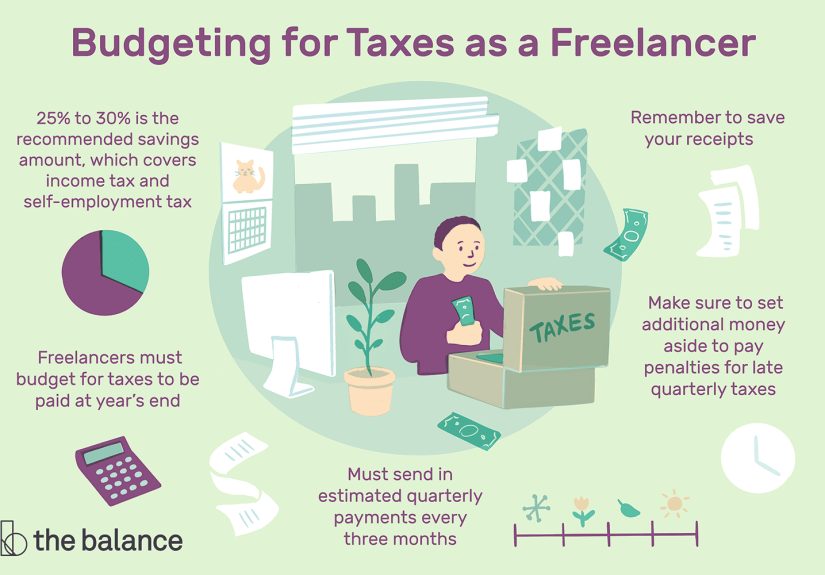
You’ll hear advice like “save 25–30% of your income for taxes.” That rule of thumb is popular because it’s
simpleand often lands in the right neighborhood for many freelancers once you combine income tax and
self-employment tax.
A better version of that advice is: start with a safe, conservative rate, then customize.
Here are practical starter ranges many freelancers use:
- 20–25%: lower-income freelancers in low-tax states, after deductions
- 25–30%: common middle-ground starting point
- 30–35%+: higher earners, high-tax states, or anyone who wants a larger buffer
If you’re not sure where you fall, start at 30% of net income (profit), not gross
invoices. Then adjust after your first quarterly check-in.
Step 3: Budget off your profit, not your invoices
Your taxable business income is generally your net profit (income minus ordinary and necessary
business expenses). That means a freelancer who invoices $6,000/month but spends $1,000/month on legitimate
business expenses is budgeting taxes on something closer to $5,000/month.
If you don’t track expenses, you’ll either:
(1) over-save and feel broke for no reason, or
(2) under-save and discover a new emotion called “April.”
Step 4: Do a quarterly “mini close” and run Form 1040-ES math
The IRS uses Form 1040-ES to help individuals estimate and pay taxes on income not subject to
withholding. You don’t need to become a tax wizard, but you do need a quarterly routine:
- Total your year-to-date income (what actually hit your accounts).
- Subtract year-to-date business expenses (profit so far).
- Estimate your full-year profit (project based on current pace and upcoming contracts).
- Estimate taxes using a calculator or tax software, then compare to what you’ve already set aside/paid.
- Pay the quarterly amount and adjust your set-aside rate if needed.
Many freelancers treat this like “closing the books” for a tiny businessbecause that’s what you are.
A one-hour quarterly admin day can save you a four-day tax panic later.
Step 5: Use the safe harbor rules to avoid underpayment penalties
If you don’t pay enough throughout the year, you may owe an underpayment penalty. The IRS provides “safe harbor”
guidelines that can help you avoid that penalty if you pay in enough during the year.
A commonly used safe harbor rule of thumb is paying the smaller of:
- 90% of the tax you’ll owe for the current year, or
- 100% of the tax shown on your prior-year return (or 110% if your prior-year AGI was above a specified threshold).
This is why last year’s tax return is so useful: it’s a real number, not a vibe. If your income is rising fast,
safe harbor can still keep you penalty-free while you build cash reserves (though you may still owe a balance at
filing time).
Step 6: Build a “tax buffer” for the stuff you forget
Even good estimators get surprised by:
big one-off projects,
late 1099s,
a year where expenses were lower than expected,
or a quarter where you earned a lot and forgot you’re not immortal.
Build a buffer by:
- Saving an extra 1–3% on top of your set-aside rate, or
- Keeping a fixed $500–$2,000 “tax cushion” that never gets spent.
The buffer isn’t wasted money. If you don’t need it for taxes, it becomes your emergency fund or your next-year
head start.
A realistic example: turning freelance chaos into a predictable tax plan
Let’s say Jordan is a freelance designer. In April, Jordan’s numbers look like this:
- Invoices collected in April: $8,000
- Business expenses (software, coworking, supplies): $1,500
- Net profit: $6,500
Jordan chooses a conservative set-aside rate of 30% of net profit. That’s:
$6,500 × 0.30 = $1,950 moved into the tax account.
Jordan repeats this every time money comes in (or weekly), then does a quarterly check-in:
if the projected annual profit rises, the set-aside rate might bump to 32–35%.
If profit drops, Jordan can lower it slightlywithout guessing wildly.
What if your income is wildly uneven?
Many freelancers don’t earn a neat monthly amount. One month you’re booked solid; the next month you’re “networking”
(which is a polite word for “refreshing your inbox like it owes you money”). Uneven income is normaland there are
two good ways to budget for taxes anyway:
Option A: Percentage-of-each-payment method (most common)
Every time you get paid, immediately move your tax percentage into the tax account. This scales up and down
automatically with your income.
Option B: Annualized income approach (for extreme seasonality)
If most of your income arrives in one part of the year (common in some consulting and creative niches), you may
benefit from an annualized method that aligns payments with when you actually earned the income. This can
sometimes reduce underpayment penalties, but it’s more complex and may involve additional forms. If that sounds
like you, it’s worth asking a CPA about the best approach for your specific pattern.
Don’t forget state taxes (and don’t assume they match federal)
Federal estimated tax dates are only half the story. Many states also require estimated payments, and the rules
can differ (dates, thresholds, payment portals, even how they define taxable income).
A simple workflow:
- Find your state’s estimated tax page (it’s usually on the Department of Revenue site).
- Learn the due dates and minimum thresholds.
- Add a separate “state tax” line to your set-aside rate (e.g., +3% to +8%, depending on where you live and your income).
Expense tracking: the easiest legal way to lower your tax bill
The fastest way to improve your tax budget isn’t “finding a magic loophole.”
It’s tracking deductions you’re legitimately entitled to, so you’re taxed on profitnot gross revenue.
Common freelancer expense categories include:
- Software subscriptions and online tools
- Business insurance
- Professional services (accountant, lawyer)
- Advertising and marketing
- Office supplies and equipment
- Phone and internet (business portion)
- Home office (if you qualify and use the space regularly and exclusively)
- Business travel and continuing education (when legitimately work-related)
A practical budgeting move: if you’re planning to buy a needed business tool anyway, doing it in a high-income
year may reduce taxable profit. (This is planning, not a spending spree. The IRS can smell a “deduction haul” from
space.)
Tax-advantaged accounts can helpbut don’t let them wreck your cash flow
Retirement contributions can reduce taxable income and strengthen long-term finances. For example, a SEP IRA can
allow contributions up to a percentage of compensation with annual dollar caps that change over time.
The important budgeting point is this:
retirement contributions should come after you’ve secured enough cash for taxes and essentials.
Think of it like airplane oxygen masks:
first, cover taxes (so you don’t face penalties and panic),
then optimize with retirement planning if you have surplus cash flow.
Quick checklist: your freelancer tax budgeting routine
- Each payment: move your tax percentage into a separate tax account.
- Monthly: reconcile income and expenses (so you’re budgeting off profit).
- Quarterly: run a 1040-ES estimate, pay what’s due, adjust your set-aside rate.
- Annually: use last year’s tax return as your benchmark and safe-harbor anchor.
When you should seriously consider hiring a tax pro
Some freelancers can DIY with software and a solid system. But consider hiring a CPA or Enrolled Agent if:
- Your income jumped significantly (congratsand also: taxes).
- You moved states or work in multiple states.
- You’re unsure about deductions (home office, vehicle, travel, etc.).
- You have a spouse’s income, investments, or other complexity and want accurate estimates.
- You’re paying penalties or constantly surprised by what you owe.
A good pro often pays for themselves by preventing costly mistakes, finding overlooked deductions, and helping you
set correct estimated paymentsso your budget stops getting ambushed.
Conclusion: make taxes boring on purpose
The freelancer tax win isn’t “owing nothing.” It’s knowing the money is already set aside, the dates are on the
calendar, and your quarterly check-ins are routine. When you budget for taxes using a separate account, a sensible
set-aside rate, and quarterly adjustments, you trade anxiety for control.
And honestly? In freelancing, control is basically a luxury good. Treat yourself.
Freelancer Experiences: Real Lessons From the Tax Budgeting Battlefield
Most freelancers don’t learn tax budgeting from a tidy spreadsheet and a calm cup of tea. They learn it the
way humans learn everything important: by doing something slightly chaotic, then swearing they’ll “never again,”
then building a system that prevents the chaos from recurring (or at least reduces it to a manageable simmer).
One of the most common freelancer experiences is the “big payment, big confidence” moment.
You land a great client, money hits your account, and you feel like you could buy a small moon. Then reality taps
you on the shoulder: that money is not all yours. Some of it belongs to Future Youspecifically Future You who has
to pay the IRS. The freelancer who doesn’t have a tax system tends to spend based on gross income, and that’s how
you end up emotionally negotiating with yourself in March like, “Okay, but do I really need groceries?”
Another classic: the uneven-income whiplash. A strong quarter makes you think you’ve “made it.”
A slow month makes you think you should live in a hollow tree and forage for berries. Tax budgeting smooths out
both emotions. When you set aside a percentage of every payment and treat taxes like a non-negotiable operating
cost, your lifestyle stops swinging with your invoice cycle. You don’t feel rich on payday and broke two weeks
lateryou feel steady, which is wildly underrated.
Then there’s the “I forgot expenses count” realization. Early-stage freelancers often budget taxes
off invoices because it’s easy: “I earned $5,000, I’ll save 30%.” But once you track expenses properly, you realize
your taxable income is profit, not revenue. That’s a mindset shift. It can instantly improve cash flow because you
stop over-saving out of fear and start saving based on real numbers. Plus, it encourages better business decisions:
tools, education, and services that genuinely support your work become part of a plannot random guilt purchases.
Many freelancers also experience the “quarterly payment dread” until they rename it as something
else: “paying myself first, but for taxes.” When your tax money sits in your main checking account, it feels like
it’s available. When it sits in a separate “tax vault” account, it feels allocated. That mental separation can be
the difference between calm quarterly payments and frantic last-minute scrambling. One freelancer-friendly trick is
to schedule a recurring “money date” a week before each estimated due date: reconcile income and expenses, run a
quick estimate, pay the amount, and move on with your life.
Finally, there’s the experience of growing up financially as a business owner. The moment you stop
thinking of taxes as a punishment and start thinking of them as a predictable cost of earning income is the moment
you become more profitable. You might still grumble (that’s allowed), but you’ll grumble while calmly transferring
money into your tax accountlike a professional.
If you’re new to freelancing, here’s the most reassuring truth: you don’t have to nail the perfect percentage on
day one. You just need a system that makes it easy to save consistently and adjust quarterly. After a year of
doing that, you’ll feel like you discovered a cheat codeexcept the cheat code is… being organized. Wild.






 Close
Close