
Table of Contents >> Show >> Hide
If you searched for exoplanet images hoping for a crisp vacation photo of an alien beach, I have two updates. First, science is amazing. Second, science is also a little rude. Most exoplanet images are not glossy, high-definition portraits with visible oceans, continents, and suspiciously cinematic sunsets. They are usually tiny points of light, carefully processed infrared data, or maps built from subtle changes in brightness. And yet, they are still some of the most astonishing images humans have ever made.
Why? Because every one of them represents a planet orbiting another star. Not a maybe. Not a poetic metaphor. A real world, far beyond our solar system, teased out from blinding starlight by a mix of engineering, math, patience, and the stubborn refusal of astronomers to let the universe keep its secrets.
This is what makes exoplanet images so compelling. They are not just pictures. They are proof that we can detect, isolate, and begin to understand worlds we will not visit anytime soon. Some images show planets directly. Others reveal their atmospheres through spectra. Still others turn tiny shifts in light into temperature maps. None of that is ordinary. All of it is thrilling.
What Counts as an Exoplanet Image?
The phrase “exoplanet images” covers more than many people realize. In everyday conversation, it usually means a direct image of a planet beyond our solar system. But in astronomy, the category is broader and more interesting.
Direct Images
A direct image is the real celebrity here. This is when a telescope captures light from the planet itself rather than inferring the planet from its effect on a star. That sounds simple until you remember the star is absurdly bright and the planet is basically lurking next to it like a firefly beside a stadium floodlight. The result is often a faint dot near a darkened area where the star’s light has been blocked or subtracted.
So yes, a direct exoplanet image can look a little underwhelming at first glance. A blurry smudge. A tiny orange speck. A suspicious pixel that looks like it owes you an apology. But scientifically, that speck is gold. It means astronomers have separated the planet’s light from the overwhelming glare of its host star.
Spectra, Heat Signatures, and Maps
Not every meaningful exoplanet image looks like a dot in space. Some of the most useful visual products are spectra, thermal maps, and processed brightness maps. These are built from real observations and help researchers estimate temperature, chemistry, clouds, and atmospheric structure. In other words, even when we cannot see an exoplanet the way we see Mars through a textbook telescope, we can still create scientifically rich visual representations of that world.
That is important for search intent too. Many readers looking for images of exoplanets are actually trying to understand what scientists can truly see. The answer is: more than you might think, but in a form that often requires interpretation.
Why Exoplanet Images Are So Hard to Capture
The main problem is not distance alone. The main problem is contrast. A planet can be billions of times dimmer than the star it orbits. Even if the telescope can technically detect the planet, the starlight can wash it out so completely that the world vanishes into glare.
Then there is the matter of separation. From our point of view, a planet and its star usually appear extremely close together. That means astronomers need both sharp resolution and aggressive light suppression. In plain English: they have to split the two apart visually and dim the star enough for the planet to stop hiding.
Coronagraphs Do the Heavy Lifting
This is where coronagraphs earn their paycheck. A coronagraph blocks or suppresses starlight so faint nearby objects can emerge. Modern instruments such as those on the James Webb Space Telescope use specialized masks and optical tricks to make this possible. Ground-based observatories add another tool: adaptive optics, which corrects for the atmosphere’s blurring effect in real time. If the universe had a “no peeking” setting, coronagraphs and adaptive optics are the cheat codes.
Even after that, astronomers still have to process the data carefully. They subtract residual starlight, compare multiple wavelengths, and test whether the signal is really a planet and not an artifact, background object, or cosmic prank. That is why direct imaging of exoplanets remains one of the most challenging forms of astronomy.
Famous Exoplanet Images That Changed the Story
Some exoplanet images are more than technical milestones. They change how the public imagines other worlds and how scientists design future missions.
HIP 65426 b: Webb’s First Direct Image
One of the most talked-about modern examples is HIP 65426 b. In 2022, the James Webb Space Telescope delivered its first direct image of an exoplanet. The target was a gas giant, young and hot enough to glow brightly in infrared light. The images from different Webb instruments looked different because they sampled different wavelengths, and that mattered. The planet was not just photographed; it was characterized.
This moment mattered because Webb was not built only to chase exoplanets. Yet when it turned its coronagraphs toward HIP 65426 b, it showed how powerful infrared imaging could be for studying distant worlds. It was the kind of scientific flex that politely says, “By the way, I can do this too.”
Epsilon Indi Ab: A Colder, More Mature World
In 2024, Webb directly imaged Epsilon Indi Ab, a giant planet about 12 light-years from Earth. That is exciting not just because it is nearby in cosmic terms, but because it is one of the coldest exoplanets observed directly so far. Cold planets are harder to catch because they do not blaze as brightly as their younger, hotter cousins. Seeing one pushes exoplanet imaging closer to the kinds of mature planetary systems that feel more familiar to us.
This is a big deal for readers interested in realistic exoplanet photography. The future is not just about more images. It is about better targets: older, colder, more subtle worlds that start to bridge the gap between giant baby planets and planets that resemble the architecture of our own system.
HR 8799 and Beta Pictoris: The Classics
Before Webb stole headlines, systems like HR 8799 and Beta Pictoris helped define the public image of direct exoplanet detection. These worlds became famous because they showed that planetary systems could be imaged around bright nearby stars and that the planets were not alone. They belonged to dynamic, structured systems with disks, wide orbits, and enough detail to fuel both scientific papers and public fascination.
These classic cases also taught an important lesson: the exoplanets easiest to image directly are often young, massive, and far from their stars. In other words, direct imaging has historically favored dramatic over subtle. The universe loves a flashy entrance.
PDS 70: Planets in the Act of Growing Up
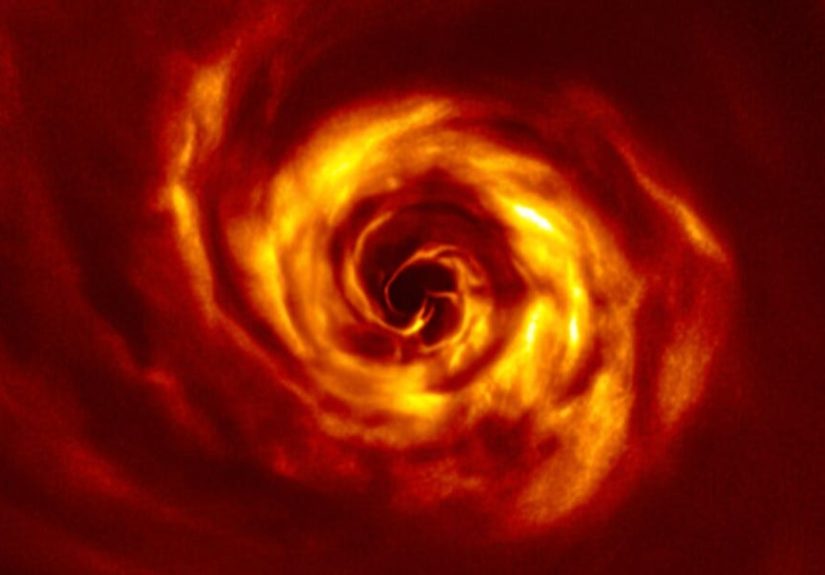
If you want exoplanet images with serious storytelling power, few examples beat PDS 70. This system has produced striking real images of planets embedded in a disk of gas and dust. That is not just visually impressive. It is practically planetary archaeology in progress. Instead of merely seeing a finished world, astronomers are catching giant planets interacting with the material from which planets form.
That kind of image reshapes the conversation. We stop asking only, “What does this world look like?” and start asking, “How did this world get here, and what is it doing to the rest of the system?”
TWA 7 and the New Frontier
One of the most intriguing recent developments is the Webb observation of a likely Saturn-mass planet candidate in the debris disk around TWA 7. The key word is candidate, because astronomy is careful for good reason. But if the object is confirmed, it would represent Webb’s first direct image discovery of a planet and the lightest planet yet seen with this technique. That is the kind of progress that makes scientists quietly excited and science writers suddenly overuse exclamation points.
How Scientists Turn Raw Data Into Readable Pictures
A common misconception is that exoplanet images are fake because they are processed. That is not how it works. Processing is not cheating. It is translation.
Telescopes collect light at specific wavelengths. Instruments isolate faint signals. Software subtracts the star’s leftover glare. Scientists compare images taken in multiple bands, test the signal against noise, and build a version the human eye can interpret. Sometimes the final result uses false color, especially in infrared work, because those wavelengths are invisible to us. The color choices are there to highlight structure and contrast, not to fool anyone into thinking the planet is literally glowing tangerine orange like a cosmic traffic cone.
That distinction matters for SEO-rich questions such as “Are exoplanet images real?” Yes, they are based on real observational data. But like X-rays, MRI scans, and weather radar, they are often processed into a format that humans can understand.
What Exoplanet Images Can Tell Us
The value of exoplanet images is not simply that they exist. It is what they reveal.
Atmospheres and Chemistry
When astronomers capture images and spectra together, they can begin to estimate what an exoplanet’s atmosphere contains. Molecules leave patterns in the light. That can help researchers infer temperature, clouds, composition, and sometimes broader questions about weather or planetary evolution.
Temperature and Structure
Some exoplanet “images” are really maps assembled from brightness changes over time. These can reveal hot and cool regions, atmospheric layers, and energy transport. That means astronomers are no longer limited to saying a world exists. They can start describing how it behaves.
Planet Formation
Images of planets inside disks or near gaps in dusty rings help researchers connect planets to the structure around them. In some systems, planets may be shaping the disk itself. That is powerful because it turns imaging into a tool for understanding how planetary systems are built, not just for collecting pretty science trophies.
The Future of Exoplanet Imaging
The next chapter is not just about sharper pictures. It is about reaching smaller, older, colder planets. NASA’s Roman Space Telescope is expected to push direct imaging technology further with a dedicated coronagraph, especially in visible light. That should help astronomers study planets that are less like glowing youngsters and more like mature giants orbiting nearby stars.
Further ahead, the dream is even bigger: imaging worlds closer to Earth in both size and temperature, then studying their atmospheres for signs of habitability. No serious scientist thinks we are about to publish a high-resolution beach scene from an Earth twin next Tuesday. But the line between impossible and merely difficult keeps moving in our favor.
That is why exoplanet images matter so much. They are not the final step in understanding alien worlds. They are the beginning of a new visual language for astronomy. Each faint dot says the same incredible thing in a slightly different accent: there is a world here.
Experience: What Exoplanet Images Feel Like to Us
There is a strange emotional experience that comes with looking at exoplanet images, even when the image itself is scientifically modest. You open a page expecting a dramatic alien landscape and instead find a tiny light source beside a carefully blocked star. At first, your brain wants to complain. That’s it? That’s the famous picture? A dot? But then the meaning lands, and the dot suddenly becomes enormous.
You start to feel the scale of what you are looking at. That dot is not a decoration. It is not a simulation made for a movie trailer. It is a planet. A real one. It circles a sun that is not ours, inside a system that had been invisible to human experience for all of history until instruments, code, and human curiosity teamed up and dragged it into view. The emotional effect is sneaky. These images are not loud. They are humbling.
For a lot of readers, the first encounter with images of exoplanets changes what “space” means. Space stops being a backdrop full of abstract stars and starts feeling populated. The night sky becomes less like a ceiling and more like a neighborhood map where most of the houses are still dark because we have not figured out how to see them well yet. That shift is powerful. It makes the universe feel crowded, dynamic, and a little less theoretical.
There is also a special kind of delight in learning how much work hides behind a single image. Once you understand that astronomers had to suppress starlight, correct for distortion, compare wavelengths, and verify that the signal was not a glitch, the picture becomes richer. You are not just looking at a planet. You are looking at the result of a scientific detective story. The final frame is the clean ending, but the real drama happened behind the scenes in observation planning, optical design, and data analysis.
That experience can be surprisingly personal. Some people see exoplanet images and think about the future of telescopes. Some think about whether life could exist somewhere out there. Some just get a weird and wonderful chill from realizing that humanity has reached the point where we can pick a planet out from the glare of another sun. It feels like standing at the edge of a map while cartographers whisper, “Good news. The blank parts are filling in.”
And maybe that is why these images matter beyond astronomy news. They give people a manageable way to feel cosmic perspective without getting lost in it. A galaxy can be too big to emotionally process. A universe can be too abstract. But one faint planet next to one star? That is intimate enough for the mind to hold. It invites wonder without demanding that you solve existence before lunch.
So the experience of exoplanet imaging is not really about visual perfection. It is about contact. Imperfect, indirect, carefully processed contact with worlds that once belonged entirely to imagination. Even the blurriest exoplanet image carries a message that feels almost unbelievable: the universe is full of places, and we are learning how to see them.






 Close
Close