
Table of Contents >> Show >> Hide
- What “Behind The Iron Curtain” Means In Test Equipment
- The First Impression: Heavy, Serious, And Very Cyrillic
- Oscilloscopes: The Star Of The Vintage Bench
- Wobbulators, Sweep Generators, And Odd Hybrid Machines
- Analog Multimeters: The Everyday Workhorses
- Insulation Testers And Resistance Bridges
- How Soviet Design Priorities Differed From Western Gear
- The Cold War Technology Gap And Export Controls
- Common Restoration Issues In Iron Curtain Test Gear
- Why Collectors And Engineers Still Care
- Specific Examples Worth Knowing
- Bench Experiences: What It Feels Like To Wake One Up
- Conclusion
- SEO Metadata
There is a special kind of suspense that comes from looking at vintage electronic test gear made behind the Iron Curtain. A modern oscilloscope wakes up with a polite beep, a colorful screen, and menus that behave like a tiny computer with excellent manners. A Soviet-era instrument, on the other hand, often greets you with Cyrillic labels, a steel case heavy enough to qualify as gym equipment, and a power switch that makes you wonder whether you are about to measure a waveform or accidentally summon a Cold War submarine.
But jokes aside, examining test gear from behind the Iron Curtain is more than a quirky hobby. These instruments reveal how engineers in the Soviet Union and Eastern Bloc solved real measurement problems under very different economic, political, and manufacturing conditions. Oscilloscopes, multimeters, signal generators, insulation testers, sweep generators, and resistance bridges were not just bench accessories. They were tools for radio repair, industrial control, military maintenance, television servicing, laboratory research, and the everyday survival of electronics in a world where replacement parts were not always a phone call away.
This article takes a close look at Soviet and Eastern Bloc test equipment: how it was built, why it looks so different from Western gear, what makes it interesting today, and why these old machines still fascinate collectors, engineers, repair technicians, and anyone who enjoys the smell of warm dust and questionable capacitors.
What “Behind The Iron Curtain” Means In Test Equipment
The phrase “Iron Curtain” refers to the political, military, and economic division between the Soviet-led Eastern Bloc and the Western world during the Cold War. In electronics, that divide shaped nearly everything: access to components, availability of documentation, design priorities, production methods, export rules, and even the way front panels were labeled.
Western companies such as Hewlett-Packard, Tektronix, Fluke, General Radio, and later Keysight became famous for precision test and measurement equipment. Their gear often emphasized refinement, modularity, high bandwidth, calibration support, and a user interface polished by competitive commercial markets. Meanwhile, Soviet and Eastern Bloc equipment developed in a system where industrial planning, military needs, durability, and local manufacturing capacity mattered more than consumer-style elegance.
That does not mean Eastern Bloc test gear was “bad.” That is the lazy answer, and lazy answers should be politely escorted out of the lab. Much of it was rugged, serviceable, and designed for long use. Some instruments were crude by Western standards. Others were surprisingly clever. Many were overbuilt in the places where it mattered and hilariously awkward in places where Western engineers would have reached for a different knob, connector, or layout.
The First Impression: Heavy, Serious, And Very Cyrillic
The first thing many people notice about Soviet test equipment is the visual language. The Cyrillic markings instantly set it apart. Where a Western oscilloscope might say “VOLTS/DIV,” a Soviet instrument may use Russian abbreviations. A beginner may feel as if the machine is less an oscilloscope and more a small metal exam in linguistics.
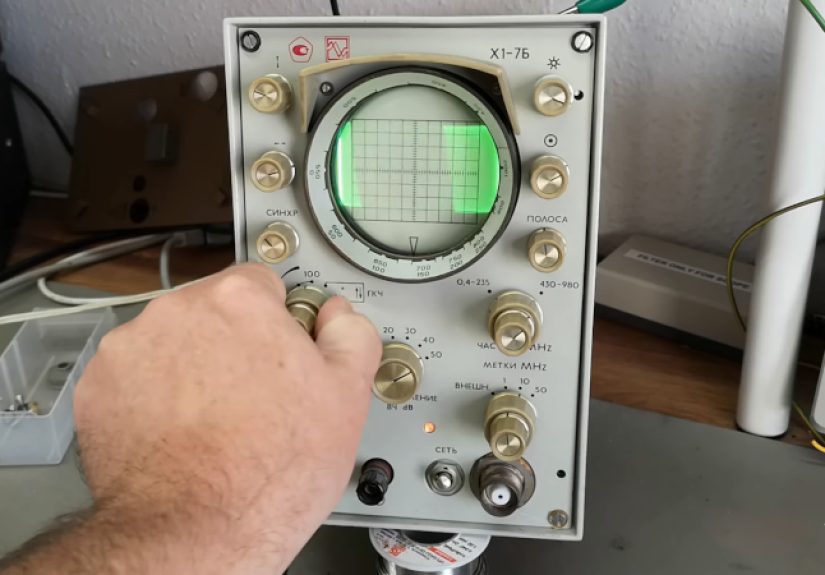
Then comes the weight. Many Soviet instruments were built with thick sheet metal, large transformers, chunky rotary switches, and mechanical assemblies that feel more like industrial hardware than delicate electronics. A piece such as a Soviet X1-7B-style sweep or display instrument, often discussed as a combination oscilloscope, spectrum analyzer, or wobbulator-like device, can weigh several kilograms and use a round cathode-ray tube with unusual controls. Some examples feature rotating bezels, mechanical tuning elements, and internal construction that looks conventional in one area and wonderfully mysterious in another.
That combination of familiar and strange is exactly what makes this gear so compelling. You may open the case and recognize transistors, resistors, transformers, shielded sections, and point-to-point wiring. Then you notice a mechanical arrangement that looks like it came from a radio shop, a submarine console, and a clockmaker’s bench all at once.
Oscilloscopes: The Star Of The Vintage Bench
No discussion of vintage test gear is complete without oscilloscopes. An oscilloscope turns voltage into a visible trace, letting engineers see waveforms, distortion, ripple, timing errors, oscillation, noise, and all the tiny electrical mischief that a simple meter cannot reveal. In the Cold War era, having a reliable scope could mean the difference between understanding a circuit and poking around blindly like a raccoon in a fuse box.
One notable Soviet/Eastern Bloc example is the C1-94, also written as S1-94 or С1-94. It is commonly described as a compact 10 MHz single-channel service oscilloscope, suitable for radio, television, and general repair work. Compared with a big laboratory Tektronix mainframe, it looks modest. But modest is not the same as useless. A 10 MHz scope can handle plenty of audio, power supply, radio servicing, and low-speed digital troubleshooting tasks. For many technicians, that was enough.
The C1-94 also shows a practical Eastern Bloc design philosophy: make the tool portable, usable, and repairable. It was not built to win a beauty contest, although to collectors it has its own stern charm. Its compact shape, CRT display, and mechanical controls make it a useful example of how Soviet manufacturers approached service equipment. It was meant to sit on a bench, survive repeated use, and produce a trace without requiring a software update or a subscription plan. Imagine that.
Wobbulators, Sweep Generators, And Odd Hybrid Machines
Some of the most interesting Iron Curtain test devices are not simple oscilloscopes at all. They are hybrid instruments used for radio and television alignment. A wobbulator, for example, is a swept-frequency signal generator. It sends a signal that moves across a frequency range, while the display shows how a filter, amplifier, tuner, or intermediate-frequency stage responds.
This is especially useful in older television and radio work. Instead of testing one frequency at a time, a technician can see the shape of a passband. Is the response flat? Is it lopsided? Is the filter tuned properly? Is the signal dropping off where it should not? A wobbulator helps answer those questions visually.
Some Soviet instruments with round CRTs and unusual rotary assemblies make more sense when viewed through this lens. A Western observer might initially call one a spectrum analyzer or an oscilloscope, only to realize it may be closer to a sweep alignment tool. That confusion is part of the fun. These devices were often designed for specific service environments, and without a manual, the front panel can feel like a puzzle box designed by a committee of radio engineers with excellent poker faces.
Analog Multimeters: The Everyday Workhorses
Oscilloscopes get the glamour, but multimeters did much of the daily labor. Soviet analog meters such as the C4315, also written as Ц4315, were common examples of multipurpose measurement tools. These instruments could measure DC voltage, AC voltage, current, resistance, and sometimes capacitance or decibel levels depending on the model and configuration.
The C4315-style meter often came in a hard case and used a large analog scale with multiple ranges. To modern eyes, reading one may feel slower than glancing at a digital multimeter. But analog meters have advantages. They show trends naturally. A moving needle can reveal a drifting voltage, a pulsing signal, or a capacitor charging in a way that a digital display may hide behind constantly changing numbers.
These meters also reflect a culture of repair rather than replacement. The user was expected to understand ranges, polarity, loading effects, and scale interpretation. There was less hand-holding. The meter did not gently warn you with a cheerful icon. It simply waited for you to know what you were doing. If you did not, the needle might perform a dramatic leap of protest.
Insulation Testers And Resistance Bridges
Another fascinating category is high-voltage insulation testing. A Soviet M4100/4-style insulation tester from the mid-1980s, for instance, represents a very different kind of instrument from a bench oscilloscope. Instead of displaying waveforms, it checks whether insulation can withstand high voltage without leaking excessive current. Such tools were important for motors, cables, transformers, industrial equipment, and electrical maintenance.
Many insulation testers use a hand crank to generate a high test voltage, often around 1,000 volts depending on the model. That crank-driven design is beautifully practical. It does not require a wall outlet, and it gives the instrument a self-contained, field-ready personality. It also adds a little theater. Nothing says “serious electrical maintenance” like generating a thousand volts by hand while hoping the old insulation does not confess its sins.
Resistance bridges were another important class of equipment. A bridge circuit allows accurate resistance measurement by balancing known and unknown values. Soviet bridge instruments from the 1960s and later were used in labs, workshops, and industrial settings. They may look old-fashioned beside modern handheld meters, but bridge methods remain deeply important in precision measurement history.
How Soviet Design Priorities Differed From Western Gear
When comparing Soviet test gear with Western brands, it helps to avoid cartoon thinking. The differences were not simply “East bad, West good.” They came from different pressures.
Durability Over Convenience
Many Eastern Bloc instruments were mechanically tough. Thick panels, large knobs, heavy switches, and conservative power supplies were common. The result could be a device that felt indestructible, though not always refined. Western gear often offered smoother controls, clearer documentation, better ergonomics, and tighter integration with calibration systems. Soviet gear often seemed to say, “Here is a knob. It is large. You will respect it.”
Serviceability Over Miniaturization
A lot of older Soviet equipment is spacious inside compared with later compact electronics. Components may be easier to identify and replace. Wiring may be accessible. Circuit boards may be single-sided or simple by modern standards. This is good news for restorers. The downside is that old capacitors, oxidized contacts, brittle wiring, and questionable connectors can still turn a repair into a patience contest.
Standardization And State Production
Eastern Bloc production often involved state factories, centralized specifications, and long model lifespans. The same basic instrument might remain in service for years, with small variations. This could create consistency for institutional users but also slow the adoption of newer technologies. In contrast, Western manufacturers competed aggressively, pushing bandwidth, triggering, portability, digital readouts, and eventually microprocessor control.
The Cold War Technology Gap And Export Controls
Test equipment sits at the heart of technological development. You cannot build advanced electronics reliably unless you can measure them. During the Cold War, this made oscilloscopes, frequency counters, semiconductor manufacturing tools, and precision measurement systems strategically important.
Export-control systems restricted the flow of advanced Western technology to the Soviet Bloc. The concern was obvious: high-performance electronics could support military development, radar, computing, communications, aerospace systems, and weapons research. This did not stop technology transfer entirely, but it did complicate it. Some Western equipment reached Eastern Bloc users through legal trade, gray-market channels, third countries, reverse engineering, or specialized agreements. Meanwhile, domestic Soviet and allied industries had to build their own alternatives.
This helps explain why Eastern Bloc test gear can feel like a parallel branch of electronic evolution. It solved similar problems but often with different parts, different packaging, and different assumptions about who would use the instrument and how long it would remain in service.
Common Restoration Issues In Iron Curtain Test Gear
Vintage test equipment is never just “plug it in and see what happens,” unless your hobby is smoke identification. Soviet and Eastern Bloc instruments require the same caution as any old electrical device, sometimes more.
Capacitors
Old paper capacitors, electrolytic capacitors, and suppression capacitors can fail dramatically. A mains input filter capacitor may leak to the chassis or fail short. Electrolytics can dry out, lose capacitance, or develop high leakage. In high-voltage CRT instruments, capacitor failure can cause weak traces, jitter, slow startup, or no display at all.
Switches And Contacts
Large rotary switches are common in older test gear. They are also magnets for oxidation, dust, and intermittent behavior. Cleaning them requires care. Aggressive spraying can create new problems, especially in high-impedance circuits. The correct approach is patient inspection, selective cleaning, and mechanical respect.
Power Supplies
Power sections deserve special attention. Transformers, rectifiers, fuses, voltage selectors, and line filters should be checked before full power is applied. An isolation transformer, current-limited startup method, and careful grounding practice are strongly recommended. The fuse is not a magic guardian angel. Sometimes it does its job. Sometimes it watches the drama unfold like everyone else.
Documentation
Manuals may be in Russian, German, Polish, Czech, Hungarian, or another language depending on where the instrument was made or exported. Even when a schematic is available, component markings and measurement procedures can take time to decode. Translation tools help, but technical context matters. A literal translation of a control label may not explain how the instrument was intended to be used.
Why Collectors And Engineers Still Care
So why bother with old Soviet test gear when modern instruments are faster, safer, smaller, and easier to use? Because these machines teach things modern devices hide.
A modern digital oscilloscope is powerful, but much of its behavior is buried in software. An old analog scope exposes the relationship between power supply, CRT, sweep circuit, trigger circuit, amplifier bandwidth, and front-panel controls. A bridge instrument teaches balance measurement. A wobbulator teaches filter response visually. An analog meter teaches loading, range discipline, and needle interpretation.
There is also historical value. Every instrument is a physical artifact of engineering culture. The layout, materials, fasteners, labels, and circuit choices all tell a story. Behind the Iron Curtain, engineers dealt with limited access to certain components, state-driven production goals, and the need to keep equipment working for decades. The result is not merely old hardware. It is a record of problem-solving under constraint.
Specific Examples Worth Knowing
The Soviet X1-7B-style display and sweep instrument is a great example of why these devices attract curiosity. With its round CRT, unusual controls, and possible wobbulator function, it does not fit neatly into modern categories. It reflects a service world where radio and television alignment demanded visual tools that combined signal generation and display.
The C1-94 oscilloscope shows the more familiar side of Eastern Bloc test gear. As a compact 10 MHz service scope, it represents the kind of practical instrument a technician might use for everyday troubleshooting. It is not exotic because of extreme performance. It is interesting because it made waveform viewing available in a compact, repairable package.
The C4315 analog multimeter represents the everyday measurement culture of the era. It was the kind of tool that could live in a workshop, survive repeated use, and handle many basic diagnostic jobs. Its needle, range switch, and dense scale remind us that measurement once required more interpretation from the user.
The M4100/4-style insulation tester shows the field-maintenance side of Soviet instrumentation. Rugged, crank-powered, and designed for high-resistance insulation checks, it belongs to a world of motors, cables, factories, and electrical infrastructure rather than delicate lab research.
Bench Experiences: What It Feels Like To Wake One Up
Examining test gear from behind the Iron Curtain is less like unboxing a gadget and more like interviewing a retired engineer who does not trust you yet. The first experience is visual. You study the front panel, decode the labels, and try to understand the instrument’s purpose before touching anything. On some units, the knobs are intuitive. On others, the arrangement seems designed to humble anyone who assumed “scope is scope.” The Cyrillic markings slow you down in a useful way. They force you to observe instead of rushing.
The next stage is physical inspection. The case comes off, often after removing screws that look as if they were tightened during a five-year industrial plan. Inside, you may find a surprisingly neat layout: shielded compartments, generous spacing, large transformers, hand-routed wiring, and boards with components that look oversized by modern standards. There may be waxy capacitors, old electrolytics, carbon resistors, ceramic parts, and wire harnesses tied with practical confidence. The smell is usually a blend of dust, warm varnish, metal, and time. It is not unpleasant, but it does remind you that “vintage aroma” is sometimes just chemistry asking for supervision.
Before power-up, the careful restorer checks the mains wiring, fuse, voltage selector, grounding, transformer resistance, and obvious shorts. A current-limited startup setup is a wise friend here. So is an isolation transformer when appropriate. The first power application should be slow and cautious, not a heroic flip of the switch followed by cinematic regret. If a pilot lamp glows and nothing snaps, hisses, or perfumes the room with capacitor smoke, morale improves immediately.
With an oscilloscope, the moment a trace appears is genuinely satisfying. It may be dim. It may jitter. It may lean like it has had a long day. But a trace means the CRT, sweep, power supply, and at least part of the vertical system are alive. From there, the process becomes detective work: feed a known signal, check calibration, exercise switches, compare ranges, inspect ripple, and decide whether restoration should be minimal or deeper.
Using the instrument afterward is equally educational. A Soviet service scope beside a modern digital oscilloscope feels like a conversation across generations. The modern scope gives numbers instantly. The old scope gives behavior. It makes you think about coupling, triggering, probe compensation, grounding, and bandwidth. A wobbulator-style unit makes you think about radio alignment as a visual craft. An analog meter makes you slow down and choose the proper range before trusting the needle.
The biggest experience-related lesson is respect. These instruments are not toys, even when they look charmingly strange. CRT circuits can hold high voltage. Insulation testers can generate dangerous output. Old mains filters can leak to the chassis. A device that survived the Cold War can still lose a fight with a careless owner. But handled correctly, Iron Curtain test gear offers a rare reward: it lets you touch an alternate history of electronics and learn from the engineers who built useful tools with the materials, rules, and pressures of their time.
Conclusion
Examining test gear from behind the Iron Curtain is a journey into a parallel engineering world. Soviet and Eastern Bloc instruments may look unusual, heavy, and occasionally intimidating, but they are packed with practical lessons. Their oscilloscopes, wobbulators, analog meters, insulation testers, bridges, and signal generators reflect a culture of durability, repairability, and adaptation.
They also remind us that measurement is the foundation of electronics. Whether an engineer worked in California, Oregon, Minsk, Moscow, Prague, Warsaw, or East Berlin, the core challenge was the same: understand what electricity is doing, then make the circuit behave. The tools differed. The politics differed. The labels definitely differed. But the pursuit of a clean signal, a correct reading, and a working machine was universal.
For collectors and technicians today, Iron Curtain test gear offers more than nostalgia. It offers hands-on education, historical perspective, and the occasional bench-side mystery. It may not always be elegant. It may require translation, patience, and a healthy respect for old capacitors. But when that green trace finally crawls across the CRT, the old machine stops being a relic and becomes what it always was: a tool built to reveal the invisible.
Note: Vintage electronic test equipment can contain hazardous voltages even after it is unplugged. Restoration, repair, and power-up testing should be performed with proper safety equipment, technical knowledge, and caution.





 Close
Close