
Table of Contents >> Show >> Hide
- First, what doctors mean when they say “eczema”
- The main way doctors diagnose eczema: history + skin exam
- Pattern recognition: what points toward atopic dermatitis
- Ruling out look-alikes: the rash “lineup”
- Tests doctors might use (because sometimes the skin needs receipts)
- How doctors assess severity (and why they keep asking you to rate itch)
- How to prepare for an eczema diagnosis appointment
- When to get evaluated sooner (don’t “wait it out” in these cases)
- Conclusion: eczema diagnosis is a process, not a single test
- Experiences: what the eczema diagnostic journey often feels like (about )
- Final takeaway
Eczema can feel like your skin woke up and chose drama: itchy, cranky, dry, and suddenly offended by the air itself.
The tricky part is that “eczema” isn’t one single conditionit’s a family of skin problems that can look similar
(and love to impersonate other rashes). So how do doctors actually diagnose eczema? Spoiler: they don’t usually
“run one magic test.” Instead, they play skin detectiveasking smart questions, examining patterns, and ruling out
the usual suspects.
This guide walks you through what doctors look for, what questions they ask, what tests they might order (and why),
and how you can show up to an appointment preparedwithout turning your bathroom into a DIY dermatology lab.
(Please don’t. Your shampoo isn’t board-certified.)
First, what doctors mean when they say “eczema”
“Eczema” is a broad label for inflamed, irritated skin. The most common type is atopic dermatitis,
but doctors also use “eczema” for several related conditions that can overlap or look alike. That’s why diagnosis
starts with defining which kind you might haveand whether something else is copying its homework.
Common eczema types doctors consider
- Atopic dermatitis: often long-term and linked with allergies, asthma, or family history of “atopy.”
- Contact dermatitis: a reaction to something that touched your skin (like nickel, fragrance, or certain cleaners).
- Dyshidrotic eczema: tiny blisters on hands/feet that itch like they’re getting paid to do it.
- Nummular eczema: coin-shaped patches that can look suspiciously like fungal infections.
- Stasis dermatitis: irritation on lower legs tied to circulation issues.
The type matters because the triggers, treatment plan, and “what to avoid” list can be wildly different.
And if it’s not eczema at allsay, psoriasis or a fungal rashthen treating it like eczema can backfire.
The main way doctors diagnose eczema: history + skin exam
Most of the time, eczema is diagnosed clinicallymeaning the diagnosis comes from your story plus what the rash
looks like and where it shows up. A primary care clinician can often recognize it, and dermatologists are especially
skilled at spotting patterns that most of us would describe as “uh… red and itchy?”
The questions doctors ask (and why they’re not just being nosy)
Expect questions that sound basic but are actually highly specific. Doctors are looking for clues that match eczema
and clues that suggest something else.
- When did it start? Early childhood onset can support atopic dermatitis, but eczema can appear later too.
- What’s the main symptomitch, burning, pain? Eczema is famously itchy; pain can suggest cracking, infection, or another diagnosis.
- Does it come and go? Chronic or relapsing patterns are common in atopic dermatitis.
- Where is it? Location patterns (hands, eyelids, inside elbows, behind knees) can be a big clue.
- What makes it worse or better? Soaps, sweating, stress, winter air, swimming pools, or a new lotion can matter.
- Any new exposures? New job chemicals, jewelry, detergents, skincare, or a “totally harmless” essential oil.
- Personal/family history of eczema, asthma, hay fever, or allergies can support an atopic pattern.
- Other symptoms: fever, oozing, crusting, or fast-spreading redness may point to infection or other urgent issues.
Pro tip: doctors love timelines. Even a simple “It started two weeks after I switched laundry detergent”
is like handing them a flashlight in a dark room.
What they look for on your skin
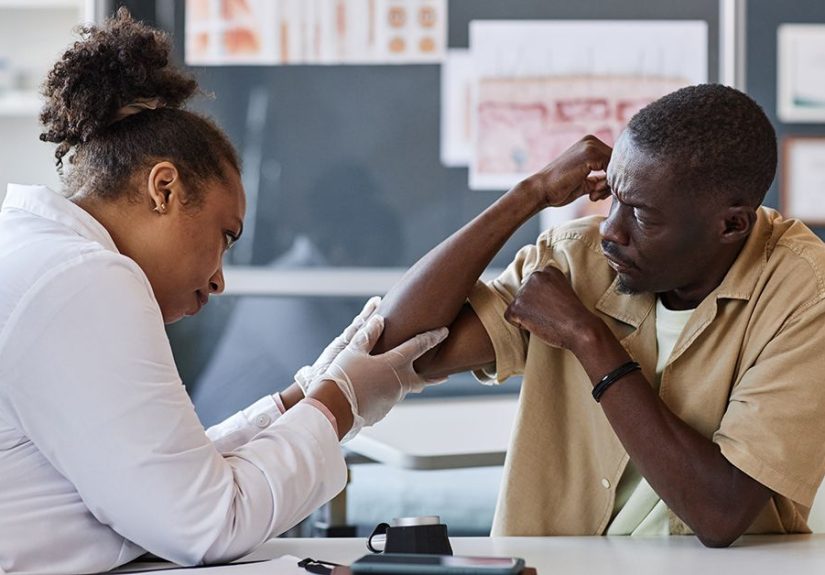
During the physical exam, clinicians check the morphology (how the rash looks), the
distribution (where it is), and signs of chronic scratching or inflammation.
- Dryness (xerosis) that can look like “ashy” or rough skin
- Red to dark patches (color can look different depending on skin tone)
- Excoriations (scratch marks) and thickened skin from repeated rubbing (lichenification)
- Typical hotspots such as flexural areas (inside elbows, behind knees) in many older kids and adults
- Signs of infection (honey-colored crust, pustules, warmth, tenderness, worsening oozing)
Doctors also look at your nails (eczema scratching can leave changes), your scalp, and sometimes areas you wouldn’t
think to mention (like eyelids or behind ears). Not because they’re trying to embarrass youbecause rashes don’t
respect personal boundaries.
Pattern recognition: what points toward atopic dermatitis
When doctors suspect atopic dermatitis (the most common eczema type), they’re usually looking for a set of features:
itch, eczema-like rash, a chronic/relapsing course, and
typical patterns for age and body areas.
Age-and-location clues doctors use
- Infants: often cheeks/scalp and extensor surfaces (outside of arms/legs).
- Children: commonly flexural areas (inside elbows, behind knees), wrists, ankles.
- Teens/adults: hands, eyelids, neck, flexures; sometimes more widespread dryness and patches.
These patterns aren’t rules carved into stone tablets. They’re clues. Doctors combine them with your history and
how the skin behaves over time.
“But my rash doesn’t look like the pictures” (very common)
Online images usually show one “classic” appearanceoften on lighter skin tones, often at one stage of inflammation.
In real life, eczema can look different depending on skin tone, the stage of a flare, scratching, infection, and what
products have been applied. That’s why in-person evaluation is so helpful: clinicians aren’t diagnosing a single photo;
they’re diagnosing a pattern.
Ruling out look-alikes: the rash “lineup”
A big part of diagnosis is making sure it’s not something else. Several conditions can mimic eczema, and doctors may
rule them out based on how the rash looks, where it is, and what symptoms come with it.
Common conditions doctors consider in the differential diagnosis
- Allergic contact dermatitis: often tied to a specific exposure; can be localized (e.g., under a watchband) or widespread.
- Irritant contact dermatitis: from repeated wet work/soaps/chemicals; common on hands.
- Psoriasis: tends to have thicker, well-demarcated plaques; sometimes scalp and nails are clues.
- Fungal infections (tinea): can create ring-like lesions that look “eczema-ish” until tested.
- Scabies: intensely itchy, often worse at night, and can spread to household contacts.
- Seborrheic dermatitis: greasy scale in scalp/face folds; can overlap with eczema in some people.
If your rash is not responding to standard eczema care, is oddly shaped (like a perfect rectangle where a product
touched), appears in an unusual location, or keeps recurring in the same spot, doctors may shift from “treat it like
eczema” to “prove what this is.”
Tests doctors might use (because sometimes the skin needs receipts)
There’s no single lab test that definitively says “Yes, this is eczema.” But testing can help confirm triggers,
identify infections, or rule out other diagnoses.
Patch testing: when contact allergy is suspected
If your doctor suspects allergic contact dermatitis (a delayed allergic reaction to substances touching
the skin), they may recommend patch testing. Small amounts of common allergens are placed on patches,
usually on the back, and left in place for a set time. You return for readings over several days so the clinician can
see whether specific allergens triggered a reaction.
Patch testing is especially useful when dermatitis is stubborn, located in places like the eyelids/hands, appears
“geometric,” or flares after using particular products. It can also reveal surprising culpritsfragrance mixes, preservatives,
certain topical antibiotics, metals, or ingredients hiding in “natural” skincare.
Allergy testing (skin prick or blood tests): helpful, but not a diagnosis of eczema
Some people with atopic dermatitis also have allergies. In certain casesespecially when symptoms suggest immediate allergic
reactionsclinicians may use skin prick testing or blood tests to evaluate allergic sensitization.
These tests can support broader management, but they don’t diagnose eczema by themselves. A positive allergy test doesn’t always
mean that allergen is causing your skin flare.
Skin scraping or KOH test: ruling out fungus
When a rash might be fungal (especially if it’s ring-shaped, scaly at the border, or not responding to eczema treatment),
a clinician may do a quick scraping and examine it or test it. This matters because antifungals help fungus; steroids alone
can sometimes make fungal rashes harder to recognize.
Skin biopsy: rarely needed, sometimes very useful
A skin biopsy means taking a small sample of skin to examine under a microscope. Doctors don’t biopsy most
routine eczema cases. But if the rash is unusual, severe, not responding as expected, or if another diagnosis needs to be
ruled out, a biopsy can help clarify what’s going on.
Swabs/cultures: checking for infection
Eczema can crack the skin barrier, making it easier for bacteria or viruses to cause infection. If the skin is oozing,
crusting, very tender, spreading quickly, or accompanied by fever, clinicians may evaluate for infection and treat accordingly.
How doctors assess severity (and why they keep asking you to rate itch)
Diagnosis is step one. Step two is figuring out how severe it is and how it affects your life. Two people can have similar-looking
rashes, but one sleeps fine and the other is up at 3 a.m. negotiating with their elbows.
What severity assessment may include
- Body surface area involved (how much skin is affected)
- Intensity (redness, thickness, oozing, scratch marks)
- Itch and sleep impact (yes, those “rate 0–10” questions actually matter)
- Quality of life (school/work distraction, embarrassment, avoidance of activities)
- Response to previous treatments
In specialty settings, clinicians may use formal scoring systems to track progress over time. Even without formal scoring,
photos and consistent notes can help compare flares across seasons and treatments.
How to prepare for an eczema diagnosis appointment
You don’t need to show up with a PowerPoint, but a little preparation can turn a vague “my skin hates me” into a clearer,
faster diagnosis.
A quick checklist you can bring
- Timeline: when it started, how it changes, and how often it flares
- Where it shows up: take photos if it comes and goes (especially if it’s calmer on appointment day)
- Product list: soaps, detergents, lotions, cosmetics, hand sanitizers, topical meds
- Triggers you suspect: sweating, stress, certain fabrics, weather changes, swimming, pets
- Treatment history: what you tried, how long, what helped, what burned or made it worse
- Family history: eczema, asthma, allergic rhinitis, allergies
If patch testing is on the table, your doctor may give instructions about what to avoid before the test (for example, certain topical
medications on the test area). Follow their guidancepatch tests are picky, like sourdough starters.
When to get evaluated sooner (don’t “wait it out” in these cases)
- Rapidly spreading redness or swelling
- Severe pain, warmth, pus, or honey-colored crusting
- Fever or feeling very unwell with a new or worsening rash
- Blistering, eye involvement, or rashes in sensitive areas that worsen quickly
- Intense itch with suspected scabies exposure or household spread
Eczema itself isn’t “contagious,” but infections and infestations can be. If you’re unsure, it’s safer to get checked.
Conclusion: eczema diagnosis is a process, not a single test
Doctors diagnose eczema by combining your symptom story with a careful skin exam and pattern recognition. When things aren’t clear,
they rule out look-alike conditions and may use targeted testsespecially patch testing for contact allergy, scrapings for fungus,
or (rarely) biopsy for confusing cases. The goal isn’t just to name the rash; it’s to understand what kind it is, what’s driving it,
and how to control it with the least disruption to your life.
Experiences: what the eczema diagnostic journey often feels like (about )
People often describe the road to an eczema diagnosis as equal parts relief and “Wait, that’s it?” Relief, because having a name
for the problem can make you feel less stuck. “That’s it?” because many expect a big lab panel or a dramatic scanwhen the reality is
usually a conversation and a close look at the skin.
A common experience is realizing that the doctor’s questions are more precise than your own mental notes. Many patients walk in saying,
“It itches,” and walk out realizing the doctor was actually mapping patterns: when it itches most, how sleep is affected, whether it
flares after showers, and whether the rash appears in the same zones again and again. People who start keeping a simple “skin diary”
(even just a phone note) often say it’s the first time they feel like they can predict flares instead of being ambushed by them.
Another common moment: discovering that “eczema” may not be one thing. Some people are told they likely have atopic dermatitis but also
have a contact allergy on top of itmeaning the baseline skin barrier is sensitive, and then a specific ingredient (like fragrance,
preservative, or metal) pours gasoline on the fire. When that happens, patch testing can feel like a turning point. The experience of
patch testing itself is often described as mildly annoying but manageable: patches placed on the back, a few days of “please don’t sweat,
shower, or twist like a pretzel,” and then the big reveal during the reading visit. The surprising part for many is that the “allergen”
can be something you’ve used for years. People often say, “But I didn’t react before!”and clinicians explain that allergies can develop
over time, and damaged skin can be easier to sensitize.
Many also report frustration when the rash doesn’t match the internet’s “classic” photos. This is especially true for people with deeper
skin tones, where redness can look more purple, gray, or dark brown, and inflammation may show up as texture changes and swelling rather
than bright pink. Patients often say the best appointments are the ones where the clinician explains what they’re seeing out loud:
“This pattern plus the itching plus the history suggests X, but I want to rule out Y because of Z.” That transparency turns the visit
into teamwork instead of a mystery novel with a rushed ending.
Finally, many people describe diagnosis as the start of “trial-and-learn,” not instant perfection. The first plan may involve gentle skin
care, trigger reduction, and targeted medicationthen adjustments based on what works. People often say their biggest lesson is that eczema
management is less about finding one miracle product and more about building a routine that keeps the skin barrier calm. It’s not glamorous,
but it’s effectiveand yes, your future self will thank you for choosing boring, fragrance-free moisturizer over the lotion that smells like
a tropical vacation and feels like regret.
Final takeaway
If you suspect eczema, a clinician can often diagnose it with a focused history and examand use targeted testing only when needed.
The sooner you get a clear diagnosis, the sooner you can stop guessing and start treating the right problem.







 Close
Close