
Table of Contents >> Show >> Hide
- Why Prostate Cancer Radiation Toxicity Matters
- What Is SBRT for Prostate Cancer?
- MRI-Guided Radiation vs. CT-Guided Radiation
- Inside the MIRAGE Trial
- Why MRI Guidance May Reduce Toxicity
- What This Means for Patients
- What This Means for Doctors and Cancer Centers
- Limits of the Trial
- How MRI-Guided Radiation Fits Into the Future of Prostate Cancer Care
- Patient Experience: What MRI-Guided SBRT May Feel Like in Real Life
- Conclusion
For many men diagnosed with localized prostate cancer, radiation therapy comes with two big questions: “Will it control the cancer?” and “What will it do to my day-to-day life?” The first question has received decades of attention. The second oneurinary urgency, bowel irritation, sexual changes, fatigue, and the awkward logistics of treatmentoften becomes painfully real only after therapy begins.
That is why the MIRAGE trial has made such a splash in radiation oncology. This phase 3 randomized clinical trial compared MRI-guided stereotactic body radiation therapy, or MRI-guided SBRT, with conventional CT-guided SBRT for localized prostate cancer. The headline finding is simple enough for patients to understand and important enough for doctors to study closely: MRI guidance allowed doctors to target the prostate with tighter margins and significantly reduce treatment-related toxicity.
In plain English, the trial suggests that seeing the prostate more clearly during treatment may help protect the bladder, rectum, urethra, and surrounding healthy tissue. That matters because the prostate is not exactly living alone in a spacious apartment. It is tucked between sensitive neighbors, and those neighbors complain loudly when radiation drifts too close.
Why Prostate Cancer Radiation Toxicity Matters
Prostate cancer is one of the most commonly diagnosed cancers among men in the United States. While many cases are found early and can be managed successfully, treatment decisions are rarely simple. Active surveillance, surgery, external beam radiation therapy, brachytherapy, hormone therapy, and newer precision approaches all have different benefits and trade-offs.
Radiation therapy is a standard treatment for localized prostate cancer. It can be highly effective, especially when modern planning and delivery techniques are used. However, the prostate sits close to the bladder, urethra, rectum, bowel, nerves, and blood vessels. Even carefully delivered radiation can irritate nearby tissues.
Common Side Effects of Prostate Radiation
Side effects can vary from mild and temporary to persistent and frustrating. Men may experience urinary frequency, burning, urgency, leakage, difficulty starting urination, bowel urgency, diarrhea, rectal irritation, fatigue, or erectile dysfunction. Some symptoms appear during treatment or shortly after, while others develop months or years later.
This is where the word “toxicity” can sound colder than the lived experience. In a medical paper, toxicity may mean a scored side effect. In real life, it may mean planning every errand around bathroom access, waking up four times a night, avoiding long drives, or quietly worrying about sexual health. Reducing toxicity is not a cosmetic upgrade. It is a quality-of-life issue.
What Is SBRT for Prostate Cancer?
Stereotactic body radiation therapy, commonly called SBRT, is a highly focused form of external beam radiation. Instead of giving many small radiation doses over several weeks, SBRT delivers larger doses in fewer sessions. For prostate cancer, treatment is often completed in about five sessions.
That shorter schedule is one reason SBRT is attractive. Fewer appointments can mean fewer missed workdays, less travel, lower logistical stress, and faster completion. For patients who live far from a cancer center, five visits instead of twenty or more can feel like being handed a calendar miracle.
But SBRT also demands precision. Because each dose is larger, the treatment team must be extremely careful about where the radiation goes. The goal is to hit the prostate hard while sparing the bladder, rectum, urethra, bowel, and sexual function as much as possible. In other words, SBRT is powerfulbut power needs steering.
MRI-Guided Radiation vs. CT-Guided Radiation
Traditional image-guided prostate radiation often uses CT imaging, cone-beam CT, X-rays, and sometimes fiducial markers. Fiducial markers are tiny markers placed in or near the prostate to help guide treatment. CT guidance is widely used and can be very effective, but CT images do not show soft tissue as clearly as MRI.
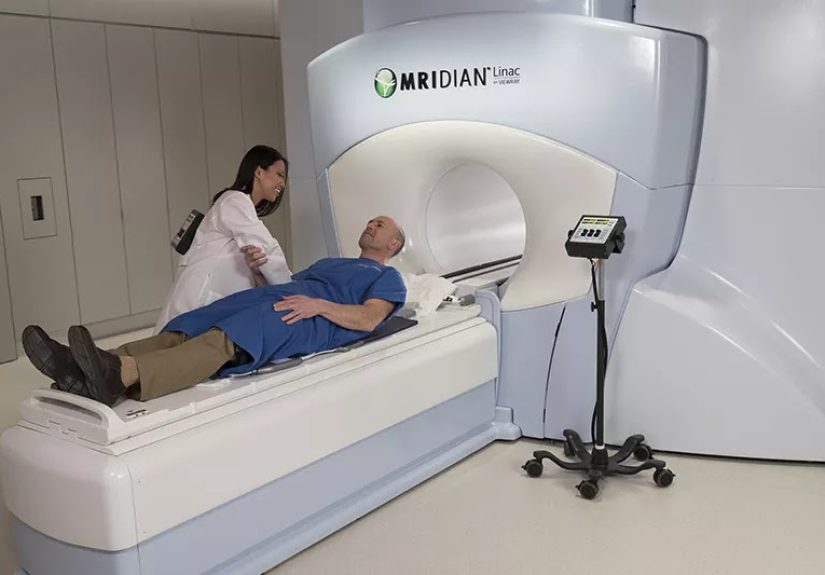
MRI-guided radiation therapy changes the pictureliterally. MRI provides superior soft-tissue contrast, allowing doctors to see the prostate and nearby organs more clearly. Some MRI-guided systems can also track prostate motion during treatment. That matters because the prostate is not frozen in place. It can shift due to bladder filling, rectal gas, bowel movement, breathing, and normal internal motion.
Think of CT guidance as using a reliable map, while MRI guidance is more like watching live traffic with sharper street-level detail. Both can get you to the destination, but the clearer view may help avoid unnecessary detours through healthy tissue.
Inside the MIRAGE Trial
The MIRAGE trial enrolled 156 men with clinically localized prostate adenocarcinoma. Participants were randomized to receive either CT-guided SBRT or MRI-guided SBRT. Both groups received 40 Gy in five fractions, a common ultra-hypofractionated SBRT approach.
The key technical difference was the treatment margin. In the CT-guided group, the planning target volume margin was 4 millimeters. In the MRI-guided group, the margin was reduced to 2 millimeters. That may sound tinybarely the width of a couple of grains of ricebut in prostate radiation, millimeters matter. A smaller margin can mean less high-dose radiation reaching nearby organs.
The Acute Toxicity Results
The primary endpoint was acute grade 2 or greater genitourinary toxicity within 90 days after treatment. Genitourinary toxicity refers to urinary and reproductive system side effects. The results favored MRI guidance: acute grade 2 or greater urinary toxicity was significantly lower in the MRI-guided group than in the CT-guided group.
The trial also found a major difference in gastrointestinal toxicity. Acute grade 2 or greater gastrointestinal toxicity occurred in the CT-guided group but was not seen in the MRI-guided group. Patient-reported outcomes also favored MRI guidance, including smaller declines in bowel quality-of-life scores and fewer large increases in urinary symptom scores.
The Two-Year Follow-Up
The two-year follow-up strengthened the story. Researchers reported that MRI-guided SBRT continued to show lower rates of moderate or severe urinary and bowel toxicity compared with CT-guided SBRT. In the two-year analysis, MRI-guided patients had fewer urinary problems and dramatically fewer gastrointestinal problems. Quality-of-life measures, including bowel function and sexual health, also favored MRI-guided treatment.
That is important because prostate cancer treatment is not only about surviving the next scan. It is also about how a patient feels six months, one year, and two years later. A man who is cancer-free but constantly managing urinary urgency or bowel unpredictability may not describe the outcome as a total win. The MIRAGE data suggest that better imaging may reduce that burden.
Why MRI Guidance May Reduce Toxicity
The benefit appears to come from a combination of clearer anatomy, direct prostate visualization, real-time tracking, and smaller planning margins. With CT-guided radiation, doctors often need a larger safety margin because the prostate may move and the image may not define soft tissues as sharply. That safety margin helps ensure the prostate receives the full dose, but it can also expose more normal tissue.
MRI guidance can make the target clearer. If the team can see the prostate and surrounding organs more accurately, they can treat with more confidence and reduce the extra margin. Less margin can mean less radiation to the rectum, bladder, and urethra. Less radiation to those structures can mean fewer side effects.
A Simple Example
Imagine painting a tiny circle on a moving balloon while trying not to touch the objects around it. If your view is blurry, you might paint a larger circle just to make sure you cover the target. If your view is sharp and you can see the balloon move, you can paint more precisely. MRI-guided radiation applies a similar idea, except the balloon is the prostate, the paint is radiation, and the nearby objects are organs you definitely do not want to annoy.
What This Means for Patients
For patients, the trial does not mean everyone should immediately demand MRI-guided SBRT. Treatment decisions depend on cancer risk category, prostate size, baseline urinary function, anatomy, prior procedures, access to technology, insurance coverage, and the experience of the radiation oncology team.
Still, the findings give patients better questions to ask. Men considering radiation for localized prostate cancer may want to discuss whether SBRT is appropriate, what image-guidance method is used, whether fiducial markers are required, what margins are typical at that center, and how urinary, bowel, and sexual side effects are tracked over time.
Questions to Ask a Radiation Oncologist
- Am I a good candidate for prostate SBRT?
- Do you use CT-guided, MRI-guided, or another image-guided approach?
- What side effects are most likely based on my baseline urinary and bowel function?
- How do you protect the rectum, bladder, urethra, and sexual function?
- Do I need fiducial markers or a rectal spacer?
- How many prostate SBRT cases has this center treated?
- How will we monitor PSA and quality of life after treatment?
What This Means for Doctors and Cancer Centers
The MIRAGE trial is also a technology story. MRI-guided linear accelerators are expensive, treatment sessions can take longer, and not every cancer center has access to the equipment or trained staff. A technology that improves precision still has to prove that the improvement is meaningful, reproducible, and worth the resources.
MIRAGE helps answer part of that question by showing measurable reductions in toxicity. However, practical questions remain. How easily can other centers reproduce these outcomes? Which patients benefit most? Will longer follow-up continue to show durable advantages? How should cost, access, workflow, and equity be handled?
These are not small concerns. The best technology in the world does little good if only a narrow group of patients can access it. For MRI-guided radiation to reshape prostate cancer care broadly, cancer centers will need training, reimbursement clarity, careful patient selection, and transparent communication about benefits and limitations.
Limits of the Trial
No trial is perfect, and MIRAGE should be interpreted carefully. It was a single-center trial, which means results may differ in other settings. The treatment teams were highly experienced. The study was not blinded, which can matter when side effects are assessed. MRI-guided treatment also took longer than CT-guided treatment, and equipment costs are higher.
Another important point: reduced toxicity does not automatically mean improved cancer control. The trial focused on side effects and quality-of-life outcomes, not proving superior cancer survival. CT-guided SBRT remains an effective option at many centers, and longer radiation schedules may still be appropriate for many patients.
The takeaway is not “CT-guided radiation is bad.” The more accurate takeaway is: “MRI-guided SBRT may allow smaller margins and lower toxicity for selected men with localized prostate cancer when delivered by an experienced team.” That sentence is less flashy, but medicine tends to prefer accuracy over confetti cannons.
How MRI-Guided Radiation Fits Into the Future of Prostate Cancer Care
Prostate cancer treatment is becoming more personalized. Doctors are increasingly using MRI, genomic tests, PSMA PET imaging, risk stratification, focal therapy research, refined radiation planning, active surveillance protocols, and patient-reported outcomes to tailor care. The future is not simply about treating cancer harder. It is about treating it smarter.
MRI-guided radiation fits that direction perfectly. It uses better visualization to deliver treatment more precisely. It may reduce side effects without asking patients to give up the convenience of SBRT. It also shifts the conversation from “Can we treat in five sessions?” to “Can we treat in five sessions while protecting quality of life better?”
That is a meaningful evolution. Many men with localized prostate cancer live for years or decades after treatment. When survival is long, quality of life becomes a central outcomenot a footnote.
Patient Experience: What MRI-Guided SBRT May Feel Like in Real Life
For a patient, the journey usually begins long before the treatment machine turns on. There may be a PSA test, biopsy, MRI scan, risk discussion, second opinion, and a kitchen-table conversation with family. By the time radiation is scheduled, many men are already emotionally tired. They may have read too many forums, learned too many acronyms, and discovered that every treatment option has both fans and horror stories.
One of the most reassuring parts of SBRT is the shorter schedule. Instead of arranging life around weeks of daily treatment, a patient may complete therapy in five sessions. That can make a huge difference for someone who works full time, cares for a spouse, lives far from the treatment center, or simply wants to get through treatment without turning the calendar into a medical obstacle course.
With MRI-guided SBRT, the session may feel longer than conventional image-guided treatment. The patient may lie on the table while the team obtains images, checks anatomy, confirms the prostate position, and monitors motion. Some patients may find the extra time slightly annoying. Others may find it comforting because the team is watching closely. Precision can feel slow in the moment, but slow is not always bad when the target is tiny and the neighbors are sensitive.
The preparation routine can also become part of the experience. Patients may be asked to arrive with a comfortably full bladder and an empty rectum. This is not glamorous. No one puts “strategic bladder filling” on a bucket list. But these steps help position organs consistently and can reduce radiation exposure to healthy tissue. Patients often learn quickly that small habitshydration timing, bowel regularity, diet adjustments, and communication with the teamcan make treatment smoother.
After treatment, some men may have mild urinary burning, increased frequency, urgency, fatigue, or bowel changes. The hope raised by the MIRAGE trial is that MRI guidance can reduce the odds and severity of these problems, especially the more disruptive urinary and gastrointestinal effects. That does not mean zero symptoms. It means a better chance of fewer problems, fewer medications, fewer awkward bathroom emergencies, and less worry about long-term quality of life.
Emotionally, reduced toxicity can change the entire treatment story. A patient who gets through therapy with manageable symptoms may feel more confident returning to normal routineswalking the dog, traveling, working, exercising, dating, or enjoying dinner without mentally mapping the nearest restroom. Family members may also feel relief because side effects affect the household, not just the patient.
Sexual health deserves honest mention, too. Many men are nervous to ask about erections, intimacy, and libido, but these are not side issues. They are part of survivorship. The two-year MIRAGE follow-up suggesting better sexual health quality-of-life measures is encouraging, although individual results vary. Patients should ask direct questions and expect direct, respectful answers. A good care team will not make the conversation weird. Prostate cancer already has that job covered.
The most practical experience-related lesson is this: technology matters, but the team matters too. A skilled radiation oncologist, physicist, therapist, nurse, urologist, and supportive care team can help patients understand trade-offs, manage symptoms early, and avoid feeling like they have been handed a machine brochure instead of a treatment plan. MRI-guided SBRT is promising because it combines advanced imaging with a patient-centered goal: controlling cancer while helping men remain themselves after treatment.
Conclusion
The MIRAGE trial represents an important step forward in prostate cancer radiation therapy. By comparing MRI-guided SBRT with CT-guided SBRT in a randomized setting, researchers showed that better imaging can translate into fewer side effectsnot just prettier scans. The ability to use smaller treatment margins appears to reduce radiation exposure to nearby healthy tissues, lowering urinary and bowel toxicity and supporting better quality-of-life outcomes.
For patients, this breakthrough does not replace individualized medical advice. It does, however, make the treatment conversation more specific. Men considering radiation for localized prostate cancer can now ask more informed questions about image guidance, treatment margins, SBRT eligibility, side-effect prevention, and long-term quality of life.
The future of prostate cancer care is not only about curing disease. It is about helping men live well after treatment. MRI-guided radiation is not magic, but it may be a sharper tooland in prostate cancer treatment, sharper tools can make a very human difference.
Note: This article is for educational publishing purposes only and should not replace medical advice from a qualified oncology, urology, or radiation therapy professional.





 Close
Close