
Table of Contents >> Show >> Hide
- The House Itself: Quiet Architecture, Big Personality
- Why “Work in Progress” Is the Whole Point
- The Kitchen: Utility With Excellent Manners
- Color, Texture, and the Art of Not Being Boring
- The Bedrooms: Calm Without Falling Asleep
- The Sitting Room and Dining Room: A Life of Accumulation
- The Garden: A Parallel Story of Growth
- What Modern Homeowners Can Learn From the Dorset Parsonage
- Experience and Reflection: Living With a House That Keeps Becoming Itself
Some houses try very hard to impress you. They fling open their doors, flash their marble, and basically whisper, “Please notice how expensive I am.” Ben Pentreath’s parsonage in Dorset does something far more interesting. It charms. It settles in. It lets the books lean, the flowers droop slightly in a happy way, and the furniture look as if it has known the room for decades. That is the real magic of this house: it feels complete without ever pretending to be finished.
For anyone who loves traditional interiors, English country houses, or the art of decorating without making everything look like a hotel lobby with commitment issues, this home offers a masterclass. Pentreath’s Dorset parsonage is often admired for its color, comfort, and old-world grace, but the deeper story is about process. It is a house shaped by time, instinct, collecting, editing, rethinking, and living. In other words, it is a work in progress in the best possible sense.
This is why the house continues to resonate with design lovers. It is not merely pretty. It has ideas. It shows how a historic home can be refreshed without being stripped of character, how utility can sit comfortably beside beauty, and how decoration becomes richer when it grows slowly. If you have ever stared at your own unfinished room and thought, “Maybe I am failing at interior design,” this parsonage politely replies, “Or maybe you are just not done yet.”
The House Itself: Quiet Architecture, Big Personality
The Dorset parsonage is the kind of house that proves restraint can be deeply expressive. Originally built as the church house next door’s parsonage, the early-19th-century building is not showy in an architectural sense. It is simple, balanced, and calm. That calmness turns out to be a superpower. Rather than competing with furniture, art, books, textiles, and collections, the house frames them.
That framing effect matters. Pentreath has described the home as a place whose modest architectural language allows its rooms to become a backdrop for books, china, pictures, and all the layered details that make a house feel personal rather than staged. This is one reason the interiors feel so persuasive. The architecture sets the rhythm, but the decoration provides the melody. Yes, that is a dramatic sentence about wallpaper and side tables, and yes, it is deserved.
What makes the parsonage especially memorable is the refusal to overcorrect. Many historic homes get renovated into a state of eerie over-perfection. Every surface becomes too polished, every room too coordinated, every decision too self-aware. Here, the rooms breathe. They allow for irregularity. They welcome pieces that do not match exactly but belong emotionally. That is a harder trick than buying all one collection from the same showroom and calling it a day.
Why “Work in Progress” Is the Whole Point
The phrase “work in progress” is not a polite apology. It is the governing principle. Pentreath’s wider decorating philosophy has long favored evolution over instant completion. He has argued against over-restoring interiors and against lavishing too much obsessive care on every tiny detail of a period house. His reasoning is refreshingly sane: too much pedantry can drain the life out of a room.
That philosophy shows up all over the parsonage. Instead of treating the house like a museum specimen, he lets it behave like a home. Rooms keep their quirks. Furnishings gather by accretion. Utility is not hidden away as though it were embarrassing. Decoration is layered, not delivered in one single grand performance. The result feels generous and human.
There is also a financial truth tucked inside this idea, one that makes the house especially relatable. Progress in a meaningful home often comes in phases. A room gets painted one year, better curtains arrive later, a useful chest turns up at an antiques shop, a lamp migrates from one floor to another, and eventually the room becomes itself. This is slower than internet fantasy makeovers, but it is often far more convincing. The Dorset parsonage makes patience look stylish.
The Kitchen: Utility With Excellent Manners
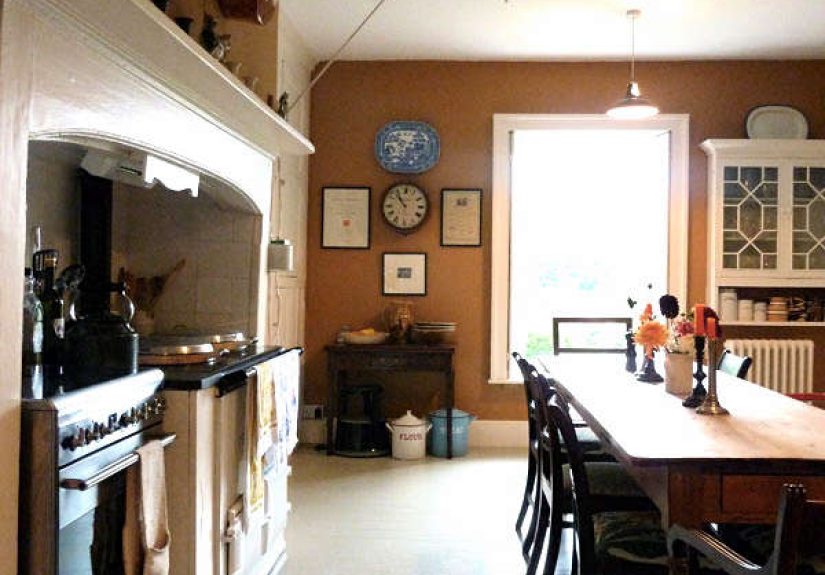
If the soul of the house has a headquarters, it may well be the kitchen. This is not a kitchen obsessed with pretending nobody actually cooks. It is practical in the most attractive way. A Sheila Maid laundry airer hangs above the AGA, a detail that instantly signals usefulness over fuss. The original wood cupboards, made by a local carpenter in the 19th century, remain part of the room’s identity. An 18th-century Welsh dresser adds open storage and visual generosity.
And here is the clever part: nothing about this practicality feels plain. The room is handsome because it is useful. The dresser is beautiful because it works. The airer gives the space character because it belongs to real daily life. This is classic Pentreath territory, where domestic labor and decorative pleasure are allowed to live together without awkwardness. The kitchen feels like a place where breakfast happens, flowers get dropped into jugs, muddy boots pause by the door, and guests hover hopefully near toast.
That approach is one of the strongest lessons from the house. In traditional kitchen design, charm is not created by deleting evidence of living. It comes from balancing order with activity. A room becomes memorable when it suggests movement, ritual, and routine. You can almost hear the clink of plates and the low murmur of morning conversation in this space. Some kitchens look photogenic. This one looks inhabited, which is much better.
Color, Texture, and the Art of Not Being Boring
Pentreath’s interiors are often discussed through the lens of Englishness, but that can be misleading if it makes people think of timidity. There is nothing timid here. The Dorset parsonage embraces color with wit and confidence. The dining room’s vibrant purple is a perfect example. It is unexpected, rich, and slightly mischievous. In less assured hands, purple could become theatrical in the wrong way. Here, it reads as both learned and playful.
Texture does just as much work as color. Seagrass flooring appears as a practical, handsome foundation. A kilim layered over seagrass squares adds warmth and informality. Ticking fabric brings discipline to mismatched chairs without sanding away their individuality. Cobalt blue glassware catches the eye and gives the sitting room a note of sparkle and tradition at once. These are not random decorative gestures. They are part of a system built on contrast: plain and patterned, humble and refined, old and newer, formal lines and relaxed living.
Crucially, the house avoids the trap of “statement pieces” that scream for attention like overcaffeinated dinner guests. The room compositions are lively, but they are also anchored. There is always something quiet under the exuberance: paneled walls, architectural drawings, off-white bedrooms, worn surfaces, practical storage. That grounding is what makes the stronger colors feel intelligent rather than noisy.
The Bedrooms: Calm Without Falling Asleep
Bedrooms in the parsonage reveal another side of the house. If the public rooms are sociable and layered, the sleeping spaces retreat into softness. Pentreath has spoken about bedrooms as places of withdrawal, and the palette reflects that belief. Calm shades of off-white and gray create a sense of relief. In one room, the leafy view outside softly influences the atmosphere, giving the space a greenish hush in summer light.
These rooms are important because they show that comfort is not the same as blandness. There is storage above cupboards, oversized books tucked into otherwise awkward spaces, and in the attic bedroom, beaded-board paneling used to address a projecting chimney breast while also making the room feel warmer and more cocooning. This is design that solves problems while improving mood. Frankly, that should be the ambition of more bedrooms and fewer decorative throw pillows with inspirational slogans.
The Sitting Room and Dining Room: A Life of Accumulation
The parsonage’s sitting room captures what many people mean when they say they want a home to feel “collected.” Too often, that word gets abused. Collected should not mean cluttered, nor should it mean a decorator purchased 27 “vintage-inspired” objects on a single Tuesday. In this house, collected means built up through taste, reading, travel, memory, and affection.
Books, magazines, flowers, a drinks tray, pictures, glassware, and an architectural rendering on the wall all contribute to a room that values conversation and continuity. It is a room designed not for a single photograph, but for repeated use. The dining room works similarly. Upholstered William IV chairs, unified by ticking fabric, sit within a broader composition that respects imperfection while still feeling deliberate. The message is clear: harmony does not require sameness.
This is one reason the house has become such a touchstone for lovers of classic interior design. It demonstrates how decoration can feel serious without becoming solemn. There is scholarship in the references, yes, but also humor and appetite. The rooms are clever, but they are not cold. That balance is harder to achieve than maximalism or minimalism alone. It requires editing, confidence, and the willingness to let a room remain slightly unfinished.
The Garden: A Parallel Story of Growth
The garden deepens the meaning of the house. When Pentreath first encountered the property, the Dorset garden had become badly overgrown. Over time, it was reshaped into a place of herbaceous borders, structure, and seasonal anticipation. Gardening, he has observed, is always about looking forward, about enjoying what is there while thinking ahead to what should change, improve, or be replanted. That mindset mirrors the house exactly.
The garden and interiors are not separate projects. They are companion pieces. Both are about stewardship rather than conquest. Both rely on patient editing. Both gain character from age, repetition, and adjustment. And both reject the fantasy that beauty arrives all at once. A border settles in over several seasons. A sitting room deepens after years of collecting. A house becomes itself through revision.
In that sense, the garden is the outdoor version of the decorating philosophy inside. It is optimistic, observant, and never really finished. That may sound exhausting to people who want one-and-done perfection, but for anyone who actually loves homes, it is thrilling. A living place should keep asking something of you.
What Modern Homeowners Can Learn From the Dorset Parsonage
1. Let old houses stay old in the right ways
You do not need to scrub every bit of eccentricity out of a historic home. Original cupboards, awkward corners, inherited proportions, and visible wear can add more than they subtract. Character is not a problem to be solved.
2. Practical rooms can still be beautiful
The kitchen proves that utility and style are not enemies. In fact, they are often happiest when introduced properly and given tea.
3. Matching is overrated
The dining room chairs and layered textiles show that unity can come from rhythm, texture, and repeated tones rather than strict sets. A home with a little variation has more pulse.
4. Finish slowly
Some of the most convincing interiors are those that are not wrapped up too quickly. Leave space for better ideas, better finds, and better timing.
5. Personality beats trend-chasing
The house feels timeless not because it avoids personality, but because it embraces it. Taste ages better than trend reports.
Experience and Reflection: Living With a House That Keeps Becoming Itself
What makes a home like Ben Pentreath’s Dorset parsonage so emotionally persuasive is not just the furniture, the paint, or the architecture. It is the experience the house promises. It suggests a way of living in which beauty is tied to attention rather than display. You notice the dresser because it has been useful for years. You notice the soft bedroom colors because they calm you after a long day. You notice the garden because it changes every week and teaches you to look again. The house trains its occupants to become more observant, and that may be the most luxurious quality of all.
There is also something deeply reassuring about a home that does not claim to be finished forever. Most people live in stages. Budgets change. Tastes sharpen. Children arrive. Dogs shed. Shelves fill. A chair that once looked perfect suddenly needs replacing, and a room that once felt complete starts asking for a different lamp, a better curtain, or a rug with more life in it. The Dorset parsonage acknowledges that reality with grace. It does not shame the unfinished corner. It turns that corner into part of the story.
For design enthusiasts, that idea can be liberating. You do not need to solve your house in one heroic burst of spending. You can make one good choice at a time. Paint the room. Keep the useful old cupboard. Buy the antique table when you finally find the right one. Add art slowly. Let the walls wait for what they truly want. Let the garden teach patience. Let daily life leave evidence. Houses that mature this way often feel more rooted because they have actually accompanied a life rather than merely hosting a photo shoot.
Another powerful lesson is that comfort does not weaken beauty; it completes it. In the best rooms at the parsonage, you can imagine reading, hosting, daydreaming, and doing absolutely nothing at all. That matters. A successful home is not one that makes you feel cautious about touching anything. It is one that makes you want to stay. The drinks tray in the sitting room, the practical working kitchen, the layered bedrooms, the evolving garden, all point toward hospitality in the broadest sense. The house welcomes not only guests, but also time, change, and ordinary routine.
And perhaps that is why the parsonage continues to feel relevant. In an era of speed, trends, and algorithm-approved sameness, it stands for another model of domestic life: slower, more literary, more tactile, more forgiving. It reminds us that a house can be cultivated rather than completed, and that decoration at its best is not performance but companionship. A home should not merely show your taste. It should help you live better inside your own days.
If there is a final experience to take from this Dorset house, it is this: the richest interiors are rarely those that arrive all at once. They are the ones that gather themselves gradually, through memory, necessity, instinct, and affection. They keep a little room for surprise. They improve with use. They reveal more over time. In other words, they remain, happily and permanently, a work in progress.
Note: This article is an original editorial-style synthesis written for web publication, based on real reporting and cleaned of stray citation artifacts or publishing markup.







 Close
Close