
Table of Contents >> Show >> Hide
Every family has at least one photo that causes a full-room pause. Someone holds up an old picture of Mom in second grade, then puts it next to her daughter’s school portrait, and suddenly the whole table sounds like a game show audience. “Nope. That is the same face.” Then Uncle Mike joins in with a grainy teenage photo, and his son appears to have borrowed the exact same eyebrows, grin, and “I may or may not have started this chaos” expression.
That is why parent-child lookalike photos never get old. They are funny, a little spooky, and weirdly comforting. We know kids inherit traits from their parents, but a side-by-side picture turns biology into a punch line. One matching dimple can feel cute. The same nose, same head tilt, same sleepy eyes, and same crooked half-smile? That is not resemblance anymore. That is a family photocopier running low on originality.
Of course, kids are not literal clones. Real-life resemblance is a mix of inherited traits, growth, development, and the tiny habits families share without noticing. A child may get Dad’s jawline, Mom’s curls, Grandma’s cheeks, and somehow still make every expression like a tiny version of the family dog. But when the right photo shows up at the right angle, it can look as if the universe simply hit copy, paste, and add snacks.
Below are 50 kinds of parent-child photos that absolutely sell the “copy-paste” theory. Some spotlight facial features. Some capture identical expressions. Others show that posture, attitude, and photo timing can be just as powerful as genetics. Together, they explain why family resemblance remains one of the internet’s most delightful rabbit holes.
Why These Family Lookalike Photos Hit So Hard
Part of the magic is visual shorthand. Our brains are fast. We pick up patterns before we can explain them, which is why a matching smile or the same eye shape can feel obvious in a split second. A side-by-side photo also strips away distractions. Suddenly, you are not looking at two different people from two different decades. You are looking at one family signature repeating itself like a chorus.
Then there is the emotional part. These photos are funny because they exaggerate what families already joke about. They are sweet because they connect generations without a long speech. One picture can quietly say, “You came from somewhere,” and also, “Apparently that somewhere had aggressively strong cheekbones.”
And let’s be honest: the best of these comparisons are tiny masterpieces of accidental comedy. The same haircut. The same annoyed stare. The same “I did not ask to be photographed” body language. Genetics may start the story, but timing, lighting, and family sass finish it.
50 Photos That Prove Kids Are Copy-Paste Versions Of Their Parents
Facial Features That Clearly Refused to Stay in One Generation
- The exact same smile. Not just “both happy.” We mean the same toothy grin, same lip curve, and same energy of “I definitely got away with something.”
- The copy-paste nose. Some noses do not whisper family resemblance. They walk in, own the room, and demand everyone admit the child is Dad with a smaller backpack.
- Matching eyes. Same shape, same color, same sleepy-lidded look that says coffee will someday become necessary.
- The inherited dimples. When the cheek dents appear in exactly the same spot, the photo comparison practically makes itself.
- That very specific eyebrow arch. You know the one: half skeptical, half amused, fully genetically committed.
- The signature chin. Whether strong, rounded, or adorably dramatic, it shows up again like a family logo.
- Identical hair texture. Same curls, same waves, same lifelong battle with humidity.
- The forehead that cannot be denied. A parent and child side-by-side with the same hairline is family comedy at its purest.
- Matching freckles or beauty marks. Tiny details become huge when they appear in almost the same place.
- The same ears, somehow. Ears do not get enough attention until two generations line up and prove they absolutely should.
Expressions That Make the Photo Comparison Unfair
- The laugh face. Mouth open, eyes squeezed shut, zero elegance, maximum resemblance.
- The side-eye. Some families do not pass down silverware. They pass down judgment.
- The pout. Parent at age seven and child at age six looking equally offended by vegetables? Incredible.
- The mischievous smirk. These photos say, “This family has been up to nonsense for decades.”
- The stubborn face. Chin up, lips pressed, tiny storm cloud forming overhead. Genetics really showed off here.
- The camera-shy look. Same turned shoulder, same half-hide behind another person, same “please stop documenting me.”
- The surprised expression. Even shock can apparently be hereditary when both faces widen in the exact same cartoonish way.
- The sleepy morning stare. Parent in an old Polaroid, child in a smartphone snap, both looking like consciousness is optional.
- The fake smile for school pictures. You know it instantly: polite lips, deadpan eyes, soul elsewhere.
- The dramatic crying face. Some children inherit emotional intensity with premium-level theatrical presentation.
When Hair, Style, and Vibe Join the Family Group Chat
- The same haircut at the same age. Bowl cut, bangs, curls, or glorious chaos; history repeats itself with scissors.
- The denim-jacket duplicate. Parent in the 1980s, child in the 2020s, same attitude, different decade, identical cool.
- The family-photo pose. Hands folded, shoulders squared, smile ready. It is less a pose and more a dynasty tradition.
- The matching messy-hair energy. Some families wake up looking cinematic. Others look like the wind won a custody battle.
- The athlete stance. Same confident posture, same “put me in, coach” look, same photo that embarrasses them equally later.
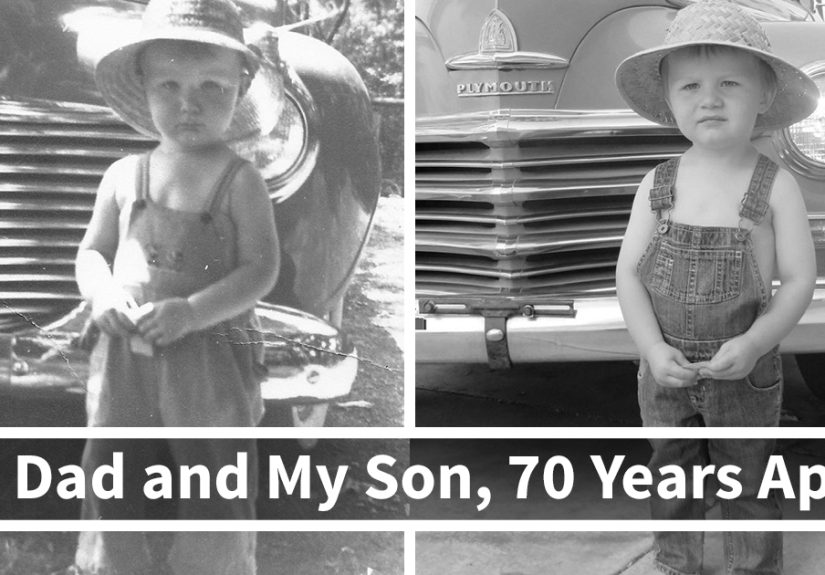
- The tiny fashion echo. A child wearing overalls or a jacket that accidentally mirrors an old parent photo makes the comparison almost unfair.
- The glasses era. Same frames, same serious expression, same future of losing them on top of the head.
- The formalwear twin moment. Parent in a prom photo, child at a dance decades later, and somehow even the posture matches.
- The beach-day copy. Windy hair, squinting eyes, sunburn flirting with disaster, yet still unmistakably related.
- The holiday snapshot twin. Matching grins in front of a tree, and now Grandma is emotional for understandable reasons.
Photos Where the Body Language Does Half the Work
- The crossed-arm stance. Parent and child both look like tiny supervisors checking on the quality of everyone else’s effort.
- The one-hip lean. A little posture goes a long way when it appears in the exact same casual way.
- The hands-in-pockets photo. Relaxed, slightly smug, and way too similar for comfort.
- The chin-on-hand thinker pose. It screams “deep thoughts,” even if both subjects were probably thinking about snacks.
- The arms-thrown-wide pose. Same joyful drama, same center-stage spirit, same inability to enter a room quietly.
- The sleepy slouch. Some family traits are noble. Others involve collapsing into furniture in exactly the same shape.
- The goofy overbite grin. It shows up in old childhood photos and reappears on the next generation like a punch line with legs.
- The head tilt. Subtle in person, undeniable in photos, and somehow one of the strongest resemblance clues of all.
- The serious portrait posture. Straight spine, solemn face, and the deep understanding that picture day is not for jokes.
- The running-wild snapshot. Even blur can look inherited when the body language is pure generational chaos.
Moments So Similar They Feel Scripted by the Universe
- The same age, same location remake. Parent stands where they stood years earlier, child mirrors the pose, and suddenly time folds in half.
- The sibling-plus-parent comparison. One child looks like Mom, another like Dad, and the family album starts resembling casting notes.
- The school portrait deja vu. Similar background, similar lighting, same facial expression, and a truly suspicious amount of resemblance.
- The baby photo shocker. A parent’s baby picture gets mistaken for their child’s, which is the gold medal of family lookalike moments.
- The teenage twin effect. Puberty arrives, and suddenly the child becomes a retro reboot of a parent’s yearbook page.
- The smile-after-winning photo. Same proud grin, same spark in the eyes, same “yes, I absolutely earned this.”
- The candid mid-conversation shot. These are often the most convincing because nobody had time to perform.
- The grumpy vacation photo. Nothing says family resemblance like identical annoyance in matching tourist settings.
- The grandparent bonus round. Sometimes the child skips a generation and returns with Grandpa’s entire face like a tribute act.
- The side-by-side that ends the debate. One glance, one gasp, and the room agrees that genetics absolutely had a favorite hobby.
What These Photos Really Show
The funniest part of these parent-child photo comparisons is that they feel both scientific and deeply personal. Yes, inherited traits help explain the same eyes, chin, nose, or hair pattern. But a great resemblance photo also captures something less technical: a family rhythm. It shows how expression, timing, attitude, and even the way someone occupies a room can echo across years.
That is why the best lookalike photos do more than make people laugh. They tell a story about continuity. They remind us that families are built from both biology and daily life. A child may inherit a parent’s face, but they also learn the same grin, the same dramatic sigh, the same habit of raising one eyebrow when the room gets suspiciously quiet.
In other words, these photos are not just evidence that kids can look like copy-paste versions of their parents. They are evidence that resemblance is bigger than a single feature. It is a whole pattern, a family fingerprint spread across generations, preserved in school portraits, holiday snapshots, beach pictures, and all the gloriously awkward camera moments in between.
Shared Experiences Behind the “Copy-Paste” Photos
What makes these family photos even better is the experience wrapped around them. Almost nobody sets out to create a legendary lookalike comparison. It usually starts with a random discovery. Someone is cleaning a closet, flipping through an old album, or opening a dusty storage box labeled with something optimistic like “organized memories.” Then a photo appears. It is a parent at age eight in a striped shirt, standing with one shoulder slightly raised and a grin that is somehow both shy and smug. A few seconds later, someone grabs a phone, scrolls to a recent picture of the child, and the whole house loses its mind.
That moment matters because it feels like time playing a trick. The family is not just looking at resemblance. They are watching decades collapse into one frame. Grandparents get emotional. Siblings become amateur detectives. Even the family member who usually contributes nothing but sarcasm suddenly turns into a serious photo curator. “Wait,” they say, “I know another one. There’s a vacation picture from 1996 where Dad looks exactly like Ben does right now.” And just like that, the hunt begins.
These experiences also become family folklore. The side-by-side photos get sent to group chats, printed for birthdays, and brought out during holiday dinners whenever conversation needs a reliable winner. They become the kind of story people tell over and over because it never really gets old. The image is proof, but the reaction is the real memory: the laughing, the pointing, the mock accusations that one child did not inherit a face so much as borrow it on a long-term lease.
There is also something reassuring about these comparisons. Families change. Kids grow. Parents age. Hairstyles improve, then regress, then improve again. But resemblance creates a thread that feels steady. A child can stand next to a decades-old picture and instantly reveal where they came from. That can be funny, yes, but also grounding. It gives ordinary snapshots a little emotional weight. Suddenly a crooked smile is not just a crooked smile. It is a recurring family event.
And maybe that is the secret reason people love these photos so much. They are not only about looks. They are about belonging. They say, in the most entertaining way possible, that families leave marks on one another. Sometimes it is a dimple. Sometimes it is a laugh. Sometimes it is an expression so familiar that it jumps across generations like it had an appointment. The best copy-paste family photos remind us that resemblance is not only visible. It is lived, shared, remembered, and retold.
Conclusion
From matching dimples and stubborn chins to identical side-eyes and suspiciously familiar school-picture smiles, these parent-child photos prove one thing: family resemblance can be both scientifically fascinating and comedy gold. The best comparisons make us laugh first and think later, which is exactly why they stay with us. They are tiny time machines, tiny personality tests, and tiny reminders that genetics sometimes has an excellent sense of humor.
So the next time somebody says a kid “looks just like” a parent, do not settle for casual agreement. Ask for the receipts. Open the albums. Search the camera roll. Because somewhere in that family archive, there is probably a side-by-side photo waiting to prove that the copy machine has been running beautifully for generations.






 Close
Close