
Table of Contents >> Show >> Hide
- Quick refresher: what a factorial really means
- Way #1: Expand just enough to regroup (the “smart unrolling” method)
- Way #2: Rewrite the product using binomial (and counting) identities
- The identity that unlocks factorial products
- Example 1: Multiply 10! × 3! using a binomial coefficient
- Example 2: Multiply 6! × 7! without expanding either
- Why this isn’t just “pretty math”
- Bonus identity: rising products without expanding factorials
- Extra-credit: gamma function viewpoint (when factorials get “non-integer”)
- Way #3: Multiply using prime exponents (the “industrial-strength” method)
- The big idea: factorials are made of primes
- Legendre’s formula (how to get prime exponents fast)
- Example: build 10! from prime exponents
- How this multiplies factorials effortlessly
- A practical step-by-step algorithm (no heavy theory required)
- When you don’t need the exact value: Stirling’s approximation
- Example: estimate digits of a factorial product
- Cheat sheet: picking the best method
- Common mistakes (and quick fixes)
- Extra: of real-world “experiences” with multiplying factorials
- Conclusion
Factorials are the math version of a snowball rolling downhill: they start small, then suddenly they’re the size of a minivan. Multiplying factorials can look innocentlike 7! × 5!until you realize you’re about to juggle a bunch of giant products. The good news: you usually don’t need to expand everything and suffer. With the right strategy, you can multiply factorials quickly, simplify expressions cleanly, and even handle “too-big-for-a-calculator” situations.
In this guide, you’ll learn three practical ways to multiply factorials: (1) expand just enough to regroup and cancel, (2) use binomial/combinatorial identities to rewrite products in one line, and (3) use prime-factor methods (plus smart approximations) when numbers get enormous.
Quick refresher: what a factorial really means
For a nonnegative integer n, the factorial n! is the product of all positive integers from n down to 1:
n! = n × (n−1) × (n−2) × … × 2 × 1- By definition,
0! = 1(this keeps counting formulas consistent) - A super-useful identity:
(n+1)! = (n+1) × n!
That last identity is the “secret door” for most factorial multiplication tricks. It lets you peel off (or attach) factors without expanding everything.
Way #1: Expand just enough to regroup (the “smart unrolling” method)
This method is perfect when factorials overlap, like 8! × 6! or (n+3)! × n!. Instead of expanding both factorials fully, you expand only the bigger one until it contains the smaller onethen you factor and regroup.
The core idea
If a > b, then:
a! = a × (a−1) × (a−2) × … × (b+1) × b!
So when multiplying a! × b!, you can rewrite it as:
a! × b! = [a × (a−1) × … × (b+1) × b!] × b! = (a × … × (b+1)) × (b!)²
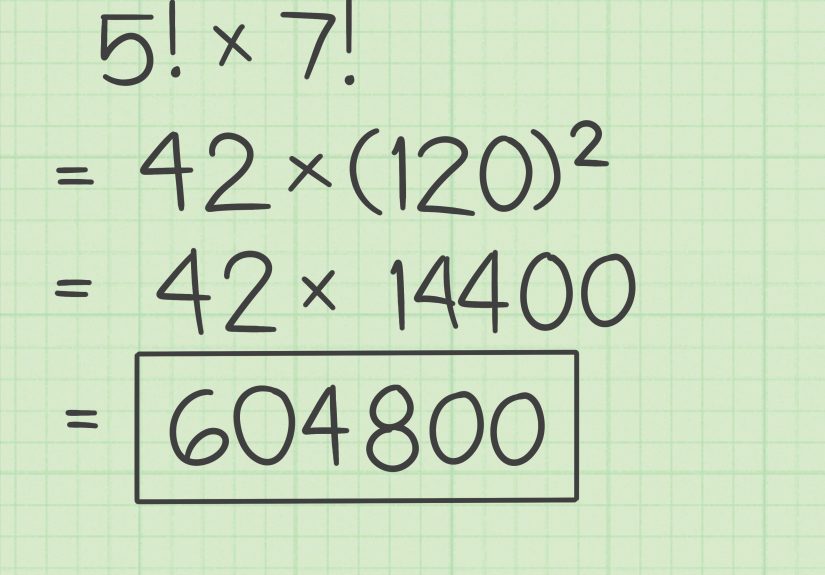
Example 1: Multiply 7! × 5! without “calculator sadness”
Expand only 7! down to 5!:
7! = 7 × 6 × 5!
Now multiply:
7! × 5! = (7 × 6 × 5!) × 5! = 42 × (5!)²
Since 5! = 120:
42 × 120² = 42 × 14400 = 604800
Example 2: Multiply 8! × 6! the clean way
Expand 8! down to 6!:
8! = 8 × 7 × 6!
Then:
8! × 6! = (8 × 7 × 6!) × 6! = 56 × (6!)²
This is often better than multiplying 40320 × 720 directlysame answer, less mess.
Example 3 (algebraic): Multiply (n+3)! × n!
Expand (n+3)! down to n!:
(n+3)! = (n+3)(n+2)(n+1)n!
Multiply by n!:
(n+3)! × n! = (n+3)(n+2)(n+1) × (n!)²
When this method shines
- When factorials are close in size:
100! × 98!becomes100×99×(98!)². - When you want simplification, not giant numbers: it keeps expressions tidy.
- When you’re doing algebra: it turns scary factorials into ordinary factors.
Common pitfall to avoid
Don’t confuse (ab)! with a!b!. They are almost never equal. In fact, (ab)! is usually astronomically larger. (If factorials had a personality, they’d be the friend who shows up with “just a small snack” and it’s a 12-foot sub sandwich.)
Way #2: Rewrite the product using binomial (and counting) identities
This method is for when you want a one-line transformation that’s both elegant and useful in probability, combinatorics, and algebra. The key player is the binomial coefficient: “n choose k.”
The identity that unlocks factorial products
The binomial coefficient is:
C(n, k) = n! / (k!(n−k)!)
Rearranging gives:
k!(n−k)! = n! / C(n, k)
Now watch what happens if you want a! × b!. Let n = a+b and k = a:
C(a+b, a) = (a+b)! / (a!b!)
So:
a!b! = (a+b)! / C(a+b, a)
Example 1: Multiply 10! × 3! using a binomial coefficient
Here a=10, b=3, so a+b=13:
10! × 3! = 13! / C(13,10)
And C(13,10) = C(13,3) = 286, so:
10! × 3! = 13! / 286
This is a great “simplified exact form” for algebra, and it’s also a nice sanity check in counting problems (because C(13,3) counts ways to choose 3 items from 13).
Example 2: Multiply 6! × 7! without expanding either
6! × 7! = 13! / C(13,6)
That’s it. One line. Your calculator can rest.
Why this isn’t just “pretty math”
Many real problems naturally contain products like k!(n−k)!. For instance, probabilities involving combinations often simplify instantly if you swap factorial products for binomial coefficients (or vice versa). It also helps you recognize structure: factorial products often mean “counting in two steps.”
Bonus identity: rising products without expanding factorials
Sometimes the “multiplication” you need is really the product of consecutive integers. The factorial ratio captures this cleanly:
(n+r)! / n! = (n+1)(n+2)…(n+r)
Then multiplying factorials becomes multiplying a short string of consecutive numbers. Example:
(n+5)! × n! = [(n+5)!/n!] × (n!)² = (n+1)(n+2)(n+3)(n+4)(n+5) × (n!)²
Extra-credit: gamma function viewpoint (when factorials get “non-integer”)
If you ever see factorial-like expressions with half-integers or need a continuous extension, mathematicians use the gamma function:
n! = Γ(n+1)
You don’t need gamma to multiply ordinary integer factorials, but it explains why certain identities exist and helps when you move into advanced math, statistics, or approximations.
Way #3: Multiply using prime exponents (the “industrial-strength” method)
For large factorials, direct multiplication is inefficient and sometimes impossible in typical number formats. The prime-exponent method avoids overflow, reduces repeated work, and gives clean exact resultsespecially when you’re multiplying and dividing factorials together.
The big idea: factorials are made of primes
Every integer factors into primes, so a factorial does too:
n! = ∏ p≤n p^{v_p(n!)}
where v_p(n!) is the exponent of prime p inside n!.
Legendre’s formula (how to get prime exponents fast)
For a prime p:
v_p(n!) = ⌊n/p⌋ + ⌊n/p²⌋ + ⌊n/p³⌋ + …
The sum stops automatically when p^k > n because the floors become zero.
Example: build 10! from prime exponents
Primes ≤ 10 are 2, 3, 5, 7.
v_2(10!) = ⌊10/2⌋ + ⌊10/4⌋ + ⌊10/8⌋ = 5 + 2 + 1 = 8v_3(10!) = ⌊10/3⌋ + ⌊10/9⌋ = 3 + 1 = 4v_5(10!) = ⌊10/5⌋ = 2v_7(10!) = ⌊10/7⌋ = 1
So:
10! = 2^8 × 3^4 × 5^2 × 7
How this multiplies factorials effortlessly
Multiplying factorials becomes adding exponents:
(a!)(b!) = ∏ p p^{v_p(a!) + v_p(b!)}
Dividing factorials becomes subtracting exponents (super useful for simplifying ratios like 100! / (60!40!)).
A practical step-by-step algorithm (no heavy theory required)
- List all primes up to
max(a, b). - For each prime
p, computev_p(a!)andv_p(b!)using floor sums. - Add the exponents for multiplication (or subtract for division).
- Rebuild the integer by multiplying primes to their exponents (or keep the factorized form).
This is exactly how many “big integer” or symbolic math systems stay accurate with gigantic factorial expressions. Instead of multiplying massive numbers early, they keep structure as long as possible.
When you don’t need the exact value: Stirling’s approximation
Sometimes you only need the size (number of digits) or an approximation. Factorials grow so quickly that even 100! is far beyond everyday arithmetic, so estimation matters. Stirling’s approximation gives:
n! ≈ √(2πn) × (n/e)^n
Even better for “how many digits?” questions is the logarithm form:
log10(n!) ≈ n·log10(n/e) + 0.5·log10(2πn)
Then the number of digits in n! is:
digits(n!) = ⌊log10(n!)⌋ + 1
Example: estimate digits of a factorial product
To estimate digits of 100! × 80!, you can do:
log10(100! × 80!) = log10(100!) + log10(80!)
Approximate each with Stirling’s log form, add them, then apply ⌊…⌋ + 1. You’ll get a reliable digit count without ever computing the full number. (Your laptop will thank you.)
Cheat sheet: picking the best method
- Small factorials or close sizes? Use Way #1 (expand just enough, regroup).
- Expressions like
a!b!ork!(n−k)!in counting/probability? Use Way #2 (binomial identities). - Huge factorials, exact arithmetic, or ratios? Use Way #3 (prime exponents / Legendre).
- Only need magnitude or digits? Use Stirling (under Way #3).
Common mistakes (and quick fixes)
Mistake 1: Treating (a+b)! like a! + b! or a!b!
Factorials don’t distribute over addition, and they don’t “split” across multiplication inside the factorial. If you see something like (a+b)!, your best move is usually to leave it alone or rewrite other pieces in terms of it (Way #2).
Mistake 2: Forgetting 0! = 1
This one causes off-by-one chaos in counting problems. If a formula includes 0!, that term is 1, not 0 and not “undefined.”
Mistake 3: Expanding everything too early
If you expand a big factorial before simplifying, you’re basically choosing the hardest path for no reason. Keep factorials symbolic as long as possible, simplify first, then compute.
Extra: of real-world “experiences” with multiplying factorials
If you’ve ever learned factorials in school, you know the first experience is usually: “Oh, this is easy.” The second experience is: “Why is my answer bigger than my entire future?” That emotional whiplash is basically the factorial brand.
One of the most common experiences people have with multiplying factorials is mixing up a! × b! with (ab)!. They look like cousins. They are not. A quick reality check helps: 5! × 4! = 120 × 24 = 2880, but (5×4)! = 20!, and 20! is so huge it makes 2880 look like pocket change. Once you’ve been burned by that mistake once, you rarely forget it.
Another very normal experience: you start expanding factorials because it feels concrete, and five seconds later you’re drowning in parentheses. That’s usually the moment you discover Way #1. Students often describe it like learning a “shortcut,” but it’s more like learning the correct tool. Expanding is a screwdriver; regrouping is a power drill. Same job, different efficiency.
In probability and combinatorics, factorial products show up disguised as “choose” and “arrange” problems. People will work three pages of algebra, then someone rewrites k!(n−k)! as n!/C(n,k) and the whole thing collapses into one line. That experience is half relief, half annoyance, and 100% motivation to remember the identity next time. (It’s also why binomial coefficients feel like math’s cheat codeslegal, elegant cheat codes.)
In programming or data science, the experience is different: factorial multiplication isn’t just “hard,” it can be impossible if you try to compute it directly with standard number types. People learn this when a factorial overflows or returns nonsense. That’s where the prime-exponent method feels like a superpower. Instead of multiplying huge integers early, you store prime exponents and combine them. It’s the same idea as keeping ingredients separate until you’re ready to cookmuch easier than trying to re-separate a baked cake.
There’s also the “estimation” experience: sometimes you don’t need the exact value at all. You just need to know if something is around 10^50 or 10^500. That’s when Stirling’s approximation becomes your best friend. People often remember it because it’s surprisingly accurate and because it gives you a quick gut-check: if your exact computation returns something wildly different from the estimate’s magnitude, that’s a hint you made an algebra mistake earlier.
And finally, a very relatable experience: factorials make you more careful with notation. Once you’ve simplified a few expressions correctly, you start reading factorial products the way you read recipesspotting which pieces belong together, which can be “factored out,” and which should never be expanded unless absolutely necessary. That’s not just a factorial skill; it’s a general math skill you’ll use everywhere.
Conclusion
Multiplying factorials doesn’t have to be a battle against giant numbers. If factorials overlap, expand only as far as you need and regroup (Way #1). If the expression smells like counting, rewrite products with binomial coefficients (Way #2). And if the numbers are massiveor you’re simplifying complicated factorial ratiosswitch to prime exponents and approximations (Way #3). With these three approaches, factorial multiplication becomes less “panic” and more “pattern.”







 Close
Close