
Table of Contents >> Show >> Hide
- Before You Adjust Anything: Know What Type of Sprinkler Head You Have
- 3 Simple Ways to Adjust Sprinkler Heads
- Common Mistakes to Avoid When Adjusting Sprinkler Heads
- Quick Troubleshooting Checklist (When an Adjustment Isn’t Enough)
- When to Adjust vs. When to Replace
- Best Practices for Better Watering After You Adjust
- Real-World Experiences and Lessons Learned (About )
- Conclusion
If your sprinkler system is watering the sidewalk like it pays property taxes, this guide is for you. The good news: most sprinkler head problems are not “dig up the yard and question your life choices” problems. They’re adjustment problems. A quick tweak to direction, spray pattern, or distance can fix overspray, dry spots, and puddleswithout replacing the whole system.
In this guide, you’ll learn 3 simple ways to adjust sprinkler heads so your lawn gets better coverage with less waste. We’ll also cover common mistakes, quick troubleshooting, and real-world experiences from homeowners who learned (sometimes the hard way) that a 5-minute adjustment can save a lot of water and frustration.
Before You Adjust Anything: Know What Type of Sprinkler Head You Have
Not all sprinkler heads adjust the same way. If you use the wrong method, you can strip a screw, force a stop, or accidentally create a mini geyser where your flower bed used to be.
Common sprinkler head types
- Spray heads (fixed or adjustable nozzles): Best for smaller areas, tighter fan-shaped coverage, and short-to-medium distances.
- Rotor heads (gear-driven rotors): Best for larger lawn areas. These rotate and usually allow arc and radius adjustments.
- Bubblers/flood heads: Used for shrubs, planters, or tree wells. These are adjusted differently and usually focus on flow, not arc.
Pro tip: Run each zone for a minute before adjusting. Watch where the water lands, note dry spots, and flag problem heads. You’ll work faster and avoid the classic DIY move of “adjusting everything and forgetting what was actually wrong.”
Tools that help (but are not always required)
- Flathead screwdriver
- Rotor adjustment key (brand-specific for some models)
- Small pliers (used gently)
- Gloves
- A marker flag or stake for problem areas
Some heads can be adjusted while the water is on; others are easier to set with the water off first, then fine-tuned while running. If you’re repairing, replacing, or digging, turn off the system and water supply before working.
3 Simple Ways to Adjust Sprinkler Heads
1) Re-aim the Head (Direction and Alignment)
This is the easiest fix and often the most effective. If a sprinkler is spraying the driveway, fence, or your neighbor’s mailbox, the head may simply be misaligned.
What this adjustment fixes
- Overspray onto sidewalks, driveways, or walls
- Dry patches caused by a head pointing the wrong way
- Uneven watering from tilted or sunken heads
How to do it
- Run the zone briefly and identify which heads are off target.
- Turn the zone off (recommended for beginners), then rotate the sprinkler head or nozzle to aim it toward the landscape.
- Check the head’s angle. The head should be as close to perpendicular (straight up) to the soil as possible. A tilted head throws more water to one side.
- Check head height. Pop-up heads should rise above the grass canopy. If grass blocks the spray, you’ll get weak coverage and random dry spots.
Many homeowners assume the nozzle is “bad” when the real issue is that the head got bumped by a mower, a foot, or a soccer ball. (Lawnmowers and sprinkler heads have a long and complicated relationship.) If the head is repeatedly leaning, it may be installed too loosely or sitting in settled soil and may need to be raised or reset.
Example: A side-yard strip is getting soaked at the fence line but still looks dry near the house. Re-aiming a slightly twisted spray head and straightening a tilted pop-up can restore even coverage without changing the nozzle at all.
2) Adjust the Spray Pattern or Arc (How Wide the Water Swings)
If direction is correct but the sprinkler is watering too much area (or not enough), the next step is adjusting the spray pattern (spray heads) or arc (rotors).
What this adjustment fixes
- Water hitting hardscapes even when the head is pointed correctly
- Corner areas that need quarter-circle coverage, not half-circle
- Patchy lawns from arc settings that are too narrow or too wide
For spray heads (adjustable nozzles)
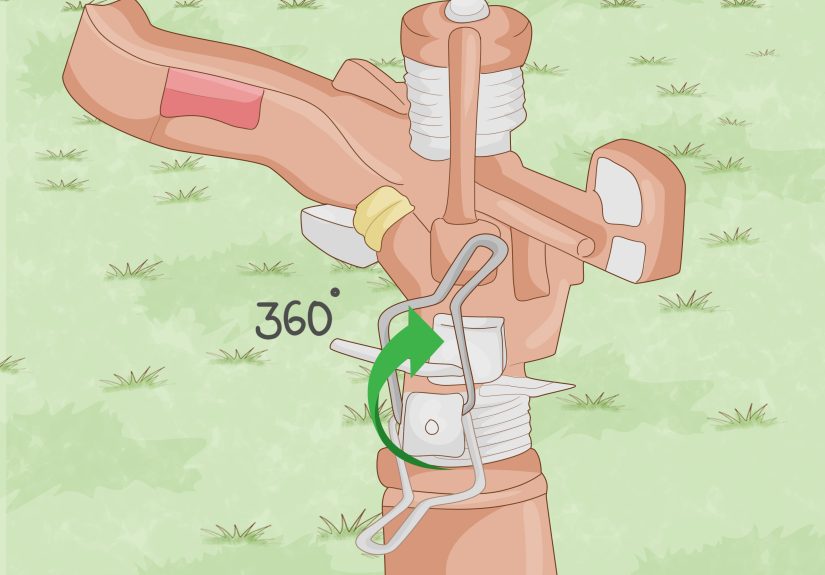
Many adjustable spray nozzles let you change the arc on top of the nozzle using a dial, collar, or twist mechanism. On some models, you first align one edge of the spray, then twist the nozzle top to set the other edge. If the nozzle is adjustable, it may also allow a full-circle (360°) setting.
Simple method:
- Pull up or expose the spray stem/nozzle as needed.
- Set the nozzle’s starting edge toward one boundary of the area.
- Adjust the nozzle top/dial to widen or narrow the pattern until it matches the target area.
- Run the zone and fine-tune.
For rotor heads (gear-driven rotors)
Rotor heads usually have a preset stop range and a dedicated adjustment socket or slot for the arc. A common setup is a fixed side (often the right stop) and an adjustable arc. On many residential rotors, turning the arc adjustment clockwise increases the arc and counterclockwise decreases itbut always follow the markings on your specific head.
Simple method:
- Rotate the turret gently to identify the left and right stops.
- Hold the turret at the fixed side (commonly the right stop).
- Use the proper tool (flathead or rotor key) in the adjustment slot/socket.
- Turn in small increments and test after each adjustment.
- Do not force beyond the stop point or ratcheting limit.
Example: A rotor in the front lawn is watering the driveway corner by 3 feet. Reducing the arc from about 210° to 180° often solves it immediatelywithout reducing coverage elsewhere.
3) Fine-Tune Distance or Radius (How Far the Water Travels)
This is the adjustment people skip most oftenand then wonder why the sidewalk is always wet. Even with correct direction and arc, the water may be traveling too far or not far enough.
What this adjustment fixes
- Overspray beyond the lawn edge
- Short throws that create dry spots between heads
- Misting caused by partial clogs or pressure issues
How to adjust distance on spray heads
Most spray nozzles use a center screw for distance reduction. In many common designs, turning the screw clockwise reduces the spray distance (often by up to about 25%), and turning it back increases distance. This is ideal for trimming coverage near sidewalks, fences, or planting beds.
Important: Distance screws are for fine-tuningnot turning a 15-foot nozzle into a 5-foot nozzle. If you need a dramatic change, swap to a nozzle with the correct radius.
How to adjust distance on rotor heads
Rotor heads usually have a radius adjustment screw (sometimes called a retention screw). Turning it clockwise typically reduces the distance by interrupting the stream; counterclockwise increases distance. Make small turns and test the spray. Don’t over-rotate the screw or force it past its range.
If distance adjustment doesn’t solve it
If the spray still looks weak, misty, or uneven, the issue may not be adjustmentit may be:
- Clogged nozzle or filter screen
- Wrong nozzle for the area
- High or low water pressure
- Too many heads on one zone
High pressure can cause misting and poor distribution (you’ll see a fog instead of defined streams). Low pressure can cause poor pop-up and short throws. In both cases, the lawn loses and the sidewalk wins.
Common Mistakes to Avoid When Adjusting Sprinkler Heads
- Mixing spray heads and rotors on the same zone: They apply water at different rates, which leads to overwatering one area and underwatering another.
- Forcing rotor stops: If it ratchets or stops, stop turning. Forcing the mechanism can damage internal gears.
- Adjusting only one head in isolation: Sprinklers work as a system. One “perfect” head can create a dry gap if the neighboring head is still off.
- Ignoring head-to-head coverage: Sprinkler streams should generally reach the next head for even coverage.
- Blaming every problem on the head: Sometimes the real culprit is pressure, a valve issue, a leak, or a clogged line.
Quick Troubleshooting Checklist (When an Adjustment Isn’t Enough)
Sprinkler sprays crooked or unevenly
- Check if the head is tilted
- Clean nozzle and filter screen
- Replace warped or worn nozzle
Head doesn’t pop up fully
- Clear grass/soil around the cap
- Check for debris in the stem
- Check pressure or too many heads on the zone
Water keeps leaking after shut-off
- Check for debris in the head/cap
- Inspect for a loose cap or nozzle
- If multiple heads seep or pooling appears, inspect valves and pressure issues
Dry spots remain after adjusting
- Confirm head-to-head coverage
- Check nozzle size/radius match
- Make sure the head pops above turf
- Verify arc settings on adjacent heads
When to Adjust vs. When to Replace
Adjust it if the head is working but aimed wrong, spraying too wide, or throwing a little too far.
Replace it if the body is cracked, the riser is damaged, the spring won’t retract, the nozzle is stripped, or the rotor mechanism no longer rotates correctly after cleaning.
Also consider replacement if you’re dealing with ongoing misting and overspray in a high-pressure zone. Pressure-regulating heads or spray bodies can improve performance and reduce water waste in the right setup.
Best Practices for Better Watering After You Adjust
- Run your system monthly during the watering season to inspect heads, leaks, and alignment.
- Adjust schedules seasonally instead of “set it and forget it.”
- Water the landscape, not hardscapes.
- Use shorter cycles (cycle-and-soak) if runoff occurs.
- Keep shrubs, edging, and grass from blocking spray paths.
In short, the most efficient sprinkler system isn’t the fanciest oneit’s the one that’s adjusted correctly.
Real-World Experiences and Lessons Learned (About )
One of the most common homeowner experiences with sprinkler adjustment starts with a mystery: “Why is this one patch always brown when the sprinkler is clearly running?” In many cases, the answer is not a dead zone or bad soilit’s a sprinkler head that got nudged a few degrees off target. A small twist back toward the lawn can make a dramatic difference within a week or two. People are often surprised by how little movement it takes. We’re talking inches at the head, not major surgery.
Another very common experience happens after mowing. A homeowner notices water suddenly spraying the fence, then assumes the sprinkler “broke.” Sometimes it did. But just as often, the head was bumped and is now slightly tilted or rotated. Straightening the head so it sits upright and re-aiming the nozzle fixes the problem in minutes. This is especially common in yards where sprinkler heads sit a little high or where the soil has settled around the body over time.
Many DIYers also discover that overspray is a pattern problem, not just a direction problem. A head may be pointed in the correct direction but still watering part of a sidewalk because the spray arc is too wide. Narrowing the arcespecially on corner and edge zonesoften feels like the “aha” moment. Suddenly the water stays on the lawn, and the driveway stops getting its daily shower.
Distance adjustment creates another classic learning moment. A lot of people try to fix a 3- to 5-foot overspray issue by cranking the center screw way down, only to end up with poor coverage and a weak spray pattern. The better approach is usually small distance adjustments first, then switching to a more appropriate nozzle if needed. Homeowners who learn this early tend to get better results and fewer dry rings around the sprinkler.
Pressure-related problems are also eye-opening. People often describe the spray as “foggy” or “misty” and assume the nozzle is dirty. Sometimes it is, and cleaning the nozzle/filter helps. But in many cases, the real issue is pressure. Once homeowners understand that too much pressure can ruin distribution and cause drift, they stop chasing endless nozzle adjustments and start looking at regulation or zone design.
A particularly useful habit reported by experienced DIYers is running each zone for just a couple of minutes once a month and walking the yard with a notepad (or phone notes). They write down things like “left side rotor hitting walkway,” “back corner spray head sunk 1 inch,” or “flower bed nozzle clogged.” Doing this prevents the once-a-year chaos where ten small issues pile up into one giant Saturday project.
And finally, there’s the universal lesson: test after every adjustment. Even pros make one change, run the zone, and then tweak again. Sprinkler tuning is more like seasoning soup than building a wallsmall changes, quick checks, better results. Once homeowners approach it that way, adjusting sprinkler heads becomes less intimidating and a lot more satisfying.
Conclusion
Adjusting sprinkler heads doesn’t have to be complicated. If you remember these three simple movesre-aim the head, adjust the spray pattern/arc, and fine-tune the distanceyou can solve most common coverage problems without replacing your system. Add a little seasonal maintenance and a quick monthly walk-through, and your sprinklers will water your lawn instead of your concrete.
Your grass stays happier, your water bill behaves better, and your driveway finally gets to dry in peace. Everybody wins.






 Close
Close