
Table of Contents >> Show >> Hide
- A quick “read this first” note on meaning
- 25 Common Pagan Symbols and What They Mean
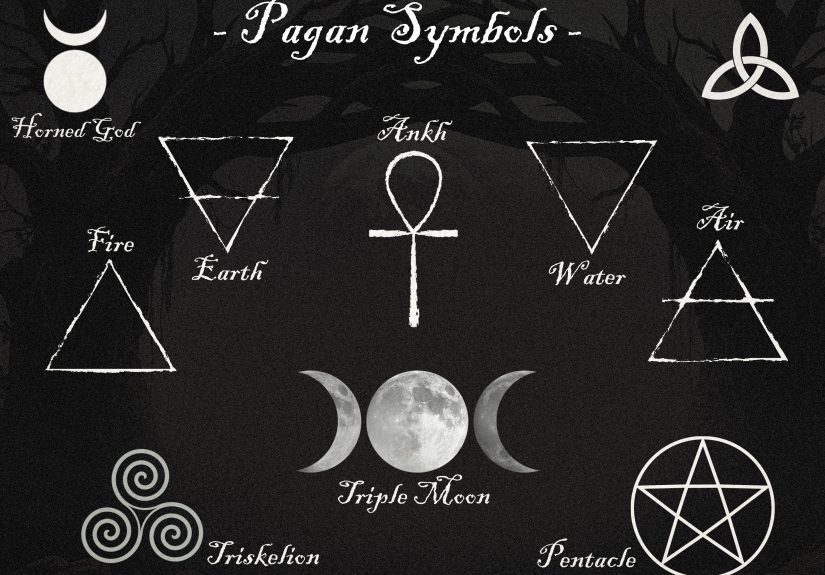
- 1) Pentacle (Pentagram in a Circle)
- 2) Triple Moon
- 3) Goddess Symbol (Crescent + Circle + Cross)
- 4) Horned God Symbol (Crescent Horns + Circle)
- 5) Triquetra (Trinity Knot)
- 6) Triskelion (Triple Spiral / Three Legs)
- 7) Celtic Knotwork (Endless Knot)
- 8) Awen (Three Rays)
- 9) Brigid’s Cross
- 10) Green Man
- 11) Tree of Life / World Tree
- 12) Spiral (Single Spiral)
- 13) Labyrinth
- 14) Sun Wheel / Solar Cross
- 15) Wheel of the Year
- 16) Moon Phases (Waxing–Full–Waning)
- 17) Ankh
- 18) Eye of Horus (Wedjat)
- 19) Ouroboros
- 20) Labrys (Double Axe)
- 21) Mjölnir (Thor’s Hammer)
- 22) Valknut (Knot of the Slain)
- 23) Runes (Futhark)
- 24) Vegvísir (Icelandic “Wayfinder” Stave)
- 25) Helm of Awe (Ægishjálmur)
- How to interpret pagan symbols without accidentally starting a debate
- Experiences: How People Actually Encounter Pagan Symbols Today (and What It Feels Like)
- Conclusion
- SEO Tags
Pagan symbols are kind of like spiritual emojis: tiny shapes that carry big ideasnature, cycles, gods and goddesses, protection, transformation, and the
occasional “please don’t touch my crystals without asking” vibe. The tricky part is that many of these symbols are older than the word “pagan” itself,
and plenty of them show up across multiple cultures, centuries, and religions. So the meaning is rarely one-size-fits-all.
In this guide, you’ll find 25 common pagan symbols and what they generally mean todayespecially in modern Paganism (like Wicca, Druidry, Heathenry, and
other nature-centered paths). I’ll also flag where symbols overlap with other traditions, and why context matters (because sometimes a symbol is “ancient sun
sign,” and sometimes it’s “internet comment section warning label”).
A quick “read this first” note on meaning
- Pagan is an umbrella term. Some symbols are Wiccan, some Celtic, some Norse, some Greek, some Egyptian, and some are used across many paths.
- Same symbol, different intent. Jewelry, tattoos, art, altars, and historical artifacts can signal different things depending on the person using it.
- Misuse and appropriation exist. A handful of symbols (especially some runes and certain geometric motifs) have been co-opted by extremist groups. That doesn’t erase their older meaningsbut it does mean you should look at context carefully.
25 Common Pagan Symbols and What They Mean
1) Pentacle (Pentagram in a Circle)
The pentacle is a five-pointed star (pentagram) enclosed in a circle. In many modern pagan traditionsespecially Wiccait’s linked to the five elements:
earth, air, fire, water, and spirit. The circle is often read as unity, wholeness, and protection. It’s also one of the most recognized symbols of modern
witchcraft and Pagan identity, which means it’s frequently worn as jewelrysometimes quietly, sometimes like a neon sign that says “Yes, I brought my own tea.”
2) Triple Moon
The Triple Moon symbol shows a waxing crescent, full moon, and waning crescent. It’s commonly associated with the Goddess in many Wiccan and neopagan
traditions and often represents the Moon’s cyclegrowth, fullness, releaseand the idea that change is sacred, not suspicious. It’s popular on altar cloths,
pendants, and book covers because it’s instantly readable: moon energy, but make it timeless.
3) Goddess Symbol (Crescent + Circle + Cross)
This symboloften a crescent on top of a circle above a crossshows up in modern Paganism as a shorthand for the Divine Feminine, the Goddess, or the sacred
in nature. People interpret it in different ways: the crescent as lunar mystery, the circle as wholeness, and the cross as the physical world (or the four
directions/elements). It’s also used as a general emblem for women’s spirituality, so you’ll see it beyond strictly pagan contexts.
4) Horned God Symbol (Crescent Horns + Circle)
The Horned God symbol is typically a circle topped with a crescent (resembling horns). In Wicca and related paths, it’s used to represent the masculine
divineoften tied to wild nature, the cycle of seasons, animals, forests, and vitality. It’s not about “scary horns”; it’s more “the woods are alive and
you’re a guest here.” Many practitioners pair it with Goddess imagery to emphasize balance rather than a hierarchy.
5) Triquetra (Trinity Knot)
The triquetra is a three-looped knot form that appears in early medieval art and later becomes widely used in Celtic-inspired symbolism. In modern pagan
settings, it often stands for “three-in-one” ideas: land/sea/sky, mind/body/spirit, or the Triple Goddess. It’s a favorite because it communicates a layered,
interconnected realityno single strand exists alone.
6) Triskelion (Triple Spiral / Three Legs)
The triskelion is a threefold motifsometimes a triple spiral, sometimes three bent legs radiating from a center. It appears in ancient European art and is
often connected (in modern usage) to motion, transformation, and cycles that keep cycling whether you’re ready or not. Many pagans read it as the three
realms (land, sea, sky) or the flow of life-death-rebirth. In other words: change is the point, not the side quest.
7) Celtic Knotwork (Endless Knot)
Celtic knot patterns weave lines with no clear beginning or end. In modern Pagan and Celtic-inspired spirituality, they commonly symbolize eternity, the
interconnectedness of life, and the idea that all things are bound togetherpeople, ancestors, land, and time. Knotwork is also popular simply because it’s
beautiful, and “beautiful” is a perfectly valid spiritual reason to put something on your wall.
8) Awen (Three Rays)
Awen is a modern Druidic symbol often shown as three rays (sometimes with three dots), frequently enclosed by circles. It’s commonly interpreted as
inspiration, illumination, and spiritual insight. Different Druid groups explain it differentlyearth/sea/sky, body/mind/spirit, love/wisdom/truthso it’s
less a single definition and more a “choose the triad that speaks to you” kind of symbol.
9) Brigid’s Cross
Brigid’s Cross is traditionally woven from rushes or straw. While strongly associated with Saint Brigid in Christian Ireland, it’s also connected (especially
in modern pagan contexts) to Imbolc and themes like protection, home blessings, and the turning of winter toward spring. It’s a great example of how symbols
can move between cultures and faithssometimes blending, sometimes transformingwithout losing their role as meaningful tradition.
10) Green Man
The Green Man is a foliate facehuman features surrounded by leaves and vinesseen in European art and architecture. Modern Pagans often use it as a symbol
of nature’s renewal, vegetation, and seasonal rebirth. It’s also a reminder that “wild” isn’t the opposite of “sacred.” Sometimes wild is the sacred. Mud on
your shoes optional (but likely).
11) Tree of Life / World Tree
The Tree of Life (or World Tree) appears across many cultures as a symbol of connection: roots in the underworld, trunk in the living world, branches in the
heavens. In Norse contexts it’s often linked to Yggdrasil; in broader pagan usage it represents ancestry, growth, balance, and the idea that life is layered.
It’s popular in jewelry and tattoos because it reads as both spiritual and groundedliterally.
12) Spiral (Single Spiral)
The spiral is one of the oldest human symbols, and in pagan contexts it typically represents growth, evolution, the unfolding of life, and the “not a
straight line” nature of healing and learning. A spiral can also suggest the journey inward (reflection) and outward (expression). If you’ve ever improved
as a person and then immediately backslid for two weeks, congratulationsyou understand the spiral.
13) Labyrinth
Labyrinths show up in ancient stories and sacred architecture, and modern pagans often use them as symbols of spiritual journey, contemplation, and
transformation. Unlike a maze, a labyrinth traditionally has one main pathmeaning the “point” is not winning against the walls, but walking the path with
intention. It’s a symbol that pairs nicely with the idea that the journey itself is the ritual.
14) Sun Wheel / Solar Cross
The Sun Wheel (often a circle with a cross inside) is commonly read as the sun, the four seasons, and the turning of the year. In modern Paganism it can
represent solar energy, life force, and the cyclical nature of time. Because similar designs appear in multiple cultures, it’s best understood as a broad
seasonal/solar emblem rather than a symbol belonging to a single tradition.
15) Wheel of the Year
The Wheel of the Year is a modern Pagan concept often illustrated as a circle divided into eight seasonal festivals (the sabbats): solstices, equinoxes, and
cross-quarter days. As a symbol, it represents sacred timenature as a calendar, and the year as a living cycle. Many people use it as a planning tool too,
because spirituality is lovely, but so is remembering what month it is.
16) Moon Phases (Waxing–Full–Waning)
Beyond the Triple Moon emblem, the full sequence of moon phases is widely used in modern Paganism as a symbol of natural rhythm: intention, growth, peak,
release, rest. It’s common on calendars, artwork, and jewelry. Some people relate it to personal cyclesenergy, creativity, mood, and recoverybecause
spirituality often starts with noticing what your life is already doing.
17) Ankh
The ankh is an ancient Egyptian symbol often translated as “life.” In modern Pagan and eclectic spiritual spacesespecially Kemetic-inspired practiceit’s
used to represent life force, vitality, and spiritual continuity. You’ll see it in amulets and art because it’s instantly recognizable and historically tied
to ideas of life and enduring power.
18) Eye of Horus (Wedjat)
The Eye of Horus is an ancient Egyptian symbol associated with protection, healing, and restoration. In modern pagan use, it often functions as a protective
emblemsomething like a spiritual “keep out” sign for bad vibes. Historically, it appears in amulets and funerary contexts, reinforcing its connection with
safeguarding and wholeness.
19) Ouroboros
Ouroboros is the serpent (or dragon) eating its own taila symbol that appears in ancient and later esoteric traditions. It’s often interpreted as eternal
cycles: life, death, rebirth; unity; transformation; and the idea that endings feed beginnings. If the Wheel of the Year is the seasonal calendar, Ouroboros
is the cosmic mic drop: nothing truly disappears, it just changes form.
20) Labrys (Double Axe)
The labrys is a double-headed axe associated with the ancient Aegean world and later adopted in modern contexts with varied meanings. In some modern pagan
or goddess-centered spirituality, it can symbolize power, sovereignty, and sacred authority. Like many ancient symbols, it has multiple layers depending on
the cultural lensso it’s wise to treat it as historically rich rather than single-definition.
21) Mjölnir (Thor’s Hammer)
Mjölnir, Thor’s hammer, is a well-known symbol in modern Heathenry and Norse-inspired practice. It’s commonly worn as a sign of protection, devotion, and
connection to Thor’s role as a defender. It can also represent strength and consecration. Because some extremist groups have tried to co-opt Norse imagery,
context mattersmany Heathens explicitly reject racist interpretations and emphasize the symbol’s religious meaning.
22) Valknut (Knot of the Slain)
The valknut is a motif of three interlocking triangles associated with Norse contexts and often linked (in modern interpretation) to Odin and the slain in
battle. Today it’s used by some Heathens as a religious symbol, but it has also been used by some white supremacist groups. That overlap doesn’t define the
symbol, but it does mean you should read it with care and consider surrounding cues (who’s using it, where, and alongside what).
23) Runes (Futhark)
Runes are letters from early Germanic alphabets (futharks) used across northern Europe for inscriptions. Modern pagans and Heathens may use them as symbols
connected to language, heritage, magic, or divination. Individual runes are often assigned meanings (like “journey,” “gift,” “protection”), but those
interpretations vary by tradition. As with other ancient symbols, some runic forms have been misused by extremistsso context is essential.
24) Vegvísir (Icelandic “Wayfinder” Stave)
Vegvísir is often called a “Viking compass,” but the best historical evidence places it in later Icelandic magical tradition rather than the Viking Age.
Modern pagans and folklore fans use it as a symbol of guidancefinding your way through storms, literal or metaphorical. It’s especially popular in tattoos,
which makes sense: nothing says “I will not be lost” like permanently committing that statement to your skin.
25) Helm of Awe (Ægishjálmur)
The Helm of Awe is another Icelandic magical stave associated with protection and intimidation (in the sense of “warding off threats”). It’s also referenced
as a legendary object in Norse saga tradition, though the familiar stave designs are later. In modern use, it’s often worn or displayed as a protective
symbolless “helmet,” more “please don’t mess with me, spiritually.”
How to interpret pagan symbols without accidentally starting a debate
If you want to understand a symbol respectfully, try three simple steps:
- Ask “which tradition?” A pentacle in Wicca is different from a pentagram in medieval ceremonial magic, and different again from pop-culture horror tropes.
- Ask “who’s using it, and how?” The same symbol can appear in a museum, a tattoo, a festival banner, or a hate group’s propaganda. Context changes meaning.
- Don’t assume one symbol equals one belief. Many modern pagans are eclectic, blending inspiration from multiple pantheons, cultures, and practices.
One more important note: some ancient symbols have been violently rebranded by modern extremist movementsmost famously the swastika in a Nazi context.
That symbol has older histories in multiple cultures, but in much of the modern Western world it’s widely recognized as a hate symbol. When in doubt, prioritize
harm reduction: be thoughtful about what you display, where, and why.
Experiences: How People Actually Encounter Pagan Symbols Today (and What It Feels Like)
For many people, pagan symbols aren’t first discovered in a textbookthey’re stumbled upon in everyday life. Maybe it’s a small pentacle pendant at a thrift
store, tucked between a broken watch and a suspiciously optimistic “Live Laugh Love” sign. Maybe it’s a triquetra carved on a piece of Celtic-inspired jewelry,
or a triple moon printed on a notebook at a bookstore. The first experience is often less “mystical thunderclap” and more “Wait… what is that symbol? It feels familiar.”
A common next step is noticing how differently people use symbols. At a modern Pagan festival, you might see the Wheel of the Year displayed as a practical
seasonal mapsomething to orient celebrations around the land’s rhythms. In a museum, you might see an ankh or Eye of Horus as an artifact tied to ancient
beliefs about life, protection, and the afterlife. Online, you’ll see the same imagery turned into identity markers: “This is my path,” “These are my gods,”
or simply “This is the kind of beauty that makes me feel connected to something bigger.”
People also experience these symbols emotionallysometimes unexpectedly. The Tree of Life can feel comforting for someone grieving, because it visually holds
the idea that roots (ancestors, memory, history) still feed what’s living now. Spirals and labyrinths often resonate with people who are trying to make sense
of personal change, because they don’t promise a straight line. They promise movement. And for someone healing from burnout or anxiety, a moon-phase motif can
feel like permission: it’s normal to have seasons of energy and seasons of rest.
There’s also the experience of learning the “context layer,” which can be sobering. Many people discover that some Norse symbols and some rune imagery have
been co-opted by extremist groups. That can create a weird emotional split: you want to honor history or spirituality, but you also don’t want to be mistaken
for someone broadcasting hate. In real life, this often leads to more careful choicespairing symbols with clear inclusive messaging, choosing designs with
strong cultural/historical grounding, or simply being ready to explain, “This is religious for me, and I reject racist uses of it.”
Over time, many people settle into a calmer relationship with symbols. The initial “What does this mean?” becomes “What does this mean to meand how do I
use it respectfully?” A symbol might become a daily reminderlike a pentacle that says, “Stay balanced,” or an ouroboros that says, “Endings aren’t failures.”
And sometimes the most honest experience is delight: you find a symbol that makes you feel at home in the world, and you realize spirituality can be both
serious and joyful. Sacred doesn’t have to be grim. Sacred can have a little sparkle.
Conclusion
Pagan symbols carry storiesabout nature, cycles, deities, protection, and transformation. The same design can travel through centuries and still feel
personal today, which is part of the magic: these symbols are old enough to be historical, but flexible enough to be lived. If you take one thing away,
let it be this: symbols are best understood with context, curiosity, and a little humility. (And maybe a bookmarked glossary. No shame.)





 Close
Close