
Table of Contents >> Show >> Hide
A small kitchen is basically a magic trick: it can make one cutting board, a toaster, and a single banana
look like an entire yard sale. But “small” doesn’t have to mean “claustrophobic.” Designers use a handful
of repeatable visual strategieslight, continuity, clean lines, smart storage, and a sprinkle of reflective
wizardryto make compact kitchens feel open, calm, and (dare I say) a little fancy.
Below are 22 designer-approved ways to make a small kitchen look biggerwhether you’re working with a galley,
a one-wall kitchenette, or the beloved “why is the fridge blocking the drawer?” layout. Most ideas are weekend
friendly, and even the renovation-level ones come with simpler alternatives.
Start With What Your Eyes Notice First
1) Use a light, low-contrast color palette
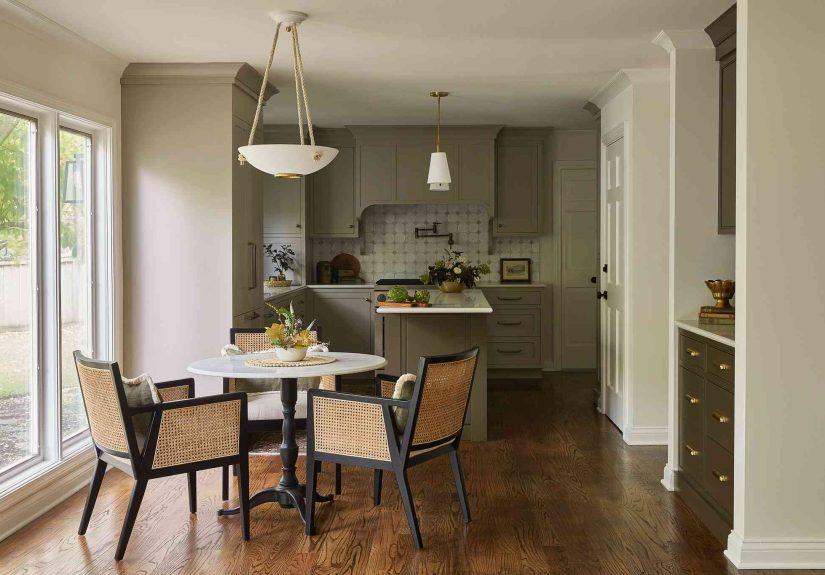
High contrast chops a small room into visual pieces. Light colors (warm whites, soft greiges, pale putty tones,
gentle blue-greens) reflect more light and blur edges, so the room reads as one continuous space.
Try this: keep walls, cabinets, and major surfaces within the same “family” of tones, then add
personality through hardware, art, or a single accent.
2) Color-drench for seamless boundaries
Painting walls and cabinetry the same shade reduces visual breaksyour eye stops tracking where one surface ends
and another begins. The result: fewer “borders,” more openness.
Try this: choose one soft neutral (or a muted color) and apply it to walls and cabinets, then
vary sheen (eggshell on walls, satin on cabinets) for depth without contrast.
3) Match the ceiling to the walls (or go one shade lighter)
A stark white ceiling over darker walls can create a hard “lid” effect. When the ceiling blends with the walls,
the room feels taller and less boxed-in.
Try this: paint the ceiling the same color as the wallsespecially in kitchens with lots of upper
cabinets or tight corners.
4) Choose finishes that bounce light
Gloss, glaze, and gently reflective surfaces brighten a small kitchen by redistributing light.
Try this: consider a glossy backsplash tile, satin cabinet paint, or a polished stone look
countertop (even some laminates do the trick without the price tag).
5) Add a mirrored or reflective backsplash (yes, really)
Designers love mirrors in small kitchens because they create depth and amplify lightespecially in narrow or
window-challenged spaces. A mirrored backsplash can make a wall “disappear.”
Try this: antique-mirror tile for a softer look, or a single mirrored panel behind open shelves
if you want reflection without a full commitment.
Make Light Do the Heavy Lifting
6) Layer your lighting like a pro
One ceiling fixture creates shadows; shadows shrink rooms. Layered lighting (ambient + task + accent) makes a
small kitchen feel airy and intentional.
Try this: a flush-mount or recessed lights for general illumination, under-cabinet lights for
counters, and a small sconce or two for warmth.
7) Install under-cabinet lighting to erase “cave counters”
Under-cabinet lighting removes the dark band that forms beneath uppersone of the biggest “small kitchen”
giveaways.
Try this: plug-in LED strips if you’re renting; hardwired LED tape if you want a clean, permanent
look.
8) Keep window treatments minimal (or strategically high)
Blocking natural light is like turning down the volume on “spacious.” If privacy is needed, go for treatments
that disappear.
Try this: a simple Roman shade mounted above the window frame, or sheer café curtains that still
let light in.
9) Use consistent bulb temperature
Mixed lighting temperatures (one yellow bulb, one icy LED) can make a small kitchen feel busy and uneven.
Try this: keep bulbs in the same warm-to-neutral range so the room looks cohesive and calm.
Reduce Visual Clutter Without Living Like a Monk
10) Clear the counters (strategically)
Countertop clutter shrinks perceived workspace and makes the room feel jammed, even if the layout is fine.
Try this: leave only your “daily drivers” out (coffee maker, knife blockmaybe). Everything else
gets a home behind doors, in drawers, or in an appliance garage.
11) Choose fewer, simpler countertop accessories
Ten small items read as chaos; two larger, intentional pieces read as design.
Try this: one attractive tray near the stove for oils/salt, one crock for utensils, and that’s it.
Bonus: it’s easier to wipe down.
12) Keep cabinet hardware uniform and streamlined
Mixed knobs and pulls can create visual “noise,” especially in tight spaces where cabinets dominate the view.
Try this: pick one style and finish for the whole kitchen; consider slim pulls to keep lines clean.
13) Hide the “small stuff” with an appliance garage or tall cabinet
The fastest way to make a small kitchen feel bigger is to make it feel calmer. Tucking away toasters, blenders,
and chargers restores visual breathing room.
Try this: dedicate one lower cabinet with an outlet (or use a pull-out shelf) to store small appliances.
Use Cabinetry and Storage to Create “More Space”
14) Go to the ceiling with at least one storage run
Short cabinets leave a dusty “dead zone” that visually chops the wall height. Full-height cabinetry draws the eye
upward and increases storage (which reduces clutter).
Try this: if replacing cabinets isn’t possible, add a simple soffit or stacked trim to bridge the gap.
15) Add more drawers than doors
Drawers are easier to organize and use, meaning fewer piles on counters. Designers often recommend maximizing drawers
because everything gets a designated spot.
Try this: convert a lower cabinet to deep drawers, or add pull-out organizers so the interior stays tidy.
16) Consider open shelvingcurated, not chaotic
Open shelves can make a small kitchen feel lighter by reducing bulky upper-cabinet mass. But they only work if
you treat them like a display and a storage system.
Try this: limit open shelves to one section, use matching containers, and keep everyday dishes in a neat stack.
17) Use glass-front cabinets (or just one “window” cabinet)
Glass fronts create depthyour eye sees beyond the cabinet face, which reduces heaviness.
Try this: swap fronts on just one or two upper cabinets and store your prettiest everyday items inside.
18) Add toe-kick drawers and narrow pull-outs
Small kitchens thrive on “found space.” Toe-kick drawers store flat items (baking sheets, placemats), while narrow
pull-outs hold spices or cleaning supplies without stealing aisle space.
Try this: look for slim pull-out kits (often 3–9 inches wide) beside the stove or fridge.
Make the Layout Feel Less Tight
19) Choose the right number of cabinets (sometimes fewer is bigger)
More storage is greatuntil uppers overwhelm and the room feels top-heavy. Designers sometimes recommend removing a
section of uppers to create breathing room.
Try this: replace one bank of uppers with open shelves, a ledge, or artthen compensate with better base-cabinet organization.
20) Try a slim peninsula or a “floating” work surface
Counter space helps functionality, but chunky islands can choke circulation. A small peninsula, a narrow mobile cart,
or a wall-mounted drop-leaf can add workspace while keeping the room open.
Try this: aim for a clear walkway so you can move without doing the sideways crab-walk.
21) Use panel-ready or visually integrated appliances
Big contrasting appliances create visual breaks. Panel-ready (or at least similarly finished) appliances make the
kitchen feel calmer and more continuous.
Try this: if panel-ready isn’t in the budget, choose a cohesive finish set and minimize competing colors.
22) Create continuity with flooring and scale
If possible, run the same flooring into adjacent spaces to make the footprint feel larger. Also, avoid tiny busy
patterns that emphasize smallness.
Try this: use large-format floor tile or longer planks laid lengthwise in a galley kitchen; keep rugs simple and correctly sized.
Pull It Together
The “bigger kitchen” look is less about one magic product and more about a consistent story: fewer visual stops, more
light, calmer surfaces, and storage that keeps daily life from exploding across your counters. If you do nothing else,
start with lighting + declutteringthen move to low-contrast color and smarter storage. Your kitchen may still be small,
but it won’t feel small. And your banana can stop living next to the sponge.
Extra: of Real-World Experience (What Usually Works, What Usually Backfires)
If you’ve ever toured an apartment listing and thought, “This kitchen is cute,” only to realize later that “cute” is
realtor code for “you can open the oven OR the dishwasher, but not both,” you’re not alone. In small kitchens, the
difference between “cozy” and “claustrophobic” is often a handful of tiny decisions repeated consistently.
One pattern homeowners mention again and again: the moment under-cabinet lights go in, the kitchen feels like it gains
a foot of width. Not physically, of courseyour walls don’t scoot outward overnight (if they do, please call an engineer,
not a designer). But eliminating the shadow line under upper cabinets removes that cave-like band that makes counters
feel pinched. It also makes mornings easier: you’re not chopping onions in what looks like a noir detective film.
Another common “aha”: the countertop purge. People assume they need more cabinets, when they often need fewer items on
display. The trick isn’t to hide everythingno one wants to live in a kitchen that feels like a museum with a microwave.
It’s to decide what earns countertop real estate. Daily coffee setup? Sure. A blender you use twice a year? It can move
into a cabinet like the rest of us during winter. This is where appliance garages and deep drawers become the unsung heroes:
they make “putting things away” a one-step action, not a 12-step program.
Open shelving is the most misunderstood small-kitchen tool. Done well, it’s airy and beautiful. Done badly, it’s a
public spreadsheet of every mismatched mug you’ve ever received. The experience most people have is this: open shelves
work best when they’re limited (one zone, not the whole kitchen), and when the items are cohesivematching jars, a neat
stack of plates, a couple of wood boards. In other words, “curated,” not “I panicked and put everything up here.”
If you want the openness without the pressure, glass-front cabinets are a forgiving middle ground.
Color is where small kitchens can either glow or get grumpy. Many people fear any color and default to “landlord white,”
then wonder why the space feels flat. Designers often recommend low-contrast schemes rather than “no color at all.”
A warm off-white, a soft mushroom tone, or a muted blue-green can feel spacious and intentionalespecially when walls and
cabinets are close in value. The biggest real-world backfire is harsh contrast: bright white uppers over dark lowers,
plus a busy backsplash, plus three hardware finishes. Each element is fine alone, but together they turn the room into a
visual obstacle course.
Finally, layout fixes don’t always require demolition. A slim rolling cart can replace a too-large island. A drop-leaf
surface can add prep space and disappear after dinner. Swapping bulky pulls for streamlined hardware can make cabinetry
feel lighter. Small kitchens reward “right-sizing” everythinglights, furniture, decor, even the number of items you own.
The best experience people report after these changes isn’t just that the kitchen looks biggerit’s that it feels easier
to live in. And honestly, in a small kitchen, “easy” is the real luxury.






 Close
Close