
Table of Contents >> Show >> Hide
- What “Catalog House” Really Means (And Why It Was a Big Deal)
- Why These Homes Still Hold Up
- 11 Vintage Houses That Came from a Catalog
- How People Bought (and Built) These Houses: The Nuts-and-Bolts Story
- How to Tell If Your House Was a Catalog or Kit Home
- Renovating a Vintage Catalog House Without Ruining the Plot
- of Real-World-Style Experiences Around Catalog Houses
- Conclusion: A Century Later, the Catalog Still Wins
Imagine ordering a whole house the way you order socks: pick a style, circle a model number, mail a form, and wait for delivery.
In the early 1900s, that wasn’t a fever dreamit was a business model. Catalog (and kit) houses turned dream-home shopping
into a mail-order adventure: practical, surprisingly stylish, and engineered to show up as a mountain of parts ready to become
a real address.
This article takes inspiration from Bob Vila’s roundup of vintage catalog houses and expands it into a deeper, more “how it worked”
look at the phenomenonplus why these homes still charm buyers, renovators, and “old-house detectives” today. We’ll walk through
11 standout models (mostly Sears, plus one competitor), explain what made them click with buyers, and share what to look for if
you think your home might have arrived by railcar instead of by moving truck.
What “Catalog House” Really Means (And Why It Was a Big Deal)
A catalog house is exactly what it sounds like: a house promoted and sold through a printed catalog, often with floor plans,
illustrations, options, and pricing. Many were “ready-cut” or “kit” housesmeaning key materials arrived pre-measured (sometimes
pre-cut and labeled), along with instructions. The buyer (or a local contractor) assembled the house on site.
That was revolutionary for a simple reason: it made homebuilding more predictable. Instead of sourcing everything separately,
buyers could purchase a coordinated package designed to go together. It wasn’t magicjust logistics, standardization, and a
strong belief that Americans deserved indoor plumbing and a sensible pantry.
Why the idea took off
- Railroads made nationwide delivery possible (so your future living room could ride in on a boxcar).
- Pre-planned designs reduced guesswork for buyers and builders.
- Style options weren’t boring: bungalows, foursquares, Cape Cods, Tudors, and Colonial-inspired homes were all on the menu.
- “Modern” features sold the dream: closets, built-ins, breakfast nooks, sun porches, and sleeping porches showed up like bonus levels in a video game.
Why These Homes Still Hold Up
Many catalog homes were built during an era when craftsmanship and materials matteredand when “doing it right” was a marketing
strategy, not just a slogan. While not every kit home was luxury-grade, the concept rewarded solid planning: straightforward
framing, efficient layouts, and designs that maximized light and airflow before air conditioning became the boss of everyone’s life.
Another reason they’ve aged well: the styles were timeless. A good foursquare doesn’t care what year it is. It just stands there
being symmetrical and judging your landscaping choices in silence.
11 Vintage Houses That Came from a Catalog
Below are 11 models highlighted in Bob Vila’s feature (with a mix of original catalog details and real-world observations about
why these designs work). Prices mentioned are historical list prices from the eranot adjusted for modern dollars (because then
we’d all start crying into our mortgage calculators).
1) Sears “Lynnhaven”
The Lynnhaven is the kind of home that looks like it’s about to host a lemonade social in 1932and honestly, it still could.
Known for its shingle siding and dramatic peaked entryway, it balanced charm with function.
- Style vibe: Cozy cottage energy with smart curb appeal.
- Layout highlight: A practical plan with clear separation between living spaces and bedrooms.
- Original price point: Listed around 1932 for about $2,300.
Today’s takeaway: If you love a home that feels picturesque without being precious, this is your spirit animal in siding form.
2) Sears “Vallonia”
The Vallonia is proof that “small” doesn’t have to mean “cramped.” Offered in configurations that could range from a simpler plan
to a more expanded version (including a potential second floor), it gave buyers flexibility.
- Signature look: A large porch and a broad dormer with a three-paned window.
- Flexible footprint: Could be laid out for about five or up to eight rooms depending on options.
- Original price point: Offered in 1921 for about $1,465.
Today’s takeaway: If you’ve ever said, “I just want a nice porch and a sensible living room,” congratulationsyou are a Vallonia person.
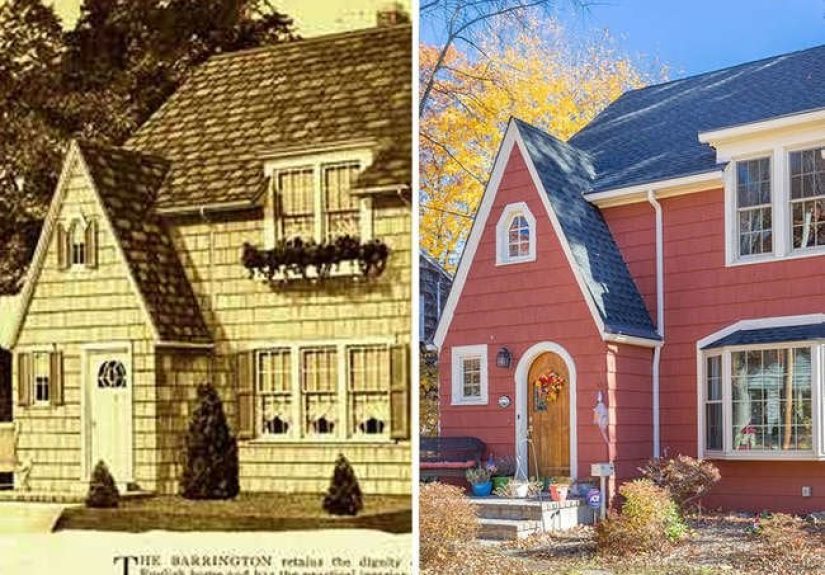
3) Sears “Barrington”
If you want your house to arrive with personality baked in, the Tudor-style Barrington showed up ready to be memorable.
Angular lines, eye-catching windows, and a chimney that looks like it’s auditioning for a storybook.
- Style vibe: Tudor flair without needing an actual moat.
- Fun extras: Period built-ins like a medicine case, telephone cabinet, flower box, and built-in ironing board were part of the appeal.
- Original price point: First listed in 1926 for about $2,329.
Today’s takeaway: This is for people who want charm and don’t mind their house having “main character energy.”
4) Sears “Honor”
The Honor leaned into the “big family, big dreams” market: more rooms, more flexibility, and thoughtful details that made daily
life feel organized instead of chaotic.
- Layout highlight: Nine rooms, including four bedrooms, plus sun and sleeping porch features that made summer livable before AC.
- Quirky genius: Some designs even left space between living room window seats for an upright pianobecause obviously your home needed a piano parking spot.
- Original price point: First listed in 1921 for about $2,747.
Today’s takeaway: If your ideal home includes a place for hobbies, guests, and the occasional dramatic monologue, the Honor delivers.
5) Sears “Crescent”
The Crescent was designed to be affordable and adaptable. Buyers could choose between two floor plan options and even add an attic,
letting the home grow with the household.
- Layout basics: Two bedrooms, living room, kitchen, dining roomplus variations that changed room sizes and porch connections.
- Original price point: First listed in 1921 for about $1,351.
Today’s takeaway: This is the “starter home” concept before starter homes became mythical creatures.
6) Sears “Woodland”
The Woodland is a reminder that early catalog homes weren’t afraid of a little visual weirdness. One of its calling cards is an
unusual arrangement of side windowsplus a wide front porch anchored by sturdy columns.
- Design personality: Slightly unconventional exterior details that keep it interesting.
- Longevity: Introduced in 1916 and remained popular into the 1930s.
- Original price point: First listed in 1916 for about $938.
Today’s takeaway: If you like a home that looks classic but refuses to be boring, Woodland is your match.
7) Sears “Americus”
The Americus aimed for timelessness: a substantial, dignified look meant to “stand out among its neighbors” without feeling trendy.
It’s the architectural equivalent of a well-cut blazer.
- Style vibe: Formal, balanced, and confidently traditional.
- Interior charm: Buyers today often love original trim, moldings, and big windows that feel generous and bright.
- Original price point: Introduced in 1921 for about $1,924.
Today’s takeaway: This is for people who want “classic” without “museum rope barriers.”
8) Sears “Marion”
The Marion arrived later in the catalog-home era (1930s) and wore its bungalow charm proudly. It offered that “floor and a half”
feel: cozy downstairs living with bedrooms tucked above.
- Layout highlight: Five rooms and a bath, with living spaces downstairs and bedrooms upstairs.
- Original price point: First listed in 1933 for about $1,330.
Today’s takeaway: It’s compact in a “cozy and efficient” way, not a “where do I put my elbows?” way.
9) Sears “Milford”
The Milford is a classic Cape Cod-style Colonial with a symmetrical façadeclean, tidy, and easy on the eyes.
It was pitched as tasteful and thoughtfully planned, which is basically what every home listing still says today,
except now it also claims there’s “good vibes.”
- Style vibe: Cape Cod symmetry, simple and charming.
- Options: Offered in two configurations, including a slightly larger plan with a dining alcove.
- Original price point: Introduced in 1933 for about $1,359.
Today’s takeaway: Great for people who want a home that feels welcoming, not showy.
10) Sears “Cornell”
The Cornell is an American Foursquare favorite: economical, relatively straightforward to build, and designed to make the most of
a boxy footprint. If the word “efficient” could wear a nice hat, it would be this house.
- Signature strengths: “Plenty of light” and “good wall space” made it easy to furnish without doing furniture Tetris.
- Original price point: First listed in 1926 for about $1,360.
Today’s takeaway: Foursquares remain popular because the layout just worksthen, now, and probably in the post-apocalypse.
11) Gordon-Van Tine “Home No. 507”
Sears wasn’t the only big player. Gordon-Van Tine, originally a lumber distributor, sold “ready-cut” homes for years and offered
designs that competed directly with Sears models in size and features.
- Layout highlight: A broad front porch, multiple downstairs rooms that could serve as bedrooms, upstairs bedrooms, and even a sewing room in the original plan.
- Original price point: Listed in 1920 for about $2,702.
Today’s takeaway: If you’re researching a suspected “Sears house,” keep an open mindyour home might be a competitor’s kit wearing a Sears-style disguise.
How People Bought (and Built) These Houses: The Nuts-and-Bolts Story
The buying experience was part shopping, part logistics, part leap of faith. You selected a model, chose options, and arranged
delivery. Materials typically arrived by rail, and then were moved to the building site for assembly. The pitch was straightforward:
reduce waste, reduce measuring, speed up construction, and make the outcome match the plan.
It also democratized design. You didn’t need a private architect to get a home with balanced proportions, practical circulation,
and thoughtful features. The catalog did a lot of that thinking for youlike a very polite early-20th-century algorithm.
How to Tell If Your House Was a Catalog or Kit Home
If you suspect your home came from a catalog, you’re not alone. Owners and historians often identify kit homes through a mix of
detective work and lucky finds. Here are the most useful approaches.
1) Look for markings on framing lumber
In many kit homes, framing members and other components were stamped or labeled to guide assembly. Basements and attics often
reveal the most clues because unfinished areas preserve original materials.
2) Hunt for old paperwork (the homeowner “time capsule”)
Shipping labels, order documents, instruction manuals, blueprints, and correspondence can sometimes survive in attics, basements,
or tucked behind renovations. Even a single label can confirm the manufacturer or supplier.
3) Compare your layout to historic catalogs and plan books
Floor plan matching is powerful, especially when combined with details like window placement, porch proportions, stair location,
and chimney position. Be careful, though: many companies sold similar styles, and some plans were widely imitated.
4) Don’t assume “Sears” automatically
Sears was famous, but it had plenty of competition. If your home has kit-home traits, it could be from another manufacturer
(like Gordon-Van Tine, Aladdin, Montgomery Ward, and others). The best identification work uses multiple clues, not just “it looks like a Sears.”
Renovating a Vintage Catalog House Without Ruining the Plot
The goal isn’t to freeze your home in 1921 like a decorative snow globe. It’s to keep the character while upgrading what matters:
safety, comfort, and long-term durability.
Smart updates that respect the original design
- Preserve original trim profiles where possible (or replicate them if you must replace).
- Upgrade wiring and plumbing with modern safety standardsquietly, behind walls and ceilings.
- Restore windows thoughtfully: weatherstripping and storm windows can improve performance without changing the look.
- Keep the layout logic: these homes often flow well. If you open walls, do it because it improves functionnot because you’re allergic to dining rooms.
One of the coolest parts of living in a catalog home is that the house has a “known origin story.” When you renovate, you’re not
just remodelingyou’re editing a chapter in a long-running series. Try not to give it a plot twist nobody asked for.
of Real-World-Style Experiences Around Catalog Houses
People who live in catalog homes often describe the same first surprise: the layouts feel intentional.
Even when the square footage is modest, the rooms tend to land where you want themliving spaces with good daylight, dining areas
that actually fit a table, and bedrooms that don’t require you to climb over furniture like it’s an obstacle course.
That “it just makes sense” feeling is a big part of why these houses keep winning fans a century later.
Another common experience is the treasure-hunt effect. Owners start with a casual curiosity (“Could this be a kit home?”)
and end up in the attic at midnight, flashlight in hand, reading pencil marks on rafters like they’re decoding an ancient scroll.
Sometimes the payoff is dramatican old shipping label, a blueprint, a stamped piece of lumber. Sometimes it’s more subtle:
you match your stair placement and porch columns to a catalog illustration and feel the oddly satisfying thrill of being right.
It’s like genealogy research, but for your hallway.
When it comes to maintenance, many owners report a mix of “wow, they built this well” and “oh right, it’s 100 years old”.
Solid framing and straightforward construction can make repairs more approachable, but time still does its thing. You may find knob-and-tube wiring
that needs modernizing, old plaster that’s both gorgeous and cranky, or insulation that’s… let’s call it “historically accurate.”
The good news is that these homes often reward careful, patient improvements. A properly planned updateelectrical, HVAC, moisture controlcan make
a catalog home feel surprisingly modern without sanding away its personality.
Neighborhood experiences matter too. In some towns, you’ll find clusters of similar modelsalmost like a living showroom spread across a few blocks.
Residents trade notes: “Your porch looks like the Milford!” or “I swear we have the same upstairs hallway.” That shared architecture creates a subtle
sense of community, even if everyone mostly communicates by waving while taking out the trash. And if your home is a recognizable modellike a foursquare
with a classic rooflinelocal history groups may get excited in a very wholesome way. Expect phrases like “original trim!” said with genuine emotion.
Finally, there’s the everyday joy of living in a home with a built-in story. A breakfast nook becomes more than a cornerit’s a reminder of how families
once imagined “modern living.” A sleeping porch (if yours still exists) feels like a time machine to summers before air conditioning. Even small details
built-ins, window seats, old closet layoutscan change how you experience the space. Owners often say the house “teaches” them how to live in it: where the
light falls, how the rooms want to be used, why the porch matters. And that’s the secret sauce. A catalog home isn’t just a structure; it’s a design idea that
proved itself in real life, over generations, one ordinary Tuesday at a time.
Conclusion: A Century Later, the Catalog Still Wins
Catalog houses weren’t just a quirky trendthey were a mass-market solution that delivered style, comfort, and practicality at a time when the idea of
ordering a whole house felt futuristic. The 11 models above show the range: cottage charm, Tudor drama, bungalow coziness, foursquare efficiency, and
competitor designs that remind us Sears didn’t own the whole dream.
If you live in one of these homes, you’re not just maintaining a buildingyou’re preserving a piece of American design history that was engineered to be lived in.
And if you’re shopping for one, you’re choosing a home that has already survived decades of trends, weather, and questionable paint colors. That’s not nostalgia.
That’s a proven track record.







 Close
Close