
Table of Contents >> Show >> Hide
- Why Certain Wallpaper Prints Become “Iconic”
- 1) Toile de Jouy: The Original “Storytime” Wallpaper
- 2) Harlem Toile de Jouy: A Classic Pattern with a Modern Point of View
- 3) Chinoiserie Scenic Panels: When Walls Become a World
- 4) Flocked Damask: Velvet Drama Without the Velvet Budget
- 5) William Morris “Strawberry Thief”: Arts & Crafts, but Make It Legendary
- 6) Jazz Age Art Deco: Geometry with a Side of Glamour
- 7) Atomic Age “Crystals”: Science-Inspired Mid-Century Cool
- 8) Supergraphics Stripes: When Wallpaper Turned into Architecture
- 9) Pop Art Portrait Wallpaper: The “Gallery Wall” That Doesn’t Need Nails
- 10) Scalamandré “Zebras”: Upper East Side Maximalism in Motion
- 11) “Martinique” Banana Leaf: The Wallpaper That Basically Has an Agent
- Final Thoughts: The Secret Life of Wallpaper Icons
- Extra: Real-World Wallpaper Experiences (So You Don’t Learn the Hard Way)
Wallpaper is the closest thing your house has to a personality test. Are you a “quiet linen texture” person? A “giant tropical leaves in the powder room” person? A “my dining room needs zebras” person? (No judgment. In fact, please invite me to that dinner.)
But some wallpaper prints aren’t just prettythey’re iconic. They show up in museums, historic homes, classic hotels, movies, and the kind of interiors people screenshot at 2 a.m. while whispering, “One day.” This guide walks through 11 historic wallpaper patterns that became design legendsplus what makes each one work so well today.
Why Certain Wallpaper Prints Become “Iconic”
A print earns icon status when it does at least one of these things: defines an era (hello, Art Deco), tells a story (toile), flexes craftsmanship (hand-painted scenic panels), or becomes inseparable from a place (the Beverly Hills Hotel banana leaves, for example). The best ones also have a “you can’t unsee it” quality the design equivalent of a catchy chorus.
1) Toile de Jouy: The Original “Storytime” Wallpaper
What it looks like
Classic toile is typically a single-color print on a light ground, filled with pastoral vignettespeople strolling, flirting, farming, or generally living in a world where nobody is late for anything.
The history behind it
Toile de Jouy takes its name from Jouy-en-Josas near Versailles, tied to an influential French textile-printing operation founded in 1760 by Christophe-Philippe Oberkampf. Toile’s engraved, pictorial look made it feel like a rolling illustrationperfect for interiors that wanted narrative, not just decoration.
How to use it now
Use toile when you want a room to feel layered and “collected.” It’s especially good in bedrooms, studies, hallways, and traditional dining rooms. Pair it with crisp paint and modern lighting to keep it from feeling like a period drama set (unless that’s your goalin which case, carry on, Your Grace).
2) Harlem Toile de Jouy: A Classic Pattern with a Modern Point of View
What it looks like
Harlem Toile uses the same toile formatrepeating scenes arranged across the surfacebut swaps the old pastoral fantasies for contemporary vignettes rooted in Black life and culture.
The history behind it
Designed by Sheila Bridges, Harlem Toile became widely recognized as a sharp, design-forward commentary that turns a traditionally aristocratic European pattern into a platform for modern storytelling and satire. It’s proof that wallpaper can be both gorgeous and culturally literatelike a room with a sense of style and a library card.
How to use it now
Let it be the star. One feature wall is often enough, especially in bold colorways. It works beautifully in entryways, powder rooms, and dining rooms where conversation is already on the menu.
3) Chinoiserie Scenic Panels: When Walls Become a World
What it looks like
Lush scenesflowers, birds, figures, gardensoften arranged as large panels that read like murals rather than small repeats. Think “wraparound landscape,” not “tiny motif.”
The history behind it
Hand-painted Chinese papers were produced for export starting in the late 17th century and helped spark a long-running fascination with East Asian-inspired interiors in Europe and America. In the 18th century, Chinese wallpapers became sought-after status symbols, sometimes replacing earlier wall treatments like textiles or leather hangings.
How to use it now
Scenic chinoiserie is best when you treat it like art: limit visual clutter, keep furnishings intentional, and let the room breathe. It’s magic in dining rooms, primary bedrooms, stair halls, and librariesplaces where you want atmosphere more than “matchy-matchy.”
4) Flocked Damask: Velvet Drama Without the Velvet Budget
What it looks like
A damask is a formal, often symmetrical pattern (florals, scrolling leaves, medallions). “Flocked” versions add a raised, fuzzy texture that mimics cut velvet. It’s basically wallpaper wearing a tuxedo.
The history behind it
Flock wallpaper was developed to imitate expensive textiles, traditionally made by applying powdered fibers (historically from the textile industry) onto adhesive in a printed pattern. Damask itself is rooted in historic luxury textiles, and in the wallpaper world it became shorthand for “grand room energy.”
How to use it now
Flocked damask shines in low-light, high-mood spaces: dining rooms, powder rooms, and dramatic bedrooms. Keep the rest of the room relatively restrainedotherwise it can feel like your walls are yelling over your furniture.
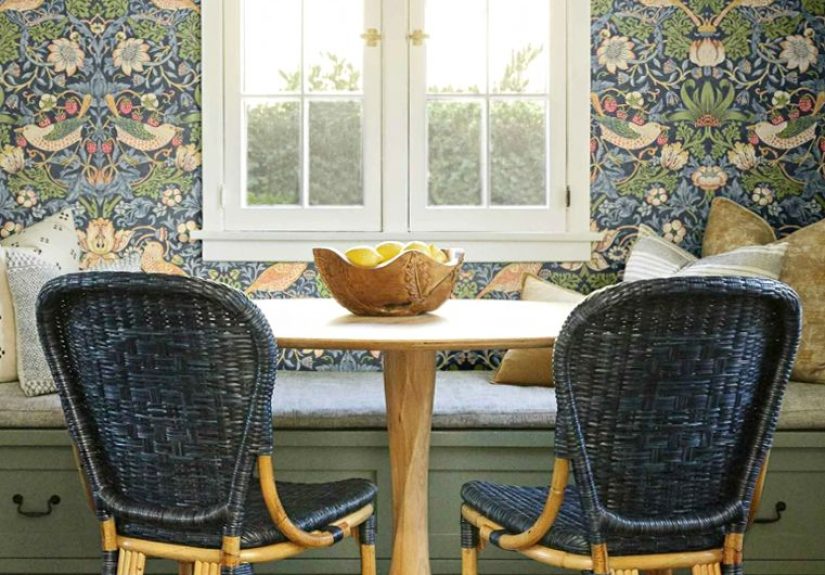
5) William Morris “Strawberry Thief”: Arts & Crafts, but Make It Legendary
What it looks like
Birds (thrushes) darting through dense foliage, stealing strawberriesan all-over pattern that feels alive, busy, and oddly soothing once you stop trying to count the birds.
The history behind it
“Strawberry Thief” was designed by William Morris and registered in 1883, tied to Morris’s larger Arts and Crafts mission: elevate everyday life through beauty, nature, and strong design. The pattern became one of the movement’s most recognizable visuals and has stayed in rotation ever sincebecause it’s both decorative and deeply composed.
How to use it now
This is a great “whole room” wallpaper if you embrace pattern, but it also works as a single statement wall. Pair it with warm woods, matte metals, and simple upholstery so the print feels curated, not chaotic.
6) Jazz Age Art Deco: Geometry with a Side of Glamour
What it looks like
Bold shapes, stylized botanicals, metallic accents, fan motifs, stepped forms, and high-contrast palettes. Art Deco wallpaper doesn’t whisper. It arrives.
The history behind it
Art Deco surged in the 1920s and 1930s alongside modernity, nightlife, and machine-age optimism. Wallpaper designs from the era often used simplified forms, layered silhouettes, and metallic details that played beautifully with low lamplightexactly the vibe you’d want if you were about to serve cocktails with names like “French 75” and “Bad Decisions.”
How to use it now
Try Art Deco prints in foyers, bars, dining rooms, or a bedroom accent wall. Balance them with clean-lined furniture and contemporary art so the room reads “timeless glam,” not “theme party.”
7) Atomic Age “Crystals”: Science-Inspired Mid-Century Cool
What it looks like
Starbursts, boomerangs, orbit-like dots, and crystalline “snowflake” formspatterns that feel futuristic even decades later.
The history behind it
Post–World War II design absorbed scientific imagery, and atomic-age aesthetics became visual shorthand for the future. Some wallpaper patterns drew inspiration from crystallography and geometric structuresturning lab-world diagrams into living-room optimism.
How to use it now
Atomic prints are excellent in kitchens, breakfast nooks, home offices, and playful guest rooms. Keep the palette controlled and let the pattern do the talkingmid-century works best when it’s confident, not cluttered.
8) Supergraphics Stripes: When Wallpaper Turned into Architecture
What it looks like
Oversized stripes, murals, and graphic blocks of coloroften scaled so large they stop reading as “pattern” and start reading as “space-shaping.”
The history behind it
Supergraphics and mural-style wallcoverings surged in the late 1960s and early 1970s, aligning with bold modern interiors. Some mural designs nodded to emerging technology (yes, even barcode-like visuals) and were sized to cover huge spans of wall, turning a room into an immersive environment rather than a decorated box.
How to use it now
Use supergraphics to fix awkward spaces: long hallways, stair landings, basement rec rooms, or any wall that feels like an afterthought. It’s also fantastic for kids’ roomsbecause nothing says “fun” like a wall that looks like it’s moving.
9) Pop Art Portrait Wallpaper: The “Gallery Wall” That Doesn’t Need Nails
What it looks like
Big, bold imagery pulled from celebrity culture, advertising, and graphic artsometimes with reflective or metallic finishes that make the wall itself feel like an object.
The history behind it
Pop art emerged from mid-century consumer culture, and modern wallcoverings have taken that sensibility into wallpaperturning iconic faces and commercial imagery into room-sized statements. Museums and designers have collected and showcased contemporary pop-inspired wallpapers that blur the line between fine art and interior surfaces.
How to use it now
This is best in small doses: a powder room, a dressing area, a bar nook, or an accent wall behind shelving. Add simple lighting and one “quiet” material (like matte tile or warm wood) so the space doesn’t feel like it’s competing with itself.
10) Scalamandré “Zebras”: Upper East Side Maximalism in Motion
What it looks like
Leaping zebras, tiny arrows, and a whole lot of confidence. It’s whimsical, graphic, and impossible to forgetlike a great party guest who leaves before doing anything embarrassing.
The history behind it
The “Zebras” motif traces back to a New York City Italian restaurant on the Upper East Side (Gino of Capri), where a zebra-filled wall became part of the place’s identity. After a 1970s fire, the pattern was recreated and eventually entered the broader design world, becoming one of the most recognizable wallpaper prints associated with classic New York interiors.
How to use it now
Zebras love spaces with humor: powder rooms, bars, entryways, and dining rooms. Keep everything else streamlinedsolid-color trim, simple artso the zebras get to do their little runway show without interruption.
11) “Martinique” Banana Leaf: The Wallpaper That Basically Has an Agent
What it looks like
Sweeping banana leaves layered in a dense tropical arrangement. It’s lush, rhythmic, and instantly reads as “vacation energy,” even if the room contains nothing but a laundry basket and your regrets.
The history behind it
The iconic “Martinique” pattern was created in 1942 for C.W. Stockwell by illustrator Albert Stockdale and later became famously associated with the Beverly Hills Hotel after decorator Don Loper used it during a 1949 renovation. Over time it became a symbol of mid-century tropical glamour and has continued to pop up across fashion, film, and interiors.
How to use it now
Banana leaf wallpaper is surprisingly versatile: go full maximalist in a powder room, or use it in a sunroom with rattan and pale woods. If you’re nervous, start with a single wall. If you’re not nervous, congratulations on your emotional stability.
Final Thoughts: The Secret Life of Wallpaper Icons
Iconic wallpaper patterns survive because they’re more than decorationthey’re visual language. Toile tells stories. Chinoiserie builds worlds. Flocked damask adds texture and drama. Morris brings nature with purpose. Deco and atomic prints bottle entire eras. And prints like Zebras and Martinique prove that a single room can launch a design legend.
If you’re choosing wallpaper today, the best question isn’t “Is this trendy?” It’s: “Will I still want to look at this every dayand will it still make me smile when I’m holding a coffee and questioning all my life choices?” Pick the pattern that makes the answer “yes.”
Extra: Real-World Wallpaper Experiences (So You Don’t Learn the Hard Way)
Wallpaper looks effortless in photos because photos don’t show the part where someone is on a ladder saying, “Why does this repeat hate me?” Here are some practical, experience-based realities designers and homeowners run intoplus how to make your iconic wallpaper dreams feel less like an extreme sport.
First: pattern scale is mood. A classic toile can feel calm or busy depending on how large the scenes are and how tight the repeat is. Large-scale supergraphics and stripes can make a small room feel bigger (or make it feel like you live inside a modern art museum). If you’re unsure, tape up a sample at eye level and then live with it for 48 hours. The truth arrives somewhere between day one (“This is gorgeous!”) and day two (“Why are these birds staring at me?”).
Second: gloss and texture change everything. Flocked damask is dramatic because it catches light differently than flat ink. Metallic Art Deco patterns can look subtle in daytime and suddenly become a whole personality at night. If you’re wallpapering a dining room or bar, test it under evening lighting. Many “too much” patterns become “just right” once the lamps are on and the room shifts into its after-dark self.
Third: historic prints behave differently with modern stuff. That’s not a warningit’s a superpower. Pairing William Morris-style botanicals with clean-lined furniture keeps the room from feeling like a museum diorama. A chinoiserie scenic can look fresh with contemporary art and minimal window treatments. And classic banana leaves can go from “hotel lobby” to “cool modern” when you keep the palette tight and let natural materials do the supporting work.
Fourth: start with the “small-but-mighty” rooms. Powder rooms and entryways are the best training ground for iconic wallpaper prints. They’re short-commitment spaces with huge payoff. Zebras in a powder room? Instant joy. Harlem Toile in an entry? A conversation starter before anyone even takes off their shoes. If you fall in love with wallpaper here, you’ll have the confidence to tackle larger rooms later.
Fifth: prep is the invisible luxury. The most expensive wallpaper looks cheap on bumpy walls. If your goal is “iconic,” treat the wall like a canvas: smooth repairs, clean surface, proper primer, and careful lining up at corners and ceilings. Wallpaper’s magic is precision. (It’s also why many people hire a pro installer for complicated repeatsbecause sometimes self-care is outsourcing.)
Finally: don’t underestimate how wallpaper affects daily life. Toile and botanicals can feel comforting because the eye finds familiar rhythm. Supergraphics can energize a workspace. Pop art can make a room feel playful and bold. If you’re picking an iconic print, choose one that supports how you actually want to feel in the roomnot just how you want it to photograph. The best wallpaper isn’t just a background. It’s a vibe you live inside.







 Close
Close