
Table of Contents >> Show >> Hide
- 1. Qafzeh Cave and the Earliest Hint of Ritual Burial
- 2. The Chinchorro Mummies, Older Than Egypt’s Greatest Hit
- 3. The Gobero Triple Burial in the Sahara
- 4. The Lady of Vix and Her Wagon Burial
- 5. Egypt’s Boat Burials at Abydos
- 6. The Pazyryk Ice Burials of the Altai
- 7. The Griffin Warrior’s Unlooted Grave at Pylos
- 8. The Pachacamac Mummy Bundles With False Heads
- 9. The Flooded Tomb of a Pre-Inca Priestess in Peru
- 10. Giant Amazonian Funerary Urns Hidden in the Floodplain
- What These Unusual Ancient Burials Really Tell Us
- A Modern Reader’s Experience of Ancient Burials
Ancient burials are supposed to be quiet. Archaeology disagrees. The deeper researchers dig, the more the dead seem to say, “Actually, I have notes.” Some graves are packed with gold, horses, boats, or giant jars. Others are astonishing because they feel heartbreakingly human: a hand placed on a child, a body wrapped with care, a burial arranged with symbols that still make sense thousands of years later.
What makes an ancient burial unusual is not just wealth or rarity. It is the way it bends our expectations. We expect the past to be simple, but ancient funerary rituals were anything but. They could be emotional, theatrical, spiritual, political, and deeply personal all at once. A grave might announce power, protect a soul, honor the dead, or send a message to the living. Sometimes it did all four before breakfast.
Below are 10 unusual ancient burials that still fascinate archaeologists and curious readers alike. Together, they reveal a bigger truth: ancient people were just as creative, symbolic, and occasionally dramatic as we are today. They simply had fewer zippers and more grave goods.
1. Qafzeh Cave and the Earliest Hint of Ritual Burial
One of the oldest known intentional burials comes from Qafzeh in present-day Israel, where the remains of early Homo sapiens were found alongside red ocher and ocher-stained tools. That detail matters. Ocher is not the sort of thing that accidentally wanders into a grave on its own. Its presence suggests symbolism, ritual, or at the very least a community that believed burial should mean more than simply placing a body in the ground.
Why it stands out
This burial is unusual because it marks a turning point in human behavior. It hints that people around 100,000 years ago were already thinking about death in symbolic terms. In other words, burial may have become one of humanity’s earliest forms of storytelling. No monument, no marble, no grand speech, just a body, pigment, and meaning.
2. The Chinchorro Mummies, Older Than Egypt’s Greatest Hit
When most people hear the word “mummy,” they picture ancient Egypt, a pharaoh, and enough linen to empty a department store. But the Chinchorro people of what is now northern Chile and southern Peru were practicing artificial mummification thousands of years earlier. Their mummies are among the oldest known human-made mummies in the world.
What makes the Chinchorro burials especially striking is that mummification does not seem to have been reserved only for elites. Archaeologists have found evidence that children, infants, and ordinary members of the community were also preserved. That gives these burials a very different emotional tone from royal tomb culture. They suggest care that was communal, not just hierarchical.
Why it stands out
The Chinchorro changed the body after death instead of simply burying it. That is unusual on its own, but the broader significance is even more fascinating: these ancient coastal communities treated preservation as an expression of social connection. The result is one of the most surprising chapters in the history of ancient burial practices.
3. The Gobero Triple Burial in the Sahara
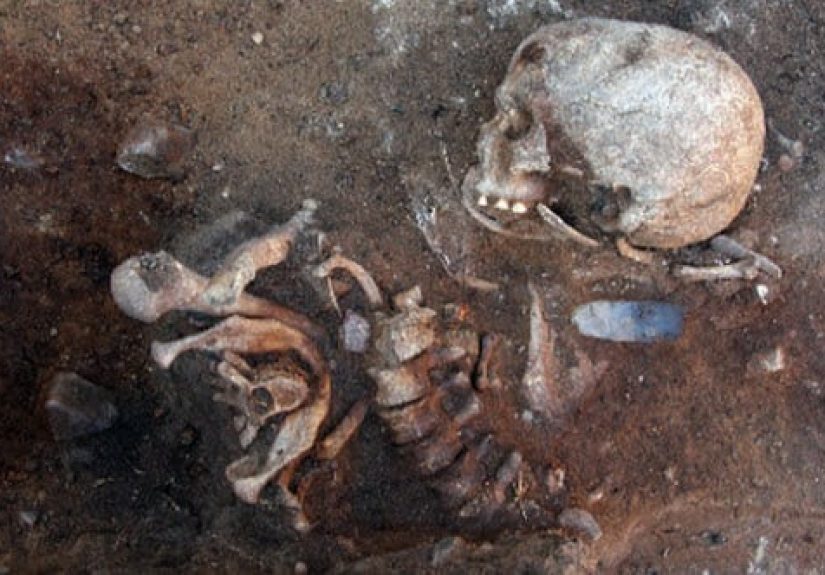
At Gobero in Niger, archaeologists uncovered one of the most moving prehistoric burials ever found: a woman and two children arranged in a close embrace. The positioning is so deliberate that it still feels intimate thousands of years later. One child clung to the other. The woman’s arm curved toward them. Pollen found beneath the bodies suggests flowers may have been part of the burial.
That combination of tenderness and mystery is what makes Gobero unforgettable. The trio appears to have been buried with care, yet the cause of death remains unknown. There is no neat historical label to slap on it and walk away feeling clever.
Why it stands out
This burial feels unusually emotional. Ancient graves often reveal status or ritual, but Gobero reveals affection. It reminds us that prehistoric people were not abstract figures in textbooks. They were families. They grieved. And they arranged their dead in ways that still communicate love across millennia.
4. The Lady of Vix and Her Wagon Burial
In Iron Age Burgundy, archaeologists discovered the grave of an elite woman now known as the Lady of Vix. Buried around 480 B.C., she was laid to rest with an extraordinary collection of goods, including fittings for a funerary wagon and a gigantic Greek bronze krater used for mixing wine. The vessel is enormous, almost absurdly so, which is part of what makes the grave unforgettable.
This was not a modest farewell. It was a full-scale announcement that the person buried here mattered. A lot. The imported luxury goods also show long-distance connections between Celtic Europe and the Mediterranean world.
Why it stands out
The Vix burial challenges old assumptions that prestige burials in Iron Age Europe were mainly male territory. Here, a woman was buried with elite objects on a scale that would make many kings jealous. It is one of the clearest examples of how an ancient tomb could be both a funeral and a political statement.
5. Egypt’s Boat Burials at Abydos
Some ancient Egyptians were not merely buried with jewelry, food, or furniture. They were buried in a funerary landscape that included full-size boats or boat graves. At Abydos, archaeologists have found remarkable evidence of this nautical symbolism tied to royal ideology and the afterlife. In Egypt, the boat was not just transportation. It was cosmology with planks.
The idea makes sense once you step into ancient Egyptian belief. The dead pharaoh was expected to continue a journey beyond life, and boats were powerful symbols of movement, kingship, and divine travel. In a desert setting, that image becomes even more dramatic. A boat in the sand is not practical. It is purposeful.
Why it stands out
Boat burials are unusual because they transform the grave into a vehicle. The burial does not merely hold a body; it stages a voyage. That turns an ancient tomb into a kind of spiritual launchpad, which is both elegant and wonderfully extra.
6. The Pazyryk Ice Burials of the Altai
The Pazyryk burials in the Altai Mountains are some of archaeology’s greatest accidental time capsules. These tombs were built as underground chambers beneath stone mounds. Groundwater entered, then froze, preserving textiles, wooden objects, horse gear, and even tattooed skin in extraordinary condition.
These were not plain graves. They contained richly equipped individuals associated with the wider Scythian world, plus horses buried with elaborate trappings. Because the burials froze, modern researchers have been able to recover details that usually vanish first, like fabric, felt, and body art.
Why it stands out
The Pazyryk tombs are unusual because nature turned them into archives. Most ancient graves lose their soft materials and become skeletons plus durable goods. These burials kept the visual texture of a culture alive. Instead of a whisper, the dead left behind a full wardrobe, travel kit, and design portfolio.
7. The Griffin Warrior’s Unlooted Grave at Pylos
The so-called Griffin Warrior burial in Greece stunned archaeologists because it had escaped looting and was packed with more than a thousand objects. The grave held weapons, jewelry, precious stones, signet rings, cups, and objects linked to both Mycenaean and Minoan traditions. The arrangement of the goods appears deliberate, not random.
That matters because unlooted elite tombs are rare, and this one offers a remarkably clear snapshot of status and cultural exchange in the ancient Aegean. The burial did not just contain wealth. It contained evidence of a world in contact, where art, ritual, and power flowed between communities.
Why it stands out
This tomb is unusual because it feels curated. The objects do not merely say, “This person was important.” They say, “This person belonged to a carefully constructed identity.” Ancient burials often speak through symbolism, and the Griffin Warrior practically shouts through a gold megaphone.
8. The Pachacamac Mummy Bundles With False Heads
At Pachacamac in Peru, archaeologists documented mummy bundles shaped like bales, often topped with false heads made of wood, pottery, or painted materials. The dead were transformed into carefully wrapped forms that were less like a body in a coffin and more like a constructed sacred presence.
That visual choice changes the entire emotional language of burial. Instead of emphasizing the recognizable human face, these burials created a ritual object with a face-like marker. The mummy became part person, part bundle, part ceremonial identity.
Why it stands out
Pachacamac is unusual because the burial treatment reshaped the body into something portable, formal, and symbolically powerful. These were not casual wrappings. They were designed to preserve memory, status, and ritual significance in a very intentional way.
9. The Flooded Tomb of a Pre-Inca Priestess in Peru
One of the most unusual graves ever reported from ancient Peru is a Lambayeque tomb built in a way that allowed part of it to sit below the water table. Archaeologists found a stacked funerary complex, including elite remains and lower, waterlogged burials beneath. In effect, this was a tomb designed to interact with water.
That is an astonishing concept, because water in a grave sounds like a problem until you realize it may have been the point. Researchers connected the design to the ritual and political importance of water in the region. The burial was not simply placed in the landscape. It was engineered to participate in it.
Why it stands out
This tomb is unusual because it turns environment into ritual architecture. It suggests that ancient funerary rituals could be dynamic rather than static. The dead were not just buried beneath the earth; they were positioned inside a symbolic relationship with one of the most powerful forces of life.
10. Giant Amazonian Funerary Urns Hidden in the Floodplain
In the Brazilian Amazon, archaeologists investigating a toppled tree discovered massive funerary urns containing human bones. Some of the urns are enormous, and the broader site sits in a region shaped by ancient Indigenous engineering to manage seasonal flooding. The urns do not neatly match previously known pottery traditions from the area, which makes the discovery even more intriguing.
Burial in urns is already a distinctive funerary tradition, but these examples stand out because of their scale, setting, and mystery. They were hidden in a floodplain, tangled in roots, and only revealed by chance. Archaeology occasionally feels like science. Other times it feels like the forest deciding to spill gossip.
Why it stands out
These Amazon burials are unusual because they combine landscape, craftsmanship, and uncertainty. We do not yet know everything about who made them or exactly how old they are, but the find expands our understanding of ancient funerary rituals in a region where preservation is difficult and discoveries are precious.
What These Unusual Ancient Burials Really Tell Us
The strangest thing about unusual ancient burials is not that they are strange. It is that they are logical within their own worlds. A wagon burial speaks the language of status. A boat grave speaks the language of journey. A mummy bundle speaks the language of continuity. A grave with flowers, ocher, water, horses, or giant urns is not random decoration. It is cultural grammar.
That is why ancient tombs remain so powerful for historians and readers alike. They show what people feared, loved, valued, and hoped for after death. They can reveal trade networks, social rank, religious belief, family bonds, and artistic taste. In short, they are not just about death. They are about how the living made sense of life.
If there is a single lesson in these archaeological finds, it is this: the past was never dull. It was inventive, symbolic, emotional, and occasionally gloriously weird. And thank goodness for that, because “ordinary pile of dirt discovered” would make for a terrible headline.
A Modern Reader’s Experience of Ancient Burials
Reading about ancient burials today can feel strangely personal, even if the sites are thousands of miles away and separated from us by entire civilizations. There is something deeply humbling about standing in a museum gallery, scrolling through excavation photos, or studying an archaeological report and realizing that every one of these graves was once part of a real goodbye. That is the experience that stays with people. Not just the gold, or the mummies, or the mystery, but the recognition that grief is one of humanity’s oldest shared behaviors.
For many readers, unusual ancient burials create a double reaction. First comes curiosity. You want to know why someone was buried with a boat, a wagon, a false head, or a mountain of objects. Then comes empathy. Suddenly the burial is not a puzzle box anymore. It is a family decision, a ritual act, or a community effort to honor someone whose world made perfect sense to them, even if it takes us centuries to decode it.
There is also an oddly cinematic quality to these discoveries. Imagine the emotional impact of seeing the Gobero triple burial for the first time, or the eerie wonder of a frozen Pazyryk chamber opening after centuries in the ice. Picture an archaeologist brushing dirt away from a carefully wrapped bundle at Pachacamac or realizing that a tomb in Peru was intentionally built to flood. These moments remind us that archaeology is not only about measurement and classification. It is also about surprise, restraint, and respect.
Another powerful experience connected to this topic is the way ancient burials force us to rethink our assumptions. Modern people often imagine progress as a straight line, as if older cultures were automatically simpler. But these burials prove otherwise. Ancient societies could build intricate symbolic systems around death, combine engineering with spirituality, and create funerary rituals that were visually sophisticated and emotionally resonant. The more we learn, the less comfortable it becomes to treat the ancient world as primitive background scenery.
There is even a practical, human experience embedded in the act of reading about these graves online today. You may start by searching for “weird ancient tombs” out of pure curiosity, but you often end up thinking about memory, identity, and what people choose to leave behind. Why flowers? Why ocher? Why boats? Why preserve a body so carefully? Those questions do not stay in the past. They circle back to us.
That is why unusual ancient burials continue to fascinate modern audiences. They are mysterious enough to spark wonder, but familiar enough to feel intimate. Beneath the artifacts, the symbolism, and the archaeological jargon, each burial preserves a basic human truth: people have always tried to make death meaningful. And in that sense, these ancient graves are not remote at all. They are mirrors, just buried very, very deep.
Note: This article is based on real historical and archaeological information synthesized for web publication. Source links were intentionally omitted, and unnecessary citation artifacts were removed from the final copy.






 Close
Close