
Table of Contents >> Show >> Hide
- What Is “Higher Lower,” Exactly?
- Why the Screen-Free Design Feels So Fresh
- The Hardware Is Tiny, but the Thought Process Is Not
- Why This Tiny Game Fits a Bigger Trend
- More Than a Gimmick: The Audio Challenge Is Legitimately Interesting
- Minimalist Game Design at Its Best
- The Experience of Playing a Tiny Audio Game in a Very Loud World
- Final Thoughts
Every once in a while, a gadget shows up and politely asks modern technology to calm down. Not forever. Just for a minute. No app store. No account creation. No push notifications. No “premium subscription” for the color blue. Just a tiny machine, a few tones, and one deceptively simple question: was that second sound higher or lower?
That, in a delightfully small nutshell, is the appeal of Higher Lower, a minimal handheld electronic game that proves a screen is not required for something to be clever, addictive, and oddly charming. In fact, the game’s whole personality comes from what it refuses to include. It is screen-free, audio-driven, compact, and built around the idea that the best kind of fun sometimes arrives when the feature list gets a haircut.
In an age where handheld gaming often means giant processors, giant price tags, and menus that look like tax software with better lighting, Higher Lower takes the opposite route. It strips the experience down to tone, touch, memory, and timing. The result feels part toy, part DIY electronics kit, part ear-training exercise, and part retro handheld fever dream. That sounds like a lot for something so minimal, but that tension is exactly why it works.
What Is “Higher Lower,” Exactly?
At its core, Higher Lower is an audio-based handheld game built around musical intervals. Two tones play. Your job is to decide whether the second tone is higher in pitch or lower than the first. That’s it. That’s the whole pitch, literally and figuratively.
And yet the game gets surprisingly rich from that tiny premise. The longer you keep guessing correctly, the harder the challenge becomes. Instead of drowning the player in rules, maps, lore, or twenty-seven button combinations that require the dexterity of a concert pianist, the game leans into a single mechanic and explores it thoroughly. It trusts that one clear idea, executed well, can do more than a messy pile of “features.” That trust is refreshing.
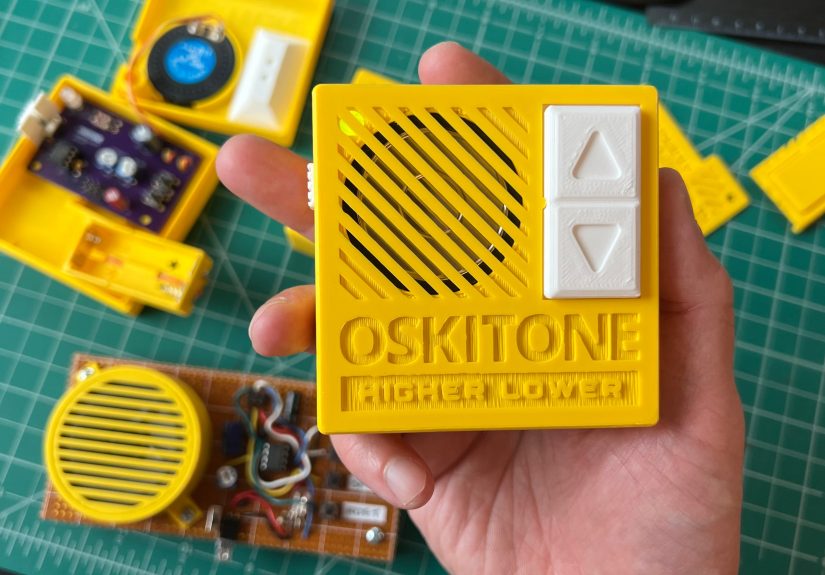
What makes the device even more interesting is how intentionally physical it is. Higher Lower is a handheld electronic game with a 3D-printed enclosure, a rocker-style input, a small speaker, and internal trim pots for volume and difficulty. It is powered by two AAA batteries and built around an ATtiny85V chip, which is a wonderfully humble little brain for a project that seems to enjoy doing more with less. In other words, this thing is not trying to outmuscle your phone. It is trying to out-charm it.
That design choice matters. When you pick up a dedicated handheld game, even a tiny one, you are stepping into a more focused relationship with the object. There is no text message arriving mid-round. No accidental slide into social media. No sudden urge to check the weather in a city you do not live in. The game says, “Listen.” And for once, your brain actually does.
Why the Screen-Free Design Feels So Fresh
Calling a gadget “screen-free” usually sounds like the sort of phrase used in wellness brochures next to a photo of someone holding tea while staring at a mountain. But in this case, the lack of a screen is not a lifestyle gimmick. It is the mechanic. It is the point.
Because Higher Lower relies on sound instead of visuals, it forces the player to interact differently. You are not reading numbers, watching animations, or following icons. You are listening carefully, making a judgment, and committing to it. That means the game lands in a fascinating sweet spot between entertainment and perception. It feels playful, but it also asks your ears to do actual work. Your attention has to sharpen. Your mind has to compare. Your guess has to mean something.
That is part of what makes minimal handheld games memorable. When a game has only one core action, every detail around that action becomes more important: pacing, sound, feedback, difficulty curve, button feel, and even how the object sits in your hand. There is nowhere for weak design to hide. A bloated game can survive on spectacle. A tiny game must survive on quality.
Higher Lower appears to understand that rule completely. Instead of treating audio as a side effect, it treats audio as the full stage. The score is communicated through sound. The challenge is communicated through sound. The mood is communicated through sound. The machine does not apologize for being small. It turns smallness into style.
The Hardware Is Tiny, but the Thought Process Is Not
One of the most charming things about Higher Lower is that it feels handmade without feeling half-baked. There is a difference. Plenty of DIY electronics projects are fun to admire and less fun to actually use. This one seems designed with real care for assembly, playability, and physical interaction.
The 3D-printed shell, custom PCB, and minimalist control scheme give it the personality of a boutique object rather than a throwaway novelty. The rocker button is especially smart because it turns the whole interaction into something tactile and immediate. Up or down. Higher or lower. No clutter, no confusion. Just a satisfying physical answer to a simple audible question.
Even the hidden difficulty and volume controls add to the appeal. They keep the face of the device clean while still letting players tune the experience. That matters because games like this live or die by calibration. Too easy, and it becomes background noise. Too hard, and it becomes a tiny plastic insult machine. The ability to adjust the challenge makes the game more personal, which is a clever move for something so mechanically lean.
There is also something undeniably appealing about a kit that can be assembled in roughly half an hour and remains open to tinkering. For maker-minded players, Higher Lower is not just a finished product. It is an invitation. Build it, understand it, hack it, improve it, or at the very least proudly show it to a friend and say, “Yes, this little square thing is judging my ears now.”
Why This Tiny Game Fits a Bigger Trend
The success of handheld games has never been only about power. Historically, dedicated portable gaming has thrived when it delivered a strong idea in a compact, affordable, easy-to-carry form. Earlier handheld electronic games proved that players did not need sprawling systems to get hooked. Later portables dominated because they balanced content, comfort, battery life, and immediacy.
That history helps explain why a device like Higher Lower feels timely instead of quaint. Today’s retro hardware boom is not just nostalgia for old plastic. It is nostalgia for clarity. People miss objects that do one thing well. They miss buttons that feel like buttons. They miss devices that start quickly and make sense immediately. They miss hardware that has a point of view.
Modern retro-inspired gadgets keep succeeding because they tap into that hunger for tactile, focused play. Some do it with full game libraries and premium screens. Higher Lower does it with tones, a tiny speaker, and an almost stubborn refusal to become more complicated than it needs to be. Honestly, that restraint is kind of heroic.
More Than a Gimmick: The Audio Challenge Is Legitimately Interesting
Here is where the game gets sneakily smart. Distinguishing whether one pitch is higher or lower than another sounds easy until the notes get closer together and your confidence starts sweating. Then the game becomes a miniature battle between instinct and perception.
That is part of what gives Higher Lower staying power. It is not random button-mashing. It leans on pitch discrimination, a real auditory skill connected to how humans process music and sound. The mechanic has educational flavor without becoming educational spinach. You are still playing a game, not taking a quiz disguised as fun by an overenthusiastic committee.
For some players, the game may feel like casual ear training. For others, it will simply feel like a weirdly compelling challenge that makes them say, “Wait, play that again,” even though the machine obviously cannot hear them negotiating. Either way, the design turns listening into action, and that is a neat trick.
It also makes the game more social than you might expect. Because the premise is easy to understand, it invites handoff play. One person makes a guess, passes it over, and suddenly a tiny screen-free gadget has become the center of a room full of competitive squinting and suspiciously confident wrong answers. Multiplayer does not always need split-screen graphics. Sometimes it just needs one question and enough ego in the room.
Minimalist Game Design at Its Best
There is a long-running design truth that constraints can produce stronger ideas than abundance. Higher Lower is practically a case study in that. When you limit the parts, limit the interface, and limit the output, you are forced to make each remaining element count. That pressure can create unusually elegant results.
This is why the game feels bigger than its feature list. It has a small rule set, a narrow decision space, and abstract audiovisual feedback, but those limitations are not weaknesses. They are the source of its identity. The device is not trying to compete with a handheld PC, a phone, or even a classic console. It is creating a tight little world with its own logic and asking whether that world is enjoyable enough on its own. The answer seems to be yes.
In fact, there is something deeply satisfying about a game that knows when to stop. So much modern design is terrified of silence. Every interface wants to sparkle, explain itself, upgrade itself, and recommend three more things before you finish the first one. Higher Lower does not do that. It gives you a tone, a choice, and the consequences. Clean. Direct. Slightly ruthless. Beautiful, really.
The Experience of Playing a Tiny Audio Game in a Very Loud World
Imagine tossing Higher Lower into a bag and pulling it out during one of those awkward in-between moments that usually get sacrificed to doomscrolling. You are waiting for coffee. You are early for a meeting. You are pretending not to notice that your phone battery is hanging on by a thread and your attention span is doing the same. A regular game might ask for ten minutes of setup, a tutorial, and an emotional commitment. This little handheld asks for your ears and one decent thumb.
The first few rounds would probably make you overconfident. “Please,” you would think, “I understand the concept of up and down.” Then the tones get closer. Your certainty gets shakier. Suddenly you are listening harder than expected, tilting the device like that might help, as if gravity personally supervises pitch. It does not, but your brain will absolutely try to negotiate with physics anyway.
That is the sly joy of the experience. The game pulls you into concentration without making a big speech about mindfulness. It becomes absorbing because it is small, not in spite of it. You are not juggling menus, inventory, or map markers. You are just inside a tiny loop of sound, judgment, and consequence. That loop can become surprisingly immersive. One tone. Another tone. Decide. Repeat. Miss. Groan. Start over. Immediately want another round. The cycle is almost musical.
And because the game is physical, the experience feels different from tapping a phone screen. There is a specific pleasure in pressing a dedicated control on a dedicated object. The rocker button gives the whole thing a mechanical honesty. It says exactly what it means: one direction or the other. The enclosure, the batteries, the speaker, the slight toy-like absurdity of the device itself all add character. It is a machine with a point of view, and that gives every correct guess a little more personality.
The social experience is easy to picture too. Someone nearby hears the tones and asks what on earth you are doing. You explain the rules in one sentence. They ask for a turn. Now the game is moving around the room. One friend guesses immediately and gets humbled. Another stares into the middle distance like a concert judge and nails three in a row. Someone insists the machine is wrong. Someone else claims they are “actually very musical,” which is exactly the sort of sentence that tends to be followed by an incorrect answer and a lot of laughter.
That is where Higher Lower feels especially smart: it creates conversation without needing spectacle. It is not loud in the visual sense, and it does not need to be. The fun comes from reaction, from surprise, from the tiny drama of confidence colliding with reality. In a world full of devices trying to become platforms, ecosystems, and lifestyle statements, this one just becomes a moment. A weird, thoughtful, charming moment.
There is also something oddly comforting about the game’s modesty. It does not promise to change your life, optimize your brain, or replace your entertainment stack. It just gives you a focused experience with real tactile charm. That can feel almost luxurious now. Not luxury in the glossy, expensive sense. Luxury in the rare sense. The luxury of a device that knows exactly what it is and never tries to become your entire personality.
So yes, the experience related to Higher Lower is partly about the game itself. But it is also about what happens around it: the concentration, the curiosity, the handoffs, the tiny bursts of competition, and the relief of interacting with a machine that is not trying to harvest every spare second of your attention. It just wants you to listen. That is a small request. These days, it feels almost radical.
Final Thoughts
Higher Lower is the kind of handheld electronic game that looks tiny on a desk but oddly huge in design terms. It takes a microscopic rule set and turns it into something playful, memorable, and refreshingly human. It celebrates sound, constraints, tactility, and the old-fashioned joy of a dedicated gadget doing one thing well.
That is what makes it worth tuning into. This is not a handheld for players chasing horsepower. It is for people who appreciate inventive game design, DIY electronics, retro-inspired hardware, and the thrill of a smart idea executed cleanly. In other words, it is not trying to be everything. It is just trying to be good. That may be the most modern idea in the whole package.
Note: This article is based on real reporting and product documentation. Source links are intentionally omitted for clean web publishing.






 Close
Close