
Table of Contents >> Show >> Hide
- What Is A Road Cat’s Eye?
- The Optical Trick: Retroreflection
- The Self-Cleaning Problem: Roads Are Filthy Places
- How The Classic Self-Cleaning Cat’s Eye Works
- Water: The Unsung Cleaning Fluid
- Modern Road Studs: Not All Self-Clean The Same Way
- Materials That Make The System Durable
- Why Self-Cleaning Matters For Safety
- The Engineering Trade-Offs Nobody Sees
- Specific Examples Of Road Cat’s Eye Engineering In Practice
- Experiences Related To Road Cat’s Eye Self-Cleaning Engineering
- Conclusion: Small Marker, Serious Engineering
- SEO Tags
At first glance, a road cat’s eye looks almost too simple to deserve applause. It sits in the pavement, gets run over thousands of times, spends its evenings being splashed by rainwater, and still manages to wink back at drivers like a tiny highway lighthouse with excellent work ethic. But inside that little reflective road stud is a clever mix of optics, materials science, mechanical movement, drainage, and durability design.
The phrase “road cat’s eye” usually refers to a retroreflective raised pavement marker: a small road safety device that reflects headlight beams back toward drivers. In the United States, these devices are often discussed under broader terms such as raised pavement markers, retroreflective pavement markers, RRPMs, or RPMs. Their job is easy to explain but hard to perfect: make lane lines, curves, medians, ramps, and road edges visible at night, especially when paint alone becomes hard to see in rain, glare, fog, or darkness.
The self-cleaning feature is where the engineering becomes especially charming. The classic cat’s eye design does not rely on someone polishing it with a microfiber cloth at 2 a.m. Instead, it uses passing traffic, flexible materials, water, and carefully positioned reflectors to wipe away dirt. In other words, every passing tire can become part of the cleaning crew. Not bad for a gadget that never asks for overtime.
What Is A Road Cat’s Eye?
A road cat’s eye is a small marker installed on or into the road surface to help drivers understand lane position and roadway alignment. Unlike ordinary paint, it is three-dimensional. It can be seen, felt, and sometimes heard as a vehicle crosses it. That tactile feedback is useful, but its biggest value appears after sunset, when headlights strike the marker and the marker sends light back toward the driver.
Most modern road studs are designed to supplement painted pavement markings rather than replace them entirely. A white marker may support lane separation, a yellow marker may mark a centerline or left edge, and red reflective faces can warn drivers that they are traveling the wrong way. Blue markers are sometimes used to indicate fire hydrant locations. The exact color and placement depend on road rules, agency standards, and the purpose of the installation.
Why Drivers Notice Them So Quickly
Human vision is not equally powerful in every condition. At night, a black road, a wet surface, worn paint, and oncoming glare can turn lane tracking into a guessing game no one asked to play. Retroreflective pavement markers reduce that uncertainty by creating bright points of reference. Instead of depending only on a continuous painted stripe, the driver sees a repeated pattern of shining markers that outlines the roadway ahead.
This is especially valuable on curves, ramps, divided highways, construction zones, rural roads, and high-speed corridors. The marker does not need to flood the road with light. It only needs to return enough light toward the driver’s eyes to say, “Here is the lane; please do not improvise.”
The Optical Trick: Retroreflection
The magic word behind a cat’s eye is retroreflection. A normal mirror reflects light away at an equal and opposite angle. Retroreflective materials behave differently. They return much of the incoming light back toward its source. That is why road markers, traffic signs, and reflective pavement markings seem to glow when hit by headlights.
Inside many road studs are glass lenses, cube-corner reflectors, or microprismatic optical elements. These tiny structures bend and bounce headlight beams so that light travels back toward the vehicle. The driver sees the marker brighten, even though the marker itself does not need batteries, wiring, or a motivational speech.
Glass Beads, Prisms, And Lens Geometry
Different markers use different optical systems. Some older or classic designs use glass elements. Many modern raised pavement markers use prismatic lenses, which are engineered with small geometric surfaces that redirect light efficiently. The shape, angle, clarity, and durability of the lens all matter. If the optical face is scratched, muddy, cracked, or submerged in water without proper design, brightness drops.
This is why lens engineering is not just about sparkle. It is about maintaining performance under abuse. A road marker must reflect at shallow headlight angles, survive tire pressure, resist sand abrasion, handle temperature changes, and remain visible when rainwater turns the road into a low-budget mirror maze.
The Self-Cleaning Problem: Roads Are Filthy Places
Roads are not exactly spa environments. A pavement marker sits among dust, oil mist, brake particles, tire rubber, sand, salt, mud, rainwater, leaves, and the occasional mystery substance no one wants to identify. If reflective faces become coated, the marker loses brightness. A dirty cat’s eye is still a cat’s eye, but it becomes more of a sleepy kitten.
Traditional paint has its own visibility problems. Pavement markings wear down under traffic, lose retroreflective particles, and can become hard to see when water covers them. Raised pavement markers add height, optical surfaces, and a physical profile that improves visibility. But because they stick up or sit in a housing, they also collect grime. The self-cleaning mechanism was designed to fight that exact weakness.
How The Classic Self-Cleaning Cat’s Eye Works
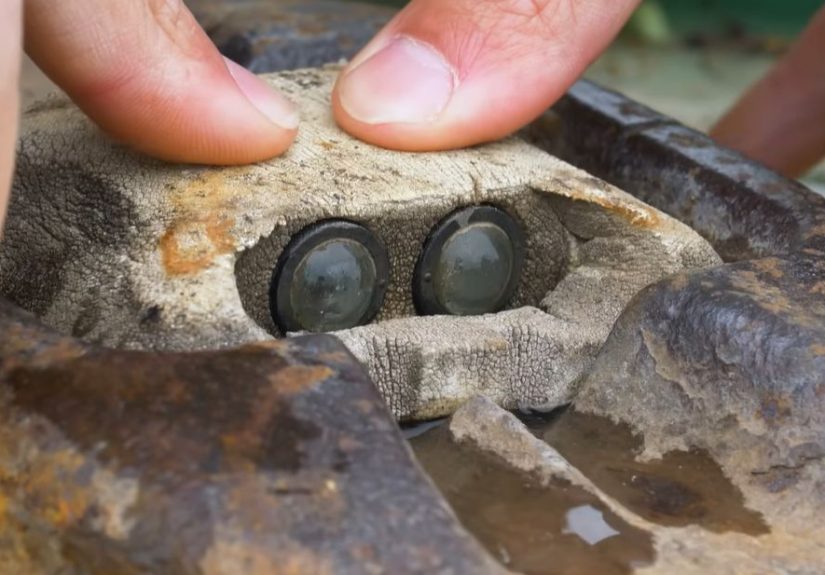
The classic self-cleaning cat’s eye is beautifully mechanical. It uses a rubber insert that holds reflective lenses inside a metal or cast housing. When a vehicle tire passes over the marker, the rubber insert compresses downward. As it moves, the reflective lenses pass against a fixed wiping edge. That wiping motion scrapes away dirt, grit, and water film from the optical surface.
Rain improves the action. Water collected around the marker softens and loosens dirt, turning the wiping motion into a mini car wash. The road does not need a maintenance crew to scrub each reflector by hand. The marker is designed so normal traffic loads repeatedly trigger the cleaning cycle.
Compression: The Tiny Suspension System
The flexible rubber body acts like a miniature suspension system. It must be soft enough to deform under tire load, yet tough enough to rebound afterward. If it is too stiff, it will not wipe effectively. If it is too soft, it may deform too much, wear quickly, or fail to hold the lenses at the correct angle.
Engineers must balance elasticity, fatigue resistance, weathering, and grip. The rubber has to tolerate heat, cold, water, oil, and continuous compression. Every tire impact is a small mechanical event. Multiply that by thousands or millions of vehicles, and the material suddenly needs the patience of a saint and the toughness of a hockey puck.
The Wiper Edge: Simple, But Not Random
The fixed wiper edge in a self-cleaning cat’s eye is positioned so that the reflector moves past it during compression. This creates contact across the lens face. The goal is not to grind the reflector aggressively; that would scratch the optical surface. The goal is controlled wiping: firm enough to remove grime, gentle enough to preserve clarity.
That is the quiet genius of the design. It converts a problemvehicles constantly running over the deviceinto the solution. Instead of traffic destroying the marker, traffic helps maintain it.
Water: The Unsung Cleaning Fluid
Rain is usually bad news for road visibility. Wet pavement can reduce contrast, scatter light, and hide painted lines. But in a classic self-cleaning cat’s eye, water can become helpful. A small amount of water around the insert loosens debris and supports the wiping motion. The reflector is not merely being rubbed dry; it is often being washed and wiped at the same time.
This does not mean flooding is good. Poor drainage can cover or obscure a marker. However, controlled water exposure can help carry away dust and fine particles. The best designs manage the relationship between water and visibility rather than pretending rain will politely stay out of the road’s business.
Modern Road Studs: Not All Self-Clean The Same Way
Not every raised pavement marker uses the classic compress-and-wipe mechanism. Many U.S. installations use durable plastic or ceramic-bodied markers bonded to asphalt or concrete. These often rely on abrasion-resistant lenses, wet retroreflective optics, sloped surfaces, tire contact, and rain wash-off rather than an internal moving rubber insert.
Modern markers may be designed with hard-coated lenses that resist scratching from dust, sand, and tires. Some are engineered to keep reflecting even when wet. Others are placed in recessed pockets or protected castings so snowplows do not shear them off. In areas with heavy snow removal, the marker may need to hide below the plow blade line like a sensible little turtle.
Raised, Recessed, And Snowplowable Designs
Road agencies choose marker designs based on climate, traffic, pavement type, maintenance budget, and safety goals. A simple surface-mounted marker may work well in warm regions where snowplows are not a major concern. In snowy regions, a raised marker can be damaged by plow blades. The answer is often a recessed or snowplowable marker, installed in a groove or protected housing.
Recessed markers reduce exposure to plows and direct tire impacts, but they also introduce new challenges. The recess must drain properly, remain free of packed debris, and hold the marker at the correct optical angle. If the marker is too low or the slot fills with dirt, visibility suffers. Engineering is rarely about finding one perfect solution. It is more often about choosing the least annoying compromise.
Materials That Make The System Durable
A road cat’s eye needs to be small, bright, tough, weather-resistant, and affordable enough to install in large numbers. That is a demanding job description for an object shorter than many candy bars.
The housing may be metal, ceramic, or high-impact plastic. The optical face may use glass or prismatic polymer. The adhesive may be epoxy, bituminous material, pressure-sensitive adhesive, or another approved bonding system. In snowplowable systems, a cast iron or steel housing may protect the reflector. Each material has a job, and each job involves punishment.
Impact Resistance
Vehicles do not gently pat road markers. They strike them at speed with heavy tires, sometimes under braking, turning, or wet conditions. The marker must resist crushing, cracking, and dislodging. High-impact plastics and protected housings help absorb and distribute forces.
Abrasion Resistance
Sand and grit act like sandpaper. Over time, they can dull reflective lenses. Abrasion-resistant coatings help preserve optical clarity. This is especially important because a marker can remain physically attached while becoming optically useless. A road safety device that is still present but no longer visible is like a flashlight with dead batteries: technically there, emotionally disappointing.
Adhesion To Pavement
A marker is only useful if it stays where engineers put it. Adhesive selection depends on pavement type, surface preparation, weather, and traffic load. The road surface usually must be clean and dry during installation. Poor bonding can lead to loose markers, missing reflectors, or road debris. Good installation is part of the engineering, not an afterthought.
Why Self-Cleaning Matters For Safety
The self-cleaning concept matters because visibility is not a one-day achievement. A brand-new marker can look fantastic during inspection. The real question is whether it remains visible after months of traffic, storms, dust, and temperature swings. The road does not care about brochure photos. Drivers need performance on ordinary Tuesday nights when rain is falling and the windshield wipers sound like tired metronomes.
Clean reflective faces improve the chance that headlights will return a strong visual signal. That signal helps drivers understand lane boundaries earlier, react sooner to curves, and avoid drifting. On roads with poor lighting, the repeated sparkle of cat’s eyes can create a visual rhythm that guides drivers forward.
Wet-Night Visibility
Wet-night visibility is one of the strongest arguments for raised retroreflective markers. When water covers painted markings, light scatters and contrast drops. A raised or properly designed marker can remain more visible because its optical face stands above the water film or is engineered for wet retroreflectivity. That does not make drivers invincible, but it gives them better information at the exact moment they need it.
Guidance On Curves
Curves are where small errors can become serious. A line of reflective markers gives drivers a preview of the road’s shape. Instead of discovering the curve only when the steering wheel starts filing a complaint, the driver sees the arc ahead. This is why markers are often valuable on horizontal curves, ramps, and locations where alignment changes quickly.
The Engineering Trade-Offs Nobody Sees
Like most good infrastructure, road cat’s eyes disappear into the background when they work well. But engineers must make dozens of decisions before those tiny reflectors ever meet traffic.
How high should the marker sit? Too high, and it may be noisy, uncomfortable, or vulnerable to damage. Too low, and it may not reflect well. How far apart should markers be? Too close, and costs rise. Too far apart, and drivers lose the visual rhythm. What color should be used? What adhesive fits the climate? Will snowplows operate here? Will motorcycles, cyclists, or pedestrians interact with the surface? Will the road be resurfaced soon?
Even maintenance philosophy matters. Some agencies prefer durable markings with fewer raised devices. Others use markers selectively in high-priority locations. The best design is not always the shiniest one; it is the one that fits the road, climate, traffic, budget, and safety need.
Specific Examples Of Road Cat’s Eye Engineering In Practice
On a warm-climate freeway, surface-mounted retroreflective markers may be installed along lane lines to improve nighttime guidance. Their plastic bodies and prismatic lenses are selected for impact resistance and brightness. The road may not need plow protection, so a simpler raised design can work well.
On a mountain highway, the same approach may fail because snowplows can strike and remove exposed markers. In that environment, engineers may specify recessed pavement markers or snowplowable castings. The reflector sits protected inside a groove or housing, reducing the risk of winter damage.
At a wrong-way ramp, red reflective faces may be aimed toward drivers entering from the wrong direction. The marker becomes a silent warning sign embedded in the pavement. It does not shout, but when headlights hit it, it can deliver a very clear message: “Nope. Try again.”
Experiences Related To Road Cat’s Eye Self-Cleaning Engineering
Anyone who has driven a dark highway during a sudden rainstorm understands why road cat’s eyes matter. The painted lane line that looked perfectly acceptable at noon can nearly vanish at night when the pavement turns glossy. Then, out of the darkness, a row of small reflectors appears. They do not make the rain stop. They do not remove glare. They simply give the eye something reliable to follow. That small improvement can make the road feel less like a guessing game and more like a guided path.
One memorable experience many drivers share is noticing cat’s eyes most clearly on unfamiliar roads. On a dry, well-lit city street, you may barely think about them. But on a rural road with no streetlights, their value becomes obvious. The markers create a dotted line of confidence. Each reflection confirms the road’s direction, the lane’s edge, or the curve ahead. The engineering feels almost invisible because it works in the background, quietly reducing mental workload.
The self-cleaning idea becomes especially impressive after watching how road grime behaves. Dust and splash collect quickly on anything near traffic. License plates, headlights, bumpers, and roadside signs all get dirty. A tiny marker embedded in the road should, logically, become useless very quickly. Yet the classic cat’s eye design turns vehicle weight into a maintenance action. Every compression of the rubber insert helps wipe the reflector. Rainwater, usually the enemy of visibility, becomes a helper by loosening dirt. It is a wonderfully practical design because it accepts the road as it is: wet, dirty, busy, and not interested in delicate equipment.
From a driver’s perspective, the best road safety engineering is often the kind you only notice when it is missing. Travel on a road with worn paint and no reflective markers during heavy rain, and the absence feels immediate. The lane boundaries blur. Curves arrive with less warning. Oncoming headlights seem brighter because the pavement provides fewer visual anchors. Add clean, reflective road studs, and the entire road gains structure again.
Maintenance crews also experience the practical side of the design. A marker that self-cleans or resists dirt reduces the frequency of manual attention. That does not eliminate maintenance; damaged, missing, or worn markers still need replacement. But a self-cleaning feature helps preserve visibility between service cycles. For agencies managing thousands of lane miles, that matters. A tiny mechanical wipe repeated by ordinary traffic can save labor, support safety, and extend useful performance.
The road cat’s eye is a reminder that good engineering does not always look dramatic. Sometimes it looks like a small reflective bump in the pavement. It survives tires, rain, grit, heat, cold, and snowplow planning meetings. It uses optics to send light back to drivers and mechanics to keep its own face cleaner. It is humble, clever, and slightly funny in the way all great infrastructure is funny: everyone depends on it, almost nobody thanks it, and it keeps doing the job anyway.
Conclusion: Small Marker, Serious Engineering
The self-cleaning road cat’s eye is a masterclass in practical engineering. Its brilliance is not just that it reflects light. Its brilliance is that it was designed for the real world: dirty roads, wet nights, heavy traffic, limited maintenance windows, and drivers who need clear guidance fast.
By combining retroreflective optics, flexible compression, wiping action, water-assisted cleaning, durable materials, and smart installation methods, road cat’s eyes turn ordinary vehicle movement into part of their maintenance system. Modern versions may use different materials and designs, but the goal remains the same: stay visible, stay attached, and help drivers read the road before the road becomes a surprise.
So the next time a little pavement reflector flashes in your headlights, give it a tiny mental salute. It may be small, but it is doing a lot of engineering in a very unforgiving workplace.







 Close
Close