
Table of Contents >> Show >> Hide
- What Happened Before the Letterman Appearance
- Why Jerry Seinfeld Got Involved
- The Apology Itself: Awkward, Rambling, and Instantly Famous
- Why the Apology Didn’t Really Work
- The Seinfeld Factor: Why This Hit So Hard in Pop Culture
- The Long Shadow Over Michael Richards’ Career
- Why the Clip Still Gets Passed Around
- Related Experiences: What It Feels Like to Revisit This Moment Now
- Conclusion
Some TV moments age like fine wine. Others age like milk left in a studio audience under hot lights. Michael Richards’ 2006 appearance on Late Show with David Letterman, with Jerry Seinfeld acting as the bridge, buffer, and increasingly uncomfortable chaperone, belongs firmly in the second category.
If you remember it, you probably remember the vibe before you remember the words: tense, awkward, strangely theatrical, and yet painfully real. It was supposed to be an apology. Instead, it became one of the most infamous celebrity mea culpas of the modern TV era, a six-minute collision between outrage, embarrassment, fame, and the brutal truth that not every public apology can be fixed with a couch, a satellite feed, and a famous friend.
For pop culture fans, the moment still stands out because it combined three things that almost never mix well: racism, late-night comedy, and the lingering ghost of Seinfeld. Add David Letterman’s dry skepticism and a crowd that did not initially know how to read the room, and the result was less “graceful damage control” and more “everyone please locate the emergency exit.”
What Happened Before the Letterman Appearance
To understand why the apology landed so badly, you have to start at the Laugh Factory. Richards, forever linked in the public imagination to Cosmo Kramer, was performing stand-up in Los Angeles when he was heckled by audience members. Instead of tossing back a sharp joke, deflecting the interruption, or doing the classic comic move of making the heckler look foolish, he detonated. He responded with racist language, threats, and imagery so extreme that the room reportedly shifted from noisy comedy-club energy to outright shock.
That difference matters. This was not one tasteless line, one bad improv swing, or one “whoops, that joke died” moment. It was a meltdown. And once video of it spread online, the image of Richards changed almost instantly. For millions of viewers, the beloved physical comedian who once made sliding through Jerry’s apartment door look like an Olympic event was suddenly attached to footage that was angry, ugly, and impossible to laugh away.
The timing also mattered. This happened in 2006, when celebrity scandals were already becoming more immediate online, but before the now-familiar social media apology template had fully hardened into PR ritual. There was no notes-app confession, no carefully paced Instagram video, no long-form podcast rebrand. There was just the clip, the outrage, and a quick attempt to respond on one of television’s biggest stages.
Why Jerry Seinfeld Got Involved
Jerry Seinfeld had already been booked to appear on Letterman, which is one reason this whole episode feels so surreal in hindsight. Seinfeld was not there to host an intervention. He was there to do what late-night guests usually do: tell stories, promote things, and smile under flattering network lighting. Instead, he ended up helping usher his former co-star into one of the most uncomfortable public apologies in TV history.
That detail is crucial because it explains why the segment had such a strange emotional shape. Seinfeld was both a friend and a witness to the fallout. He had already publicly said he was sick over what Richards had said, and yet he also helped arrange the satellite appearance. In other words, he was not exactly defending the behavior, but he was helping create a space for Richards to address it.
That put Seinfeld in an impossible-looking position. He was part friend, part moral escort, part horrified former colleague. It also meant that the segment came with built-in emotional confusion: was this a talk-show bit, an emergency statement, a personal favor, or a public reckoning? The answer, disastrously, was all of the above.
The Apology Itself: Awkward, Rambling, and Instantly Famous
Richards appeared via satellite and began apologizing, saying he had been heckled, had taken it badly, and had gone into a rage. He insisted that he was not racist and said he was deeply sorry. On paper, those are the ingredients of a standard apology. In practice, the segment felt unsteady almost immediately.
Part of the problem was delivery. Richards sounded shaken, but also scattered. He drifted between remorse, self-explanation, and philosophical fog. At moments, the apology seemed sincere. At others, it felt like he was trying to narrate his own inner crisis in real time, which is not usually the clearest path to reassuring a national audience.
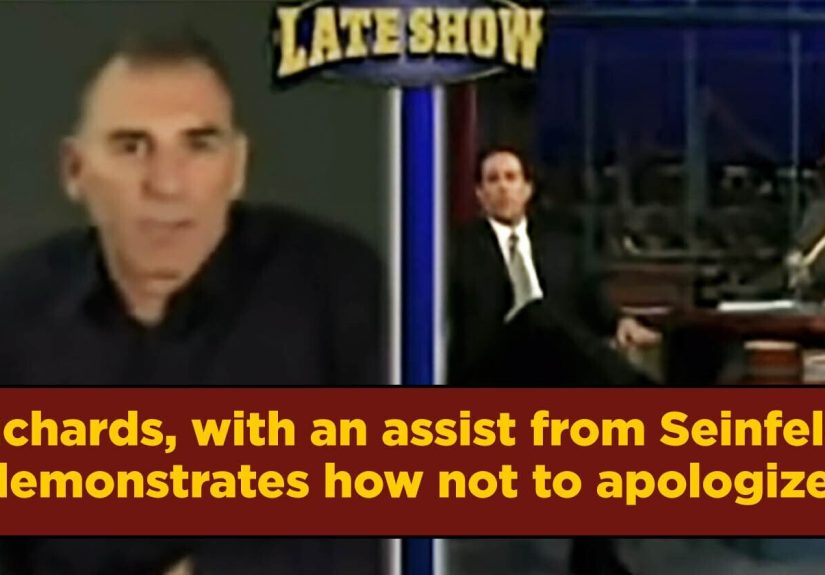
Then came the detail that pushed the segment from merely uncomfortable into legendary cringe territory: some audience members laughed. Not because the subject was funny, but because they were watching a comedian on a late-night show next to Jerry Seinfeld and David Letterman, two masters of comic timing, and the setting itself seemed to suggest “bit” before it suggested “reckoning.” Seinfeld famously had to shut that down. In one short line, he made it clear that nobody was supposed to be enjoying the spectacle.
And that was the whole disaster in miniature. The apology was serious, but it was happening inside a format built for entertainment. Richards was trying to be contrite, but he was still a performer speaking in performance rhythms. The audience did not know whether they were watching television or a confession. Even Richards seemed aware of the mismatch, at one point reacting to the audience laughter with visible discomfort.
Letterman, to his credit, did not simply let the apology float by like a press release in human form. He pushed back. He asked a basic but necessary question: if the hecklers had been white, would Richards have reacted the same way? That question cut to the center of why the apology could not just be about “losing his temper.” Anger alone did not explain the language Richards chose. It only explained the volume knob.
Why the Apology Didn’t Really Work
Public apologies tend to fail when they confuse explanation with accountability. Richards fell into that trap almost immediately. He described his rage, his state of mind, his impulses as a performer, and the chaos he felt inside. But for many viewers, especially Black viewers and the men targeted in the club, the central question was simpler: why did racism become the weapon he reached for the moment he wanted to wound somebody?
That is why the phrase “I’m not a racist” did not magically rescue the segment. Plenty of people watching were not looking for a label debate. They were looking at behavior. If a person erupts into racist language as soon as he feels humiliated, then public trust does not come back because he says the magic words “that’s not who I am.” The audience had already seen who he was in that moment.
Critics and civil rights leaders made that point in the days that followed. The backlash was not just about offensive language. It was about the old American habit of treating racist speech as an isolated emotional accident instead of as something revealing. The response from public figures made clear that healing would require more than a televised apology. Even the men involved said a personal, direct apology mattered more than a performance for cameras.
And that is the real reason the Letterman appearance still feels so squirm-inducing today. It was not just awkward television. It was a failed test of whether celebrity access could short-circuit accountability. It could not.
The Seinfeld Factor: Why This Hit So Hard in Pop Culture
Had this involved a less beloved sitcom actor, the moment still would have been huge. But because it was Michael Richards, the fallout had a strange extra charge. Kramer was one of the most famous comedy characters on television, a human cartoon of entrances, hair, and improbable physical confidence. He was chaos with good timing. Americans had spent years watching him turn nonsense into delight.
So when Richards showed up on Letterman, the collision between the Kramer image and the reality of the incident made the whole thing feel even more destabilizing. Seinfeld fans were not just processing bad behavior. They were watching a familiar comic universe crack open. And there sat Jerry Seinfeld himself, trying to manage the collapse without endorsing it.
That visual mattered. Seinfeld’s presence turned the apology into more than a scandal update. It became a cultural event tied directly to the legacy of Seinfeld. One reason the clip still circulates is because it looks like a scene no sitcom would dare write: the architect of observational cool sitting on one side, Letterman doing low-key triage, and Richards on a satellite screen trying to explain the unexplainable.
The Long Shadow Over Michael Richards’ Career
The incident never fully left Richards’ public story. In later years, he mostly stepped back from the spotlight, and when he reflected on the episode, he described immediate regret and years of self-examination rather than a big comeback strategy. That, too, says something. Some scandals are folded into a redemption arc within months. This one lingered.
Nearly two decades later, the apology remains attached to his name because the original wound was public, specific, and caught on video. There is no fuzzy memory to hide behind. And unlike some celebrity controversies that drift into rumor or partisan spin, this one has always had a visual receipt.
Richards’ later comments suggest he understands that the fallout became part of his life story, not a minor detour. He has said he was sorry immediately and that he is not looking for a comeback. Those statements do not erase what happened, but they do help explain why the Letterman appearance now feels less like the end of a scandal and more like the first visible chapter in a much longer personal and public reckoning.
Why the Clip Still Gets Passed Around
People still revisit the Letterman segment because it captures a lot more than one celebrity apology. It captures the exact second when old-school television could no longer comfortably contain a rapidly spreading public controversy. It shows a star trying to speak before a real script exists for how stars are supposed to do this. It also shows how quickly tone can betray intent. Even if Richards wanted to apologize sincerely, the setting kept sabotaging him.
There is also the sheer awkwardness factor. This was not polished spin. It was raw, odd, and hard to categorize. The audience reaction, Seinfeld’s visible discomfort, Letterman’s pointed questions, Richards’ defensive phrasing, the overall feeling that every person involved wanted to be somewhere else by minute two all of it turned the segment into a permanent entry in the museum of televised discomfort.
And yet the clip is not memorable only because it is cringe. It lasts because it forces viewers to confront how celebrity culture often tries to process serious harm through familiar entertainment machinery. Sometimes that machinery breaks on camera. This is one of the clearest examples.
Related Experiences: What It Feels Like to Revisit This Moment Now
Watching the Michael Richards apology now is a very different experience from watching it in 2006, and that difference is part of what makes the clip so culturally sticky. Back then, many viewers experienced it as breaking celebrity news. It was immediate, disorienting, and tangled up in the shock of seeing a familiar sitcom face in such an ugly context. Today, the clip plays more like a case study in race, in fame, in media, and in the limits of televised repentance.
For longtime Seinfeld fans, the experience can be especially strange. There is often a split-second of old recognition when Richards appears on screen. You see Kramer’s face before your brain catches up to the seriousness of the moment. That gap between nostalgia and reality is jarring. It reminds viewers how much celebrity identity depends on borrowed affection. Audiences feel like they know a performer because they know a character. Then reality barges in without knocking, like Kramer himself, except this time nobody laughs.
For viewers interested in media history, the experience is different again. The segment feels like a snapshot from a transitional era, when television still believed it could serve as the central stage for public accountability, even as online video was beginning to rewrite the script. If the same event happened today, the apology would likely be sliced into clips, meme-ified, debated across platforms, and judged within minutes by millions of people who were never going to wait for late-night TV to organize their feelings. Revisiting the 2006 moment now feels like opening a time capsule from the last years before scandal became fully platform-native.
For many Black viewers, and for anyone focused on the racial dynamics of the incident, the experience of revisiting the clip is less about awkwardness and more about recognition. The most unsettling part is not that Richards lost control. It is that when he wanted to humiliate people, he reached for racist language with horrifying speed. That changes the emotional experience of the apology. It is hard to watch it as a simple story of one man saying the wrong thing in anger. The clip instead raises the question of what anger reveals when social filters fail.
Even the studio audience becomes part of the experience. Their laughter has been analyzed for years, and not because people think they found racism funny in any straightforward sense. The laughter reflects confusion, late-night conditioning, discomfort, and the weird social panic that happens when a room full of people realizes too late that this is not a bit. Watching that reaction now can feel almost anthropological. You are not just watching Richards apologize; you are watching an audience learn, in real time, that some formats are too flimsy to hold certain truths.
That may be why the segment remains so compelling. It offers multiple experiences at once: celebrity collapse, media transition, racial reckoning, and secondhand embarrassment strong enough to bend metal. It is ugly, revealing, and historically weird. Above all, it shows that an apology can be unforgettable for the exact opposite reason an apologizing person hopes.
Conclusion
That time Michael Richards showed up on Letterman with Jerry Seinfeld to apologize endures because it was never just an apology. It was a televised stress test for celebrity culture, late-night TV, and the public’s patience for explanations that stop short of full accountability. Seinfeld’s involvement made it more dramatic. Letterman’s questions made it more honest. The audience laughter made it more surreal. And Richards’ own words made it impossible to wave away as a simple PR stumble.
In the end, the segment remains one of the most uncomfortable moments in late-night history not because television failed to smooth things over, but because, for once, television could not. The performance frame cracked. What spilled out was messy, revealing, and impossible to forget.







 Close
Close