
Table of Contents >> Show >> Hide
- Who Was Frisbee, and Why Did People Care?
- Why Andy Samberg “Hated” Frisbee
- How the Joke Turned into a Late-Night Legend
- What Samberg Said After Frisbee Died
- So Why Did Andy Samberg Really Hate Seth Meyers’ Dog?
- Why This Story Landed With So Many People
- Experiences This Story Brings to Mind
- Conclusion
Some celebrity feuds are built on betrayal, lawsuits, and enough passive-aggressive Instagram activity to power a small city. This was not one of those feuds. The strange, long-running “beef” between Andy Samberg and Seth Meyers’ dog, Frisbee, was built on something much sillier: one tiny Italian Greyhound, one relentlessly committed comedy bit, and one friend who simply would not stop roasting another friend’s dog.
Now that Frisbee has died at 14, the internet has done what the internet does best: mourn sincerely, joke irresponsibly, and immediately ask the question that had been simmering for years. Why, exactly, did Andy Samberg hate Seth Meyers’ dog so much?
The answer is both simpler and funnier than the headline suggests. Samberg did not “hate” Frisbee in any real, villain-twirling-mustache way. He hated Frisbee the way comedians hate a bit that works too well: loudly, theatrically, and with such absurd consistency that it became part of the dog’s public identity. Over time, Frisbee was no longer just Seth Meyers’ pet. She was a recurring late-night character, a punchline, a tiny greyhound celebrity, and somehow Andy Samberg’s sworn enemy.
Who Was Frisbee, and Why Did People Care?
Before we get to the mock hostility, it helps to understand why Frisbee mattered to fans in the first place. She was not some obscure off-camera family dog mentioned once and forgotten by the next commercial break. Frisbee was a genuine part of the Late Night with Seth Meyers orbit.
Meyers often talked about her on air and on podcasts, and she appeared in show segments often enough to become familiar to regular viewers. That matters in late-night land, where recurring bits turn background details into beloved lore. One week it is a side character. Another week it is a running gag. Eventually, it is television mythology. Frisbee crossed into that category years ago.
She was also, by all accounts, a deeply loved family dog. Seth Meyers’ tribute after her death painted a picture that pet owners instantly recognize: a dog who curled into laps, tolerated costumes better than most humans tolerate office small talk, and became woven into the emotional fabric of the house. Meyers called her the family’s “OG IG,” a sweet nickname for their original Italian Greyhound, and thanked her for 14 amazing years. That kind of language does not come from a casual pet-owner relationship. That comes from the “you were here for whole chapters of our life” kind of bond.
So when people reacted strongly to Frisbee’s death, they were not reacting to a random celebrity pet story. They were reacting to a dog they had “met” through years of stories, jokes, segments, holiday costumes, and that increasingly famous Andy Samberg grudge.
Why Andy Samberg “Hated” Frisbee
It started with her look
Let’s not overcomplicate this: the running joke was largely about Frisbee’s appearance. Italian Greyhounds are elegant to some people and hilariously odd to others. They are tiny, angular, bony, delicate, and built like a drawing someone forgot to finish. Their feet can look suspiciously bird-adjacent. Their posture can alternate between aristocratic and goblin. In other words, they are comedy gold if you are Andy Samberg and one of your best friends happens to own one.
Samberg’s comments over the years made the bit very clear. He repeatedly joked that Frisbee looked like a rat, compared her to something vaguely alarming, and mocked her overall “appearance,” “vibe,” “essence,” and “feel.” That is an impressively broad indictment for such a small dog. He was not making a rational case. He was constructing a comic persona: the man who finds one harmless little pet so aesthetically offensive that he treats her like a cinematic nemesis.
Then he kept escalating the bit
Like all great comedy feuds, this one survived because nobody let it stay normal. Meyers told audiences that Samberg had hated Frisbee since she was little. That detail is important. This was not a late-career pivot or a one-season joke. Samberg committed to the anti-Frisbee position for years, which transformed the bit from “one weird comment” into “a foundational piece of friendship lore.”
One of the funniest examples came from a Christmas card story that sounds made up, but apparently was not. Meyers said Frisbee appeared on the family holiday card every year, and Samberg once scratched out the dog’s face “like a serial killer” and mailed it back. That is not pet dislike. That is bit commitment at Olympic level.
And because Samberg is Samberg, he did not stop at a single insult. He kept finding new ways to describe Frisbee as unsettling, monstrous, rodent-like, or visually unacceptable. A lesser comedian would have overplayed it. Samberg somehow made the repetition part of the joke. Every new insult felt less like genuine malice and more like watching a friend stubbornly defend the world’s dumbest hill.
Frisbee became the perfect comedy target
To be fair, Frisbee was the ideal subject for this kind of teasing. She was tiny. She was expressive. She could appear on camera. She had a distinctive look. Most importantly, Seth Meyers loved her enough to react every single time. Comedy lives in reaction, and Meyers gave Samberg exactly what he needed: amused outrage, mock defense, and just enough sincerity to keep the joke alive.
In other words, Samberg did not just “hate” the dog. He loved what the dog did to the conversation.
How the Joke Turned into a Late-Night Legend
The feud kept showing up on air
Once a joke works on a late-night show, it tends to return like an uninvited but charismatic dinner guest. Frisbee kept popping back into the Late Night universe, and Samberg kept seizing the opportunity to insult her. Viewers saw the bit evolve from casual teasing into a recurring comic subplot.
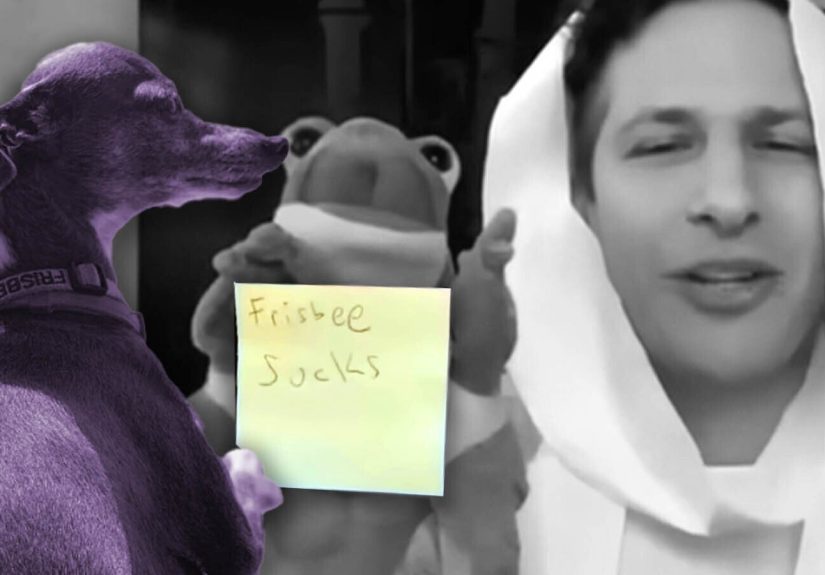
There were official show clips, audience Q&As, podcast stories, and segments where the joke resurfaced in new forms. At one point, Samberg was still roasting Frisbee while simultaneously softening the attack just enough to keep it absurd. In one memorable moment, the visual gag reportedly involved him holding a note that read, “Frisbee sucks,” while verbally pretending it was all in good fun. That is the essence of the whole saga: faux diplomacy wrapped around cartoon hostility.
The “Good Hang” prank was the modern peak
If the feud needed a late-career masterpiece, Amy Poehler’s Good Hang podcast provided one. Seth Meyers encouraged Poehler to tell Samberg that Frisbee had died just to see how he would react. This was either a terrible idea or a perfect one. As it turned out, it was both.
Samberg’s response was brutally on-brand. He did not melt into sympathetic silence. He did not offer a polite sitcom-level “Oh no.” Instead, he said not to even joke about it because he would be so happy. He doubled down further, insisting that he would never back off his stance and comparing the dog to something like a “rat carcass.” The result was shocking, hilarious, and so committed to the bit that it somehow confirmed what fans already knew: this was one of those rare comedy rivalries that had become bigger than its premise.
And yet the prank also proved an important point. Everyone involved knew this was a joke. Poehler knew it. Meyers knew it. Samberg knew it. The audience knew it. The humor came from how outrageously overcommitted Samberg was to a fake feud with a dog that could not care less about his opinion.
The internet turned it into folklore
At some point, you no longer need the original clip because the internet has already archived the entire emotional ecosystem. That happened here. Fans began making compilations of Samberg insulting Frisbee. Commenters treated the feud like a real rivalry with its own mythology, timeline, and suspect board. When Frisbee died, many people’s first thought was not just sadness. It was, “Well, someone check Andy’s alibi.”
That reaction sounds ridiculous until you remember how many years the joke had been running. Samberg and Frisbee had become one of those hyper-specific entertainment side stories that feel niche and mainstream at the same time. If you followed Meyers at all, you probably knew about the dog. If you followed Samberg at all, you probably knew he hated that dog. If you followed both, congratulations: you were emotionally invested in the strangest cold war in late-night comedy.
What Samberg Said After Frisbee Died
Once Frisbee’s death became public, the next chapter wrote itself. Reporters asked Samberg about it. Fans made jokes. Headlines leaned hard into the “nemesis” angle. And Samberg, because of course he did, stayed in character while also revealing that the real friendship underneath the bit was intact.
He joked that he did not kill Frisbee, “much as that would have delighted” him. He also described the whole situation as weirdly funny, especially the fact that major media outlets were now covering the death of a dog partly through the lens of his supposed feud with her. On podcast discussions afterward, Meyers admitted that the coverage made him laugh even in the middle of genuine grief, because the idea of Frisbee’s legacy being tied to Samberg’s hatred was so absurdly specific and so deeply rooted in their long friendship.
That last part matters. Behind the darkly funny one-liners, Samberg reportedly responded normally and compassionately when Meyers told him Frisbee had actually died. He checked in about the family. He was a friend first, comedian second. That is why the bit never felt mean in the way truly cruel celebrity jokes do. The foundation was affection. The delivery was nonsense.
So Why Did Andy Samberg Really Hate Seth Meyers’ Dog?
Here is the clean answer for anyone who clicked looking for the simplest explanation: Andy Samberg “hated” Seth Meyers’ dog because Frisbee became the perfect target for a running comedy bit. Her unusual little-greyhound look, her repeat appearances in Seth’s stories and on his show, and Meyers’ own willingness to defend her created the ideal setup. Samberg kept exaggerating his disgust because the joke kept landing.
He hated the look. He hated the vibe. He hated the tiny talon-like paws. He hated the whole dog-shaped aura, apparently. But what he really loved was the comedic rhythm of pretending to hate her.
That is why the feud lasted. It was not about Frisbee doing anything wrong. She was not destructive, scandalous, or plotting revenge from a chaise lounge. She was simply there, being a weird little Italian Greyhound, and Samberg decided that was enough to build a decade of material around.
Why This Story Landed With So Many People
There is also a human reason this story hit harder than a normal celebrity-pet headline. Most people know some version of this dynamic. Maybe you have a beloved dog that one friend insists looks haunted. Maybe your cat has an enemy in the group chat. Maybe there is a family pet everyone teases but secretly expects to live forever. These animals become shared reference points. They gather stories. They survive holiday photos, moves, breakups, babies, and bad furniture choices. Then one day they are gone, and all the jokes become memories almost overnight.
That is what made Frisbee’s story oddly moving. The laughter and the grief were not competing emotions. They were stacked together. Meyers was mourning a family dog. Fans were mourning a familiar little character from the extended late-night universe. Samberg was still doing the bit, but now the bit itself had become part of the tribute. Somehow, the joke helped measure how long Frisbee had been around and how deeply she had settled into people’s lives.
For a supposedly ridiculous celebrity story, that is a pretty meaningful legacy.
Experiences This Story Brings to Mind
If you have ever owned a pet with a “public reputation,” even if that public was just your family, your group chat, or three neighbors who know your dog by name, the Frisbee story probably feels oddly familiar. Every family has one animal that becomes more than a pet. It becomes a running joke, a household celebrity, and an emotional landmark all at once.
Maybe it is the dog who always looks guilty even when innocent. Maybe it is the cat who hates men in hats. Maybe it is the tiny rescue dog your toughest friend claims to despise while also somehow knowing every detail about her eating schedule. Over time, the jokes pile up. Somebody calls the dog a gremlin. Somebody else says she has “tax evader energy.” The pet ends up in Christmas cards, birthday captions, and low-stakes arguments that somehow continue for years.
That is why the Frisbee-and-Samberg saga feels bigger than tabloid fluff. It mirrors a real experience: pets become part of the language of friendship. They are inside jokes with paws. A friend roasting your dog is usually not about the dog at all. It is about familiarity. It is about history. It is about knowing each other well enough to build a joke that can survive repetition without getting old.
And then, when that pet gets old, the joke changes. Not completely, and not all at once. But it softens around the edges. Suddenly everyone remembers how long the animal has been there. The dog who used to be mocked for looking like a folded umbrella or a suspicious Victorian child somehow becomes the one who was present for first apartments, marriages, kids, job changes, and holidays. The joke remains funny, but it is now sitting beside gratitude.
That emotional overlap is something many pet owners recognize instantly. You can laugh at the same dog you are crying over. You can make a joke about your friend’s ridiculous long-running grudge while still feeling the loss of the tiny creature who inspired it. In fact, joking is often how people survive that kind of sadness. It keeps the memory active. It prevents grief from flattening a whole life into one solemn note.
There is also something unmistakably modern about the way Frisbee lived in public memory. Not famous in the movie-star sense. Famous in the “I know this dog from clips, jokes, screenshots, and holiday chaos” sense. Lots of people now have this kind of relationship with pets they have never met. They follow them online, watch them appear in stories, and build affection through repetition. A pet can become part of someone’s media identity almost accidentally. Then when that pet dies, the response feels personal even if the connection was one-sided.
So yes, this is a funny story about Andy Samberg loudly disliking Seth Meyers’ dog for years. But it is also a story about how pets gather meaning. They become family history, friendship history, internet history, and emotional shorthand all at once. That is a lot for one tiny Italian Greyhound to carry. Frisbee, by all evidence, carried it like a pro.
Conclusion
Frisbee’s death closed the chapter on one of late-night comedy’s weirdest and most unexpectedly charming recurring bits. Andy Samberg did not hate Seth Meyers’ dog because Frisbee wronged him in some elaborate canine subplot. He hated her because she looked funny, the joke worked, Seth reacted, and the bit became too good to quit.
In the end, that “hate” turned into a strangely memorable form of affection. Frisbee was loved by her family, known by viewers, and immortalized by one comedian’s refusal to stop insulting her. That is not a normal legacy. It is, however, a very good late-night one.
Rest in peace, Frisbee. You were apparently an icon, a menace, a lap dog, a holiday-costume professional, and the only creature on earth capable of making Andy Samberg sound like a man personally offended by a 14-pound ghost deer.






 Close
Close